 Alfa Romeo 156
Specs, engines and history
Published Sources (1) Report an error
By Felix Hartmann, Automotive Technology & EV Contributor
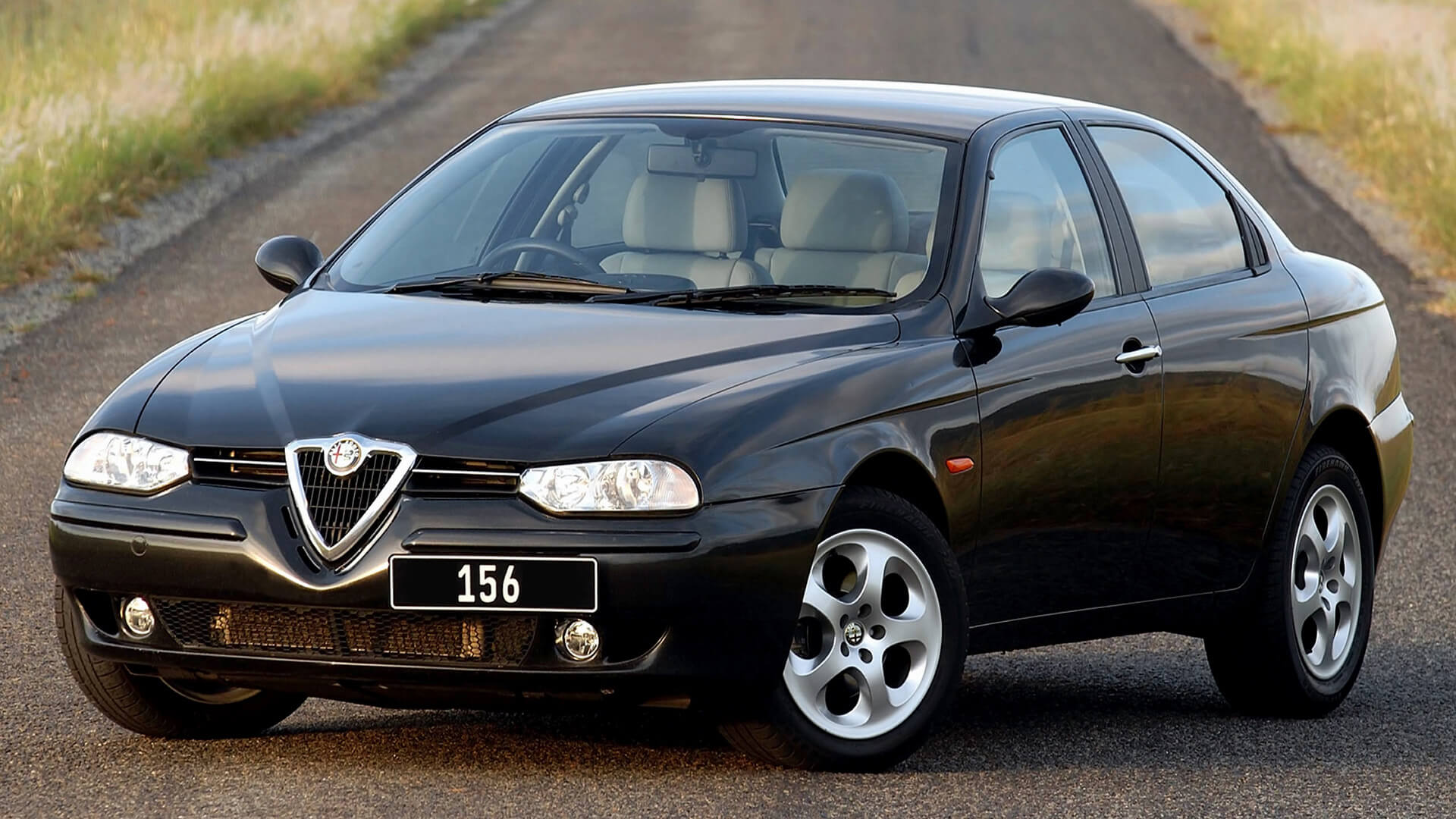
The Alfa Romeo 156 is a compact executive car that the Italian company built from 1997 to 2007 as a four-door saloon and, from 2000, as the Sportwagon estate. It replaced the angular Alfa Romeo 155, won European Car of the Year for 1998 and became one of the brand's best-selling models, with 673,435 cars built. The 156 did a great deal to rebuild Alfa Romeo's reputation and sales, and it was succeeded by the Alfa Romeo 159.
In short
- Unveiled at the Frankfurt motor show in 1997; built until 2007 at Pomigliano d'Arco in Italy and, from 2002, also in Rayong, Thailand.
- Styled by Walter de Silva at Alfa Romeo's Centro Stile; facelifted in 2002 and again in 2003 with a Giugiaro-designed front and rear.
- Engines ranged from the 88 kW (120 PS) 1.6 Twin Spark to the 184 kW (250 PS) 3.2 V6 of the 156 GTA, plus pioneering common-rail JTD diesels.
- Double-wishbone front suspension and the optional Selespeed automated gearbox set it apart from rivals.
Alfa Romeo 156 at a glance
The 156 was first shown at the 1997 Frankfurt motor show as the replacement for the 155. It was built at the Fiat group's Pomigliano d'Arco plant in southern Italy, and from March 2002 also at a General Motors plant in Rayong, Thailand, mainly for Asia-Pacific markets. The saloon was joined by the Sportwagon estate at the Geneva motor show in 2000. The car was updated in 2002, mostly inside, and then in late 2003, when Giorgetto Giugiaro's Italdesign redrew the front and rear. In 2004 Alfa Romeo added the raised, all-wheel-drive 156 Crosswagon Q4, the last version to remain in production until 2007. More of the brand's range is in our Alfa Romeo catalogue, and its background is covered in the history of Alfa Romeo.
Design
Even by today's standards, the 156 looks good. Several design houses — Pininfarina, Bertone and Italdesign — were involved in proposals, but the final shape was the work of Walter de Silva, then head of Alfa Romeo's Centro Stile. The bonnet carries two strong creases that run down into the grille, which keeps the brand's traditional chrome shield. Small air intakes sit near the halogen headlights and in the front bumper, which also holds round fog lights. The drag coefficient is a good 0.31.
The side view features slightly flared wheel arches, subtle creases and oval door mirrors. The most famous detail is the rear door handle hidden in the window frame, which makes the saloon look like a coupé from some angles — a trick that many other makers later copied. Wheels range from 15 inches to 17 inches on more powerful versions, and ground clearance is an average 150 mm. The rear is more restrained, with narrow tail lights, a substantial bumper with mouldings and one or two exhaust pipes depending on the engine; the boot lock is hidden under the Alfa Romeo badge. When it appeared, the 156's styling felt years ahead of its time.
The 156 GTA
At the Frankfurt motor show in September 2001, Alfa Romeo presented the 156 GTA (Gran Turismo Alleggerita, "lightened"). It was built as a saloon and Sportwagon until October 2005 and was distinguished by its own body kit, wider track and sports interior. Under the bonnet it had the 3.2-litre version of the famous "Busso" V6, producing 184 kW (250 PS) and 300 Nm, enough for 0–100 km/h in about 6 seconds and a top speed of around 250 km/h.
Interior and practicality
The cabin was not lavishly equipped by today's standards, but its design compared well with rivals of the time. Base versions have simple cloth seats, and depending on the trim level the seats and much of the cabin could be trimmed in leather. Space is adequate rather than generous. The lines throughout the cabin are harmonious and flowing.
The driver faces an oval three-spoke steering wheel with audio buttons, adjustable for height and reach, and on many versions trimmed in wood. Two deep cowled dials show road speed and engine speed, and a trip computer provides useful information. The driver's seat is very comfortable, so the car suits long journeys.
The centre console has three analogue gauges at the top to monitor the engine, angled towards the driver in classic Alfa fashion. Below them is the factory radio, which many owners now replace, then three round controls for the heating and air conditioning, and an ashtray at the bottom. The standard speakers were supplied by Bose, and their sound quality still holds up; satellite navigation was optional. The tunnel has small storage compartments, the gear lever, a mechanical handbrake, a cigarette lighter, transmission mode buttons and an armrest.
The rear bench can take three adults, though only two will be truly comfortable. The saloon's boot holds about 378 litres; the Sportwagon offers 360 litres, but its rear seats fold to give 1,180 litres.
Engines
| Engine | Years | Power (kW / PS) | Torque |
|---|---|---|---|
| 1.6 Twin Spark | 1997–2006 | 88 kW / 120 PS | 144 Nm |
| 1.8 Twin Spark | 1997–2006 | 106 kW / 144 PS (later 103 kW / 140 PS) | 169 Nm |
| 2.0 Twin Spark | 1997–2002 | 114 kW / 155 PS (later 110 kW / 150 PS) | 187 Nm |
| 2.0 JTS | 2002–2006 | 121 kW / 165 PS | 206 Nm |
| 2.5 V6 | 1997–2006 | 140 kW / 190 PS | 222 Nm |
| 3.2 V6 (GTA) | 2002–2005 | 184 kW / 250 PS | 300 Nm |
| 1.9 JTD / Multijet | 1997–2007 | 77–110 kW / 105–150 PS | 255–305 Nm |
| 2.4 JTD / Multijet | 1997–2006 | 100–129 kW / 136–175 PS | 304–385 Nm |
The four-cylinder petrol engines belong to the Twin Spark family, with two spark plugs per cylinder. The 2.5-litre V6 takes the 156 from 0 to 100 km/h in 7.5 seconds and on to 230 km/h. The diesels used direct common-rail injection and turbocharging; the 2.4 JTD is credited as the world's first common-rail diesel in a passenger car. The most powerful diesel produced 129 kW (175 PS) and 385 Nm, and the engines met the Euro 3 standard. They have a reputation for reliability.
Transmissions
Power went to the front wheels through five- or six-speed manual gearboxes. From 1999 the 2.0 Twin Spark could also be ordered with the five-speed Selespeed automated manual with steering-wheel controls — a genuine technical breakthrough in this segment at the time. The Crosswagon Q4 added permanent all-wheel drive.
Chassis, quality and safety
The 156 has fully independent suspension that is both comfortable and agile: double wishbones at the front and a MacPherson-type strut layout with two transverse links and a longitudinal strut at the rear. Brakes are discs of 281 mm at the front and 251 mm at the rear, with larger brakes on more powerful versions. ABS, EBD and the VDC stability system, which on many cars could not be switched off, were fitted.
The predecessor, the 155, had suffered from corrosion, and Alfa Romeo solved this problem on the 156; the electronics were also made more reliable. Safety equipment included front and side airbags and curtain airbags, together with ABS and the stability system.
Strengths and weaknesses
The 156 is valued for its timeless design, pleasant and comfortable cabin, wide choice of engines and engaging handling. It is generally reliable, but repairs can be costly, and good examples are increasingly hard to find. It appeals most to enthusiasts of the brand and of Italian design. In its day it competed with the Audi A4, Honda Accord and the BMW 3 Series of the E36 and E46 generations.
Alfa Romeo 156 in our rankings
In production longer than 61% of ranked nameplates in the 1CARS catalog (No. 332 of 912).
FAQ
When was the Alfa Romeo 156 made?
From 1997 to 2007. It was unveiled at the 1997 Frankfurt motor show and replaced by the Alfa Romeo 159.
Who designed the Alfa Romeo 156?
Walter de Silva at Alfa Romeo's Centro Stile; Giugiaro's Italdesign redesigned the front and rear in 2003.
What engine does the 156 GTA have?
A 3.2-litre V6 producing 184 kW (250 PS) and 300 Nm.
Did the Alfa Romeo 156 win Car of the Year?
Yes, it was European Car of the Year for 1998.
What is the Selespeed gearbox?
A five-speed automated manual with steering-wheel controls, offered from 1999 on the 2.0 Twin Spark.
Data sources
Data checked by an editor against the sources below.