 Alfa Romeo 33
All generations, specs and history
Published Sources (1) Report an error
By Felix Hartmann, Automotive Technology & EV Contributor
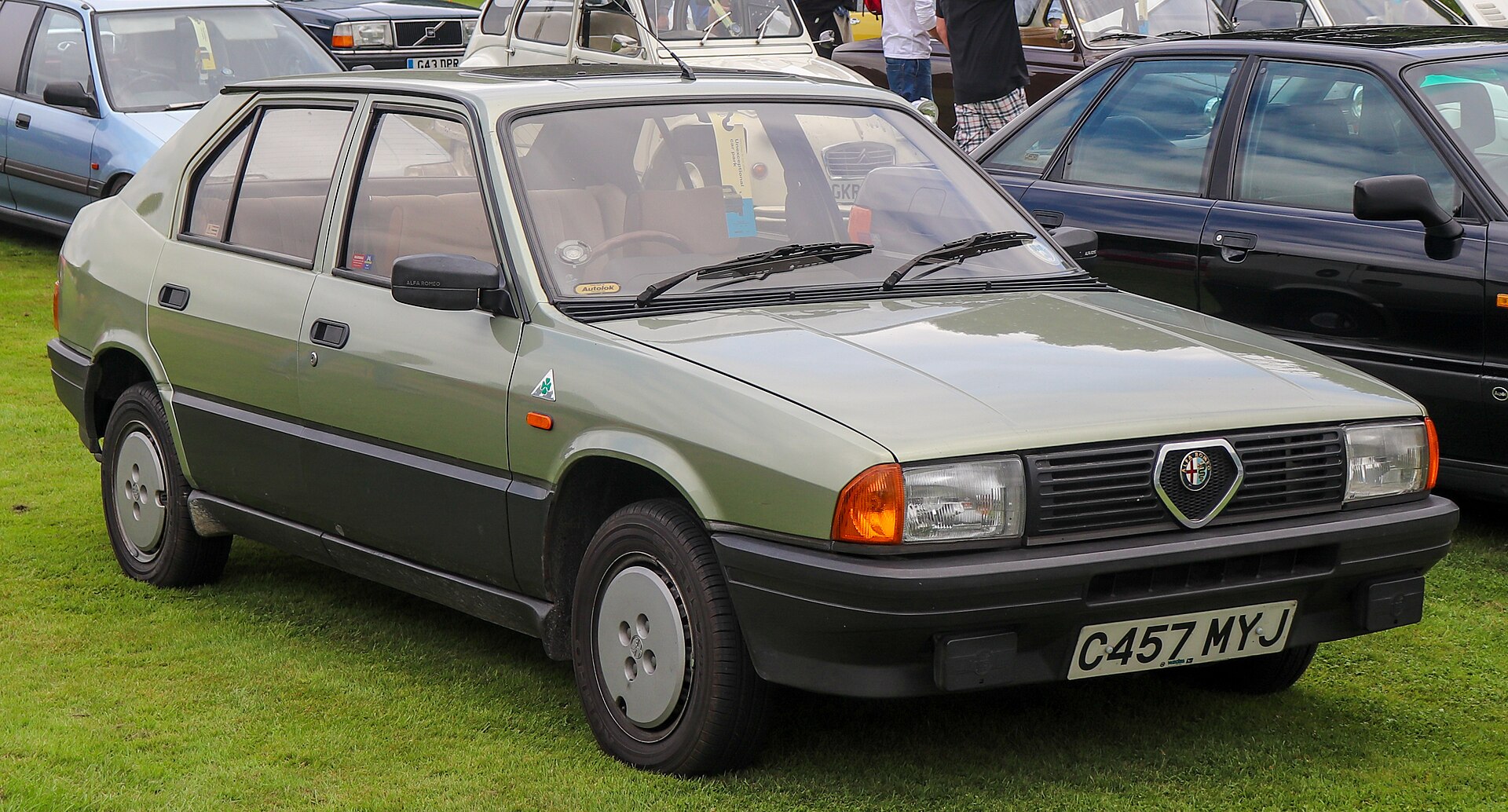
- Built
- 1983–1995
- Generations
- 2 · 905 to 907
- Top power
- 101 kW (137 PS)
Timeline
33 generations
Click a generation for its own page
- 33 Series I (905) 1983–1989 · Hatchback, Station wagon · 53–87 kW (72–118 PS)
- 33 Series II (907) 1990–1995 · Hatchback, Station wagon · 57–101 kW (77–137 PS)
Newest first · 2 generations since 1983
- 1990 907 1990–1995 · Hatchback, Station wagon · 57–101 kW (77–137 PS)
- 1983 905 1983–1989 · Hatchback, Station wagon · 53–87 kW (72–118 PS)
All generations by year: 33 Series II (907) (1990–1995) · 33 Series I (905) (1983–1989)
Which one is mine?
Pick the year of first registration to see which generation it is.
Check by VINWhich 33 to buy
Our verdict · Felix Hartmann
- For driving: a 1.7 16V, the most powerful 33 at up to 101 kW (137 PS).
- For all-weather use: a Permanent 4 or Q4, or a Sport Wagon 4x4.
- For originality: an early Quadrifoglio Verde or Quadrifoglio Oro, with the period details.
- For durability: a late Series II car with the galvanised frame.
The Alfa Romeo 33 is a compact family car with a flat-four boxer engine, built from 1983 to 1995 as a five-door hatchback and an estate. It replaced the Alfasud, kept its floorpan and drivetrain, and with nearly one million cars built it holds a special place in Alfa Romeo's history. Most were made at Pomigliano d'Arco near Naples; the estate came from Pininfarina.
In short
- Two series: the original type 905 (1983-1989) and the facelifted Series II, type 907 (1990-1995).
- Boxer petrol engines from 1.2 to 1.7 litres, up to 101 kW (137 PS) in the 1.7 16V; a 1.8 three-cylinder turbodiesel from VM Motori.
- Front-wheel drive, with 4x4 versions from 1983 and the permanent four-wheel-drive Permanent 4 (later Q4) from 1990.
- 4,075 mm long, 890-1,070 kg; known for agile handling, criticised for rust and electrics.
Specs by version
Verified Manufacturer and type-approval data from our catalog · Sources and methodology
Alfa Romeo 33 at a glance
| Specification | Alfa Romeo 33 |
|---|---|
| Segment | C-segment small family car |
| Body styles | five-door hatchback; five-door estate (Giardinetta, later Sport Wagon) |
| Production | 1983-1995 |
| Plants | Pomigliano d'Arco and Pininfarina Grugliasco, Italy; Rosslyn, South Africa |
| Layout | longitudinal front engine, front-wheel drive or four-wheel drive |
| Designer | Ermanno Cressoni, Centro Stile Alfa Romeo; estate by Pininfarina |
| Total built | nearly 1 million |
| Predecessor / successor | Alfasud / Alfa Romeo 145 and 146 |
The 33 is a classic now, and our classic cars section covers its contemporaries.
From Alfasud to 33
The Alfasud was the reason the Pomigliano d'Arco plant existed. Construction began in April 1968 on the site of a former aircraft engine factory, the car was styled by Giorgetto Giugiaro and engineered by Rudolf Hruska, and 893,719 Alfasud saloons were built between 1972 and 1983. When Alfa Romeo replaced the saloon in 1983, it did not start again from scratch: the 33 evolved the Alfasud's floorpan and running gear, while the Sprint coupé carried on alongside it and shared the 33's mechanical parts until 1989.
The new body was drawn in-house by Ermanno Cressoni at Centro Stile Alfa Romeo. Shortly after the 33, Alfa Romeo also launched the Arna, a Nissan-based car of similar size sold for less money. Alfa Romeo simplified the Alfasud's chassis for it: the inboard front discs moved outboard to the hubs, and the rear discs gave way to drums. The drag coefficient was 0.36. Every Alfa Romeo model is listed in our Alfa Romeo catalogue.
Generations and model history
| Generation | Code | Years | Body styles | Engines | Power (kW / hp) |
|---|---|---|---|---|---|
| 33 (Series I) | 905 | 1983-1989 | hatchback, estate | 1.2, 1.3, 1.5, 1.7 boxer; 1.8 TD | 53-87 kW (72-118 PS) |
| 33 (Series II) | 907 | 1990-1995 | hatchback, estate | 1.2, 1.3, 1.5, 1.7, 1.7 16V boxer; 1.8 TD i | 57-101 kW (77-137 PS) |
Series I (1983-1989)
The hatchback arrived in 1983. Its instrument binnacle moved up and down with the adjustable steering wheel, and the Alfasud's five-speed gearbox was used with fifth as an overdrive. A 1.5 4x4 hatchback, shown at the Frankfurt Motor Show in 1983, followed in December 1983. Pininfarina built its body and Alfa Romeo fitted the mechanicals; the part-time system, developed by Ototrasm, could be engaged at any speed with a handle in front of the gear lever. The Giardinetta estate was shown at Geneva in March 1984, first sold as a 4x4 in June 1984.
In June 1984 the sporty Quadrifoglio Verde arrived with 77 kW (105 PS). From October 1984 every model except the basic 1.3 got twin-choke carburettors, which created the 63 kW (86 PS) 1.3 S, and the 1985 line-up had seven versions: 1.3, 1.3 S, 1.5 Quadrifoglio Oro, 1.5 Quadrifoglio Verde, 1.5 4x4 and the Giardinetta with front-wheel or four-wheel drive. At the 1984 Geneva show Zagato also displayed the Z33 Free Time, a tall six-seat MPV prototype on 33 mechanicals that remained a one-off. A facelift in autumn 1986 brought clear indicators, a more conventional dashboard, closer gear ratios, the 1.7 engine with 87 kW (118 PS) for the QV and the 1.8 TD diesel. The Giardinetta became the Sport Wagon in April 1988, and the 1.7 IE, the first fuel-injected 33, followed in July 1988.
Series II (1990-1995)
The Nuova 33, launched around January 1990, took the family look of the Alfa 164, with new front and rear ends, a revised interior and fuel injection. The new 1.7 16V had four camshafts and 98-101 kW (133-137 PS). The Permanent 4 combined it with permanent four-wheel drive, Recaro seats and a Nardi steering wheel; it was renamed Q4 in 1992. Late cars had galvanised frames, as introduced with the 164. Non-catalysed versions were dropped in mid-1992 for Euro 1, and the diesel ended in mid-1993.
Engines, transmissions and performance
| Engine | Years | Power | Torque |
|---|---|---|---|
| 1.3 boxer (1,351 cc) | 1983-1990 | 58 kW (79 PS) | 111-113 Nm |
| 1.3 S | 1984-1990 | 63 kW (86 PS) | 119-121 Nm |
| 1.5 boxer (1,490 cc) | 1983-1986 | 62-70 kW (84-95 PS) | 123-133 Nm |
| 1.5 QV / 1.5 (from 1986) | 1984-1992 | 77 kW (105 PS) | 133 Nm |
| 1.7 boxer (1,712 cc) | 1986-1990 | 87 kW (118 PS) | 147 Nm |
| 1.7 IE | 1988-1995 | 81 kW (110 PS) | 151-153 Nm |
| 1.7 IE 16V | 1990-1995 | 98-101 kW (133-137 PS) | 157-161 Nm |
| 1.8 TD (three-cylinder) | 1986-1990 | 53 kW (72 PS) | 153 Nm |
| 1.8 TD i (intercooler) | 1990-1993 | 62 kW (84 PS) | 178 Nm |
All petrol engines are flat-fours from the boxer family that began in the 1971 Alfasud; the last of them was built in 1997. Catalysed versions were slightly weaker, for example 95-97 kW (129-132 PS) for the 1.7 16V. The diesel came from VM Motori; a three-cylinder was chosen because it fitted the short engine bay of a car designed for a boxer, and a balance shaft reduced vibration.
The only top speed quoted in our main source is 185 km/h for the 1.5 Quadrifoglio Verde. Alfa Romeo also built three hybrid test cars on the 1.5 Sport Wagon, with a 12 kW (16 hp) three-phase electric motor that allowed 5 km on electric power at up to 60 km/h. The hybrid system added 150 kg. Convert the outputs with our power converter.
Dimensions, space and practicality
| Parameter | Metric | Imperial |
|---|---|---|
| Length | 4,075 mm | 160.4 in |
| Width | 1,615 mm | 63.6 in |
| Height | 1,350-1,375 mm | 53.1-54.1 in |
| Wheelbase | 2,475 mm (2,470 mm on 4x4) | 97.4 in (97.2 in) |
| Kerb weight | 890-1,070 kg | 1,962-2,359 lb |
Under 1,100 kg in every version, the 33 is light by modern standards. The sources we used do not give a boot volume.
Fuel economy and running costs
Official consumption figures are not part of the sources used, so we do not quote any. As a classic, the main costs are rust repair and parts for the boxer engines, which were shared with the Alfasud, Sprint, Arna and early 145 and 146.
Trims and equipment
The launch range had the Quadrifoglio Oro, a luxury trim with a silver grille, two-tone paint, a beige interior, headlamp wipers and a trip computer as standard. The Quadrifoglio Verde of 1984 added twin carburettors, spoilers, side skirts and grey alloy wheels. A TI trim arrived in 1986; in the UK the sporty versions were called Green Cloverleaf, and Alfa Romeo GB sold Veloce versions with Zender body kits.

Safety
The 33 predates Euro NCAP, which began testing in 1997, so there is no crash-test rating. Late cars had galvanised frames, which helps their structure survive. For crash-test results of modern cars, see our safety section.
Reliability and known issues
The 33 was known for nimble handling and strong boxer engines, but also for unreliable electrics and rust, a common complaint about Italian cars of the time. Its brakes and the higher unsprung weight of the outboard front discs were criticised. Cars built after the move to galvanised frames avoid the worst of the corrosion.
Rivals
| Model | Body | Why it competes |
|---|---|---|
| Volkswagen Golf II | hatchback | the C-segment benchmark of the 1980s |
| Lancia Delta | hatchback | the Italian rival from the same group |
| Alfa Romeo Arna | hatchback | the cheaper, Nissan-based Alfa sold alongside it |
| Alfa Romeo 145 / 146 | hatchback | the successors, still with boxer engines at first |
Photo gallery


Alfa Romeo 33: first vs latest generation
| Spec | 33 Series I (905) | 33 Series II (907) | Change |
|---|---|---|---|
| Years | 1983–1989 | 1990–1995 | 7 years apart |
| Most powerful version | 87 kW (118 PS) | 101 kW (137 PS) | +14 kW (+16%) |
Oldest and newest generation in the 1cars catalog. Power is the strongest version of each; other rows are shown only when both generations have the figure.
Alfa Romeo 33 in our rankings
- No. 343 of 1082 · Longest-running car nameplates (12 years · top 35%)
- No. 41 of 91 · Biggest engines: hatchbacks (1,712 cc · top 46%)
- No. 76 of 141 · Most powerful hatchbacks (101 kW · top 54%)
- No. 66 of 91 · Most torque: hatchbacks (161 Nm · top 73%)
- No. 85 of 111 · Most powerful cars of the 1990s (101 kW · top 77%)
- No. 483 of 627 · Biggest engines: cars (1,712 cc · top 78%)
In production longer than 65% of ranked nameplates in the 1CARS catalog (No. 343 of 1082).
FAQ
How many Alfa Romeo 33s were built?
Nearly one million between 1983 and 1995.
What engine does the Alfa Romeo 33 have?
A flat-four boxer engine of 1.2 to 1.7 litres, or a 1.8 three-cylinder turbodiesel from VM Motori.
Was there a four-wheel-drive Alfa 33?
Yes: the part-time 1.5 4x4 from 1983 and the permanent four-wheel-drive Permanent 4 (later Q4) with the 1.7 16V from 1990.
What replaced the Alfa Romeo 33?
The Alfa Romeo 145 and 146 in 1995, which kept the boxer engines at first but used a new platform based on the Fiat Tipo.
Data sources
Data checked by an editor against the sources below.