
 Alfa Romeo Alfetta
All generations, specs and history
Published Sources (1) Report an error
By Felix Hartmann, Automotive Technology & EV Contributor
- Built
- 1972–1987
- Generations
- 2
- Top power
- 118 kW (160 PS)
Timeline
Alfetta generations
Click a generation for its own page
116 and GT / GTV overlapped in 1974–1984, so GT / GTV sits on a second lane
- Alfetta 116 1972–1984 · Sedan · 60–96 kW (82–131 PS)
- Alfetta GT / GTV 1974–1987 · Coupe · 80–118 kW (109–160 PS)
Newest first · 2 generations since 1972
- 1974 GT / GTV 1974–1987 · Coupe · 80–118 kW (109–160 PS) 116 and GT / GTV overlapped in 1974–1984
- 1972 116 1972–1984 · Sedan · 60–96 kW (82–131 PS)
All generations by year: Alfetta GT / GTV (1974–1987) · Alfetta 116 (1972–1984)
Which one is mine?
Pick the year of first registration to see which generation it is.
- Alfetta GT / GTV 1974–1987
- 116 1972–1984
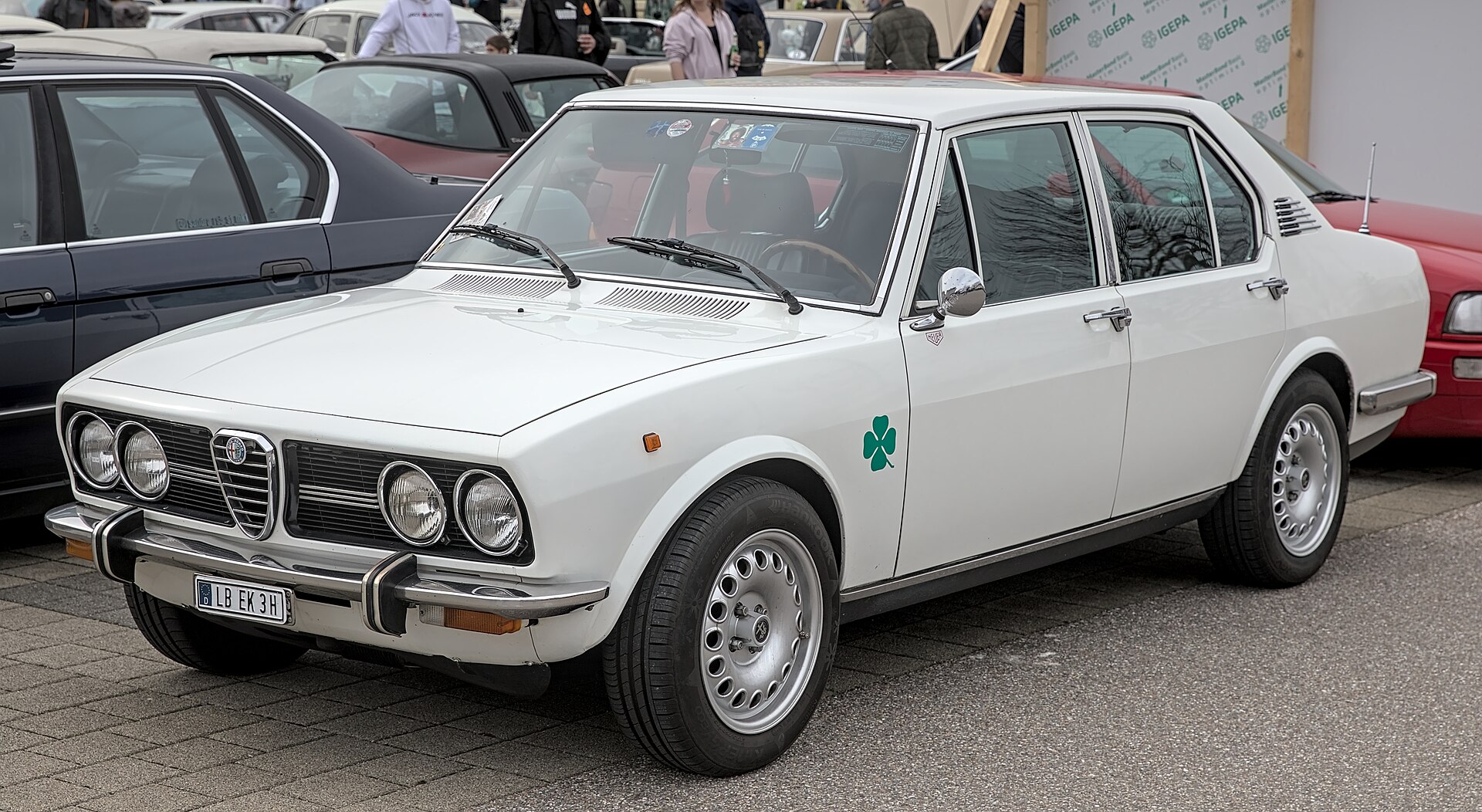
The Alfa Romeo Alfetta is a rear-wheel-drive saloon and coupe family built from 1972 to 1987, known for its transaxle layout: clutch and gearbox sit at the rear with the differential, behind a de Dion rear axle with inboard brakes. The four-door used twin-cam fours and VM turbodiesels until 1984; the Giugiaro-styled GT and GTV coupes added a 2.5-litre V6 and lasted until 1987.
In short
- Saloon revealed near Trieste on 17 May 1972; GT coupe followed in 1974.
- Engines from 1.6 to 2.0 litres (80-96 kW, 109-130 PS), turbodiesels of 60-70 kW and the 118 kW (160 PS) GTV 6 2.5.
- Built at Arese, with saloon output of about 448,000-476,000 (figures vary) and 137,579 coupes.
- Near 50:50 weight distribution; replaced by the Alfa Romeo 90 saloon in 1984.
Specs by version
Engines
| Version | Engine | Power | Gearbox | Drive | Production years |
|---|---|---|---|---|---|
| Diesel · 1 version | |||||
| 116 · 2.0 Turbo Diesel | 2.0 l · 4 cyl · Diesel 1,995 cc | 60 kW 82 PS80 hp | 5-sp Manual | Rear-wheel drive | 1979–1984 |
| Petrol · 5 versions | |||||
| 116 · 1.6 | 1.6 l · 4 cyl · Petrol 1,570 cc | 80 kW 109 PS107 hp | 5-sp Manual | Rear-wheel drive | 1975–1984 |
| 116 · 1.8 | 1.8 l · 4 cyl · Petrol 1,779 cc | 90 kW 122 PS121 hp | 5-sp Manual | Rear-wheel drive | 1972–1984 |
| 116 · 2000 L / 2.0 | 2.0 l · 4 cyl · Petrol 1,962 cc | 96 kW 131 PS129 hp | 5-sp Manual | Rear-wheel drive | 1978–1984 |
| Alfetta GT / GTV · GT 1.8 | 1.8 l · 4 cyl · Petrol 1,779 cc | 90 kW 122 PS121 hp | 5-sp Manual | Rear-wheel drive | 1974–1976 |
| Alfetta GT / GTV · GTV 6 2.5 | 2.5 l · 6 cyl · Petrol 2,492 cc | 118 kW 160 PS158 hp | 5-sp Manual | Rear-wheel drive | 1980–1986 |
Performance
Show all 1 versions
| Version | 0–100 km/h | Top speed |
|---|---|---|
| 116 · 1972–1984 | ||
| 116 · 1.8 | 9.8 s 0–62 mph | 184 km/h114 mph |
Dimensions and weight
Show all 2 versions
| Version | Kerb weight |
|---|---|
| 116 · 1972–1984 | |
| 116 · 1.8 | 1,060 kg2,337 lb |
| Alfetta GT / GTV · GTV 6 2.5 | 1,210 kg2,668 lb |
Verified Manufacturer and type-approval data from our catalog · Sources and methodology
Alfetta at a glance
| Item | Alfa Romeo Alfetta |
|---|---|
| Years | saloon 1972-1984; GT/GTV 1974-1987 |
| Production | saloon 448,417 (Wikipedia EN) or 475,719 (Wikipedia IT); coupes 137,579 |
| Plant | Arese, Italy; also assembled in South Africa |
| Body styles | four-door saloon; three-door 2+2 coupe (GT, GTV) |
| Designers | saloon: Centro Stile Alfa Romeo (Giuseppe Scarnati); coupe: Giorgetto Giugiaro, Italdesign |
| Layout | front engine, rear transaxle, de Dion rear axle, inboard rear discs |
| Engines | 1.6, 1.8, 2.0 twin-cam I4; 2.0 Turbodelta; 2.5 V6; 2.0 and 2.4 VM turbodiesels |
| Power | 60 kW (82 PS) to 118 kW (160 PS) in Europe |
| Kerb weight | saloon 1.8 about 1,060 kg; GTV 6 2.5 1,210 kg |
| Top speed | saloon 1.8: 180-184 km/h |
| 0-100 km/h | saloon 1.8: 9.8 s (road test cited by Wikipedia IT) |
| Price new | 2,441,600 lire in 1972 (saloon) |
The Alfetta is listed in the Alfa Romeo catalogue.
Why Alfa Romeo moved the gearbox to the back
The name looks back to the Alfa Romeo 158 and 159 "Alfetta" Grand Prix cars, which won the first two Formula One world titles in 1950 and 1951 with Giuseppe Farina and Juan Manuel Fangio. The road car revived the name for a new mid-size saloon with an unusual drivetrain. Engineer Giuseppe Busso supported the layout, and the saloon body came from Alfa's own Centro Stile under Giuseppe Scarnati.
The engine stayed at the front, while the clutch, five-speed gearbox and differential formed one unit at the rear. A propshaft turning at engine speed linked the two, running through three flexible Giubo couplings. The rear wheels were located by a de Dion tube with a Watt linkage and coil springs, and the rear disc brakes sat inboard next to the differential to cut unsprung weight. At the front were double wishbones with longitudinal torsion bars and rack-and-pinion steering. The result was weight distribution close to 50:50.
The saloon range, 1972-1984
The four-door was revealed near Trieste on 17 May 1972 with the 1,779 cc twin-cam from the 1750 range, rated at 90 kW (122 PS). In auto motor und sport issue 8/1973 it beat the new BMW 520 in a comparison test, mainly on price. A 1.6 with 80 kW (109 PS) arrived in 1975, and in 1977 the Alfetta 2000 replaced the Alfa Romeo 2000 saloon, with a front end 10 cm longer, rectangular headlamps and a new dashboard. The 2000 L of 1978 raised output to 96 kW (130 PS).
Late in 1979 the Alfetta became the first Italian saloon with a turbodiesel, a 1,995 cc VM unit of 60 kW (82 PS); a 2,393 cc version with 70 kW (95 PS) followed in 1983. The Quadrifoglio Oro of 1982 added twin headlamps and more equipment, and from 1983 it used Bosch Motronic and variable timing of the inlet camshaft. Only 991 cars of the 2.0 CEM, with electronic engine management, were built in 1983. Italian police forces used the saloon as a patrol car, replacing the Giulia. The Alfa Romeo 90 took over in 1984, while the Alfa 75 kept the transaxle layout into the 1990s.
| Saloon version | Years | Units built (Wikipedia IT) |
|---|---|---|
| 1.8 | 1972-1984 | 183,337 |
| 1.6 | 1975-1984 | 82,512 |
| 2000 | 1977-1978 | 29,584 |
| 2000 L | 1978-1981 | 82,660 |
| 2000 Li America | 1978-1981 | 8,862 |
| 2.0 Turbodiesel | 1979-1984 | 22,297 |
| 2.0 | 1982-1984 | 37,193 |
| Quadrifoglio Oro | 1982-1984 | 20,629 |
| 2.0 CEM | 1983 | 991 |
| 2.4 Turbo Diesel | 1983-1984 | 7,654 |
Totals differ between sources: Wikipedia EN gives 448,417 saloons, Wikipedia IT 475,719, and Wikipedia DE 478,812 cars by early 1986.
Alfetta GT, GTV and GTV 6
Giorgetto Giugiaro had been asked for a coupe in 1968, and the Italdesign GT appeared in 1974 with the 1.8-litre engine and 90 kW (122 PS). In 1976 it was replaced by the 1.6 GT and the 2.0 GTV; Octane notes that the 2.0 gave no more power than the 1.8, only a little more torque. US GTVs from 1976 had federal bumpers and Spica mechanical injection. The GTV 2000 L of 1979 brought revised camshafts and 96 kW (130 PS).
For Group 4 homologation, Autodelta developed the GTV 2.0 Turbodelta with 110 kW (150 PS), and 400 were built. The 1980 facelift brought plastic bumpers and matt-black trim, dropped the Alfetta name and the 1.6, and introduced the GTV 6 with the 2,492 cc V6 of the Alfa 6 and 118 kW (160 PS). In racing the GTV 6 won the European Touring Car Championship four years running from 1982 to 1985, and Andy Rouse took the 1983 British title in one. South Africa built a 3.0-litre GTV 6 with 137 kW (186 PS), tested at 8.36 seconds from 0 to 100 km/h. The coupe stayed in production until 1987.

Alfetta today: what to check when buying
Wikipedia DE describes the Alfetta's main weaknesses as poor reliability when new and a high tendency to rust, problems shared by other Alfa Romeos of the 1970s. Octane's buying guide of April 2026 says a full ramp inspection is essential: check the inner wings, wheel arches, floors, sills and suspension mounting points, because small rust spots spread quickly. Repair panels are harder to find than for the 105-series Giulia, and South African cars are often a safer base.
The twin-cam fours are strong when serviced with good oil. The rear gearbox is the weak point if abused: listen for grinding synchromesh or gears jumping out, and expect a shift that was never pleasant even when new. The three rubber Giubo couplings on the fast-turning propshaft and the inboard rear brakes, which sit next to the hot transaxle, deserve a close look.
Octane's April 2026 figures put an early 1.8 GT at about EUR 9,200-17,300 (GBP 8,000-15,000), chrome-bumper GTV 2000s at EUR 8,600-13,800 (GBP 7,500-12,000) for average cars, Turbodeltas at EUR 34,500-69,000 (GBP 30,000-60,000) and the best GTV 6s at EUR 28,800-40,300 (GBP 25,000-35,000). The dated guides used here do not price the saloon. The brand's wider story is in the history of Alfa Romeo, Alfa's open two-seater of the same years, based on the older Giulia, is the Alfa Romeo Spider, and more cars of the era are in the classic cars section.

Alfa Romeo Alfetta: first vs latest generation
| Spec | Alfetta 116 | Alfetta GT / GTV | Change |
|---|---|---|---|
| Years | 1972–1984 | 1974–1987 | 2 years apart |
| Most powerful version | 96 kW (131 PS) | 118 kW (160 PS) | +22 kW (+23%) |
| Lightest kerb weight | 1,060 kg | 1,210 kg | +150 kg |
Oldest and newest generation in the 1cars catalog. Power is the strongest version of each; other rows are shown only when both generations have the figure.
Alfa Romeo Alfetta in our rankings
- No. 52 of 428 · Lightest cars (1,060 kg · top 13%)
- No. 20 of 100 · Lightest coupes (1,210 kg · top 20%)
- No. 18 of 80 · Lightest sedans (1,060 kg · top 23%)
- No. 300 of 1152 · Longest-running car nameplates (15 years · top 28%)
- No. 40 of 79 · Power-to-weight: sedans (85 kW/t · top 51%)
- No. 221 of 425 · Power-to-weight: cars (98 kW/t · top 52%)
Lighter than 87% of ranked cars in the 1CARS catalog (No. 52 of 428).
FAQ
What is a transaxle on the Alfetta?
It means the clutch, gearbox and differential sit together at the rear axle while the engine stays at the front. Alfa Romeo used it, with a de Dion rear axle and inboard rear brakes, to reach a weight distribution close to 50:50.
How many Alfettas were built?
Wikipedia EN gives 448,417 saloons and 137,579 GT and GTV coupes. Wikipedia IT counts 475,719 saloons, so saloon totals vary between sources by almost 30,000 cars.
What is the difference between the Alfetta GT and GTV?
The GT of 1974 was the first 1.8-litre coupe; from 1976 the 1.6 kept the GT name and the 2.0 became the GTV. After the 1980 facelift the cars were sold as GTV 2.0 and GTV 6 without the Alfetta name.
What replaced the Alfa Romeo Alfetta?
The saloon was replaced by the Alfa Romeo 90 in 1984, while the Alfa 75 carried the transaxle and de Dion layout forward. The GTV 6 coupe ran until 1986-1987 with no direct successor in the same form.
Data sources
Data checked by an editor against the sources below.
- Wikipedia - Alfa Romeo Alfetta


