BMW 5 Series: Eight Generations of the Executive Saloon
The BMW 5 Series is BMW's executive car and the model line that introduced the company's three-digit naming system. The first car, the E12, replaced the New Class saloons in 1972; the eighth generation, the G60, has been built in Dingolfing since July 2023 and is also sold as the battery-electric i5. Across eight generations the 5 Series has been a saloon first, with Touring estates since the E34 and a long-wheelbase version for China in recent generations.
Key takeaways
- Eight generations: E12, E28, E34, E39, E60, F10, G30 and G60; the five-millionth car, a 530d saloon, was built on 29 January 2008.
- Power in the catalogue runs from 66 kW (90 PS) in the E12 518 to 535 kW (727 PS) in the plug-in hybrid M5 of 2024.
- The G60 and i5 received five Euro NCAP stars in 2023, as the F10 had in 2010.
- German prices for the G60 started at €57,550 for the 520i and €70,200 for the i5 eDrive40 (May 2023).
BMW 5 Series at a glance
| Specification | BMW 5 Series |
|---|---|
| Production | since 1972; Dingolfing (Germany) is the main plant |
| Generations | E12, E28, E34, E39, E60/E61, F10/F11/F07, G30/G31, G60/G61 |
| Bodies | saloon; Touring estate since the E34; Gran Turismo (F07); long-wheelbase saloon for China |
| Drive | rear-wheel drive; all-wheel drive first in the E34 525iX, xDrive on many G30 and G60 versions |
| Fuel | petrol, diesel, hybrid, plug-in hybrid, electric (i5) |
| Most powerful | M5 (G90, 2024): 535 kW (727 PS), 1,000 Nm |
| Length (G60) | 5,060 mm; wheelbase 2,995 mm |
| Boot (G60) | 520 litres (petrol and PHEV saloon), 490 litres (i5), 570–1,700 litres (Touring) |
| Euro NCAP | five stars (F10 in 2010, G30 in 2017, G60/i5 in 2023) |
The 5 Series sits between the BMW 3 Series and the 7 Series. Its high-performance version has its own article, the BMW M5 through all generations, and the whole range is listed in the BMW catalogue.
Size at a glance
BMW 5 Series G30
The BMW 5 Series G60 is 124 mm longer, 32 mm wider and 36 mm taller than the BMW 5 Series G30.
| Dimensions | BMW 5 Series G60 | BMW 5 Series G30 | Difference |
|---|---|---|---|
| Length | 5,060 mm199.2 in | 4,936 mm194.3 in | +124 mm+4.9 in |
| Width | 1,900 mm74.8 in | 1,868 mm73.5 in | +32 mm+1.3 in |
| Height | 1,515 mm59.6 in | 1,479 mm58.2 in | +36 mm+1.4 in |
| Wheelbase | 2,995 mm117.9 in | 2,975 mm117.1 in | +20 mm+0.8 in |
| Boot | 520 L18.4 cu ft | 530 L18.7 cu ft | −10 L−0.4 cu ft |
E12 and E28: the first two generations (1972–1987)
The E12 was designed under BMW's chief of design Paul Bracq, with Marcello Gandini of Bertone credited as co-designer of the exterior. Production started in Munich in June 1972 and moved to Dingolfing from September 1973. It began with four-cylinder engines; six-cylinder versions followed a year later. The range ran from the 518 with 66 kW (90 PS) to the 533i with 147 kW (200 PS). From 1980 the M535i, with a 3.5-litre six of 160 kW (218 PS), became the forerunner of the M5; 1,650 were built. In total 699,094 E12s left the factories.
The E28 of 1981, styled under Claus Luthe, kept the proportions of its predecessor and added a long list of firsts. It was the first 5 Series with diesel engines - the 524td was BMW's first diesel car - and the first with an angled centre console and optional ABS. Cruise control and an on-board computer also appeared. The first M5 was built on this generation from 1985: its 3.5-litre M88 six delivered 210 kW (286 PS) and 340 Nm. BMW built 722,328 E28s.
E34 (1988–1996): Touring, V8s and all-wheel drive
Production of the E34 began in November 1987, with sales from 1988. It was the first 5 Series with an estate body, the Touring, the first with V8 engines and the first with all-wheel drive: the 525iX. Traction control, stability control, a six-speed manual gearbox and adjustable damping were also new. The car was 4,720 mm long on a 2,760 mm wheelbase.
The engine range widened considerably. The 520i with the M50 six (110 kW) and the 525i (141 kW) were the volume models, with 426,971 and 434,549 cars built. The 540i used the 4.0-litre M60 V8 with 210 kW (286 PS), and the M5 grew from 3.6 to 3.8 litres and 250 kW (340 PS). Diesel buyers got the 525tds with 105 kW (143 PS). In total 1,333,412 E34s were built.

E39 (1995–2004): aluminium chassis and a V8 M5
The E39 arrived in September 1995 and the Touring in 1996. It was the first 5 Series with aluminium front suspension parts and with a four-cylinder diesel, the 520d with 100 kW (136 PS). All-wheel drive was not offered. The 540i had a 4.4-litre V8 with 210 kW (286 PS), and the M5 of 1998 used a 4.9-litre V8 with 294 kW (400 PS) and 500 Nm.
A facelift in September 2000 brought the "angel eye" headlights and the M54 sixes in the 520i, 525i and 530i; the 530d grew to 142 kW (193 PS) and 410 Nm. The US crash-test body IIHS rated the E39 Good in its moderate overlap test. With 1,488,038 cars, including 266,209 Tourings, the E39 outsold both of its predecessors.

E60 and F10 (2003–2017): iDrive, turbos and hybrids
The E60, built from July 2003, carried a design developed by Davide Arcangeli under BMW design director Chris Bangle. It introduced iDrive, a six-speed automatic and regenerative braking to the 5 Series. The M5 of 2005 used a 5.0-litre V10 with 373 kW (507 PS). Euro NCAP first gave the saloon three stars for adult occupant protection; after changes and a retest it reached four. The facelift came in March 2007.
The F10 of 2010 expanded the family to a saloon (F10), Touring (F11), Gran Turismo (F07) and a long-wheelbase saloon (F18) for China and other markets. It was the first 5 Series with a hybrid (ActiveHybrid 5), a turbocharged V8, an eight-speed automatic and active rear-wheel steering. The F10 M5 was the first turbocharged M5, with 412 kW (560 PS) and 680 Nm, and the M550d used a tri-turbo diesel with 280 kW (381 PS). In June 2010 BMW announced five Euro NCAP stars. The facelift of July 2013 brought a 518d, a 550i raised to 331 kW and an iDrive controller with a touchpad.
G30 (2017–2023): plug-in hybrid and all-wheel-drive M5
The G30 went into production in November 2016 and on sale in February 2017. It used the platform of the 7 Series, and some cars were assembled under contract by Magna Steyr in Graz. The 530e iPerformance was the first plug-in hybrid 5 Series, and the M5 of this generation (F90) was the first with all-wheel drive: 441 kW (600 PS), or 460 kW (625 PS) as the Competition. Euro NCAP awarded five stars in 2017.
The facelift unveiled on 27 May 2020 changed the lights and bumpers, made a 10.25-inch iDrive 7 screen standard and brought 48-volt mild-hybrid technology, which adds 8 kW to the hybrid models. The 545e xDrive plug-in hybrid with 290 kW arrived for the 2021 model year, and the M550i rose to 390 kW (530 PS).
The current G60 and the electric i5 (since 2023)
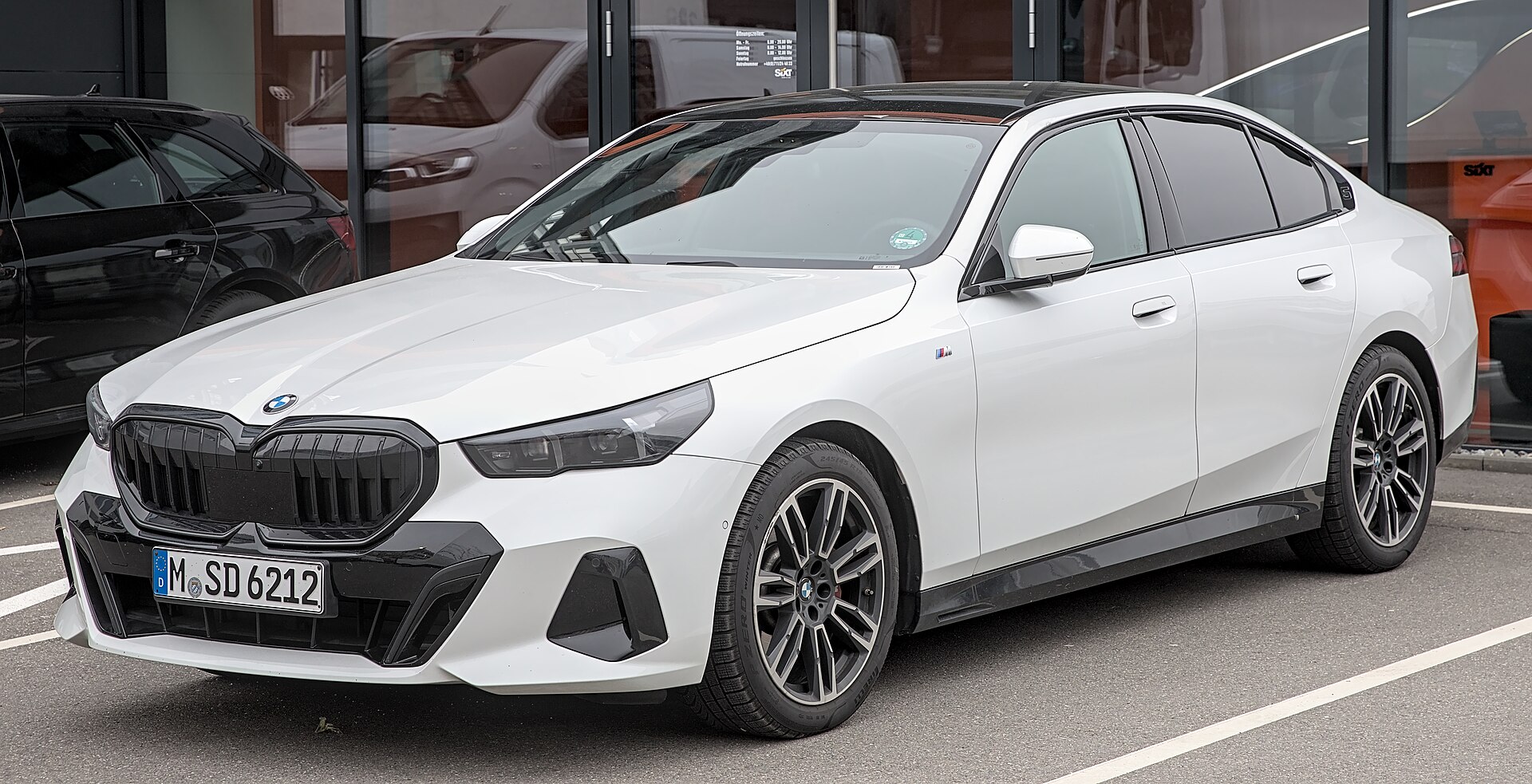
The G60 saloon and the i5 were revealed on 24 May 2023. Production started at Dingolfing on 21 July 2023, the i5 four days later; the Touring (G61) followed on 1 March 2024. The design team was led by Anders Thøgersen. At 5,060 mm the G60 is the longest 5 Series so far. All combustion engines have 48-volt mild hybrid support.
| Version (G60) | Fuel | Power | Torque | 0–100 km/h |
|---|---|---|---|---|
| 520i | petrol | 153 kW (208 PS) | 330 Nm | 7.5 s |
| 520d | diesel | 145 kW (197 PS) | 400 Nm | 7.5 s |
| 530e | plug-in hybrid | 220 kW (299 PS) | 450 Nm | 6.3 s |
| 550e xDrive | plug-in hybrid | 365 kW (496 PS) | 700 Nm | 4.3 s |
| i5 eDrive40 | electric | 250 kW (340 PS) | 430 Nm | - |
| i5 M60 xDrive | electric | 442 kW (601 PS) | 820 Nm | 3.8 s |
| M5 | plug-in hybrid V8 | 535 kW (727 PS) | 1,000 Nm | 3.5 s |
The i5 uses a battery with 81.2 kWh of usable capacity; the WLTP range of the eDrive40 saloon is 497–582 km depending on wheels and equipment. Euro NCAP tested the i5 eDrive40 in 2023 and gave five stars, with 89 percent for adult and 85 percent for child occupant protection.


Engines and dimensions by generation
| Generation | Years | Length × width | Wheelbase | Power range |
|---|---|---|---|---|
| E12 | 1972–1981 | 4,620 × 1,690 mm | 2,636 mm | 66–160 kW |
| E28 | 1981–1987 | 4,620 × 1,700 mm | 2,625 mm | 77–210 kW |
| E34 | 1988–1996 | 4,720 × 1,750 mm | 2,760 mm | 83–250 kW |
| E39 | 1995–2004 | 4,775 × 1,800 mm | 2,830 mm | 100–294 kW |
| E60 | 2003–2010 | 4,843 × 1,850 mm | 2,890 mm | 115–373 kW |
| F10 | 2010–2017 | 4,899 × 1,860 mm | 2,968 mm | 135–412 kW |
| G30 | 2017–2023 | 4,936 × 1,868 mm | 2,975 mm | 125–460 kW |
| G60 | since 2023 | 5,060 × 1,900 mm | 2,995 mm | 145–535 kW |
Each generation has grown: the G60 is 440 mm longer and 210 mm wider than the E12. Versions of all generations can be put side by side in the car comparison tool or against rivals in the size comparison.
Prices and running costs
At the start of sales in autumn 2023 the German price list began at €57,550 for the 520i, €59,750 for the 520d and €62,350 for the 520d xDrive. In the same 2023 list the i5 eDrive40 cost €70,200 and the i5 M60 at least €99,500. The plug-in hybrids followed in spring 2024.
Breakdown figures from ADAC show the usual pattern of ageing cars: 0.8 breakdowns per 1,000 cars for 2023 registrations and 1.2 for 2022, but 8.3 for 2018 and 11.3 for 2016 registrations. For a used G30 or F10, the service history matters more than the engine choice.
Which 5 Series to choose
For buyers of a new car who drive long distances, the 520d is the natural choice, while the 530e suits drivers who can charge at home and cover short daily trips electrically. The i5 eDrive40 is the version for drivers who already use public fast chargers and want the quietest car. On the used market, a late G30 after the 2020 facelift combines modern assistance systems with mild-hybrid engines at a lower price than the G60.
From an enthusiast's point of view the older generations have their own appeal: the E39 with its V8 M5, the E34 with the first V8 engines and the first Touring, and the E28 M5 as the first M5 of all. Rivals include the Mercedes-Benz E-Class and the Audi A6, compared in our Jaguar XF or Audi A6 article; the car rankings list the fastest and most powerful saloons.
Photo gallery


FAQ
How many generations of the BMW 5 Series are there?
Eight: E12 (1972), E28 (1981), E34 (1988), E39 (1995), E60 (2003), F10 (2010), G30 (2017) and G60 (2023).
Is the BMW i5 a separate model?
No. The i5 is the battery-electric version of the G60 5 Series, built on the same line in Dingolfing.
Which 5 Series was the first with all-wheel drive?
The E34 525iX. The first M5 with all-wheel drive was the F90 of the G30 generation.
How much does a new BMW 5 Series cost?
In Germany the G60 started at €57,550 for the 520i in 2023; the i5 eDrive40 cost €70,200.
What is the most powerful 5 Series?
The plug-in hybrid M5 of 2024 with 535 kW (727 PS) and 1,000 Nm.