Jaguar XF vs Audi A6: Comparing Two Executive Saloons
For most buyers the Audi A6 is the better all-round choice: it has more engine options, quattro all-wheel drive, a newer cabin and, unlike the Jaguar, a model line that continues. The Jaguar XF (X260) is the better pick for drivers who value steering feel, ride comfort and a lower used price, since its production ended in mid-2024.

Key takeaways
- Jaguar XF X260: 2015–2024, aluminium body, 2.0 Ingenium petrol and diesel engines from 120 to 221 kW, rear- or all-wheel drive.
- Audi A6 C8: from 2018, mild-hybrid petrol, diesel and plug-in hybrid engines, S6 and 441 kW RS 6, quattro on most versions.
- Both scored five stars in Euro NCAP (XF in 2015, A6 in 2018); the A6 has the newer safety technology.
- Space is close: 540 litres of boot in the XF against 530 litres in the A6 saloon.
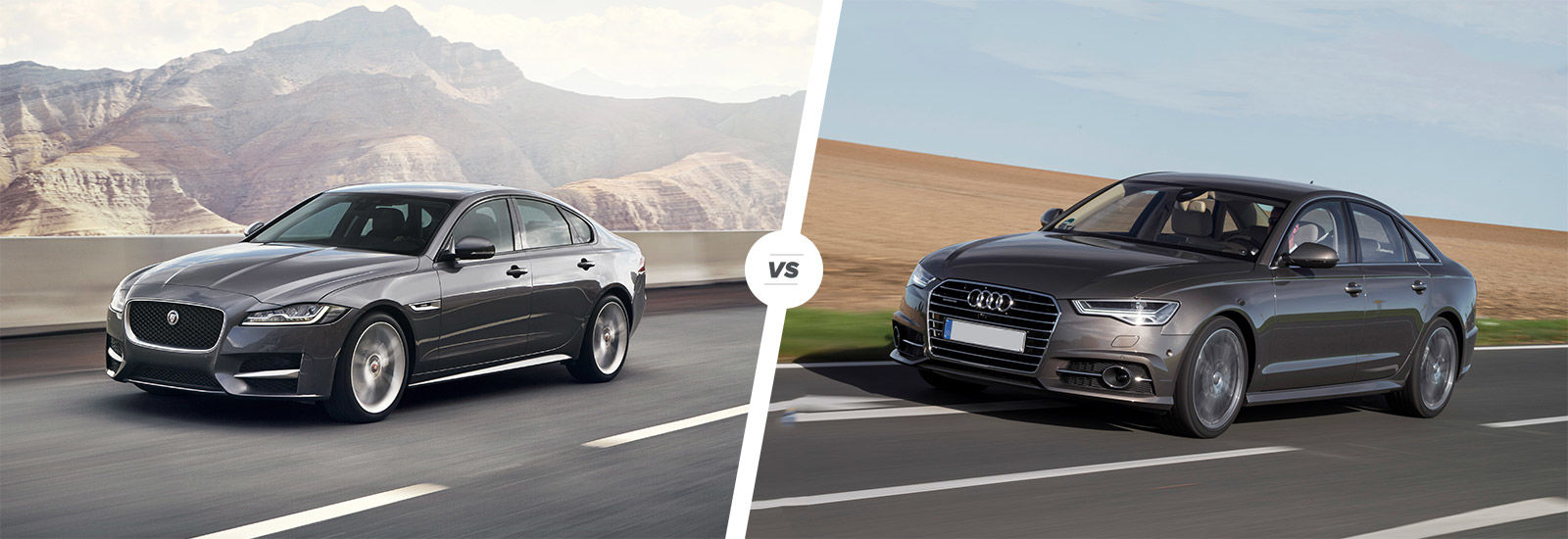
Jaguar XF vs Audi A6: quick verdict
The two cars meet in the same class as the BMW 5 Series and the Mercedes-Benz E-Class, but they reach it in different ways. The XF is a driver's saloon: light, low and tuned for steering precision and a supple ride. The A6 is a technology saloon: heavier, quieter, with two large touchscreens, many assistance systems and a broader engine range, including plug-in hybrids.
Size at a glance
| Dimensions | Jaguar XF X250 |
|---|---|
| Length | 4,961 mm195.3 in |
| Width | 1,877 mm73.9 in |
| Height | 1,460 mm57.5 in |
| Wheelbase | 2,909 mm114.5 in |
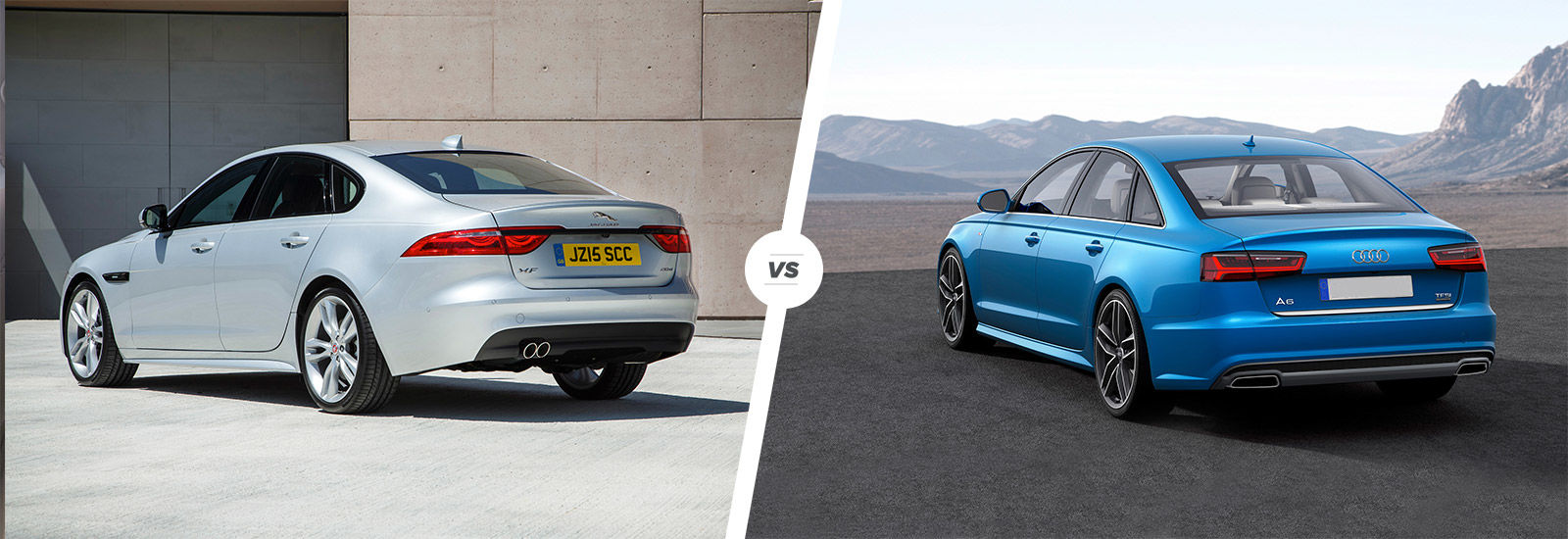
The status of each model matters as much as the specifications. Jaguar stopped building the XF in mid-2024 as the brand prepared to relaunch as an electric-only maker, so today it is a used-car decision. The A6 C8 was updated in 2023, and in 2025 Audi introduced a new generation in Europe, offered with combustion engines and as the electric A6 e-tron. A buyer comparing the two in 2026 is usually choosing between used cars of 2018–2024.
Specifications side by side
| Parameter | Jaguar XF (X260) | Audi A6 saloon (C8) |
|---|---|---|
| Years | 2015–2024 | 2018– (facelift 2023) |
| Plant | Castle Bromwich, Birmingham | Neckarsulm, Germany |
| Platform | JLR D7a, mainly aluminium | MLBevo (shared with A7 and A8) |
| Length | 4,954–4,969 mm (195.0–195.6 in) | 4,939 mm (194.4 in) |
| Wheelbase | 2,960 mm (116.5 in) | 2,924 mm (115.1 in) |
| Boot | 540 l (19.1 cu ft) | 530 l (18.7 cu ft) |
| Kerb weight | 1,545–1,855 kg | 1,770 kg (55 TFSI quattro) |
| Petrol engines | 2.0 Ingenium 184 kW (250 PS) and 221 kW (300 PS); 3.0 V6 S (early cars) | 2.0 TFSI up to 195 kW (265 PS); 3.0 TFSI 250 kW (340 PS) |
| Diesel engines | 2.0 Ingenium 120–177 kW (163–240 PS); 3.0 V6 221 kW (300 PS) | 2.0 TDI 150 kW (204 PS) and 3.0 V6 TDI versions |
| Hybrid | 48 V mild hybrid on 2.0 engines from late 2020 | Mild hybrid on all engines; plug-in 50/55 TFSI e |
| Gearbox | ZF 8-speed automatic (6-speed manual on early diesels) | 7-speed S tronic or 8-speed tiptronic |
| Drive | Rear-wheel drive or AWD | Front-wheel drive or quattro |
| Euro NCAP | 5 stars (2015) | 5 stars (2018) |
Performance and driving
The quickest regular XF is the P300, whose 2.0-litre Ingenium four-cylinder makes 221 kW (300 PS) and 400 Nm and, with all-wheel drive, reaches 100 km/h in 5.9 seconds. Early cars could also have the supercharged 3.0 V6 of the XF S, rated at 380 PS. Among diesels, the 2.0-litre 25d with 177 kW (240 PS) and the 3.0 V6 30d with 221 kW (300 PS) were the strongest.
The Audi has a wider spread. The 55 TFSI, with a 3.0 V6 turbo of 250 kW (340 PS) and 500 Nm, reaches 60 mph in 4.9 seconds and is limited to 155 mph (250 km/h). Above it sit the S6, with a V6 TDI diesel in Europe, and the RS 6 Avant, whose mild-hybrid 4.0 V8 makes 441 kW (600 PS), or 463 kW (630 PS) in the Performance version.
Nothing in the X260 XF range comes close to the RS 6; the earlier XFR of the first generation, with a 5.0 V8 of 375 kW (510 PS), still ranks seventh in the 1cars most powerful saloons list. On our own power-to-weight calculation, the XF P300 carries about 8.0 kg per kW, while the heavier but stronger A6 55 TFSI carries about 7.1 kg per kW.
On the road, testers have long praised the XF for its steering and body control, helped by the light aluminium structure and the rear-wheel-drive layout. The A6 is calmer and more insulated, with optional all-wheel steering and air suspension that make it easy to drive in town and relaxed on the motorway. Drivers who enjoy country roads usually prefer the Jaguar; those who mostly cover long motorway distances usually prefer the Audi.
Practicality and space
On paper the two are almost the same size: the XF is a few centimetres longer and has a 36 mm longer wheelbase. The boot figures are also close, at 540 litres for the XF and 530 litres for the A6 saloon. The Jaguar's boot extends to 885 litres with the rear seats folded. Both cars offered an estate: the XF Sportbrake and the A6 Avant, which also exists as the raised allroad quattro.
The cabins differ more than the dimensions. The A6 uses two touchscreens (10.1 and 8.6 inches) for infotainment and climate, with physical buttons largely removed. The XF has a simpler layout; after the 2020 update it gained a better-finished interior and Jaguar's Pivi Pro infotainment. Rear-seat space is good in both, with enough legroom for adults on long trips.
Running costs and fuel use
The plug-in hybrid A6 50 TFSI e and 55 TFSI e are the cheapest to run for drivers who can charge at home, because short trips can be covered on electricity. Among combustion engines, the four-cylinder diesels of both cars are the most economical. In official WLTP figures, the A6 55 TFSI petrol returns 32.8–33.6 mpg (UK), or about 8.4–8.6 l/100 km, and Australian test data list the XF P300 AWD at 7.4 l/100 km in the combined cycle.
Ownership costs also depend on the support network. Audi has a much larger dealer network across Europe, and the A6 will be supported by new-car service for years to come. Jaguar dealers still service the XF, but with no direct successor its used market is smaller. Used XFs are usually cheaper than A6s of the same age, which helps buyers but also means lower resale values. To estimate the yearly cost of either car, use the cost of ownership calculator.
Reliability and safety
Euro NCAP gave the XF five stars in 2015, with 92% for adult occupant protection, 84% for child occupants, 80% for pedestrians and 83% for safety assist. The A6 C8 received five stars in 2018, under a stricter protocol with more emphasis on automatic emergency braking. In both cases, check that a used car has the full recall and software update history, especially on the A6's mild-hybrid system and infotainment, and on the XF's Ingenium diesels.
Which one to buy
| Buyer type | Better choice | Why |
|---|---|---|
| Enjoys driving, wants comfort | Jaguar XF | Steering, ride and rear-wheel-drive balance |
| High motorway mileage | Audi A6 TDI | Quiet cabin, efficient diesels, quattro |
| Home charging available | Audi A6 TFSI e | Plug-in hybrid running costs |
| Lowest used price | Jaguar XF | Usually cheaper than an A6 of the same age |
| Performance first | Audi S6 / RS 6 | Up to 441–463 kW, no XF equivalent |
| Estate needed | Either | XF Sportbrake or A6 Avant |
Our verdict: buy the A6 if you want the most complete, future-proof executive car, and the XF if you want a well-priced, enjoyable saloon and accept a brand in transition. More detail on each model is in the Jaguar XF page, the history of Jaguar and the Audi catalogue. To put any two versions side by side, use the 1cars comparison tool.
FAQ
Which is more reliable, the Jaguar XF or the Audi A6?
Neither has a perfect record. The deciding factors are service history and completed recalls: check software and electrical updates on the A6 and the Ingenium diesel history on the XF. The A6's larger dealer network makes repairs easier to arrange.
Which is cheaper to run?
The four-cylinder diesels of both cars use the least fuel on long trips, and the A6 plug-in hybrids are cheapest for drivers who charge at home. The XF is usually cheaper to buy used, but it loses value faster.
Is the Jaguar XF still made?
No. Production of the second-generation XF ended in mid-2024, after about 230,900 cars had been sold worldwide between 2015 and 2024. Jaguar is relaunching as an electric-only brand, so the XF has no direct successor.
Which has the bigger boot?
The figures are almost identical: 540 litres for the XF saloon and 530 litres for the A6 saloon. With the rear seats folded, the XF offers up to 885 litres. For more space, the XF Sportbrake and the A6 Avant are the estate options.
Which is faster, the XF or the A6?
The fastest XF regulars are the P300 and the early V6 S, with 221 to 280 kW. The A6 range goes much further: the 55 TFSI has 250 kW, and the RS 6 Avant has 441 kW (600 PS), or 463 kW in the Performance.