
Archive first published
The Tow Truck: History and Evolution of the Breakdown Truck
The tow truck, also called a wrecker, breakdown truck or recovery vehicle, was invented in 1916 by Ernest Holmes Sr., a garage worker in Chattanooga, Tennessee. His first wrecker was a 1913 Cadillac fitted with a chain, a pulley and poles. Since then the design has grown into wheel-lift trucks, flatbeds and heavy rotators that can lift a lorry.
Key takeaways
- 1916: Ernest Holmes builds the first wrecker after pulling a friend's Ford Model T out of a ditch; he patents his split-boom design in 1918.
- 1908: an earlier military recovery version of Ferdinand Porsche's Austro-Daimler M 08 tractor already used a large winch.
- 1967: Arthur W. Nelson designs the wheel lift, which lifts a car by its wheels instead of a chain round the bumper.
- Today: boom, wheel-lift, integrated, flatbed and rotator trucks cover everything from city cars to 50-tonne loads.

Before the tow truck
The first cars broke down often, and the usual answer was a horse or a team of men. As car numbers grew in the early 20th century, garages needed a quicker way to bring a broken or crashed car back to the workshop. The first purpose-built recovery vehicle came from the military. In 1908 Ferdinand Porsche, then at Austro-Daimler, developed the M 08 artillery tractor for the Austro-Hungarian army. One example was built as a recovery vehicle with a large winch at the rear.

Ernest Holmes and the first wrecker (1916)
The civilian tow truck began with an accident. Ernest Holmes Sr., born on 17 January 1883, worked in a garage in Chattanooga, Tennessee. When his friend John Wiley overturned his Ford Model T into a ditch (some accounts say a creek), pulling it out proved slow and difficult. Holmes decided there had to be a better way. He fitted his own 1913 Cadillac with an iron chain, a pulley and several poles, so that it could lift a damaged car and pull it back to his garage.
Holmes kept improving the idea. His patents were based on a split-boom wrecker: one side of the rig could anchor the truck while the other side pulled. The rig could therefore recover a car from a steep bank without tipping over itself. The patent is dated 17 January 1918. Holmes then founded the Ernest Holmes Company and began to build wreckers for other garages.
| Fact | Value |
|---|---|
| Inventor | Ernest Holmes Sr. (1883–1945) |
| Place | Chattanooga, Tennessee, USA |
| First wrecker | 1916, based on a 1913 Cadillac |
| Patent | Dated 17 January 1918 (split-boom wrecker) |
| Company | Ernest Holmes Company, later part of Miller Industries |
| Museum | International Towing and Recovery Hall of Fame and Museum, Chattanooga |
The cars involved are part of the wider story of Ford and Cadillac in those early years.
The towing industry grows (1920s–1960s)
Demand grew quickly once the first wreckers were on sale, because every garage and dealer needed one. During the Second World War the Ernest Holmes Company built between 6,000 and 7,000 wreckers. After Holmes died on 10 June 1945, his eldest son, Ernest Holmes Jr., took over the business. The remains of the company later became part of Miller Industries, a maker of towing and recovery equipment based in Ooltewah, Tennessee.
For decades the standard tool was the boom with a hook and chain. The wrecker lifted the front or rear of the car by a chain wrapped round the axle or bumper and towed it on its other wheels. Later, slings and belt lifts replaced the chain to spread the load, but they could still scratch modern plastic bumpers.
Wheel lifts, flatbeds and rotators (1967 to today)
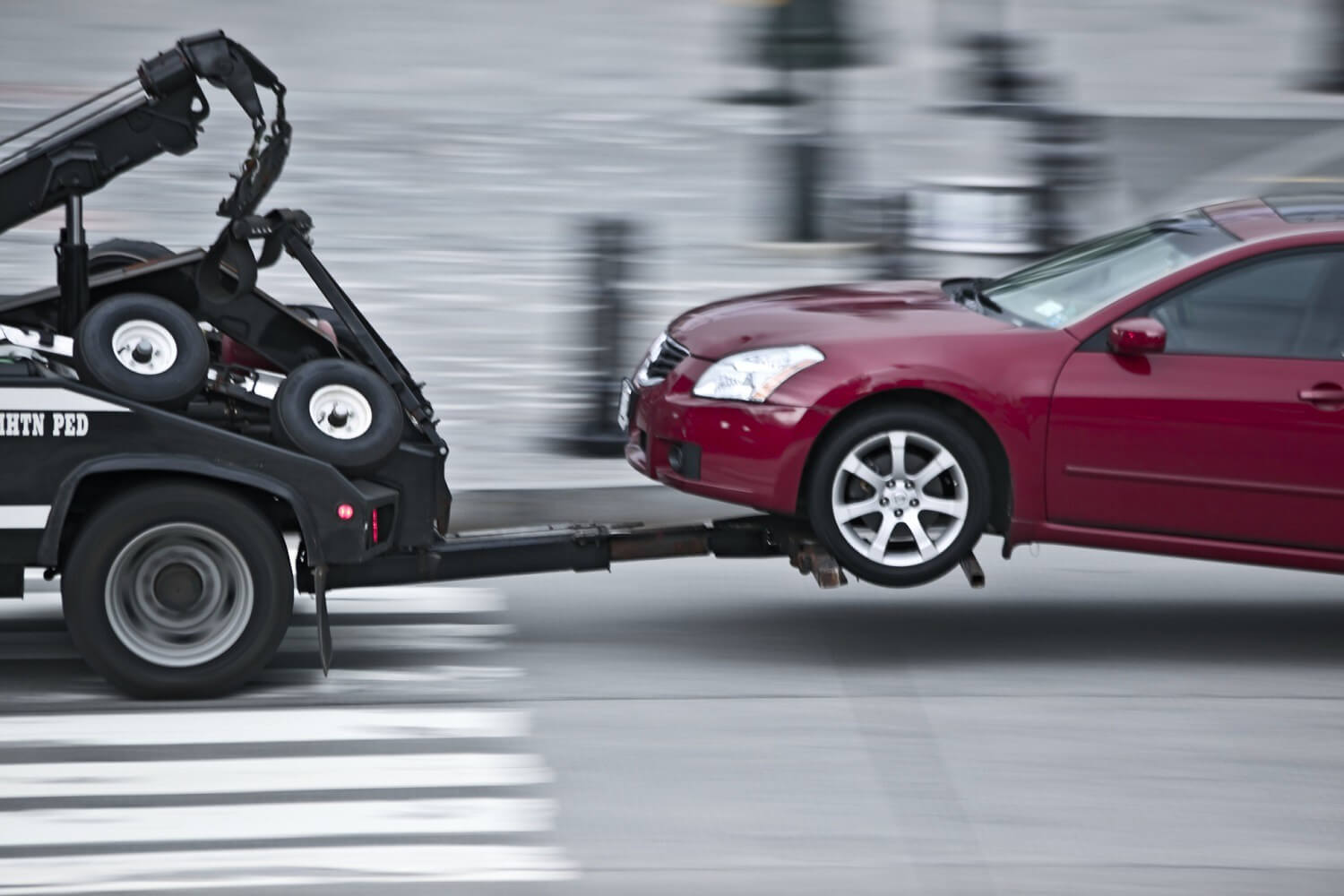
The next big step came in 1967, when Arthur W. Nelson of Weld Built Body Co. designed the wheel lift. A metal yoke slides under the drive wheels and lifts them off the ground, so nothing touches the bodywork. Bigger recovery vehicles use a stronger version, the underlift or chassis lift, which raises the axle or frame instead of the wheels.
Flatbeds, also called rollbacks, slides or tilt trays, carry the whole car on a bed that tilts down hydraulically to form a ramp. They are the safest way to move a car that cannot roll or a badly damaged one. Integrated units, sometimes called self-loaders, combine a boom and a wheel lift with controls in the cab, so one driver can pick up a car quickly without leaving the cab. At the heavy end, rotators carry a crane-like boom that turns through a full circle and can lift trucks and buses after accidents.
| Year | Milestone |
|---|---|
| 1908 | Austro-Daimler M 08 recovery tractor with rear winch |
| 1916 | Ernest Holmes builds the first wrecker in Chattanooga |
| 1918 | Patent for the split-boom wrecker |
| 1939–1945 | Ernest Holmes Company builds 6,000–7,000 wreckers |
| 1967 | Wheel lift designed by Arthur W. Nelson |
| Later decades | Flatbeds, integrated self-loaders and rotators become common |
Types of tow truck compared
| Type | How it works | Best for |
|---|---|---|
| Boom (hook and chain, sling) | Winch and boom lift one end of the car | Recovery from ditches and embankments |
| Wheel lift | Yoke lifts the drive wheels | Quick tows of undamaged cars |
| Integrated (self-loader) | Boom and wheel lift operated from the cab | Parking enforcement and repossessions |
| Flatbed (rollback, tilt tray) | Whole car rides on a tilting bed | Damaged cars, four-wheel-drive and electric cars |
| Lift flatbed | Boom with wheel-lift frame lifts the car onto the bed | Parallel-parked cars, common in Europe |
| Rotator | Rotating heavy boom, crane-like | Trucks, buses and heavy recovery |
Weight classes
Recovery vehicles are grouped by what they can handle. Light-duty units move about 4.5 to 9 tonnes, medium-duty ones about 13.5 to 18 tonnes and heavy-duty ones about 23 to 45 tonnes. Rotators themselves weigh 36 to 68 tonnes. Heavy wreckers are usually built on standard lorry chassis such as the MAN TGS or the Volvo FH, with a specialist body; more such chassis are listed among the trucks on 1cars.
By our calculation, a light-duty unit carrying a typical 1.5-tonne family car works at only a fifth of its 7-tonne mid-range capacity, while a heavy-duty wrecker recovering a 40-tonne articulated lorry works close to its 45-tonne limit. That gap is why recovery firms keep a fleet of different sizes.
| Class | Typical capacity | Typical jobs |
|---|---|---|
| Light duty | About 4.5–9 t | Cars, small vans |
| Medium duty | About 13.5–18 t | Large vans, small trucks, motorhomes |
| Heavy duty | About 23–45 t | Trucks, buses, heavy machinery |
| Rotator | Vehicle weighs 36–68 t | Overturned trucks and complex accidents |
Which tow truck to choose for a modern car
The right recovery vehicle matters more than ever. Many automatic, four-wheel-drive and electric cars must not be towed with their driven wheels on the road, because the gearbox or motors can be damaged. For them, the owner's manual normally recommends a flatbed. Low sports cars with long overhangs also need a flatbed or a truck with a low loading angle. Before calling a recovery service, check the manual for the towing rules of your car. Read up on preventing an accident in winter in the guide to driving on ice.
Rules differ between countries. In Australia, accident towing vehicles carry special number plates, and in some American states wreckers may use warning sirens like emergency vehicles.
Myths and the Mercedes "Blue Wonder"
The old 1cars text named the Mercedes-Benz "Blue Wonder" as a famous tow truck. In fact it was a fast car transporter built in the 1950s to carry the company's racing cars between circuits, so it belongs to the history of transporters rather than breakdown trucks. The story of the brand is in the history of Mercedes-Benz.
Legacy of the tow truck
Ernest Holmes's simple idea, a lifting boom on the back of a car, created an industry. The International Towing and Recovery Hall of Fame and Museum in Chattanooga now displays restored antique wreckers, tools and the history of the trade. A century after the first wrecker, the job is the same: bring a stranded vehicle home without causing more damage.
FAQ
Who invented the tow truck?
Ernest Holmes Sr. of Chattanooga, Tennessee, built the first wrecker in 1916 after struggling to pull a friend's Ford Model T out of a ditch. He used his 1913 Cadillac, a chain, a pulley and poles, and his patent is dated 17 January 1918.
When was the wheel lift invented?
Arthur W. Nelson of Weld Built Body Co. designed the wheel lift in 1967. It lifts a car by its wheels with a metal yoke, so the tow truck does not touch the bumper or bodywork.
What is the difference between a wrecker and a flatbed?
A wrecker lifts one end of the car with a boom or wheel lift and tows it on its other wheels. A flatbed carries the whole car on a tilting bed, which is safer for damaged, four-wheel-drive and electric cars.
What is a rotator tow truck?
A rotator is a heavy recovery truck with a crane-like boom that can turn through a full circle. Rotators weigh 36 to 68 tonnes and lift trucks and buses after accidents or roll-overs.
Where is the tow truck museum?
The International Towing and Recovery Hall of Fame and Museum is in Chattanooga, Tennessee, the city where Ernest Holmes built the first wrecker. It displays restored antique wreckers, tools and equipment from the history of towing.


