Archive first published
The BMW M1 Story: BMW's First Mid-Engined Supercar
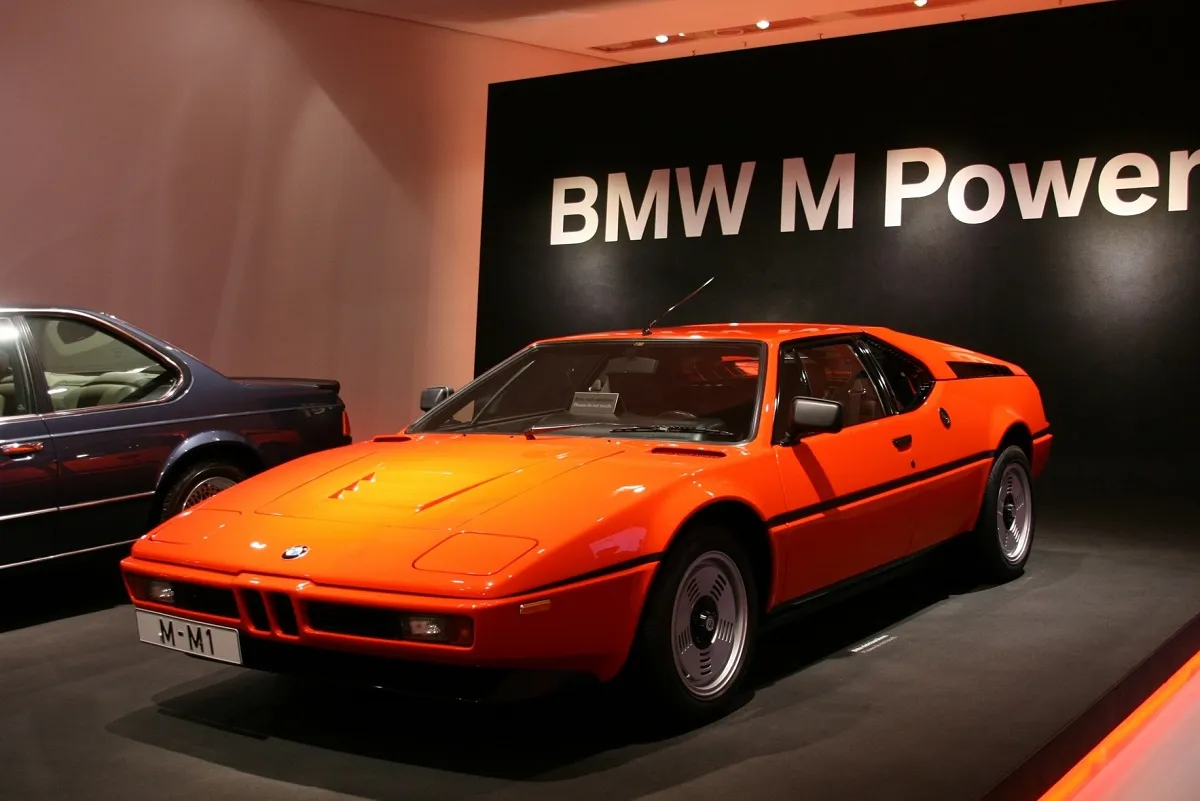
The BMW M1 is a mid-engined sports car that BMW Motorsport built from 1978 to 1981 to race against Porsche. It was developed with Lamborghini, styled by Giorgetto Giugiaro and powered by a 3.5-litre straight-six with 204 kW (277 PS). Lamborghini's financial collapse delayed it, only about 453 were made, and BMW turned its failure to homologate the car into the Procar series.
Key takeaways
- Origin: the 1972 BMW Turbo concept and Jochen Neerpasch's plan to beat Porsche in sports car racing.
- Development: chassis and prototypes contracted to Lamborghini from 1976; BMW took the project back in April 1978.
- Road car: 3,453 cc M88/1 six, 204 kW, about 1,300 kg, top speed 262–265 km/h, price 113,000 DM in 1979.
- Legacy: the Procar series won by Niki Lauda (1979) and Nelson Piquet (1980), Andy Warhol's Art Car, and an engine that later powered the M635CSi and M5.

BMW M1 at a glance

| Fact | Detail |
|---|---|
| Internal code | E26 |
| Production | autumn 1978 to 1981 |
| Built | about 453 (Wikipedia EN) to 460 (Wikipedia DE), road and racing cars |
| Layout | mid-engine, rear-wheel drive, two seats |
| Engine | M88/1 3,453 cc straight-six, four valves per cylinder |
| Power / torque | 204 kW (277 PS) at 6,500 rpm / 330 Nm at 5,000 rpm |
| Gearbox | ZF five-speed manual, 40 % limited-slip differential |
| Kerb weight | about 1,300 kg |
| Price | 113,000 DM in 1979, about €57,800 at the fixed DM rate |
From the 1972 Turbo concept to the M1 project
The M1's shape began with the BMW Turbo of 1972, a gull-winged concept designed by Paul Bracq for the year Munich hosted the Olympic Games. Two such prototypes, coded E25, were built in 1972 and 1973 with a turbocharged 2.0-litre four-cylinder engine giving 200–280 PS depending on boost. The old version of this page mixed the concept up with the 2002 Turbo road car; they were different cars.

The racing logic came from Jochen Neerpasch, who joined BMW in 1972 from Ford's competition department and became head of BMW Motorsport. He wanted a car that could take on Porsche, whose turbocharged 935 dominated Group 5 sports car racing. Neerpasch insisted on a mid-engined layout, and BMW's board approved the project; development started in 1976.
Why Lamborghini, and why it went wrong
To race in Group 5, BMW first had to build 400 road cars for homologation in Group 4. Its own plants were not set up for small-series production, so BMW signed a contract with Lamborghini for the chassis, the prototypes and the manufacturing. Gianpaolo Dallara designed the tubular steel space frame, and Giugiaro's Italdesign drew a fibreglass body inspired by the Turbo concept.

Lamborghini's finances, however, were collapsing. After seven prototypes, BMW took back control of the project in April 1978. Former Lamborghini engineers set up a company called Italengineering to finish the development close to Sant'Agata, and BMW reorganised production across several suppliers. You can read more about the Italian side in our history of Lamborghini.
A production line across the Alps
The M1 was built in a chain that stretched from northern Italy to Germany:
| Step | Supplier | Location |
|---|---|---|
| Fibreglass body panels | TIR | Reggio Emilia, Italy |
| Tubular space frame | Marchesi | Modena, Italy |
| Body assembly and interior | Italdesign | Turin, Italy |
| Final assembly with engine and gearbox | Baur | Stuttgart, Germany |
| Hand-built M88/1 engines | BMW | Munich, Germany |
| Final inspection and delivery | BMW Motorsport | Munich, Germany |

The old version of this page called this a 500 km conveyor. In fact the route between Turin, Modena and Stuttgart was considerably longer. The cost of shipping half-finished cars between plants is one reason the M1 never made money. Giugiaro's wider work is profiled on our page about Giorgetto Giugiaro.
Engine and chassis of the road car
The heart of the M1 was the M88/1 engine, designed by Paul Rosche. It was a 3,453 cc straight-six with twin overhead camshafts, four valves per cylinder, six individual throttle bodies and Kugelfischer-Bosch mechanical fuel injection. In road form it produced 204 kW (277 PS) at 6,500 rpm and 330 Nm at 5,000 rpm; the old page's "280 horsepower" was close.
The chassis used double wishbones at both ends with adjustable coil springs and Bilstein gas dampers, unassisted rack-and-pinion steering, and ventilated discs of 300 mm at the front and 297 mm at the rear. Campagnolo 16-inch alloy wheels carried Pirelli P7 tyres. All cars were left-hand drive, and the cabin used many parts from other BMWs.
| Performance | Figure |
|---|---|
| 0–100 km/h | about 5.6 s (BMW); 6.0 s in an auto motor und sport test |
| 0–200 km/h | 21.8 s (auto motor und sport) |
| Top speed | 262 km/h (BMW); 265 km/h measured |
| Weight | about 1,300 kg |
By our calculation, the road car carried about 6.4 kg per kW, a strong figure for 1978. Our power-to-weight calculator compares it with modern sports cars.
Launch in Paris and a very high price
BMW presented the M1 at the Paris Motor Show in October 1978. It was the fastest German road car of its day and the first mid-engined BMW sold to the public; the second was the i8 of 2014.
It was also very expensive. A newspaper headline of the time called it the "100,000-Mark car", and by 1979 the price had risen to 113,000 DM, about €57,800 at the fixed conversion rate and far more in today's money. The old version of this page said the price was "raised to 100,000 marks" because of the production costs; the real figure was higher.
The Procar Championship of 1979–1980
The delays meant that by the time the M1 was ready, the rules had moved on, and it could not be homologated for Group 5 in time. Neerpasch's answer was the BMW M1 Procar Championship, a one-make series run as a support race at Formula One Grands Prix in 1979 and 1980.
The format was unusual: the five fastest Formula One drivers from practice took part in identical M1s against selected private drivers. Niki Lauda won the 1979 title and Nelson Piquet won in 1980. Procar engines produced about 345 kW (470 PS; our power converter handles such conversions), and turbocharged racing versions later reached up to about 626 kW (850 PS). After two seasons the series ended, and the cars moved on to other championships.
Le Mans, the Art Car and rallying
The best-known M1 is the Art Car painted by Andy Warhol in 1979. Driven by Hervé Poulain, Manfred Winkelhock and Marcel Mignot, it finished sixth overall and second in its class at that year's 24 Hours of Le Mans. M1s stayed competitive at Le Mans in later years. The old version of this page also named a Frank Stella M1 Art Car; Stella's BMW Art Car was a different model, so we have removed that claim.
BMW France built a Group B rally version that appeared at the Tour de Corse in 1983. In 1984 Bernard Béguin won the Rallye de La Baule and the Rallye de Lorraine with it.
What the M1 left behind, and buying one today
Commercially, the M1 was a failure, but its engineering was not wasted. Versions of the M88 six powered the M635CSi and the first M5 of the E28 series, and a South African 745i used it in 1984–1986. In 2008 BMW celebrated the car's 30th anniversary with the M1 Hommage concept, shown at the Concorso d'Eleganza Villa d'Este. The full BMW story is told in our history of BMW.
For collectors, the M1 is now a blue-chip classic. In 2015 Bonhams estimated a 19,000 km example at 450,000–550,000 US dollars, about €405,000–495,000 at the exchange rate of the time. Racing and Procar cars sell for more. Buyers should check the chassis and frame history, documentation of the original engine and whether the car is a road or competition example.
How the M1 compares with the later mid-engined BMWs
| Car | Years | Engine | Power |
|---|---|---|---|
| BMW Turbo (E25) concept | 1972–1973 | 2.0-litre turbo four | 200–280 PS by boost |
| BMW M1 (E26) | 1978–1981 | 3.5-litre straight-six | 204 kW (277 PS) |
| BMW M1 Procar | 1979–1980 | 3.5-litre straight-six | about 345 kW (470 PS) |
| BMW Vision M Next concept | 2019 | plug-in hybrid | 441 kW (600 PS) |
The M1 remained BMW's only mid-engined series car until the i8 arrived in 2014, and the 2019 Vision M Next concept again borrowed its proportions. Compared with the Lamborghini Countach of the same years, the M1 was more practical and easier to drive every day, with a cabin that felt like a BMW. Other supercars of different eras are collected in our supercars section.
FAQ
Why did BMW build the M1?
BMW Motorsport under Jochen Neerpasch wanted a mid-engined car to race against Porsche in sports car racing. The rules required a run of road cars for homologation, so the M1 was sold to the public from 1978.
How many BMW M1s were made?
Between 1978 and 1981 about 453 M1s were built, according to English Wikipedia, of which 399 were road cars; German sources give 460. Around 20 of the racing cars were built for the Procar Championship.
What was Lamborghini's role in the BMW M1?
BMW contracted Lamborghini to build the chassis, prototypes and production cars. Lamborghini's financial crisis halted the work, and in April 1978 BMW took the project back after seven prototypes had been completed.
How much horsepower does a BMW M1 have?
The road car's M88/1 straight-six produces 204 kW, or 277 PS (273 hp), at 6,500 rpm. Procar racing versions reached about 345 kW (470 PS), and turbocharged racing engines up to about 626 kW.
How much is a BMW M1 worth today?
In 2015 Bonhams estimated a low-mileage road car at 450,000–550,000 US dollars. Values depend on history and condition, and Procar or racing cars with a documented past usually sell for more.