
 BMW M5
All generations, specs and history
Updated Published Sources (6) Report an error
By Felix Hartmann, Automotive Technology & EV Contributor Reviewed by Oleksandr Hnatiuk

- Built
- 1984–present
- Generations
- 7 · E28 to G90
- Top power
- 535 kW (727 PS)
Timeline
M5 generations
Click a generation for its own page
- M5 E28 1984–1988 · Sedan · 191–210 kW (260–286 PS)
- M5 E34 1988–1995 · Sedan, Station wagon · 232–250 kW (315–340 PS)
- M5 E39 1998–2003 · Sedan · 294 kW (400 PS)
- M5 E60/E61 2004–2010 · Sedan, Station wagon · 373 kW (507 PS)
- M5 F10 2011–2016 · Sedan · 412–441 kW (560–600 PS)
- M5 F90 2017–2023 · Sedan · 441–467 kW (600–635 PS)
- M5 G90/G99 Current 2024–now · Sedan, Station wagon · 535 kW (727 PS)
Newest first · 7 generations since 1984
-
2024

-
2017

-
2011

-
2004

-
1998

-
1988

-
1984


All generations by year: M5 G90/G99 (2024–now) · M5 F90 (2017–2023) · M5 F10 (2011–2016) · M5 E60/E61 (2004–2010) · M5 E39 (1998–2003) · M5 E34 (1988–1995) · M5 E28 (1984–1988)
Which one is mine?
Pick the year of first registration to see which generation it is.
Check by VINWhich BMW M5 to buy
Our verdict · Felix Hartmann
For collectors, the E28 and E34 are the classic choices, with the E34 Touring and special editions the rarest. The E39 combines a V8 with a manual gearbox, while the E60 is the only M5 with a V10. The F90 offers the best everyday usability and traction thanks to all-wheel drive, and the G90 adds electric driving at the cost of extra weight. Check the service history carefully on any M5, as engines and gearboxes are complex and costly to repair.
The BMW M5 is the high-performance version of the BMW 5 Series, built by BMW M since 1984. Over seven generations it has grown from the 210 kW E28 with a straight-six to the 2024 G90, a plug-in hybrid with a 4.4-litre twin-turbo V8 and an electric motor delivering 535 kW (727 PS) and 1,000 Nm.
In short
- Generations: E28 (1984), E34 (1988), E39 (1998), E60/E61 (2004), F10 (2011), F90 (2017) and G90/G99 (2024).
- Engines: straight-six (E28, E34), naturally aspirated V8 (E39), V10 (E60), twin-turbo V8 (F10, F90) and V8 plug-in hybrid (G90).
- Touring estates: E34, E61 and G99.
- Fastest: F90 Competition and CS with up to 467 kW and 0–100 km/h in about 3 seconds.

Specs by version
Engines
| Version | Engine | Power | Torque | Gearbox | Drive | Production years |
|---|---|---|---|---|---|---|
| E28 · 1984–1988 | ||||||
| E28 · 3.5 M88 210 kW (286 PS) Sedan | 3.5 l · 6 cyl · Petrol M88 | 210 kW 286 PS282 hp | - | - | - | - |
| M5 3.6 (E34) | 6 cyl · Petrol S38B36 | 232 kW 315 PS311 hp | 360 Nm266 lb-ft | - | - | - |
| M5 3.8 (E34) | 3.8 l · 6 cyl · Petrol S38B38 | 250 kW 340 PS335 hp | 400 Nm295 lb-ft | - | - | - |
| M5 (E39) | 8 cyl · Petrol S62 | 294 kW 400 PS394 hp | 500 Nm369 lb-ft | - | - | 1998–2003 |
| M5 (E60) | 5.0 l · 10 cyl · Petrol S85 | 373 kW 507 PS500 hp | 520 Nm384 lb-ft | - | - | 2004–2010 |
| M5 (F10) | 8 cyl · Petrol S63B44TU | 412 kW 560 PS553 hp | 680 Nm502 lb-ft | - | - | 2011–2016 |
| M5 Competition (F10) | 4.4 l · 8 cyl · Petrol S63B44TU | 441 kW 600 PS591 hp | 700 Nm516 lb-ft | - | - | 2015–2016 |
| F90 · 2017–2023 | ||||||
| F90 · 4.4 L 8 cyl Automatic (S8) · 2021 (EPA) | 4.4 l · 8 cyl 4,400 cc | - | - | 8-sp Automatic | All-wheel drive | 2021 |
| F90 · 4.4 L 8 cyl Automatic (S8) · 2020 (EPA) | 4.4 l · 8 cyl 4,400 cc | - | - | 8-sp Automatic | All-wheel drive | 2020 |
| F90 · 4.4 L 8 cyl Automatic (S8) · 2019 (EPA) | 4.4 l · 8 cyl 4,400 cc | - | - | 8-sp Automatic | All-wheel drive | 2019 |
Performance
Show all 4 versions
| Version | Fuel consumption |
|---|---|
| M5 3.6 (E34) | - |
| F90 · 2017–2023 | |
| F90 · 4.4 L 8 cyl Automatic (S8) · 2021 (EPA) | 13.8 l/100 km17.0 mpg US · 20.5 mpg UK |
| F90 · 4.4 L 8 cyl Automatic (S8) · 2020 (EPA) | 13.8 l/100 km17.0 mpg US · 20.5 mpg UK |
| F90 · 4.4 L 8 cyl Automatic (S8) · 2019 (EPA) | 13.8 l/100 km17.0 mpg US · 20.5 mpg UK |
Dimensions and weight
Show all 7 versions
| Version | Kerb weight |
|---|---|
| E28 · 1984–1988 | |
| E28 · 3.5 M88 210 kW (286 PS) Sedan | 1,550 kg3,417 lb |
| M5 3.6 (E34) | 1,550 kg3,417 lb |
| M5 3.8 (E34) | 1,550 kg3,417 lb |
| M5 (E39) | 1,550 kg3,417 lb |
| M5 (E60) | 1,550 kg3,417 lb |
| M5 (F10) | 1,550 kg3,417 lb |
| M5 Competition (F10) | 1,550 kg3,417 lb |
Verified Manufacturer and type-approval data from our catalog · Sources and methodology
BMW M5 at a glance
The M5 created the idea of a practical four-door saloon with sports-car performance. Each generation has been based on the current 5 Series, with an engine and chassis developed by BMW M. Like the BMW M3 and BMW M4, it is one of BMW's core M models, and its motorsport roots go back to cars such as the BMW M1. The brand's story is told in the history of BMW, and current models are in the BMW catalogue.

| Generation | Years | Engine | Power | Torque | Gearbox | Built |
|---|---|---|---|---|---|---|
| E28 | 1984–1988 | M88/3 3.5 I6 | 210 kW (286 PS) | – | Manual | 2,241 |
| E34 | 1988–1995 | S38 3.6/3.8 I6 | 232–250 kW (315–340 PS) | 360 Nm (3.6) | 5/6-speed manual | 12,254 |
| E39 | 1998–2003 | S62 4.9 V8 | 294 kW (400 PS) | 500 Nm | 6-speed manual | 20,482 |
| E60/E61 | 2004–2010 | S85 5.0 V10 | 373 kW (507 PS) | 520 Nm | 7-speed SMG III | 20,589 |
| F10 | 2011–2016 | S63 4.4 twin-turbo V8 | 412 kW (560 PS) | 680 Nm | 7-speed DCT | 19,533 |
| F90 | 2017–2023 | S63 4.4 twin-turbo V8 | 441 kW (600 PS) | 750 Nm | 8-speed automatic | – |
| G90/G99 | 2024– | S68 4.4 V8 + electric motor | 535 kW (727 PS) system | 1,000 Nm | 8-speed automatic | – |
E28 (1984–1988)
The first M5 was launched in October 1984 with the M88/3 straight-six, producing 210 kW (286 PS) in Europe; North American cars used the S38B35 with 191 kW. Only 2,241 were built.

E34 (1988–1995)
The E34 M5 used the S38 straight-six, first as a 3.6 with 232 kW (315 PS) and 360 Nm and, from 1992, as a 3.8 with 250 kW (340 PS). It reached 97 km/h in 6.3 seconds (5.9 seconds for the 3.8) and was limited to 250 km/h. A six-speed Getrag gearbox arrived in 1994, and 891 M5 Touring estates were built. Total production was 12,254, including special editions such as the Cecotto (22 cars), Winkelhock (51), 20 Jahre (20) and UK Limited (50).

E39 (1998–2003)
The E39 introduced a V8: the 4.9-litre S62 with 294 kW (400 PS) and 500 Nm, combined with a six-speed manual gearbox. It accelerated to 97 km/h in 4.8 seconds, was limited to 250 km/h and lapped the Nürburgring Nordschleife in 8:20. A total of 20,482 were built.

E60/E61 (2004–2010)
The E60 M5 used a 5.0-litre S85 V10 producing 373 kW (507 PS) and 520 Nm. Its seven-speed SMG III single-clutch automated gearbox was standard, with a six-speed manual offered in North America from October 2006. It reached 100 km/h in 4.7 seconds and, with the M Driver's Package, 305 km/h. Of 20,589 built, 1,025 were E61 Touring estates.

F10 (2011–2016)
The F10 switched to a 4.4-litre twin-turbo S63 V8 with 412 kW (560 PS) and 680 Nm and a seven-speed dual-clutch gearbox. It reached 100 km/h in 4.4 seconds and lapped the Nordschleife in 7:55. The Competition Package raised output to 423 kW in 2014 and to 441 kW (600 PS) with 700 Nm in 2015, and 300 "30 Jahre M5" cars marked the model's 30th anniversary. In total, 19,533 F10 M5s were built.

F90 (2017–2023)
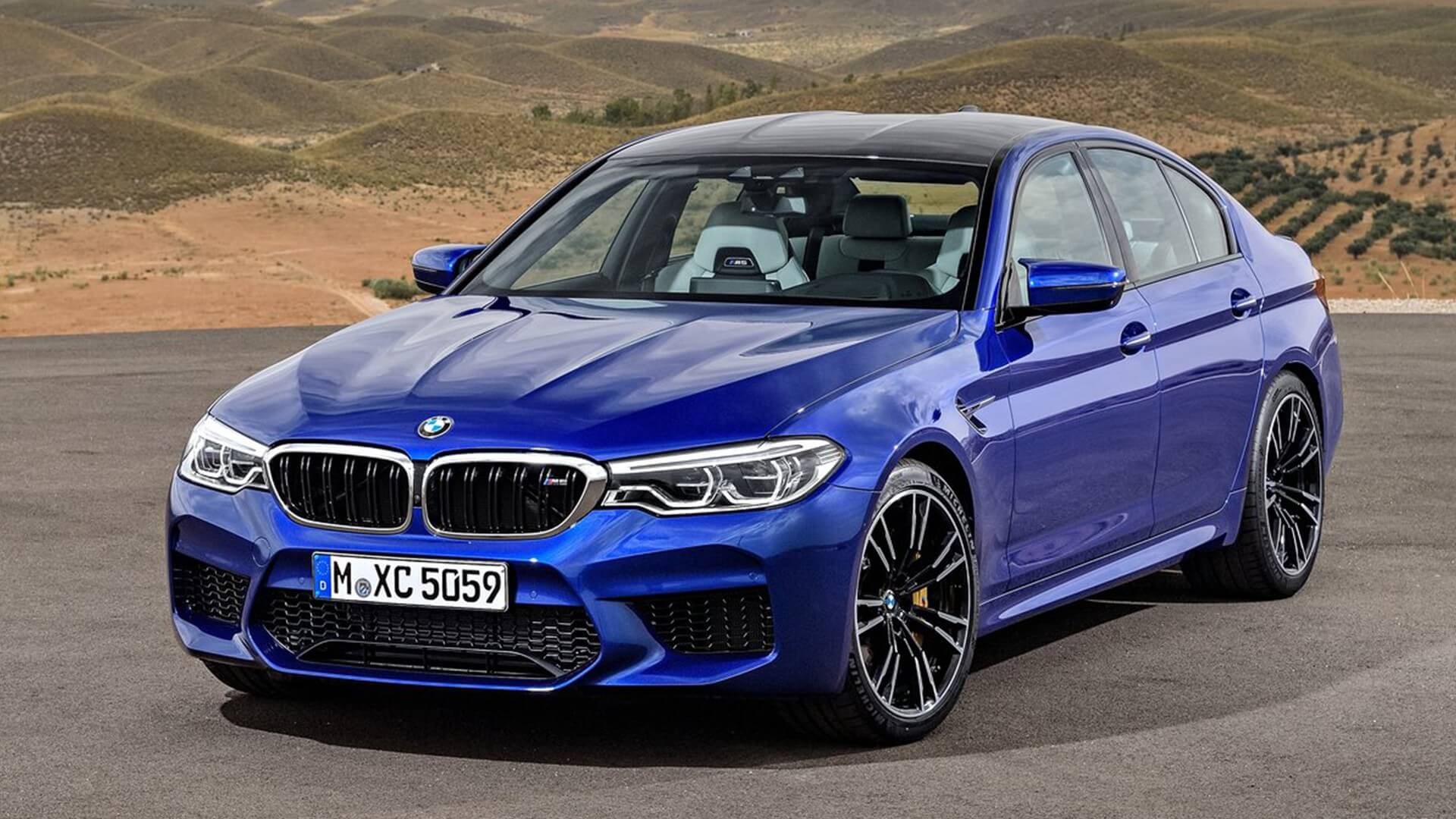
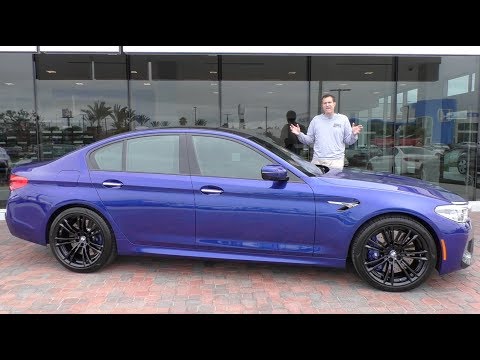
The F90 was the first M5 with all-wheel drive, using a rear-biased M xDrive system. Its S63 V8 produces 441 kW (600 PS) and 750 Nm through an eight-speed automatic, giving 0–100 km/h in 3.4 seconds and 0–200 km/h in 11.1 seconds. The Competition (from August 2018) has 460 kW (625 PS), and the CS of 2021 has 467 kW (635 PS) and weighs 1,866 kg. Special editions included the First Edition (400 cars) and "35 Jahre M5" (350 cars).

G90/G99 (from 2024)
The seventh M5, built from July 2024, is a plug-in hybrid. Its 4.4-litre S68 twin-turbo V8 (430 kW, 750 Nm) works with a 145 kW electric motor integrated into the eight-speed automatic, for a system output of 535 kW (727 PS) and 1,000 Nm. An 18.6 kWh battery gives up to 67 km of electric range under WLTP and electric driving up to 140 km/h. The car weighs 2,435 kg in European specification and reaches 100 km/h in 3.5 seconds. The G99 Touring estate returns the M5 to the estate market.

Performance by generation

| Generation | 0–100 km/h | Top speed | Nürburgring |
|---|---|---|---|
| E34 3.8 | 5.9 s (0–97 km/h) | 250 km/h | – |
| E39 | 4.8 s (0–97 km/h) | 250 km/h | 8:20 |
| E60 | 4.7 s | 250 / 305 km/h | 8:13 |
| F10 | 4.4 s | 250 / 305 km/h | 7:55 |
| F90 | 3.4 s | 250 / 305 km/h | 7:38.92 (sport auto) |
| G90 | 3.5 s | 250 / 305 km/h | – |
Rivals: how the M5 compares
The M5 has always competed with high-performance saloons such as the Mercedes-AMG E 63 and the Audi RS 6 and RS 7. Its strengths are a combination of everyday practicality, very high performance and engaging handling; its weaknesses are high running costs and, for the latest generation, weight. BMW M's racing side is represented by cars such as the BMW M3 GTR.

BMW M5 evolution in numbers
Did you know?
- The BMW M5 has been around for 42 years: 7 generations in our catalog since 1984.
- The longest-running generation is the M5 E34 (1988–1995): 7 years.
- The biggest jump in power came with the M5 E60/E61: up to 373 kW (507 PS), 79 kW more than the M5 E39.
Most powerful version, kW
Figures from the 1cars catalog: power is the strongest version of each generation; generations without the figure are left out.
BMW M5: first vs latest generation
| Spec | M5 E28 | M5 G90/G99 | Change |
|---|---|---|---|
| Years | 1984–1988 | 2024–present | 40 years apart |
| Most powerful version | 210 kW (286 PS) | 535 kW (727 PS) | +325 kW (+155%) |
Oldest and newest generation in the 1cars catalog. Power is the strongest version of each; other rows are shown only when both generations have the figure.
BMW M5 in our rankings
- No. 2 of 60 · Power-to-weight: sedans (285 kW/t)
- No. 4 of 18 · Fastest cars of the 1980s (250 km/h)
- No. 7 of 69 · Most powerful cars of the 1980s (250 kW)
- No. 9 of 151 · Most powerful German cars (535 kW)
- No. 10 of 174 · Most powerful sedans (467 kW)
- No. 30 of 1082 · Longest-running car nameplates (42 years · top 4%)
Better power-to-weight than 96% of ranked sedans in the 1CARS catalog (No. 2 of 60).
BMW M5 photos 43




BMW M5 videos 7

BMW M5 video 1

BMW M5 video 2

BMW M5 video 3

BMW M5 video 4

BMW M5 video 5
BMW M5 video 6
BMW M5 video 7
FAQ
How many generations of the BMW M5 are there?
There are seven: the E28 (1984), E34 (1988), E39 (1998), E60/E61 (2004), F10 (2011), F90 (2017) and the plug-in hybrid G90/G99 from 2024, each based on the 5 Series of its time.
Which BMW M5 had a V10 engine?
The E60/E61 M5 of 2004–2010 used a 5.0-litre S85 V10 with 373 kW (507 PS) and 520 Nm, combined with a seven-speed SMG III gearbox.
Is the BMW M5 all-wheel drive?
Since the F90 of 2017, yes. Its M xDrive system is rear-biased, and the G90 also uses M xDrive. All earlier M5s, from the E28 to the F10, were rear-wheel drive.
Is the new BMW M5 a hybrid?
Yes. The G90 M5 of 2024 combines a 4.4-litre twin-turbo V8 with a 145 kW electric motor for 535 kW (727 PS) and 1,000 Nm, and can drive up to 67 km on electricity.
What is the most powerful BMW M5?
The G90 plug-in hybrid has the highest system output at 535 kW (727 PS). Among combustion-only models, the F90 CS is the strongest, with 467 kW (635 PS).
Data sources
Data checked by an editor against the sources below.
- The text of this article (1cars archive)
- Wikipedia - BMW M5
- Wikipedia - BMW M88
- US EPA fueleconomy.gov - 42936.shtml
- US EPA fueleconomy.gov - 42002.shtml
- US EPA fueleconomy.gov - 40480.shtml


