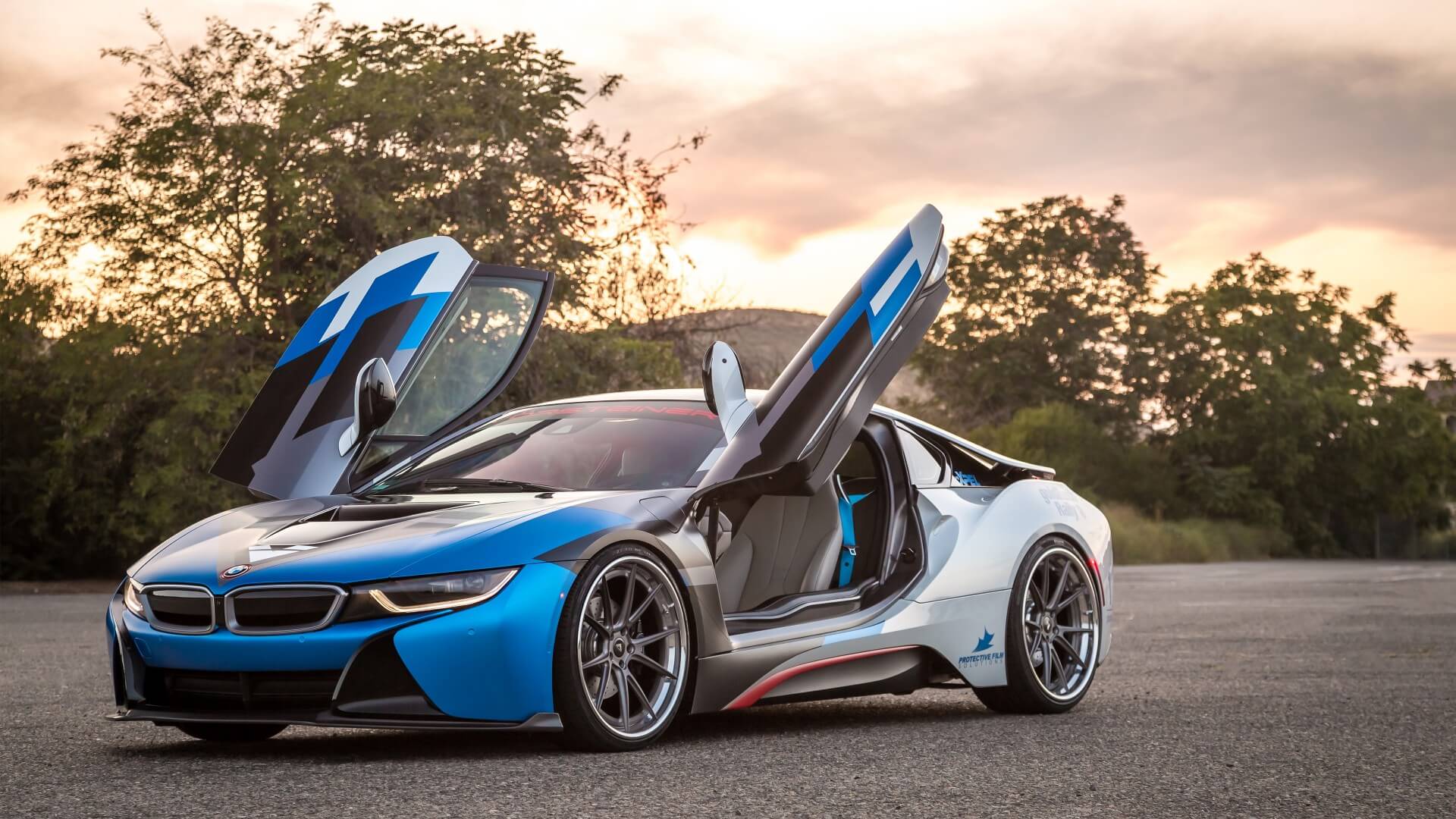
 BMW i8
Specs, engines and history
Updated Published Sources (6) Report an error
By Felix Hartmann, Automotive Technology & EV Contributor Reviewed by Oleksandr Hnatiuk
- Built
- 2013–2020
- Top power
- 275 kW (374 PS)
Which BMW i8 to buy: verdict
Our verdict · Felix Hartmann
The post-2018 coupé is the best i8 to buy: it has the bigger battery, about 50% more electric range in NEDC terms and a little more power, with the same weight-saving structure. The Roadster is rarer and suits buyers who want open-air driving and accept a slower 0–100 km/h time and no rear seats. Early 2014–2017 cars are the cheapest way into the model and still very usable if the battery checks out. More models are in the BMW catalogue, and the brand's story is in the history of BMW.
The BMW i8 is a plug-in hybrid sports car built in Leipzig from April 2014 to June 2020. It pairs a 1.5-litre three-cylinder petrol engine driving the rear wheels with an electric motor driving the front, for 266 kW (362 PS) at launch and 275 kW (374 PS) from 2018. BMW built 20,465 coupés and Roadsters.
In short
- Revealed at the Frankfurt Motor Show in September 2013; launch price in Germany from €126,000 in June 2014.
- 0–100 km/h in 4.4 seconds (coupé), 250 km/h limited, up to 120 km/h on electricity alone.
- Carbon-fibre passenger cell, aluminium chassis, butterfly doors and a drag coefficient of 0.26.
- 2018 update: bigger 11.6 kWh battery, 55 km NEDC electric range and the open i8 Roadster.

Running cost
Fuel · i8 1.5 L 3 cyl Automatic 6-spd · 2016 (EPA)
about 2,200 EUR fuel a year at 15,000 km
8.4 l/100 km · petrol at 1.75 EUR/l · change mileage, fuel price or version
Specs by version
Engines
| Version | Engine | Gearbox | Drive | Production years |
|---|---|---|---|---|
| 1.5 L 3 cyl Automatic 6-spd · 2017 (EPA) | 1.5 l · 3 cyl · Plug-in hybrid 1,500 cc | 6-sp Automatic | All-wheel drive | 2017 |
| 1.5 L 3 cyl Automatic 6-spd · 2016 (EPA) | 1.5 l · 3 cyl · Plug-in hybrid 1,500 cc | 6-sp Automatic | All-wheel drive | 2016 |
| 1.5 L 3 cyl Automatic 6-spd · 2015 (EPA) | 1.5 l · 3 cyl · Plug-in hybrid 1,500 cc | 6-sp Automatic | All-wheel drive | 2015 |
| 1.5 L 3 cyl Automatic 6-spd · 2014 (EPA) | 1.5 l · 3 cyl · Plug-in hybrid 1,500 cc | 6-sp Automatic | All-wheel drive | 2014 |
Performance
Show all 4 versions
| Version | Fuel consumption |
|---|---|
| 1.5 L 3 cyl Automatic 6-spd · 2017 (EPA) | 8.4 l/100 km28.0 mpg US · 33.6 mpg UK |
| 1.5 L 3 cyl Automatic 6-spd · 2016 (EPA) | 8.4 l/100 km28.0 mpg US · 33.6 mpg UK |
| 1.5 L 3 cyl Automatic 6-spd · 2015 (EPA) | 8.4 l/100 km28.0 mpg US · 33.6 mpg UK |
| 1.5 L 3 cyl Automatic 6-spd · 2014 (EPA) | 8.4 l/100 km28.0 mpg US · 33.6 mpg UK |
Verified Manufacturer and type-approval data from our catalog · Sources and methodology
BMW i8 at a glance
The i8 grew out of the Vision EfficientDynamics concept of 2009, which used a diesel three-cylinder, and the i8 Concept shown at the 2011 Frankfurt show. The production car kept the concept's dramatic shape and replaced the diesel with a petrol engine. It was the first production car offered with laser headlights, and it won the World Green Car of the Year award in 2015.

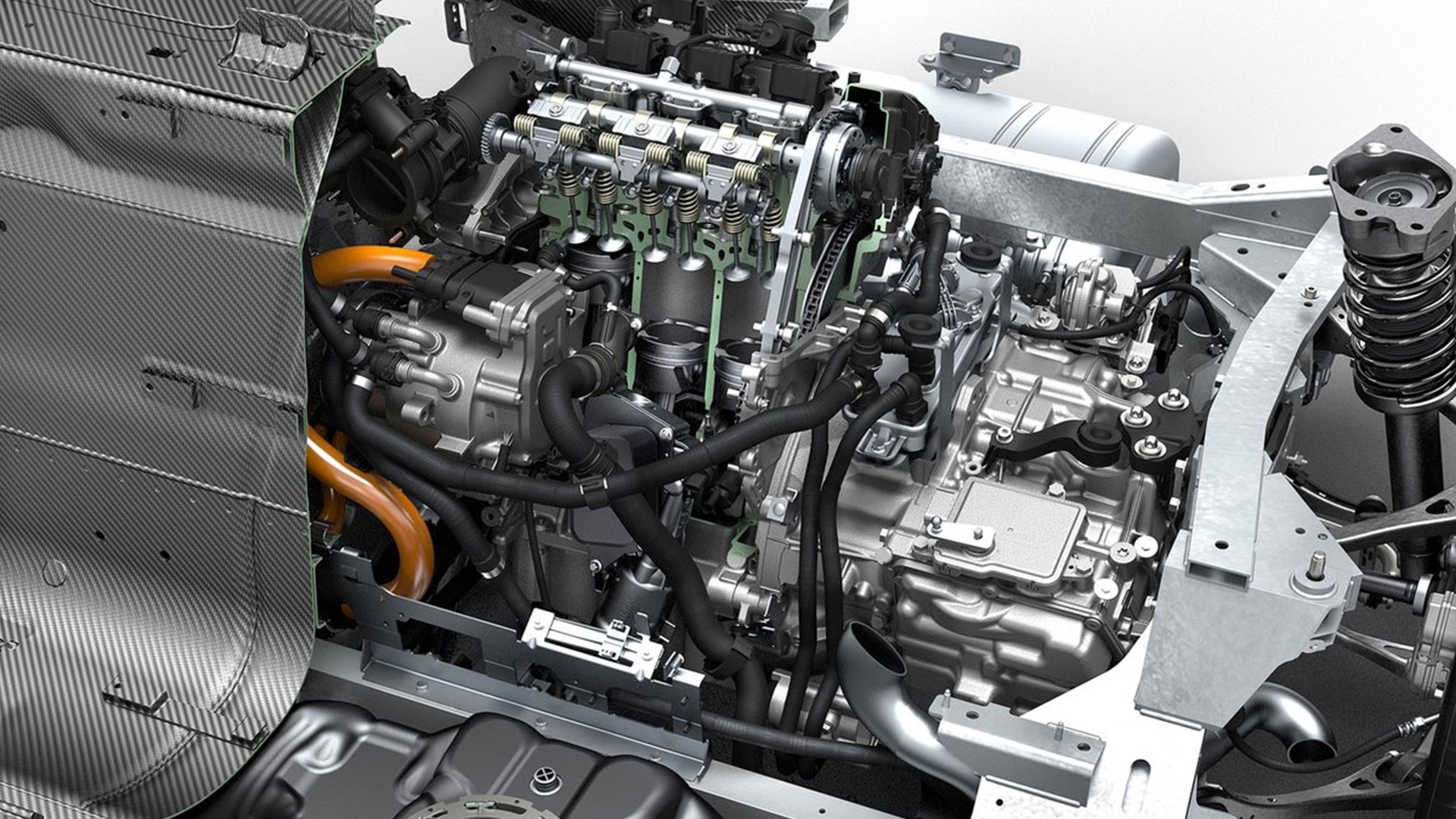
Like the BMW i3, the i8 uses a passenger cell made of carbon-fibre-reinforced plastic on an aluminium chassis that carries the drivetrain and suspension. The body has two small rear seats, butterfly doors and "floating" rear wing elements that channel air over the tail. The fake grille "nostrils" at the front are for show; under the bonnet sits the front electric motor rather than a combustion engine.
| Parameter | Metric | Imperial |
|---|---|---|
| Length / width / height | 4,689 / 1,942 / 1,298 mm | 184.6 / 76.5 / 51.1 in |
| Wheelbase | 2,800 mm | 110.2 in |
| Kerb weight (DIN) | 1,485 kg (coupé) | 3,274 lb |
| Drag coefficient | 0.26 | – |
| Boot | 154 l | 5.4 cu ft |
| Seats | 2+2 (coupé), 2 (Roadster) | – |
| Plant | Leipzig, Germany | – |
Three-cylinder engine, electric motor and performance
The petrol engine is BMW's B38 1,499 cc three-cylinder with a turbocharger, rated at 170 kW (231 PS) at 5,800 rpm and 320 Nm. It drives the rear wheels through a six-speed Aisin automatic. At the front, an electric motor of 96 kW (131 PS), raised to 105 kW (143 PS) and 250 Nm in 2018, drives the front wheels through a two-speed gearbox developed by GKN. When both work together, the i8 has all-wheel drive.
| Version | Years | System power | Battery (gross) | NEDC electric range | 0–100 km/h |
|---|---|---|---|---|---|
| i8 Coupé | 2014–2018 | 266 kW (362 PS), 570 Nm | 7.1 kWh | 37 km | 4.4 s |
| i8 Coupé (update) | 2018–2020 | 275 kW (374 PS) | 11.6 kWh | 55 km | 4.4 s |
| i8 Roadster | 2018–2020 | 275 kW (374 PS) | 11.6 kWh | 53 km | 4.6 s |
Top speed is limited to 250 km/h, and the car can run on electricity alone up to 120 km/h. A small motor-generator on the petrol engine can charge the battery while driving. On our own power-to-weight calculation, the launch coupé carries about 5.6 kg per kW, close to a conventional sports car of similar pace.
Electric range, charging and fuel consumption
In the official NEDC cycle, the i8 used 2.1 l/100 km with 49 g/km of CO2, a figure that assumes a charged battery at the start. The US EPA, which tests differently, gave 24 km (15 miles) of electric range at launch and 29 km (18 miles) from 2019, with about 27–28 mpg (US), or roughly 8.5 l/100 km, when the car runs on petrol alone.

The real-world picture lies between the two. On short trips with regular charging, the i8 can cover most commuting on electricity and use very little fuel. On long motorway journeys the battery empties quickly, and consumption is that of a light petrol sports car. With a BMW wallbox the battery reaches 80% in about two hours, while a domestic socket takes around three. To estimate costs for your own mix of driving, use the fuel cost calculator.
Cabin, space and equipment
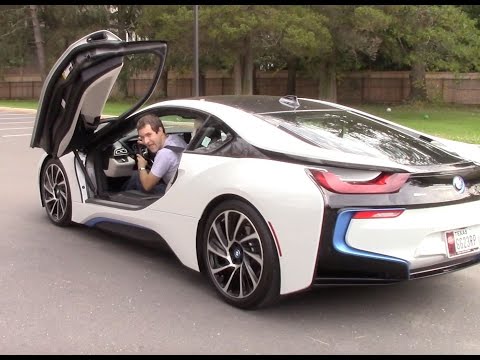
Inside, the i8 has a digital instrument display, a head-up display, a high centre console and sports seats with thin backrests that leave a little space behind. The two rear seats are only for children or bags. Entry and exit through the butterfly doors over the wide carbon sills take practice. The 154-litre boot sits behind the engine and gets warm, so it suits soft bags rather than shopping.
Standard equipment in Europe included LED headlights, 20-inch alloy wheels, leather trim, navigation, dynamic cruise control and a Harman Kardon sound system with 11 speakers. Laser headlights, with a high-beam reach of up to 600 m quoted by BMW, were an option. Special editions included the Protonic Red Edition of 2016 and the Ultimate Sophisto Edition, whose first car was the 20,000th i8 in December 2019.
Safety and reliability
Euro NCAP and the IIHS did not crash-test the i8, as is usual for low-volume sports cars. Its protection comes from the carbon-fibre passenger cell, front and rear aluminium crash structures and multiple airbags. Adaptive dampers and an electrically assisted steering rack were standard.

As a used car, the i8 has a good mechanical record, but it is a complex hybrid. Check the high-voltage battery's state of health and charging behaviour, the service history at a BMW dealer, the condition of the butterfly door struts and the carbon sills, and any warning messages from the hybrid system.
Production and sales
Production started in April 2014 and ended on 11 June 2020, when the last i8, a Roadster, left the Leipzig line. BMW built 20,465 cars: 16,581 coupés and 3,884 Roadsters. Deliveries peaked early, with 5,456 cars in 2015. The first 18 Roadsters, the First Edition, reached customers in May 2018.

Rivals: how the i8 compares
| Model | Drivetrain | Notes |
|---|---|---|
| BMW i8 | 1.5 I3 turbo + electric, AWD | Plug-in hybrid, 2+2, carbon cell |
| Acura/Honda NSX (2016–2022) | Twin-turbo V6 + three electric motors | Self-charging hybrid, much more power |
| Porsche 911 Carrera (991/992) | Flat-six petrol | More driving focus, larger range of versions |
| Audi R8 | V10 petrol | Faster, far thirstier |
The i8 was never the fastest car in its price class. Its appeal was design, technology and low official consumption. The NSX offered more performance, the 911 more involvement, and the R8 a V10 soundtrack. For a performance comparison with other BMW models, see the BMW M5, or put any two cars side by side in the 1cars comparison tool.
BMW i8 in our rankings
- No. 358 of 1011 · Most powerful cars (275 kW · top 36%)
- No. 74 of 151 · Most powerful German cars (275 kW · top 50%)
- No. 183 of 326 · Most powerful coupes (275 kW · top 57%)
- No. 622 of 1082 · Longest-running car nameplates (7 years · top 61%)
- No. 533 of 627 · Biggest engines: cars (1,500 cc · top 89%)
- No. 174 of 181 · Biggest engines: coupes (1,500 cc · top 97%)
More powerful than 64% of ranked cars in the 1CARS catalog (No. 358 of 1011).
BMW i8 photos 16


BMW i8 videos 2

Test drive
Video overview
FAQ
What engine does the BMW i8 have?
A 1.5-litre turbocharged three-cylinder petrol engine with 170 kW (231 PS), driving the rear wheels, plus an electric motor driving the front wheels. Together they produce 266 kW (362 PS), or 275 kW (374 PS) from 2018.
What is the electric range of the BMW i8?
In the NEDC cycle, 37 km for 2014–2017 cars and 55 km for the 2018 coupé (53 km Roadster). The US EPA, which uses a tougher test, gave 24 km at launch and 29 km from 2019.
What is the fuel consumption of the BMW i8?
The official NEDC figure is 2.1 l/100 km with a charged battery. On petrol alone, EPA data imply about 27–28 mpg (US), roughly 8.5 l/100 km. Real use depends on how often the battery is charged.
Is the BMW i8 all-wheel drive?
Yes, when both drives work: the petrol engine powers the rear wheels and the electric motor the front wheels. In electric mode the car is front-wheel drive, up to 120 km/h.
How many BMW i8s were made?
BMW built 20,465 i8s in Leipzig between April 2014 and June 2020: 16,581 coupés and 3,884 Roadsters. The last car, a Roadster, was built on 11 June 2020.
Data sources
Data checked by an editor against the sources below.
- The text of this article (1cars archive)
- Wikipedia - BMW i8
- US EPA fueleconomy.gov - 38230.shtml
- US EPA fueleconomy.gov - 37223.shtml
- US EPA fueleconomy.gov - 36031.shtml
- US EPA fueleconomy.gov - 35599.shtml