
 Alfa Romeo Giulia GT
All generations, specs and history
Published Sources (2) Report an error
By Sarah Whitmore, Senior Automotive Writer
- Built
- 1963–1977
- Generations
- 2
- Top power
- 97 kW (132 PS)
Timeline
Giulia GT generations
Click a generation for its own page
Giulia Sprint GT and GT Junior and 1750 and 2000 GT Veloce overlapped in 1967–1977, so 1750 and 2000 GT Veloce sits on a second lane
- Giulia Sprint GT and GT Junior 1963–1977 · Coupe, Convertible · 66–85 kW (90–116 PS)
- 1750 and 2000 GT Veloce 1967–1976 · Coupe · 90–97 kW (122–132 PS)
Newest first · 2 generations since 1963
- 1967 1750 and 2000 GT Veloce 1967–1976 · Coupe · 90–97 kW (122–132 PS) Giulia Sprint GT and GT Junior and 1750 and 2000 GT Veloce overlapped in 1967–1977
- 1963 Giulia Sprint GT and GT Junior 1963–1977 · Coupe, Convertible · 66–85 kW (90–116 PS)
All generations by year: 1750 and 2000 GT Veloce (1967–1976) · Giulia Sprint GT and GT Junior (1963–1977)
Which one is mine?
Pick the year of first registration to see which generation it is.
- 1750 and 2000 GT Veloce 1967–1976
- Giulia Sprint GT and GT Junior 1963–1977
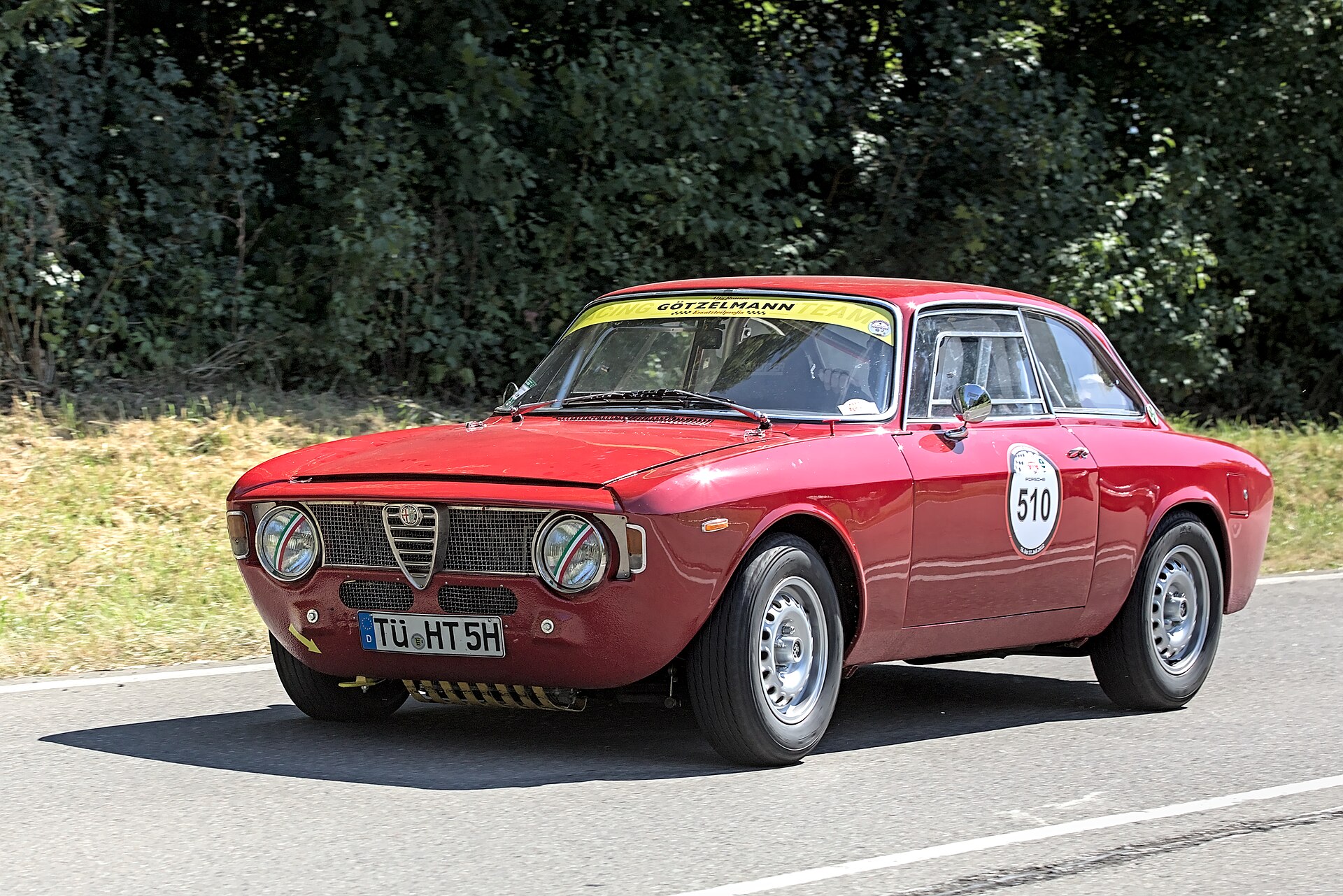
The Alfa Romeo Giulia GT is the family of Bertone coupés that Alfa Romeo built from 1963 to 1977 on a shortened Giulia floorpan, from the Giulia Sprint GT to the 2000 GT Veloce. Giorgetto Giugiaro drew the body, and twin-cam fours of 1.3 to 2.0 litres gave 66-97 kW (90-132 PS). The lightweight GTA won the European Touring Car Challenge three times.
In short
- Revealed on 9 September 1963 at the new Arese plant; Italian production ended in 1976, South African assembly in 1977.
- Main models: Sprint GT, GTC cabriolet, GTA, Sprint GT Veloce, GT 1300 and 1600 Junior, 1750 GT Veloce and 2000 GT Veloce.
- The GTA of 1965 used aluminium panels to cut dry weight to 745 kg; 500 were built up to 1969.
- More than 220,000 coupés were made, with the GT 1300 Junior the most numerous at 91,195.
Specs by version
Engines
| Version | Engine | Power | Gearbox | Drive | Production years |
|---|---|---|---|---|---|
| Giulia Sprint GT and GT Junior · GT 1300 Junior | 1.3 l · 4 cyl · Petrol 1,290 cc | 66 kW 90 PS89 hp | 5-sp Manual | Rear-wheel drive | 1965–1977 |
| Giulia Sprint GT and GT Junior · Giulia Sprint GT 1600 | 1.6 l · 4 cyl · Petrol 1,570 cc | 78 kW 106 PS105 hp | 5-sp Manual | Rear-wheel drive | 1963–1966 |
| Giulia Sprint GT and GT Junior · Giulia Sprint GTA | 1.6 l · 4 cyl · Petrol 1,570 cc | 85 kW 116 PS114 hp | 5-sp Manual | Rear-wheel drive | 1965–1969 |
| 1750 and 2000 GT Veloce · 1750 GT Veloce | 1.8 l · 4 cyl · Petrol 1,779 cc | 90 kW 122 PS121 hp | 5-sp Manual | Rear-wheel drive | 1967–1972 |
| 1750 and 2000 GT Veloce · 2000 GT Veloce | 2.0 l · 4 cyl · Petrol 1,962 cc | 97 kW 132 PS130 hp | 5-sp Manual | Rear-wheel drive | 1971–1976 |
Performance
Show all 4 versions
| Version | Top speed |
|---|---|
| Giulia Sprint GT and GT Junior · Giulia Sprint GT 1600 | 180 km/h112 mph |
| Giulia Sprint GT and GT Junior · Giulia Sprint GTA | 185 km/h115 mph |
| 1750 and 2000 GT Veloce · 1750 GT Veloce | 190 km/h118 mph |
| 1750 and 2000 GT Veloce · 2000 GT Veloce | 195 km/h121 mph |
Dimensions and weight
Show all 2 versions
| Version | Wheelbase | Kerb weight |
|---|---|---|
| Giulia Sprint GT and GT Junior · GT 1300 Junior | - | 930 kg2,050 lb |
| Giulia Sprint GT and GT Junior · Giulia Sprint GT 1600 | 2,350 mm92.5 in | - |
Verified Manufacturer and type-approval data from our catalog · Sources and methodology
Alfa Romeo Giulia GT at a glance
| Specification | Alfa Romeo Giulia GT (105/115 coupés) |
|---|---|
| Years | September 1963 to 1976 (Italy); to 1977 in South Africa |
| Production total | more than 220,000 by model tallies (see table) |
| Plants | Arese, Italy; also Setúbal, Portugal, and Rosslyn, South Africa |
| Body styles | 2+2 coupé; GTC cabriolet; Junior Z two-seater by Zagato |
| Design | Giorgetto Giugiaro at Bertone |
| Layout | front engine, rear-wheel drive, live rear axle on coil springs, five-speed gearbox |
| Engines | 1,290, 1,570, 1,779 and 1,962 cc twin-cam fours |
| Power | 66 kW (90 PS) GT 1300 Junior to 97 kW (132 PS) 2000 GT Veloce |
| Kerb weight | about 930-1,020 kg; GTA 745 kg dry |
| Top speed | over 170 km/h (1300 Junior) to over 195 km/h (2000 GTV) |
| 0-100 km/h | about 10 s (1750 GT Veloce, Italian Wikipedia) |
| Value today | GBP 35,000-40,000 for an average 1750 GTV in July 2026 (Octane) |
A shorter Giulia for the Arese plant
Alfa Romeo needed a successor for the Giulietta Sprint and chose to build it on the new Giulia saloon, cutting the wheelbase from 2,510 mm to 2,350 mm. Bertone's young designer Giorgetto Giugiaro reused ideas from his 2000 and 2600 Sprint and produced a four-seat coupé with a low waist and a large glass area. The Giulia Sprint GT was shown to the press on 9 September 1963 at Alfa's new Arese factory, appeared at Frankfurt three days later and reached customers in December.
Early cars are known in Italy as scalino, the step, because the leading edge of the bonnet sat about 1 cm above the nose. The 1,570 cc engine with two Weber 40 DCOE carburettors produced 78 kW (106 PS DIN), and Dunlop disc brakes were fitted to all four wheels. Quattroruote timed a Sprint GT at 181.9 km/h in December 1964.
Model by model from Sprint GT to 2000 GTV
Alfa changed the names more often than the body. The table uses the production tallies from English Wikipedia; Italian Wikipedia and other sources differ for several models.
| Model | Years | Engine | Power | Built |
|---|---|---|---|---|
| Giulia Sprint GT | 1963-1966 | 1,570 cc | 78 kW (106 PS) | 21,542 |
| Giulia Sprint GTC | 1964-1966 | 1,570 cc | as Sprint GT | about 1,000 |
| Giulia Sprint GTA | 1965-1969 | 1,570 cc | 85 kW (115 PS) | 500 |
| Sprint GT Veloce | 1965-1968 | 1,570 cc | 80 kW (109 PS) | 14,240 |
| GT 1300 Junior | 1965-1977 | 1,290 cc | 66 kW (90 PS) | 91,195 |
| 1750 GT Veloce | 1967-1972 | 1,779 cc | 90 kW (122 PS) | 44,269 |
| 2000 GT Veloce | 1971-1976 | 1,962 cc | 97 kW (132 PS) | 37,459 |
| GT 1600 Junior | 1972-1976 | 1,570 cc | 78 kW (106 PS) | 14,299 |
The GTC was a four-seat cabriolet built by Carrozzeria Touring in Milan until the coachbuilder closed. The 1750 GT Veloce of 1967 dropped the step front for a flush nose with four headlamps and moved to 14-inch wheels; its engine gave 186 Nm at 3,000 rpm. Alfa's production figure of 44,269 for the 1750 has been questioned, and one recalculation reaches 32,265. US-market cars had SPICA mechanical fuel injection, and the 2000 GT Veloce of 1971 brought a separate instrument binnacle. From 1974 the Junior was offered with 1.3 and 1.6 engines in a common range with the 2000.


GTA and the touring car titles
The GTA, for alleggerita or lightened, appeared in 1965. Its outer panels were Peraluman 25 aluminium, the side windows plastic, and the engine had two spark plugs per cylinder and Weber 45 carburettors. In road form it produced 85 kW (115 PS) and weighed 745 kg dry, against more than 900 kg for a Sprint GT.
Prepared by Autodelta, the racing GTA reached about 125 kW (170 PS) at 7,800 rpm and more than 220 km/h, and Alfa counts over 200 race wins in 1966 alone. Andrea de Adamich won the European Touring Car Challenge in 1966 and 1967, and Spartaco Dini took the 1969 title. The 1.3-litre GTA Junior followed in 1968. The GTAm of 1969-1971, about 40 cars built by Autodelta from the US 1750 with injection, gave up to 177 kW (240 PS), and Toine Hezemans won the 1970 European championship in one.

Giulia GT rivals and the 105 family
In Germany the two-door BMW 2002 offered similar performance from 1968 in a plainer body. Under the skin the coupé shared its twin-cam engines and five-speed gearbox with the Giulia saloon and the Pininfarina Alfa Romeo Spider, which outlived it by 16 years. The Zagato Junior Z of 1969, of which 1,117 were built with the 1.3 and 402 with the 1.6, used the same floorpan with a two-seat body by Ercole Spada.
Why the Giulia GT coupé ended in 1977
By the mid-1970s Alfa had the transaxle Alfetta GT, and the old coupé was reduced to the Junior and the 2000 GT Veloce. The last US-specification 2000 GTVs, model year 1974, were built in early 1975. Italian production ended in 1976, and South Africa assembled 25 more right-hand-drive 2000 GTVs into 1977. Alfa reused the name in 2003 for a Bertone-styled coupé, the Alfa Romeo GT, and the current range is in the Alfa Romeo catalogue.
Giulia GT today: what to check when buying
Corrosion is the biggest concern for Octane, and Hagerty puts it more bluntly: walk away from a car with rust where the rear trailing arms mount to the body. Also check the sills, footwells, wheel arches, door bottoms, the bottoms of the A-pillars, the screen surround, the radiator support, the spare-wheel well and the firewall.
Engine numbers identify the model: 00548 for a 1750 GTV and 00512 for a 2000, and engines were often swapped. Listen for timing-chain and tappet noise, and check the radiator cap for a pale residue that points to head gasket trouble. Almost all cars crunch on the 1-2 change when the oil is cold; jumping out of gear is a bigger job. Check the rubber driveshaft coupling, and use a specialist for SPICA injection. Trim and panels for the GTC and Junior Z are hard to find. A genuine GTA needs documented provenance, as Octane notes the large premium these cars command.
Values: in July 2026 Octane quoted the 1300 and 1600 Junior from the mid-GBP 20,000s to more than GBP 40,000, the 1750 GTV at GBP 35,000-40,000 for an average car and GBP 50,000-60,000 for an exceptional one, and the 2000 GTV at GBP 35,000-50,000. At about EUR 1.15 to the pound, an average 1750 GTV is roughly EUR 40,000-46,000 in July 2026.
Photo gallery

Alfa Romeo Giulia GT: first vs latest generation
| Spec | Giulia Sprint GT and GT Junior | 1750 and 2000 GT Veloce | Change |
|---|---|---|---|
| Years | 1963–1977 | 1967–1976 | 4 years apart |
| Most powerful version | 85 kW (116 PS) | 97 kW (132 PS) | +12 kW (+14%) |
| Top speed | 185 km/h | 195 km/h | +10 km/h |
Oldest and newest generation in the 1cars catalog. Power is the strongest version of each; other rows are shown only when both generations have the figure.
Alfa Romeo Giulia GT in our rankings
- No. 39 of 521 · Lightest cars (930 kg · top 8%)
- No. 14 of 114 · Lightest coupes (930 kg · top 14%)
- No. 330 of 1260 · Longest-running car nameplates (14 years · top 28%)
- No. 14 of 52 · Fastest cars of the 1960s (190 km/h · top 31%)
- No. 18 of 52 · Fastest cars of the 1970s (195 km/h · top 41%)
- No. 287 of 508 · Fastest cars (195 km/h · top 59%)
Lighter than 92% of ranked cars in the 1CARS catalog (No. 39 of 521).
FAQ
What does GTV mean on an Alfa Romeo?
GT Veloce, or fast Gran Turismo. On the 105 coupés it was used first for the 1965 Sprint GT Veloce with 80 kW (109 PS), then for the 1750 and 2000 GT Veloce, the two most powerful road versions with 90 kW and 97 kW.
How much is an Alfa Romeo Giulia GT worth?
An average 1750 GT Veloce was valued at GBP 35,000-40,000 by Octane in July 2026, about EUR 40,000-46,000. The 2000 GTV sat at GBP 35,000-50,000, Juniors from the mid-GBP 20,000s, and a documented GTA costs far more.
What is a step-front Alfa Romeo GT?
An early 105 coupé with the scalino nose, where the bonnet edge sits about 1 cm above the grille panel. It was used on the Sprint GT, GTC, GTA, Sprint GT Veloce and early GT 1300 Junior. The 1750 GT Veloce of 1967 introduced the flush nose.
How many Giulia GTA were made?
Alfa Romeo's heritage department gives 500 Giulia Sprint GTA built between 1965 and 1969. The later GTA 1300 Junior and the Autodelta GTAm, of which about 40 were built, are counted separately.
Which Giulia GT is best to buy?
Most buyers start with the 1750 GT Veloce, which has 90 kW (122 PS) and the flush four-lamp nose; Hagerty notes it is worth slightly more than a 2000 GTV. The GT 1300 Junior is the most plentiful, and the step-front cars appeal to originality-minded buyers.
Data sources
Data checked by an editor against the sources below.
- Wikipedia - 115 Series Coupés
- Heritagehubitaly - Alfa Romeo Giulia Sprint Gta


