 Alfa Romeo GT
Specs, engines and history
Published Sources (1) Report an error
By Felix Hartmann, Automotive Technology & EV Contributor
- Built
- 2003–2010
- Top power
- 177 kW (241 PS)
Which GT to buy
Our verdict · Felix Hartmann
- For economy: the 1.9 JTDm, ideally with the Q2 differential from late 2006, which also improves traction out of corners.
- For a balance of pace and cost: the 2.0 JTS, with 121 kW (165 PS) and a 0-100 km/h time of 8.7 s.
- For the sound: the 3.2 V6, the quickest GT at 6.7 s, and one of the last cars built with the Busso engine.
- For collectors: low-volume editions such as the Quadrifoglio Oro or the 100th Anniversary cars.
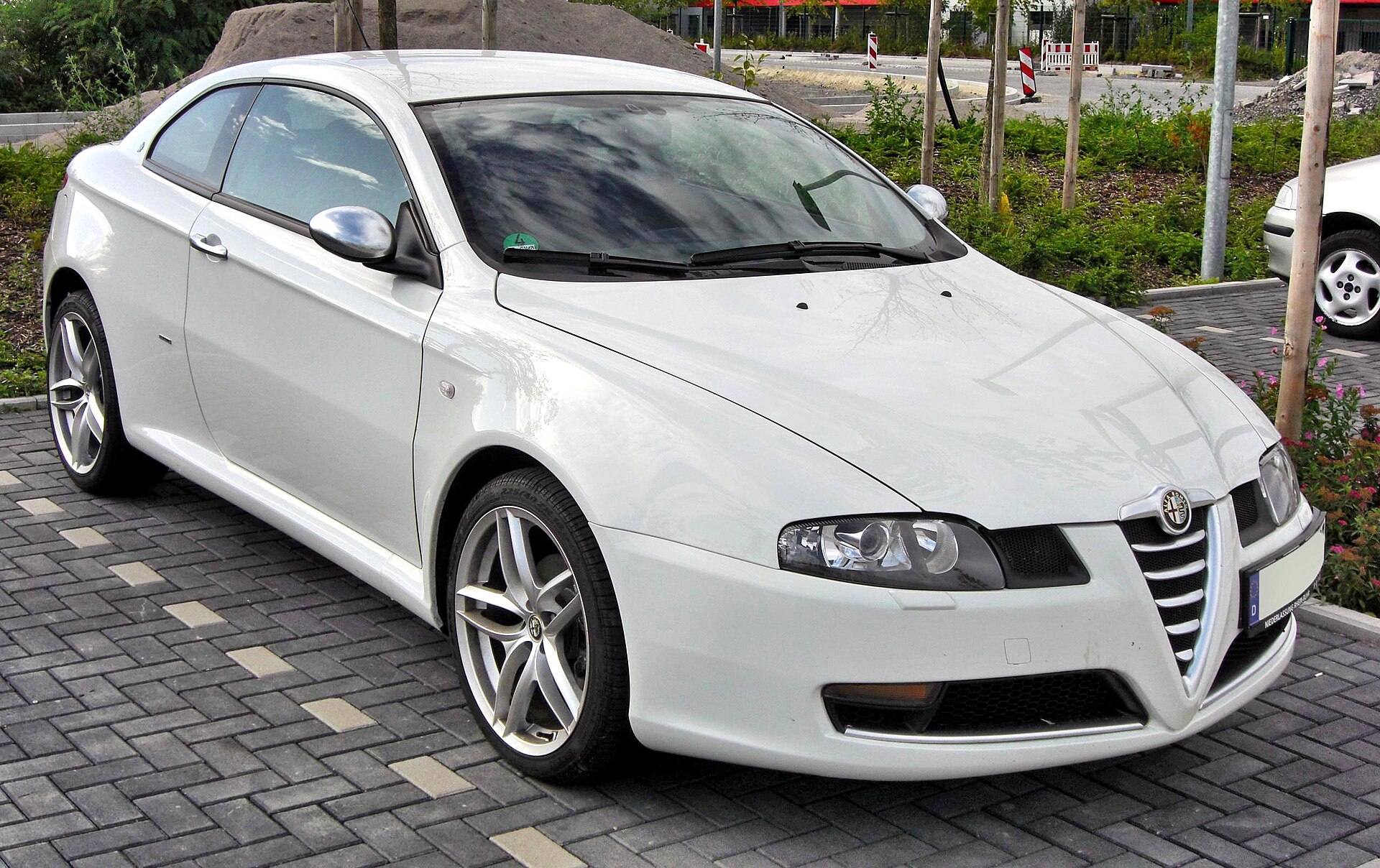
The Alfa Romeo GT is a front-wheel-drive coupé with two doors, a hatchback tailgate and a full rear bench for three. Bertone styled it, Alfa Romeo unveiled it at the Geneva Motor Show in March 2003, and Pomigliano d'Arco built 80,832 of them between November 2003 and 2010. Underneath, it is a 156 and 147 in a sharper suit, with engines from a 1.8 Twin Spark to the 3.2-litre Busso V6.
In short
- One generation (type 937), 2003-2010, three-door coupé with five seats, built at Pomigliano d'Arco, Italy.
- Engines from 103 kW (140 PS) in the 1.8 Twin Spark to 177 kW (240 PS) in the 3.2 V6; diesels with 110 or 125 kW (150 or 170 PS).
- 4,489 mm long, 320-litre boot that grows to 905 litres with the rear seats folded.
- Bertone's last design for Alfa Romeo; voted the world's most beautiful coupé in 2004.
Size at a glance
| Dimensions | Alfa Romeo GT (937) |
|---|---|
| Length | 4,489 mm176.7 in |
| Width | 1,763 mm69.4 in |
| Height | 1,362 mm53.6 in |
| Wheelbase | 2,596 mm102.2 in |
Specs by version
Engines
| Version | Engine | Power | Torque | Drive | Production years |
|---|---|---|---|---|---|
| Diesel · 1 version | |||||
| 1.9 JTDm 150 | 1.9 l · 4 cyl · Diesel 1,910 cc | 110 kW 150 PS148 hp | 305 Nm225 lb-ft | Front-wheel drive | 2003–2010 |
| Petrol · 3 versions | |||||
| 1.8 Twin Spark | 1.7 l · 4 cyl · Petrol 1,747 cc | 103 kW 140 PS138 hp | 163 Nm120 lb-ft | Front-wheel drive | 2003–2010 |
| 2.0 JTS | 2.0 l · 4 cyl · Petrol 1,970 cc | 121 kW 165 PS162 hp | 206 Nm152 lb-ft | Front-wheel drive | 2003–2010 |
| 3.2 V6 | 3.2 l · 6 cyl · Petrol 3,179 cc | 177 kW 241 PS237 hp | 300 Nm221 lb-ft | Front-wheel drive | 2003–2010 |
Performance
Show all 4 versions
| Version | 0–100 km/h | Top speed |
|---|---|---|
| Diesel · 1 version | ||
| 1.9 JTDm 150 | 9.2 s 0–62 mph | 209 km/h130 mph |
| Petrol · 3 versions | ||
| 1.8 Twin Spark | 10.6 s 0–62 mph | 200 km/h124 mph |
| 2.0 JTS | 8.7 s 0–62 mph | 216 km/h134 mph |
| 3.2 V6 | 6.7 s 0–62 mph | 243 km/h151 mph |
Dimensions and weight
Show all 4 versions
| Version | Height | Wheelbase |
|---|---|---|
| Diesel · 1 version | ||
| 1.9 JTDm 150 | 1,366 mm53.8 in | 2,596 mm102.2 in |
| Petrol · 3 versions | ||
| 1.8 Twin Spark | 1,362 mm53.6 in | 2,596 mm102.2 in |
| 2.0 JTS | - | 2,596 mm102.2 in |
| 3.2 V6 | 1,355 mm53.3 in | 2,596 mm102.2 in |
Verified Manufacturer and type-approval data from our catalog · Sources and methodology
Alfa Romeo GT at a glance
| Specification | Alfa Romeo GT |
|---|---|
| Segment | sports coupé |
| Body style | three-door coupé (hatchback), five seats |
| Production | 28 November 2003 - 2010 at Pomigliano d'Arco, Italy |
| Platform | Fiat C-platform (Type Two), shared with the 156 and 147 |
| Layout | front engine, front-wheel drive |
| Designer | Bertone |
| Total built | 80,832 |
| Predecessor | Alfa Romeo Sprint (in spirit) |
Bertone wanted to build the GT in its own factory, but Fiat refused, so production went to Pomigliano d'Arco next to the 147 and, later, the 159. The coupé shares its dashboard, climate control and much of the wiring with the 147 hatchback, and its bonnet, mirrors and front wings come from the 147 GTA. It sat beside the Brera in Alfa's range from 2005, the cheaper and more practical of the two. Other Alfa Romeo models are listed in our Alfa Romeo catalogue.
Generations and model history
The GT had one generation. Changes during production were small and mostly limited to new engines, a limited-slip differential and special editions.
| Generation | Code | Years | Body styles | Engines | Power (kW / hp) |
|---|---|---|---|---|---|
| GT | 937 | 2003-2010 | three-door coupé | 1.8 TS, 2.0 JTS, 3.2 V6, 1.9 JTDm | 103-177 kW (140-240 PS) |
- March 2003: public debut at Geneva; production starts on 28 November 2003.
- October 2006: the 1.9 JTD Q2 arrives with the Q2 limited-slip differential, meant to reduce understeer and torque steer, along with a new Black Line trim.
- 2008: the limited Cloverleaf edition with a body kit, lowered suspension and 18-inch wheels, offered with the 1.8, 2.0 and 1.9 JTDm.
- 2010: production ends on 16 June 2010. The last GT built was a Quadrifoglio Oro for Japan, one of 60 with the 2.0 JTS and Selespeed.
Bertone also developed a four-seat GT Cabrio in 2003. It never reached production and was shown publicly only on 6 April 2011.

Engines, gearboxes and performance
| Engine | Power | Torque | 0-100 km/h | Top speed |
|---|---|---|---|---|
| 1.8 Twin Spark 16V | 103 kW (140 PS) | 163 Nm | 10.6 s | 200 km/h |
| 2.0 JTS (direct injection) | 121 kW (165 PS) | 206 Nm | 8.7 s | 216 km/h |
| 3.2 V6 24V (Busso) | 177 kW (240 PS) | 300 Nm | 6.7 s | 243 km/h |
| 1.9 JTDm 16V | 110 kW (150 PS) | 305 Nm | 9.2 s | 209 km/h |
| 1.9 JTDm 16V | 125 kW (170 PS) | 330 Nm | 8.2 s | 216 km/h |
The V6 belongs to Giuseppe Busso's engine family, first built in 1979. The 3,179 cc version was used in the 156 GTA, 147 GTA, GTV and Spider, the 166 and the Lancia Thesis as well; in the GT it is rated at 177 kW (240 PS), against 184 kW (250 PS) in the 156 GTA. Wikipedia's table lists the 1.8 Twin Spark at 1,747 cc.
Three gearboxes were offered: a five-speed manual, a six-speed manual and the five-speed Selespeed automated manual. Front suspension uses double wishbones and the rear is a MacPherson-type layout with parallel arms. The standard brakes are 284 mm ventilated discs at the front and 276 mm discs at the rear; the V6 gets 330 mm front discs. Need the hp figures in kW? Use the power converter.


Dimensions, space and practicality
| Parameter | Metric | Imperial |
|---|---|---|
| Length | 4,489 mm | 176.7 in |
| Width | 1,763 mm | 69.4 in |
| Height | 1,355-1,366 mm | 53.3-53.8 in |
| Wheelbase | 2,596 mm | 102.2 in |
| Kerb weight | 1,395-1,485 kg | 3,075-3,274 lb |
| Boot | 320 l (905 l seats folded) | 11.3 cu ft (32.0 cu ft) |
The GT is a genuine five-seater rather than a 2+2: the rear bench is full width. The V6 sits lowest at 1,355 mm, the diesel highest at 1,366 mm. With a 320-litre boot and a split-folding rear seat, it is more practical than most coupés of its time, and roomier in the back than the later Brera, a 2+2. Check whether it fits your space with our garage fit tool.
Fuel economy and running costs
| Engine | Urban | Extra-urban | Combined |
|---|---|---|---|
| 1.8 TS | 12.1 l/100 km | 6.4 l/100 km | 8.5 l/100 km |
| 2.0 JTS | 12.2 l/100 km | 6.7 l/100 km | 8.7 l/100 km |
| 3.2 V6 | 18.6 l/100 km | 8.7 l/100 km | 12.4 l/100 km |
| 1.9 JTDm 110 kW (150 PS) | 8.2 l/100 km | 4.8 l/100 km | 6.1 l/100 km |
| 1.9 JTDm 125 kW (170 PS) | 8.7 l/100 km | 4.8 l/100 km | 6.2 l/100 km |
The diesels are the clear choice for high mileage: 6.1 l/100 km combined is half of the V6's 12.4 l/100 km, and in town the gap is even bigger. The 2.0 JTS uses slightly more fuel than the 1.8 Twin Spark in the official test while being quicker by almost two seconds to 100 km/h.
Trims and equipment
Standard equipment included power steering, dual-zone climate control, a trip computer, cruise control, heated mirrors and six airbags, among them curtain airbags. Options included rear parking sensors, heated seats, leather, a 10-CD changer, satellite navigation and rain-sensing wipers. Market editions were plentiful: the Black Line from 2006, the 2008 Cloverleaf, a UK Special Edition 1.9 JTDm with leather and the Q2 differential, a French Centenario with a rear camera and Blue&Me, a Dutch Run Out Edition of only 12 cars, and a 100th Anniversary Limited Edition of 130 V6 cars for Australia and South Africa.

Safety
ABS with brake force distribution and hydraulic brake assist was standard, while VDC stability control and ASR traction control were available. We found no Euro NCAP test of the GT itself in the sources used; it shares its platform with the 147 and 156. For crash-test results of other cars, see our safety section.
Reliability and known issues
The sources we used do not list documented faults or recalls specific to the GT, so we do not repeat anecdotal claims. As a used car, it shares most mechanical parts with the 147 and 156, which keeps parts supply straightforward.
Rivals
| Model | Body | Why it competes |
|---|---|---|
| Mazda RX-8 | four-door coupé | a similarly priced sporty coupé of the same years |
| BMW 3 Series Coupé (E46) | two-door coupé | the obvious German alternative to the V6 |
| Alfa Romeo Brera | 2+2 coupé | the larger, heavier and pricier in-house option from 2005 |
| Alfa Romeo 147 | three- and five-door hatchback | the same mechanicals and dashboard in a cheaper body |
Photo gallery

Alfa Romeo GT in our rankings
- No. 119 of 376 · Fastest cars (243 km/h · top 32%)
- No. 39 of 99 · Smallest coupes (4,489 mm · top 40%)
- No. 272 of 627 · Biggest engines: cars (3,179 cc · top 44%)
- No. 241 of 531 · Smallest cars (4,489 mm · top 46%)
- No. 27 of 58 · Quickest cars of the 2000s, 0–100 (6.7 s · top 47%)
- No. 26 of 56 · Fastest cars of the 2000s (243 km/h · top 47%)
Faster than 68% of ranked cars in the 1CARS catalog (No. 119 of 376).
FAQ
How many Alfa Romeo GTs were built?
Pomigliano d'Arco built 80,832 cars between November 2003 and June 2010.
Who designed the Alfa Romeo GT?
Bertone. It was the last Bertone design for Alfa Romeo, and it won the 2004 award for the world's most beautiful coupé.
Does the Alfa Romeo GT have a V6?
Yes. The 3.2-litre Busso V6 produces 177 kW (240 PS) and 300 Nm, enough for 0-100 km/h in 6.7 seconds and 243 km/h.
How big is the boot of the Alfa Romeo GT?
320 litres, or 905 litres with the rear seats folded.
Is the Alfa Romeo GT a four-seater?
It has five seats: two in the front and a full rear bench, not two individual rear seats.
Data sources
Data checked by an editor against the sources below.