 Alfa Romeo Stelvio
Specs, engines and history
Published Report an error
By Felix Hartmann, Automotive Technology & EV Contributor
Which Stelvio to buy - verdict
Our verdict · Felix Hartmann
- For long distances: the 2.2 diesel with 140 or 154 kW and Q4, with official consumption below 5 l/100 km.
- For balanced performance: the 2.0 petrol with 206 kW (280 PS) and Q4, 0–100 km/h in 5.7 seconds.
- For enthusiasts: the Quadrifoglio with the Ferrari-developed V6, one of the fastest SUVs around the Nürburgring.
- For the latest equipment: a 2023 facelift car with the "3+3" headlamps and the digital instrument cluster.
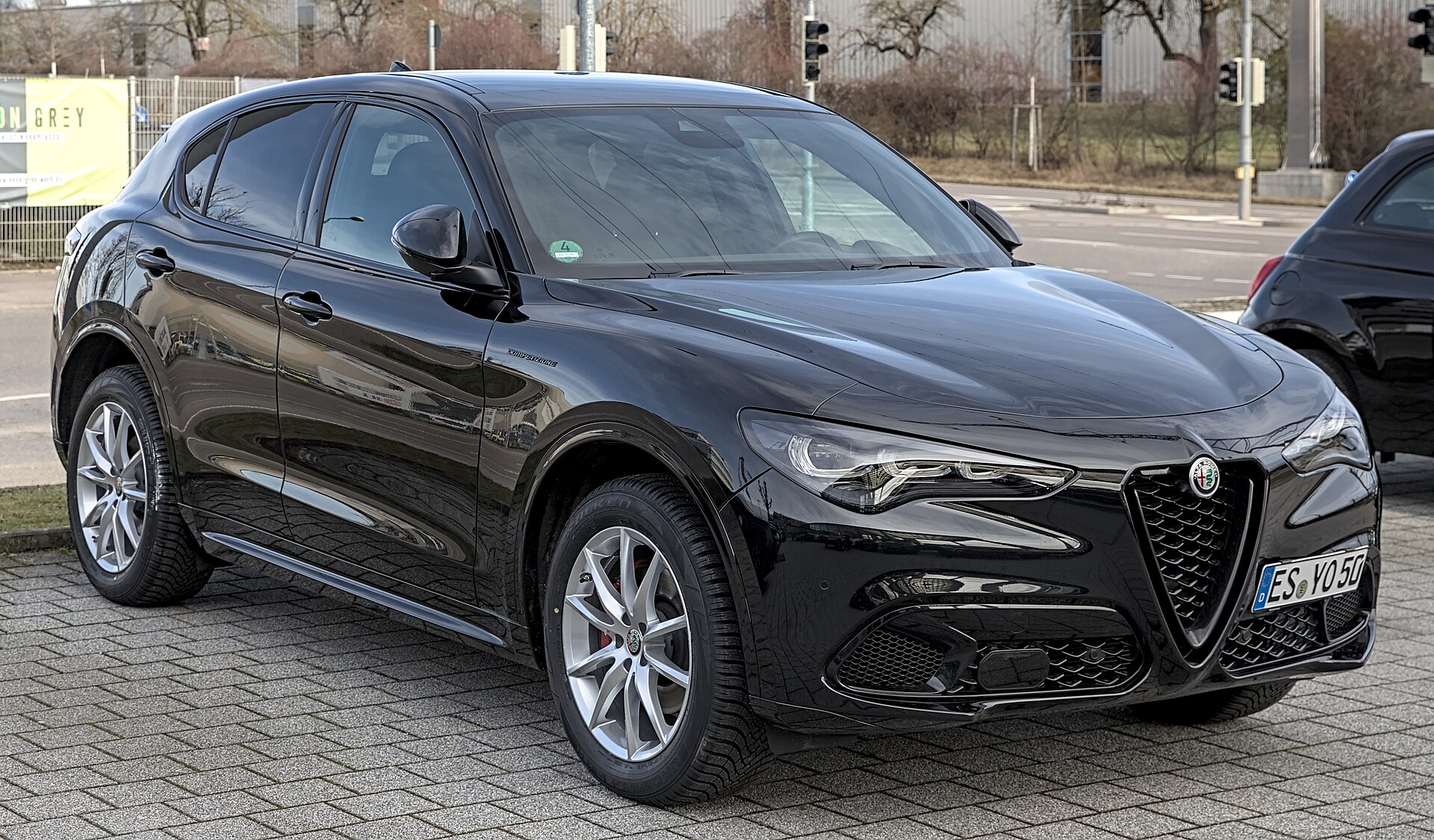
The Alfa Romeo Stelvio is a mid-size premium SUV that Alfa Romeo has built at its Cassino plant in Italy since late 2016. It was the brand's first production SUV and shares the rear-drive Giorgio platform with the Giulia saloon, raised for more ground clearance. The Stelvio is named after an Alpine pass and uses four-cylinder petrol and diesel engines. The Quadrifoglio adds a Ferrari-developed 2.9-litre twin-turbo V6, which set an SUV lap record at the Nürburgring in 2017.
In short
- Type 949, built in Cassino since 2016; shown at the Los Angeles motor show on 16 November 2016, European premiere at Geneva in 2017.
- Giorgio platform with rear-wheel drive or Q4 all-wheel drive, ZF eight-speed automatic and 50/50 weight distribution.
- Engines from 110 kW (150 PS) 2.2 diesel to 375 kW (510 PS) 2.9 V6 in the Quadrifoglio; 382 kW (520 PS) after the 2023 update.
- Euro NCAP five stars (2017) with 97% for adult occupant protection.
Alfa Romeo Stelvio at a glance
| Specification | Alfa Romeo Stelvio |
|---|---|
| Segment | D-segment premium crossover SUV |
| Production | since late 2016 (model year 2017 on) |
| Plant | Cassino, Piedimonte San Germano (Lazio, Italy) |
| Platform | Giorgio, shared with the Giulia (Type 952) |
| Body style | five-door SUV |
| Drive | rear-wheel drive or Q4 all-wheel drive |
| Gearbox | ZF 8HP eight-speed automatic |
| Power range | 110–382 kW (150–520 PS) |
| Boot | 525 l |
| Designer | Carmelo Giannone, Centro Stile Alfa Romeo |
The Stelvio is listed in our Alfa Romeo catalogue. Its technical twin, the saloon, is covered in the Alfa Romeo Giulia (952) guide.
Alfa Romeo's first SUV
Alfa Romeo had experimented with off-road and SUV ideas before - the 1950s Matta military vehicle and the 2003 Kamal concept - but the Stelvio was its first production SUV. The Quadrifoglio version was unveiled first, at the Los Angeles motor show on 16 November 2016, and European versions followed at the Geneva Motor Show in March 2017. German orders opened on 18 January 2017 with a First Edition model. It had the 206 kW (280 PS) petrol engine, all-wheel drive and the automatic gearbox, and cost from €56,000 in 2017.
The name comes from the Stelvio Pass, Italy's highest mountain pass, famous for its 48 hairpin bends. Production started at the end of 2016 in Cassino, the same plant that builds the Giulia.
Platform, chassis and technology
The Giorgio platform was designed for rear-wheel drive. For the Stelvio it was raised by 22 cm, and the front track grew by 5.4 cm and the rear by 2.9 cm compared with the Giulia. The suspension uses double wishbones at the front and an aluminium multi-link design at the rear (AlfaLink). Alfa Romeo used aluminium for body panels, suspension, brakes and engines, and a carbon-fibre propeller shaft, to reach a 50/50 weight distribution and a drag coefficient of 0.32.
Rear-wheel drive is standard; the optional Q4 all-wheel-drive system can send up to 50% of the torque to the front axle. All Stelvios use ZF eight-speed automatics: the 8HP50 in the regular models and the stronger 8HP75 in the Quadrifoglio.

Engines, transmissions and performance
| Engine | Displacement | Power | Torque | 0–100 km/h | Top speed |
|---|---|---|---|---|---|
| 2.0 turbo petrol | 1,995 cc | 147 kW (200 PS) | 330 Nm | 7.2 s | 215 km/h |
| 2.0 turbo petrol | 1,995 cc | 206 kW (280 PS) | 400 Nm | 5.7 s | 230 km/h |
| 2.2 Multijet II diesel | 2,143 cc | 110 kW (150 PS) | 450 Nm | 8.8 s | 198 km/h |
| 2.2 Multijet II diesel | 2,143 cc | 132 kW (180 PS) | 450 Nm | 7.6 s | 210 km/h |
| 2.2 Multijet II diesel Q4 | 2,143 cc | 154 kW (210 PS) | 470 Nm | 6.6 s | 215 km/h |
| 2.9 V6 biturbo (Quadrifoglio) | 2,891 cc | 375 kW (510 PS) | 600 Nm | 3.8 s | 283 km/h |
For the 2019 model year the diesels were updated to Euro 6d with AdBlue. The 110 kW (150 PS) and 132 kW (180 PS) versions gained about 7 kW (10 PS) each, becoming 118 kW (160 PS) and 140 kW (190 PS). From 2020 a 184 kW (250 PS) version of the 2.0 petrol was added for Italy, where it stays below the "superbollo" tax threshold. In the US, the 2.0 Q4 is rated at 209 kW (280 hp) and 24 mpg combined, the Quadrifoglio at 377 kW (505 hp) and 19 mpg.
Stelvio Quadrifoglio
The Quadrifoglio uses the 2.9-litre 90-degree twin-turbo V6 (engine 690T) developed with Ferrari and the stronger 8HP75 automatic gearbox. With 375 kW (510 PS) and 600 Nm it reaches 100 km/h in 3.8 seconds and 283 km/h. On 29 September 2017 a Stelvio Quadrifoglio lapped the Nürburgring Nordschleife in 7 minutes 51.7 seconds, the fastest time for a production SUV at that point.
Wikipedia DE reports that the Quadrifoglio was raised to 382 kW (520 PS) in the update of April 2023. Wikipedia EN lists 382 kW (520 PS) only for limited editions such as the 2019 Alfa Romeo Racing (about 15 cars). Other special editions included the NRING of 2018 (108 cars, carbon-ceramic brakes, Sparco seats) and the Quadrifoglio 100th Anniversary model after the 2023 facelift.


Dimensions, interior space and boot capacity
| Parameter | Metric | Imperial |
|---|---|---|
| Length | 4,687 mm | 184.5 in |
| Width (without mirrors) | 1,903 mm | 74.9 in |
| Height | 1,648 mm | 64.9 in |
| Wheelbase | 2,818 mm | 110.9 in |
| Boot | 525 l | 18.5 cu ft |
| Kerb weight, 2.0 Q4 | 1,831 kg | 4,037 lb |
| Kerb weight, Quadrifoglio | 1,955 kg | 4,310 lb |
| Drag coefficient | 0.32 | - |
Wikipedia's text also quotes a lighter 1,660 kg "with all fluids" and claims the Stelvio was 145 kg lighter than a BMW X3. The table uses the more conservative infobox figures.
Fuel economy and facelifts
Official combined consumption in Europe was 7.0 l/100 km (about 34 mpg US) for the 2.0 petrol versions. The diesels were rated at 4.7 l/100 km (50 mpg US) with 110 kW and 4.8 l/100 km with 132 kW and Q4.
The first update, shown in China in 2020, brought an 8.8-inch touchscreen with Wi-Fi hotspot and over-the-air updates, an integrated emergency call, revised interior materials and a new steering wheel. The 2023 facelift (model year 2024 in the US) introduced "3+3" headlamps, a new grille, sequential indicators, new tail lamps and a 12.3-inch digital instrument cluster with three display themes.

Safety ratings
Euro NCAP tested the Stelvio in July 2017 and awarded five stars: 97% for adult occupant protection, 84% for child occupants, 71% for pedestrian protection and 60% for safety assist. Autonomous emergency braking is standard.
Sales and rivals
Sales peaked early. In Europe Alfa Romeo sold 17,159 Stelvios in 2017 and 30,099 in 2018, falling to 16,650 in 2021. In the US the best year was 2018 with 12,043 cars; by 2024 sales had dropped to 3,162. The Stelvio was a Car and Driver Editors' Choice in 2018 and What Car? Performance SUV of the Year in 2019.
Alfa Romeo compared the Stelvio's weight with the BMW X3 and the four-cylinder Porsche Macan, its most obvious rivals. You can put them side by side in our comparison tool or search premium SUVs by size in the car finder.
Photo gallery


FAQ
How many generations of the Alfa Romeo Stelvio are there?
One so far. The Stelvio (Type 949) has been built since 2016, updated in 2020 and facelifted in 2023.
Is the Stelvio available with all-wheel drive?
Yes. Rear-wheel drive is standard and Q4 all-wheel drive is available; it can send up to 50% of the torque to the front axle.
What is the fuel consumption of the Stelvio?
Official combined figures are about 4.7–4.8 l/100 km for the diesels and 7.0 l/100 km for the 2.0 petrol engines.
How fast is the Stelvio Quadrifoglio?
It has 375 kW (510 PS), reaches 100 km/h in 3.8 seconds and 283 km/h, and lapped the Nürburgring in 7:51.7 in 2017.