 Alfa Romeo Giulia
Specs, engines and history
Published Sources (2) Report an error
By Felix Hartmann, Automotive Technology & EV Contributor
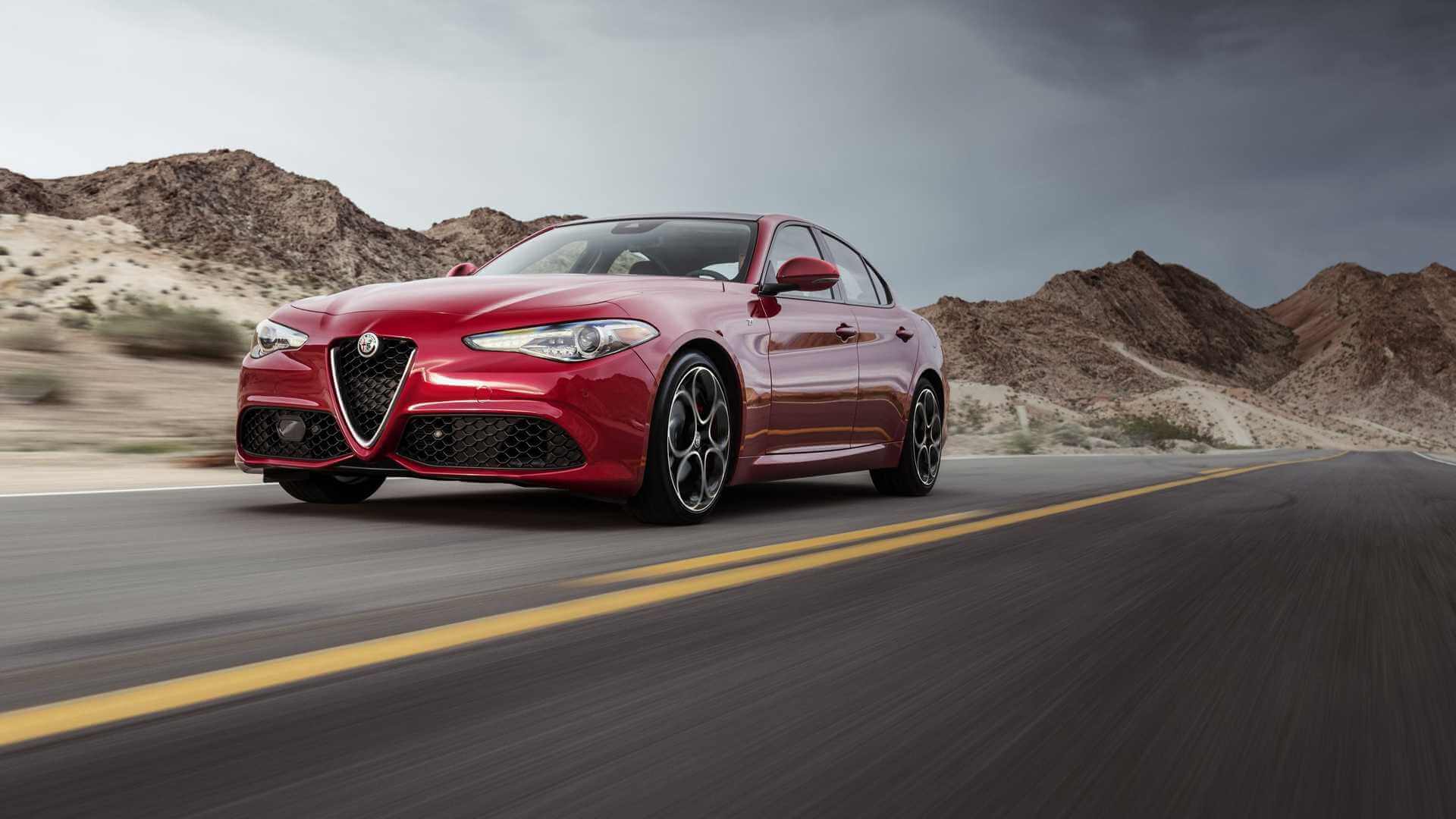
The Alfa Romeo Giulia (Type 952) is a premium D-segment sports saloon. The name goes back to the original Giulia of 1962, which stayed in production for 16 years. The new Giulia was unveiled on 24 June 2015 at the Alfa Romeo museum in Arese near Milan — directly in its top Quadrifoglio form, to mark the brand's 105th anniversary — and the regular versions were unveiled at the Geneva motor show in March 2016. It filled the gap left by the Alfa Romeo 159, whose production ended in 2011, and marked Alfa Romeo's return to the premium D segment.
In short
- Built at Cassino, Italy, since April 2016 on the new rear-wheel-drive Giorgio platform with near 50/50 weight distribution.
- Engines: 2.0 turbo petrol with 147 or 206 kW (200 or 280 PS), 2.2 diesel with 100–154 kW (136–210 PS) and the Quadrifoglio's 2.9 V6 twin-turbo with 375 kW (510 PS), later 382 kW (520 PS).
- Eight-speed ZF automatic as standard; Q4 all-wheel drive on most versions.
- Five Euro NCAP stars with a 98% adult-occupant score; 480-litre boot.
Alfa Romeo Giulia at a glance
The Giulia is a four-door saloon with a longitudinal front engine, rear-wheel drive as standard and optional Q4 all-wheel drive. Extensive use of aluminium and carbon fibre keeps kerb weight between about 1,374 and 1,530 kg depending on version. More Alfa Romeo models are listed in our Alfa Romeo catalogue.
Exterior
The Giulia looks aggressive and modern while keeping the brand's signature style. The bonnet is deeply sculpted, the slim headlights and daytime running lights use LEDs, and the trademark triangular grille has a chrome surround. The large front bumper improves aerodynamics and has big intakes to cool the engine and brakes. In profile, strong door creases, elegant lines, classic sports-saloon proportions with short overhangs and a "floating" roof on slim pillars stand out; some see a resemblance to the BMW 4 Series. Ground clearance is only 100 mm, which sharpens handling but can make some obstacles awkward. Base cars ride on 16-inch wheels, with 17- to 19-inch alloys on other versions. The drag coefficient is 0.28 for the standard car and 0.31 for the Quadrifoglio.
The regular Giulia has simpler bumpers, a bonnet without vents, no rear spoiler or large diffuser, smaller wheels, narrower wings without side vents and twin exhaust outlets. The Quadrifoglio adds a carbon-fibre bonnet and roof, a carbon boot spoiler, a large diffuser and four exhaust outlets.
Interior
The cabin uses soft plastics, leather, brushed aluminium and carbon fibre. A compact three-spoke multifunction steering wheel with a red start button faces sporty instruments with large dials and a 7-inch trip-computer display between them. The front seats sit low, with good side support, many electric adjustments and good comfort; firmer sports bucket seats are optional. Metal pedals and sill plates and turbine-like air vents add to the sporting feel. The centre console is angled towards the driver, with an 8.4-inch infotainment screen (touch-operated after the 2020 update), rectangular vents below and most controls moved to the carbon-trimmed tunnel, where three rotary controllers handle the DNA drive modes, audio volume and infotainment next to the gear selector.
The rear is roomy enough for a D-segment car, though tall passengers will find headroom tight, and the bench is shaped for two. Two round air vents serve the rear. The boot holds 480 litres and can be extended by folding the split rear backrest; a space-saver spare sits under the floor.
Engines and transmissions
| Engine | Fuel | Power (kW / PS) | Torque |
|---|---|---|---|
| 2.0 turbo I4 | Petrol | 147 kW / 200 PS | 330 Nm |
| 2.0 turbo I4 | Petrol | 206 kW / 280 PS | 400 Nm |
| 2.2 turbo I4 | Diesel | 100–154 kW / 136–210 PS | 450 Nm (110 and 132 kW versions) |
| 2.9 V6 twin-turbo (Quadrifoglio) | Petrol | 375 kW / 510 PS (later 382 kW / 520 PS) | 600 Nm |
| 2.9 V6 twin-turbo (GTA/GTAm) | Petrol | 397 kW / 540 PS | — |
The 2.2 diesel was offered with 100, 110, 118, 132, 140 and 154 kW (136, 150, 160, 180, 190 and 210 PS); the 110 and 132 kW versions gained 7 kW (10 PS) for 2019. The aluminium Quadrifoglio V6 has direct injection and cylinder deactivation. Published figures give combined consumption of about 5.9 l/100 km for the 147 kW (200 PS) petrol, 4.2 l/100 km for the diesel and 8.2 l/100 km for the Quadrifoglio. The Alfa DNA selector offers Natural, Dynamic and Advanced Efficient modes, plus Race on the Quadrifoglio.
An eight-speed ZF automatic is standard; a six-speed manual was offered in Europe, including on the Quadrifoglio. Q4 all-wheel drive, available on all versions except the Quadrifoglio, sends all torque to the rear wheels in normal driving and up to 60% to the front when grip is lost. 0–100 km/h takes 3.9 seconds in the Quadrifoglio, and top speeds range from 220 to 307 km/h depending on version. In September 2016 the Quadrifoglio lapped the Nürburgring Nordschleife in 7:32 with the automatic gearbox.
Chassis
The Giorgio platform uses aluminium for the shock towers, suspension parts, front wings and doors, and every Giulia has a carbon-fibre driveshaft. Front suspension uses double wishbones and the rear a multi-link set-up, tuned for sporty handling. Steering has electric assistance, and the brakes are discs all round (ventilated at the front). Performance versions use the electromechanical Integrated Brake System, optional carbon-ceramic discs and an active rear differential with torque vectoring.
Facelifts and special versions
A 2020 update brought a redesigned centre console and a touchscreen infotainment system. For 2022 the range was revised, with the Ti Sport renamed Veloce. A facelift announced in late 2022 added LED matrix headlights and a 12.3-inch digital instrument cluster, and raised the Quadrifoglio to 382 kW (520 PS). The GTA and GTAm, announced on 2 March 2020, produce 397 kW (540 PS) and were limited to 500 units in total; they weigh 1,605 kg and 1,580 kg respectively and reach 100 km/h in 3.6 seconds.
Safety and equipment
Euro NCAP awarded the Giulia five stars in June 2016, with 98% for adult-occupant protection. Equipment includes stability control, Pre-Fill brake preparation, ABS, Hill Holder, autonomous emergency braking, lane-departure warning, driver attention monitoring, blind-spot monitoring, surround cameras, six airbags as standard, belts with pretensioners and ISOFIX anchorages. Base versions have 16-inch wheels, dual-zone climate control, a colour infotainment screen, a premium audio system and bi-xenon headlights; the Quadrifoglio adds LED headlights, leather with aluminium and carbon trim, keyless entry, rain and light sensors and navigation.
Key specifications
| Parameter | Value |
|---|---|
| Unveiled | 24 June 2015, Arese |
| Production | From April 2016, Cassino, Italy |
| Platform | Giorgio |
| Power (kW / PS) | 100–397 kW / 136–540 PS |
| Gearbox | 8-speed ZF automatic (6-speed manual in Europe) |
| Drive | Rear or Q4 all-wheel drive |
| Ground clearance | 100 mm |
| Boot | 480 l |
| Euro NCAP | 5 stars (2016) |
Strengths and weaknesses
Owners like the Giulia's modern looks, handling, strong engines, performance, fuel economy, sound insulation and quality of materials. Drawbacks include a modest boot, limited rear space and weaker resale values than its German rivals. The main rivals are the Audi A4, BMW 3 Series, Jaguar XE and Mercedes-Benz C-Class.
Alfa Romeo Giulia in our rankings
- No. 381 of 912 · Longest-running car nameplates (10 years · top 43%)
- No. 158 of 305 · Oldest car models still on sale (10 years · top 55%)
In production longer than 57% of ranked nameplates in the 1CARS catalog (No. 381 of 912).
FAQ
When was the new Alfa Romeo Giulia launched?
It was unveiled on 24 June 2015 in Arese, and production began at Cassino in April 2016.
How powerful is the Alfa Romeo Giulia Quadrifoglio?
Its 2.9-litre twin-turbo V6 produces 375 kW (510 PS), raised to 382 kW (520 PS) with the later facelift; the GTA and GTAm have 397 kW (540 PS).
Does the Alfa Romeo Giulia have all-wheel drive?
Yes, Q4 all-wheel drive is available on all versions except the Quadrifoglio.
How safe is the Alfa Romeo Giulia?
It earned five Euro NCAP stars in 2016, with 98% for adult-occupant protection.
Data sources
Data checked by an editor against the sources below.
- Wikipedia — Alfa Romeo Giulia (952)
- Motoringresearch — The Safest New Cars Of 2016