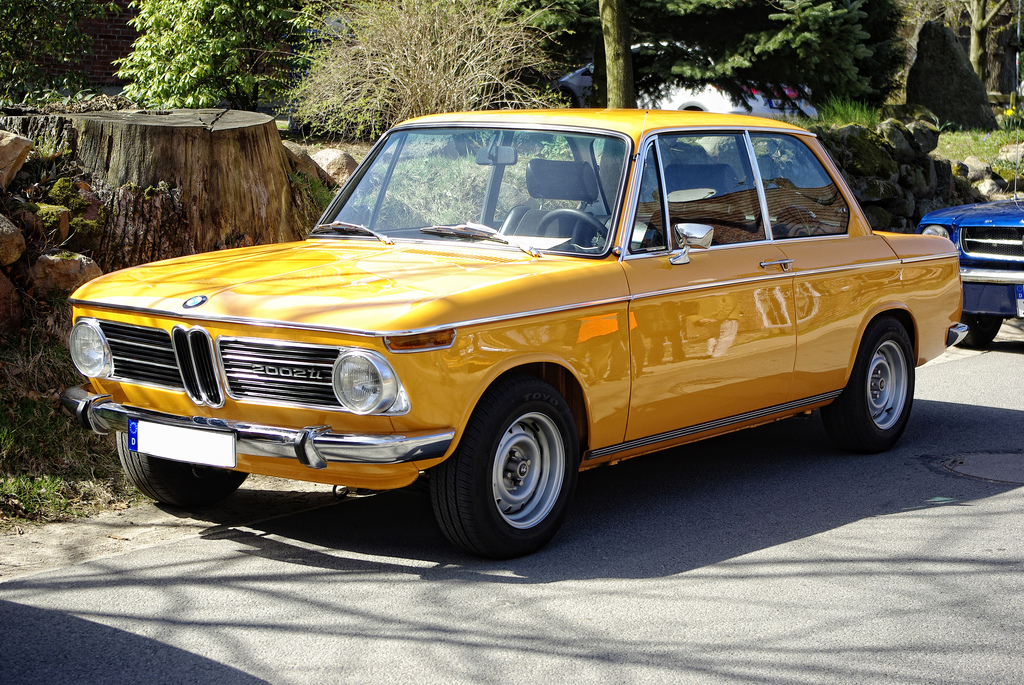
 BMW 2002
Specs, engines and history
Published Sources (1) Report an error
By Felix Hartmann, Automotive Technology & EV Contributor
- Built
- 1968–1975
- Top power
- 125 kW (170 PS)
Which 2002 to choose
Our verdict · Felix Hartmann
- For everyday classic driving: a standard 2002, the most common version with the simplest single-carburettor engine.
- For the best road car of the range: the tii, with injection, stronger brakes and 96 kW.
- For a collector's piece: the Turbo (1,672 built) or a tii Touring (422 built).
- For open-air use: the 2002 Baur Cabriolet, of which 2,517 were made.
- To compare it with later classics: our comparison tool sets the 2002 against other cars of the period.
The BMW 2002 is the two-litre version of BMW's compact two-door 02 Series saloon, built from 1968 to 1975. It grew out of an engine swap two BMW managers made in their own cars and a request from BMW's American importer, and it set the pattern for the 3 Series that replaced it. Versions ran from the 74 kW single-carburettor car to the 125 kW 2002 Turbo of 1973, the first BMW with a turbocharger.
In short
- Two-door saloon built 1968–1975 in Munich, with a Touring hatchback (1971–1974) and a Baur Cabriolet (1971–1975).
- 1,990 cc M10 four-cylinder: 74 kW (100 PS) as the 2002, 88 kW (120 PS) as the ti, 96 kW (130 PS) as the fuel-injected tii.
- 2002 Turbo (1973–1975): 125 kW (170 PS), 240 Nm and 211 km/h; only 1,672 built.
- Replaced by the E21 3 Series in 1975.
Specs by version
Engines
| Version | Engine | Power | Drive | Production years |
|---|---|---|---|---|
| 2002 | 2.0 l · 4 cyl · Petrol 1,990 cc | 74 kW 101 PS99 hp | Rear-wheel drive | 1968–1975 |
| 2002 Touring | 2.0 l · 4 cyl · Petrol M10 | 74 kW 101 PS99 hp | Rear-wheel drive | 1971–1974 |
| 2002 Cabriolet (Baur) | 2.0 l · 4 cyl · Petrol M10 | 74 kW 101 PS99 hp | Rear-wheel drive | 1971–1975 |
| 2002 ti | 2.0 l · 4 cyl · Petrol M10 | 88 kW 120 PS118 hp | Rear-wheel drive | — |
| 2002 tii | 4 cyl · Petrol | 96 kW 131 PS129 hp | Rear-wheel drive | 1971–1975 |
| 2002 tii Touring | 2.0 l · 4 cyl · Petrol M10 | 96 kW 131 PS129 hp | Rear-wheel drive | 1971–1974 |
| 2002 Turbo (E20) | 2.0 l · 4 cyl · Petrol 1,990 cc | 125 kW 170 PS168 hp | Rear-wheel drive | 1973–1975 |
Performance
Show all 2 versions
| Version | Top speed |
|---|---|
| 2002 tii | 185 km/h115 mph |
| 2002 Turbo (E20) | 211 km/h131 mph |
Dimensions and weight
Show all 7 versions
| Version | Wheelbase |
|---|---|
| 2002 | 2,500 mm98.4 in |
| 2002 Touring | 2,500 mm98.4 in |
| 2002 Cabriolet (Baur) | 2,500 mm98.4 in |
| 2002 ti | 2,500 mm98.4 in |
| 2002 tii | 2,500 mm98.4 in |
| 2002 tii Touring | 2,500 mm98.4 in |
| 2002 Turbo (E20) | 2,500 mm98.4 in |
Verified Manufacturer and type-approval data from our catalog · Sources and methodology
BMW 2002 at a glance
| Parameter | Value |
|---|---|
| Production | 1968–1975 |
| Series | BMW 02 Series (1966–1977) |
| Bodies | two-door saloon, three-door Touring, cabriolet |
| Engine | M10 four-cylinder, 1,990 cc |
| Power | 74–125 kW (100–170 PS) |
| Gearboxes | 4-speed manual; 5-speed manual (option); 3-speed ZF automatic from 1969 |
| Kerb weight | 940–1,080 kg (02 Series range) |
| Wheelbase / length | 2,500 mm / 4,220–4,230 mm |
| Built | 339,092 standard 2002s, 38,703 tii, 1,672 Turbo |
| Plants | Munich; Montevideo (Uruguay) |
| Successor | BMW 3 Series (E21) |
How the 2002 was born: two engineers and an importer
The 02 Series began in March 1966 at the Geneva Motor Show with the 1600-2, a shortened two-door version of BMW's New Class saloon. Design director Wilhelm Hofmeister gave the project to Georg Bertram and Manfred Rennen. The car weighed about 940 kg and its 1,573 cc M10 engine delivered 63 kW (85 PS).
Two BMW people then reached the same idea independently. Helmut Werner Bönsch, head of product planning, and Alex von Falkenhausen, who had designed the M10, each fitted the two-litre version of the engine into their own 1600-2. According to Silodrome they found out when both cars were in the workshop at the same time. Max Hoffman, BMW's importer in the United States, wanted a sportier 02 for his market, where the 1600 TI could not be sold because it failed the federal emissions rules. The two-litre engine could be made to pass them, so the board approved the 2002 for 1968. Some early cars were assembled in 1967 for emissions tests and press use, and about 2,850 US-specification cars were built by the end of the 1968 model year. American cars kept round tail lights until the 1974 model year.

BMW 2002 timeline
| Year | Event |
|---|---|
| 1966 | 1600-2 presented at Geneva; start of the 02 Series |
| 1968 | 2002 introduced, followed by the twin-carburettor 2002 ti |
| 1969 | ZF three-speed automatic available on the 2002 |
| 1971 | 2002 tii replaces the ti; Touring hatchback and Baur Cabriolet with the 2.0 engine |
| 1973 | 2002 Turbo shown at the Frankfurt Motor Show, shortly before the oil crisis |
| 1975 | 2002 production ends; E21 3 Series takes over |
| 1977 | Last 02 Series car, the economy 1502, is built |
The 02 family: 1600, 1802, 2002 and 1502
The 2002 was the best-seller of a range that shared one body and one engine family. Wikipedia counts 837,038 cars of the whole 02 Series, assembled in Munich and by Convex S.A. in Montevideo, Uruguay.
| Model | Years | Engine | Power | Built |
|---|---|---|---|---|
| 1600-2 / 1602 | 1966–1975 | 1,573 cc | 63 kW (85 PS) | 266,967 |
| 1600 TI | 1967–1968 | 1,573 cc, twin carburettors | 77 kW (105 PS) | 8,670 |
| 1802 | 1971–1975 | 1,766 cc | 66 kW (90 PS) | 83,351 |
| 2002 | 1968–1975 | 1,990 cc | 74 kW (100 PS) | 339,092 |
| 2002 tii | 1971–1975 | 1,990 cc, fuel injection | 96 kW (130 PS) | 38,703 |
| 2002 Turbo | 1973–1975 | 1,990 cc, turbocharged | 125 kW (170 PS) | 1,672 |
| 1502 | 1975–1977 | 1,573 cc | 55 kW (75 PS) | 72,632 |
The 2002 alone accounts for about 40 % of all 02 Series cars. Silodrome puts total 2002 production at almost 400,000, close to the 379,467 that the standard car, the tii and the Turbo add up to. The full list of versions with technical data is in our BMW catalogue.
The 2002 ti and tii: from twin carburettors to injection
The base 2002 used a single carburettor and gave 74 kW (100 PS). The 2002 ti added higher compression and twin Solex carburettors for 88 kW (120 PS) and, per Silodrome, a top speed of about 185 km/h.
In 1971 the tii replaced it. Its Kugelfischer mechanical fuel injection gave 96 kW (130 PS), and BMW fitted stronger front struts, larger brake discs and better calipers to match. Wikipedia quotes a top speed of 185 km/h; Silodrome gives 9.3 seconds from 0 to 100 km/h. Most tiis had a four-speed gearbox, and a close-ratio five-speed came later as an option. Of the 38,703 tiis, only 422 were Tourings.

The 2002 Turbo (1973–1975): BMW's first turbocharged road car
BMW showed the 2002 Turbo at the 1973 Frankfurt Motor Show. A KKK turbocharger and a low 6.9:1 compression ratio lifted the M10 to 125 kW (170 PS) at 5,800 rpm and 240 Nm. The car had a strengthened four-speed gearbox, a five-speed option, a limited-slip differential, wheel-arch extensions and a boot spoiler. It reached 211 km/h, and Silodrome quotes 7.0 seconds to 100 km/h.
Wikipedia calls it the first turbocharged production car from Europe and from BMW. Its timing was poor: it arrived just before the 1973 oil crisis, and Silodrome adds that strong turbo lag made the car hard to drive smoothly. Only 1,672 were built, which makes it the rarest of the regular 2002 versions.

Touring and Baur Cabriolet
The Touring of 1971–1974 was a three-door hatchback on the same wheelbase, offered among others as the 1802, 2002 and 2002 tii. Wikipedia lists 15,969 2000/2002 Tourings and 5,783 tii Tourings, although its own summary gives a different total of 25,827 Tourings sold.
Open cars were built by the coachbuilder Baur. The first 1600 Cabriolet (1967–1971) was a full convertible; in 1971 it was replaced by a targa-style 2002 Cabriolet with fixed window frames. Baur made 1,682 of the 1600 and 2,517 of the 2002 version.

The 2002 in motorsport
Between 1968 and 1986 the 2002 started 600 events with 2,449 entries and finished 68 % of them, scoring 50 overall wins and 53 class wins. Dieter Quester and Hubert Hahne won a European Touring Car race at Brands Hatch in June 1969, and Hans-Joachim Stuck and Clemens Schickentanz won the 1970 24 Hours of Nürburgring. In rallying, Sobiesław Zasada won the 1971 European championship, and Achim Warmbold with co-driver Jean Todt won the 1973 Austrian Rally, a round of the first World Rally Championship season. In the United States the 2002 won two Trans Am races in 1970, at Bryar and Bridgehampton, and in Uruguay it took the Gran Premio 19 Capitales in 1971 and 1973. Its oddest result came at Le Mans in 1975, where Daniel Brillat's 2002 ti with a Formula 2 engine was classified last, 85 laps behind the winning Mirage. Schnitzer built a Group 5 2002 from 1974 to 1979.
Legacy: from the 2002 to the 3 Series
Silodrome credits the 2002 with helping to secure BMW's future, and many later BMWs trace their lineage back to it. In 1968 Road & Track called the US$2,676 1600 "a great automobile for the price", and Australia's Wheels magazine wrote in 1971 that no top-ten list was complete without the 2002. Its direct successor, the E21, opened the 3 Series line in 1975. The company story around it is told in our BMW history, and the later 3 Series generations in our BMW 3 Series article.
Photo gallery

BMW 2002 in our rankings
- No. 6 of 16 · Fastest cars of the 1970s (211 km/h)
- No. 30 of 70 · Biggest engines: hatchbacks (1,990 cc · top 43%)
- No. 144 of 281 · Fastest cars (211 km/h · top 52%)
- No. 488 of 912 · Longest-running car nameplates (7 years · top 60%)
- No. 63 of 106 · Most powerful hatchbacks (96 kW · top 62%)
- No. 64 of 88 · Most powerful cars of the 1970s (125 kW · top 73%)
Faster than 62% of ranked cars of the 1970s in the 1CARS catalog (No. 6 of 16).
FAQ
When was the BMW 2002 made?
From 1968 to 1975. The wider 02 Series ran from 1966 to 1977, when the last 1502 was built.
How much horsepower does a BMW 2002 have?
The standard car has 74 kW (100 PS), the ti 88 kW (120 PS), the tii 96 kW (130 PS) and the Turbo 125 kW (170 PS).
What is the difference between the 2002 ti and tii?
The ti (1968–1971) uses twin carburettors; the tii (1971–1975) uses Kugelfischer mechanical fuel injection and has more power and stronger brakes.
How many BMW 2002 Turbos were built?
1,672 between 1973 and 1975. The 1973 oil crisis is the main reason the number stayed so low.
What replaced the BMW 2002?
The E21 3 Series in 1975; only the 1502 economy model of the 02 Series continued until 1977.
Data sources
Data checked by an editor against the sources below.