 BMW i4
Specs, engines and history
Published Sources (1) Report an error
By Felix Hartmann, Automotive Technology & EV Contributor
- Built
- 2021–present
- Top power
- 442 kW (601 PS)
Which i4 to choose
Our verdict · Felix Hartmann
- For the longest range: the eDrive40 with rear-wheel drive, up to 590 km WLTP.
- For the lowest price and lighter weight: the eDrive35 with 2,070 kg, at the cost of range and charging speed.
- For all-weather traction: the xDrive40, available since May 2023, with 295 kW.
- For performance: the M50 (400 kW, 3.9 seconds) or the M60 (442 kW, 3.7 seconds).
- For a used buy: a 2022–2024 eDrive40; the facelift mainly changed the styling and controls.
The i4 sits next to the petrol saloons described in our guide to the BMW 3 Series. BMW's electric SUVs are covered in the guides to the BMW iX and the BMW iX3, and the brand's first electric car in the guide to the BMW i3.
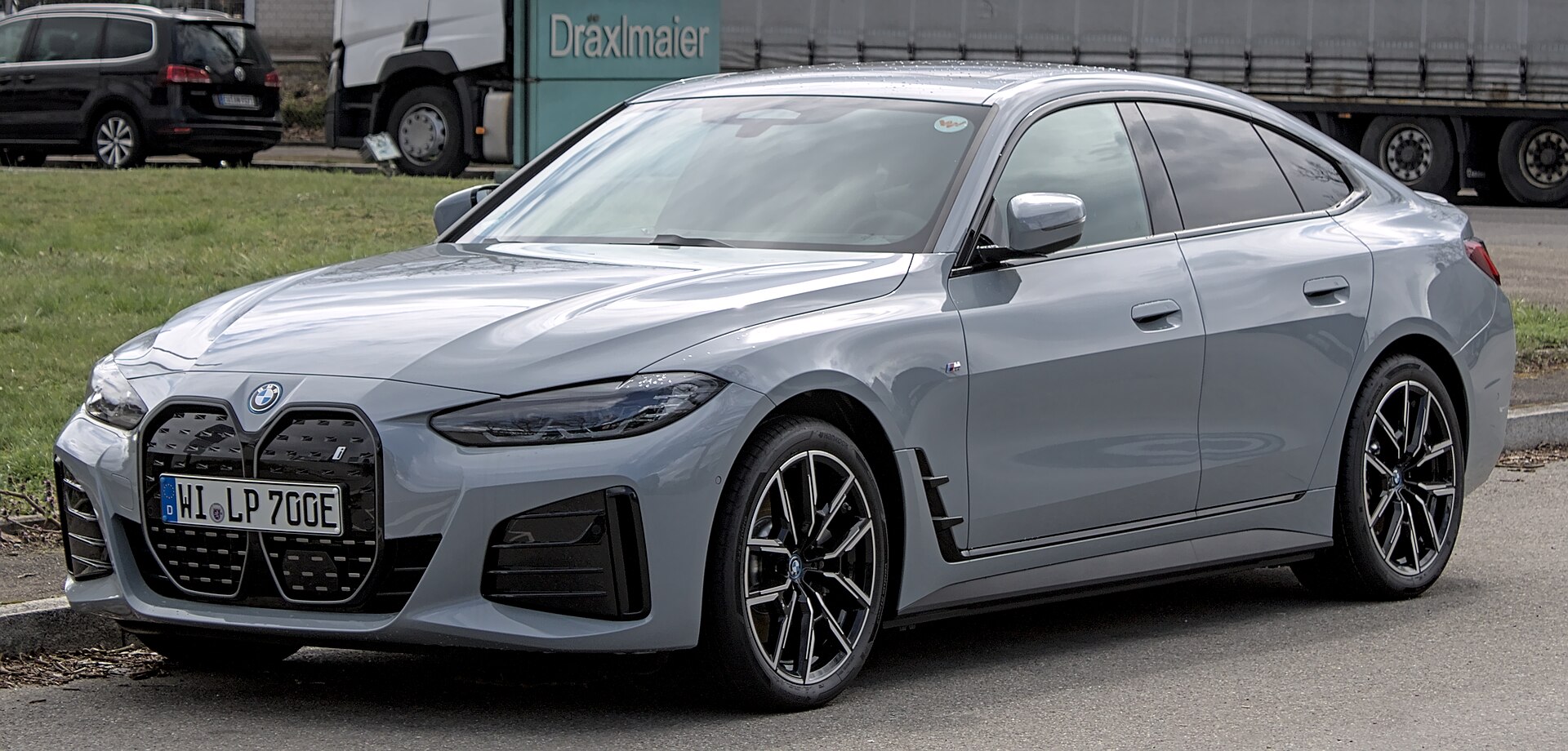
The BMW i4 is an electric five-door gran coupé built in Munich since October 2021. It shares its CLAR-based body with the 4 Series Gran Coupé (G26) and is assembled on the same line as petrol, diesel and plug-in hybrid BMWs. The range starts with the rear-wheel-drive eDrive35 and eDrive40 and runs to the all-wheel-drive M models. The M50 has 400 kW (544 PS), and the M60 of 2025 has 442 kW. A facelift in July 2024 brought new lights, a new interior design and the xDrive40.
In short
- Production since October 2021 in Munich; revealed in March 2021; facelift on sale from July 2024.
- Batteries: 83.9 kWh gross (81.5 kWh usable) and, in the eDrive35, 70.2 kWh (66 kWh usable).
- Outputs from 210 kW (286 PS) in the eDrive35 to 442 kW in the M60 xDrive.
- WLTP range up to 590 km for the eDrive40; DC charging at up to 205 kW, 10 to 80 percent in about 31 minutes.
Size at a glance
| Dimensions | BMW i4 G26 |
|---|---|
| Length | 4,785 mm188.4 in |
| Width | 1,852 mm72.9 in |
| Height | 1,448 mm57.0 in |
| Wheelbase | 2,856 mm112.4 in |
| Boot | 470 L16.6 cu ft |
Specs by version
Engines
| Version | Engine | Power | Torque | Drive | Production years |
|---|---|---|---|---|---|
| eDrive35 | Electric | 210 kW 286 PS282 hp | 400 Nm295 lb-ft | Rear-wheel drive | 2022 |
| eDrive40 | Electric | 250 kW 340 PS335 hp | 430 Nm317 lb-ft | Rear-wheel drive | 2021 |
| xDrive40 | Electric | 295 kW 401 PS396 hp | 600 Nm443 lb-ft | All-wheel drive | 2023 |
| M50 | Electric | 400 kW 544 PS536 hp | 795 Nm586 lb-ft | All-wheel drive | 2021 |
| M60 xDrive | Electric | 442 kW 601 PS593 hp | 795 Nm586 lb-ft | All-wheel drive | 2025 |
Performance
Show all 5 versions
| Version | 0–100 km/h | Top speed | Range |
|---|---|---|---|
| eDrive35 | 5.8 s 0–62 mph | — | 490 km304 mi |
| eDrive40 | 5.7 s 0–62 mph | 190 km/h118 mph | 590 km367 mi |
| xDrive40 | 4.9 s 0–62 mph | — | — |
| M50 | 3.9 s 0–62 mph | 225 km/h140 mph | 510 km317 mi |
| M60 xDrive | 3.7 s 0–62 mph | 225 km/h140 mph | 550 km342 mi |
Dimensions and weight
Show all 5 versions
| Version | Length | Width | Height | Wheelbase | Kerb weight | Boot | Battery |
|---|---|---|---|---|---|---|---|
| eDrive35 | 4,785 mm188.4 in | 1,852 mm72.9 in | 1,448 mm57.0 in | 2,856 mm112.4 in | 2,070 kg4,564 lb | 470 l16.6 cu ft | 66 kWh |
| eDrive40 | 4,785 mm188.4 in | 1,852 mm72.9 in | 1,448 mm57.0 in | 2,856 mm112.4 in | 2,125 kg4,685 lb | 470 l16.6 cu ft | 82 kWh |
| xDrive40 | 4,785 mm188.4 in | 1,852 mm72.9 in | 1,448 mm57.0 in | 2,856 mm112.4 in | 2,278 kg5,022 lb | 470 l16.6 cu ft | 82 kWh |
| M50 | 4,785 mm188.4 in | 1,852 mm72.9 in | 1,448 mm57.0 in | 2,856 mm112.4 in | 2,290 kg5,049 lb | 470 l16.6 cu ft | 82 kWh |
| M60 xDrive | 4,785 mm188.4 in | 1,852 mm72.9 in | 1,448 mm57.0 in | 2,856 mm112.4 in | 2,210 kg4,872 lb | 470 l16.6 cu ft | 82 kWh |
Verified Manufacturer and type-approval data from our catalog · Sources and methodology
BMW i4 at a glance
| Specification | BMW i4 (G26) |
|---|---|
| Production | since October 2021, Munich (Germany); motors from Dingolfing |
| Platform | CLAR; body shared with the 4 Series Gran Coupé (G26) |
| Body | five-door liftback ("four-door coupé") |
| Drive | rear-wheel drive (eDrive) or all-wheel drive (xDrive, M50, M60) |
| Power | 210 to 442 kW (286 to 601 PS) |
| Length / width / height | 4,785 / 1,852 / 1,448 mm |
| Wheelbase | 2,856 mm |
| Drag coefficient | Cd 0.24 (eDrive40), 0.25 (M50) |
| Boot | 470 litres plus 38 litres under the floor; up to 1,290 litres |
| Kerb weight | 2,070 to 2,290 kg (EU) |
From concept to production
Three concept cars led to the i4: the BMW Vision Next 100 of 2016, the i Vision Dynamics shown at the 2017 Frankfurt show and the Concept i4 of March 2020. The production car was revealed in March 2021, about three months ahead of plan. Production in Munich started in October 2021, and sales began in November 2021 as a 2022 model. For the start of i4 production in 2021, BMW invested about €200 million in the Munich plant so that electric and combustion cars can share one line. The electric motors come from BMW's plant in Dingolfing.
The i4 is not built on a dedicated electric platform but on BMW's CLAR architecture, and its body shell is that of the G26 4 Series Gran Coupé.

Versions and performance
| Version | Drive | Power | Torque | 0–100 km/h | Top speed | Available |
|---|---|---|---|---|---|---|
| eDrive35 | rear | 210 kW (286 PS) | 400 Nm | 5.8 s | — | from August 2022 |
| eDrive40 | rear | 250 kW (340 PS) | 430 Nm | 5.7 s | 190 km/h | from November 2021 |
| xDrive40 | all-wheel | 295 kW (401 PS) | 600 Nm | 4.9 s | — | from May 2023 |
| M50 | all-wheel | 400 kW (544 PS) | 795 Nm | 3.9 s | 225 km/h | from November 2021 |
| M60 | all-wheel | 442 kW (601 PS) | 795 Nm | 3.7 s | 225 km/h | 2025 |
Figures are from Wikipedia's version table; the PS values for eDrive35 to M50 are those quoted by BMW at the 2024 facelift. The EV database evkx.net lists the xDrive40 and the M60 xDrive as the versions still available in 2026. All versions are in the BMW catalogue. The eDrive35 is the lightest version, at 2,070 kg against 2,125 kg for the eDrive40 and 2,290 kg for the M50.


Battery, range and charging
The eDrive40, xDrive40, M50 and M60 use an 83.9 kWh battery with 81.5 kWh of usable capacity; BMW gave 81 kWh net at the facelift. The eDrive35 has a smaller 70.2 kWh pack (66 kWh usable, 67 kWh in BMW's 2024 data).
| Version | WLTP range | Consumption (WLTP, 2024) |
|---|---|---|
| eDrive35 | up to 490 km | — |
| eDrive40 | 493 to 590 km | — |
| xDrive40 | 444 to 548 km | 16.6 to 20.5 kWh/100 km |
| M50 | 416 to 510 km | 18.1 to 22.5 kWh/100 km |
| M60 | 433 to 550 km | — |
On a DC charger the 81.5 kWh versions accept up to 200 to 205 kW and charge from 10 to 80 percent in about 31 minutes. The eDrive35 charges at up to 180 kW and needs about 32 minutes. At home or at public AC points the i4 charges at up to 11 kW, which fills the battery from empty in under eight hours, so an overnight charge on a wallbox is enough for a full battery. In the US the EPA rated the eDrive35 at 418 km.
Facelift of 2024
BMW presented the updated i4 in April 2024, and sales started in July 2024. Outside there are new kidney-grille patterns, with horizontal bars on the M50 and a honeycomb on the other versions. Two vertical, arrow-shaped daytime running lights replaced the earlier signature. Matrix LED headlights with blue inserts and rear lights with glass-fibre elements are optional. Inside, the climate controls and seat heating moved to the touchscreen and voice control. A small switch replaced the gear lever, and ambient lighting became standard. The battery sizes stayed the same: Motor1 lists 81 kWh net for the large and 67 kWh for the small battery. BMW's facelift data include the all-wheel-drive xDrive40 with 295 kW (401 PS) and 600 Nm; Wikipedia dates its availability from May 2023.

Practicality
The i4 is a liftback, so the whole rear window opens with the boot lid. The boot holds 470 litres, plus a 38-litre compartment for the charging cables, and up to 1,290 litres with the rear seats folded. The body is 4,785 mm long, 1,852 mm wide and 1,448 mm tall on a 2,856 mm wheelbase.

Safety
Euro NCAP tested the i4 in 2022. It scored 87 percent for adult occupants, 87 for children, 71 for pedestrians and 64 for the assistance systems. The assistance score of 64 percent was the weakest of the four areas. ANCAP adopted similar results for Australia.
Photo gallery

BMW i4 in our rankings
- No. 1 of 53 · Power-to-weight: hatchbacks (200 kW/t)
- No. 3 of 51 · Quickest hatchbacks, 0–100 (3.7 s)
- No. 4 of 65 · Most torque: hatchbacks (795 Nm)
- No. 4 of 53 · Heaviest hatchbacks (2,290 kg)
- No. 5 of 106 · Most powerful hatchbacks (442 kW)
- No. 5 of 49 · Biggest boot: hatchbacks (470 l)
Better power-to-weight than 98% of ranked hatchbacks in the 1CARS catalog (No. 1 of 53).
FAQ
What is the range of the BMW i4?
Up to 590 km WLTP for the eDrive40. The M50 reaches 416 to 510 km and the eDrive35 up to 490 km.
How fast does the i4 charge?
Up to 205 kW DC in the large-battery versions, with 10 to 80 percent in about 31 minutes; up to 11 kW on AC.
How fast is the BMW i4 M50?
It has 400 kW (544 PS) and 795 Nm, accelerates to 100 km/h in 3.9 seconds and has a top speed of 225 km/h.
How big is the BMW i4 boot?
470 litres behind the rear seats, plus a 38-litre compartment for the charging cables, and up to 1,290 litres with the rear seats folded.
Where is the BMW i4 built?
In BMW's Munich plant, with electric motors from Dingolfing.
Data sources
Data checked by an editor against the sources below.