
 BMW E9
Specs, engines and history
Published Sources (2) Report an error
By Felix Hartmann, Automotive Technology & EV Contributor
- Built
- 1968–1975
- Top power
- 152 kW (207 PS)
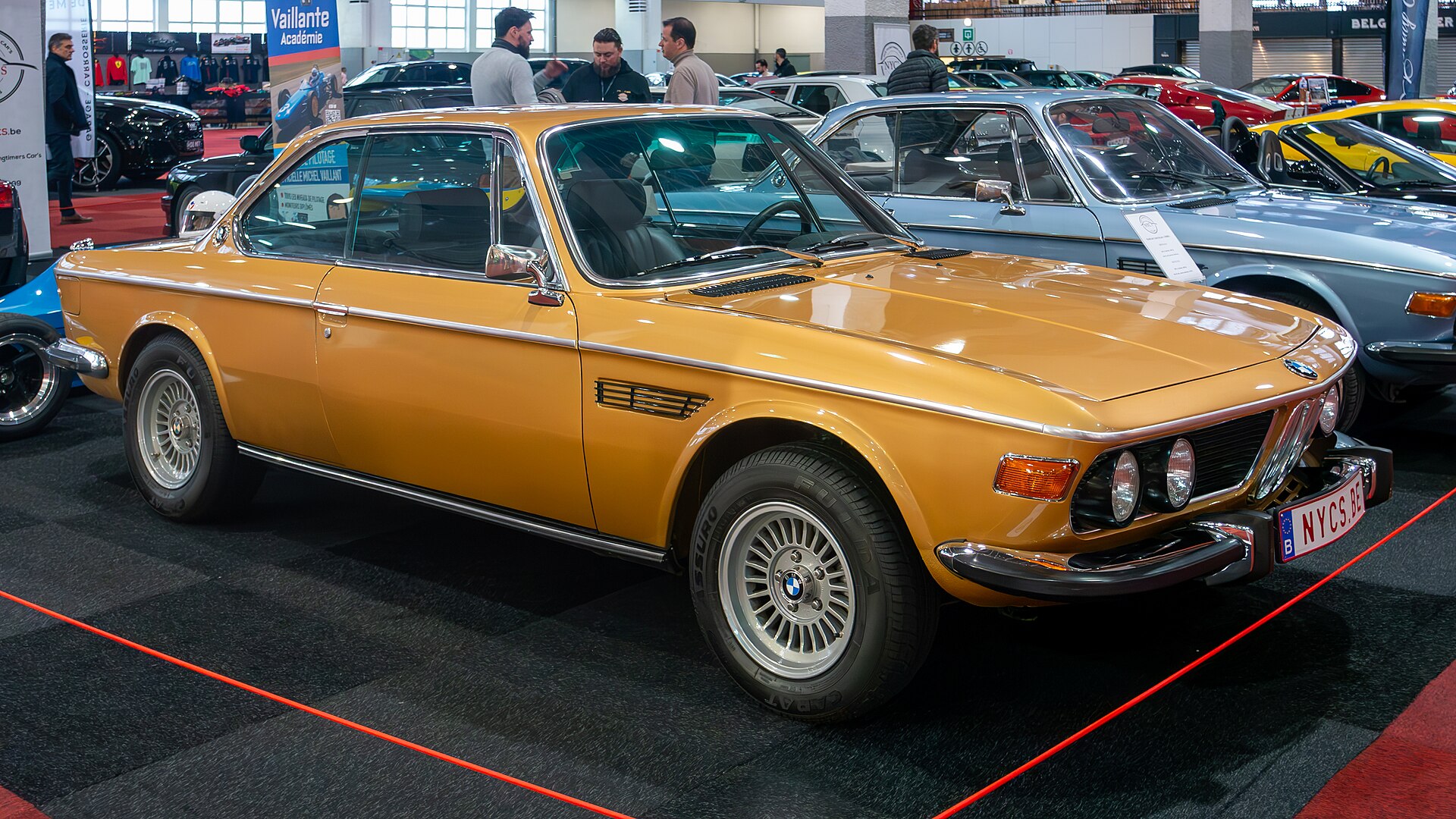
The BMW E9 is the large two-door coupé that BMW built from December 1968 to December 1975, with Karmann bodies and the M30 straight-six. The range ran from the 2800 CS through the 3.0 CS and fuel-injected 3.0 CSi to the lightweight 3.0 CSL, which won the European Touring Car Championship in 1973 and every year from 1975 to 1979. In total 30,546 were built.
In short
- Launched in September 1968, built December 1968 to December 1975, replaced by the E24 6 Series in 1976.
- 30,546 built according to Wikipedia; Classic & Sports Car gives 30,765.
- Six-cylinder engines from 2.5 to 3.2 litres and from 110 kW (150 PS) to 152 kW (206 PS).
- The 3.0 CSL saved weight with aluminium panels and Plexiglas windows and weighed 1,165 kg; 1,265 were made.
Specs by version
Engines
| Version | Engine | Power | Drive | Production years |
|---|---|---|---|---|
| 2.5 CS | 2.5 l · 6 cyl · Petrol M30 | 110 kW 150 PS148 hp | Rear-wheel drive | 1974–1975 |
| 2800 CS | 2.8 l · 6 cyl · Petrol M30 | 125 kW 170 PS168 hp | Rear-wheel drive | 1968–1971 |
| 3.0 CS | 3.0 l · 6 cyl · Petrol M30 | 132 kW 179 PS177 hp | Rear-wheel drive | 1971–1975 |
| 3.0 CSi | 3.0 l · 6 cyl · Petrol M30 | 147 kW 200 PS197 hp | Rear-wheel drive | 1971–1975 |
| 3.0 CSL 3.2 | 3.2 l · 6 cyl · Petrol M30 | 152 kW 207 PS204 hp | Rear-wheel drive | 1973–1975 |
Performance
Show all 5 versions
| Version | 0–100 km/h | Top speed |
|---|---|---|
| 2.5 CS | 9.9 s 0–62 mph | 200 km/h124 mph |
| 2800 CS | - | 205 km/h127 mph |
| 3.0 CS | - | 213 km/h132 mph |
| 3.0 CSi | 7.7 s 0–62 mph | 220 km/h137 mph |
| 3.0 CSL 3.2 | - | 220 km/h137 mph |
Dimensions and weight
Show all 2 versions
| Version | Length | Wheelbase | Kerb weight |
|---|---|---|---|
| 2800 CS | 4,660 mm183.5 in | 2,624 mm103.3 in | 1,355 kg2,987 lb |
| 3.0 CS | - | - | 1,400 kg3,086 lb |
Verified Manufacturer and type-approval data from our catalog · Sources and methodology
BMW E9 at a glance
| Item | BMW E9 |
|---|---|
| Years | December 1968 to December 1975 (launched September 1968) |
| Production | 30,546 (Wikipedia EN and DE); 30,765 (Classic & Sports Car) |
| Plants | bodies by Karmann (Osnabrück per Retro Rides, Rheine per Wikipedia); BMW in Munich completed the cars |
| Body style | 2-door coupé |
| Designer | design team led by Wilhelm Hofmeister |
| Layout | front engine, rear-wheel drive; wheelbase 2,624 mm; length 4,660 mm; width 1,670 mm |
| Engines | M30 straight-six, 2.5, 2.8, 3.0 and 3.2 litres; carburettors or Bosch D-Jetronic injection |
| Power | 110 kW (150 PS) to 152 kW (206 PS) |
| Kerb weight | 1,165 kg (3.0 CSL) to 1,400 kg (3.0 CS, 2.5 CS) |
| Top speed | 220 km/h (3.0 CSi, 3.0 CSL) |
| 0-100 km/h | 7.7 s (3.0 CSi), 6.9 s (3.0 CSL 3003 cc), both Wikipedia DE |
| Price new | DM 22,980 (2800 CS) to DM 37,580 (3.0 CSL 3.2); GBP 7,399 for the CSi or CSL in the UK in 1974 |
From the four-cylinder 2000 CS to a six-cylinder coupé
The E9 grew out of the 2000 C and 2000 CS, the four-cylinder coupés BMW built from 1965 to 1969. To fit the new M30 straight-six, BMW lengthened the wheelbase and the nose, and the result went on sale as the 2800 CS in 1968. Karmann built the bodies. Retro Rides names the Osnabrück factory and Munich for final assembly, while Wikipedia gives Rheine, so the location varies between sources.
The coupé sat above BMW's saloons of the time, including the smaller two-door models in our BMW 2002 guide. The M30 engine was also BMW's base for the CSL racing programme that followed in the 1970s.
Engines and versions from 2800 CS to 2.5 CS
| Model | Years | Displacement | Power | Top speed | Built | Price new |
|---|---|---|---|---|---|---|
| 2800 CS | 1968-1971 | 2,788 cc | 125 kW (170 PS) | 205 km/h | 9,399 | DM 22,980 |
| 3.0 CS | 1971-1975 | 2,985 cc | 132 kW (180 PS) | 213 km/h | 10,898 | DM 26,975 |
| 3.0 CSi | 1971-1975 | 2,985 cc | 147 kW (200 PS) | 220 km/h | 8,144 | DM 29,440 |
| 2.5 CS | 1974-1975 | 2,494 cc | 110 kW (150 PS) | 200 km/h | 844 | DM 28,550 |
| 3.0 CSL, first batch | 1971-1972 | 2,985 cc | 132 kW (180 PS) | 213 km/h | 169 | DM 31,950 |
| 3.0 CSL 3.0 | 1972-1973 | 3,003 cc | 147 kW (200 PS) | 220 km/h | 929 | DM 31,245 |
| 3.0 CSL 3.2 | 1973-1975 | 3,153 cc | 152 kW (206 PS) | 220 km/h | 167 | DM 37,580 |
Build numbers come from Wikipedia DE and myAutoWorld; Wikipedia EN splits them by market and gearbox and arrives at slightly different totals, for example 11,063 for the 3.0 CS in one source and 10,898 in another.
The 3.0 CS replaced the 2800 CS in April 1971 and brought disc brakes on all four wheels. The 3.0 CSi followed in autumn 1971 with Bosch D-Jetronic electronic injection and 147 kW (200 PS). Manual cars used a Getrag four-speed gearbox, and the automatic CSA versions a Borg-Warner unit. The 2.5 CS came in February 1974 as BMW's response to the oil crisis, with 110 kW (150 PS) and 0-100 km/h in 9.9 s.
The CSL: a homologation lightweight
BMW launched the CSL in May 1972 so that the coupé could race in the European Touring Car Championship. The body used thinner steel, an aluminium bonnet, boot lid and door skins, Plexiglas rear windows and less sound insulation and trim, saving up to 200 kg. A limited-slip differential was standard, and buyers who wanted more comfort could order a "city package".
The first 169 cars still had the 2,985 cc carburettor engine of the 3.0 CS. The second run, from August 1972, used a 3,003 cc injected six. In July 1973 BMW homologated an aerodynamic package with a deep front air dam, fins on the front wings, a roof spoiler and a tall rear wing. The wing was supplied in the boot for the owner to fit, and the look earned the car the nickname "Batmobile". The final cars had 3,153 cc and 152 kW (206 PS).

Six European titles and the Group 5 years
Toine Hezemans won the 1973 European Touring Car Championship in a 3.0 CSL and, with Dieter Quester, took a class win at Le Mans the same year. CSL drivers won the European title again in every season from 1975 to 1979, including Quester with Alpina in 1977 and Umberto Grano in a Luigi-entered car in 1978.
The 1974 works racing version used 3,498 cc and 324 kW (440 PS). In 1976 works-supported Group 5 CSLs won three rounds of the World Championship for Makes against the Porsche 935, a racing derivative of the Porsche 911, and kept the title open until the final round. In 1975 Sam Posey, Brian Redman and Ronnie Peterson also won races with the CSL in the American IMSA series.
The road car gave way to the E24 6 Series in 1976.
BMW E9 today: what to check when buying
Classic & Sports Car (July 2019) notes that Karmann's rust protection was minimal. Retro Rides (October 2025) lists the window openings, sills, floors and sunroof as places to check, warns that the underside can be bad on a car that looks good elsewhere and says cars first sold in snowy countries carry the highest risk. The bonnet can bend if it is slammed or caught by wind while open.
On the M30, corrosion in the alloy head's water passages can lead to blown gaskets and cracked heads; look for emulsion under the oil filler cap and signs of overheating. Check the D-Jetronic cars for fuel smells and leaks, the Getrag gearbox for worn synchromesh and noisy bearings, and the clutch for slip. Leaking struts, broken springs, worn bushes and play in the steering gear are common.
A claimed CSL needs proof. Chassis numbers begin 2-275- (2-285- for right-hand drive), and the inner-wing spot-weld pattern and BMW Classic records help confirm a real car. Other BMW models are in our BMW catalogue, and the wider period is covered in our classic cars section.
Classic Trader's market overview of sales data from 2021 to January 2026 puts well-presented 3.0 CS and CSi coupés at about EUR 60,000-125,000. Most 3.0 CSL offers in the same January 2026 overview sit at about EUR 170,000-300,000, with race and special cars far higher; these are mainly asking prices.
Photo gallery

BMW E9 in our rankings
- No. 3 of 26 · Fastest cars of the 1970s (220 km/h)
- No. 4 of 24 · Fastest cars of the 1960s (205 km/h)
- No. 5 of 18 · Quickest cars of the 1970s, 0–100 (7.7 s)
- No. 27 of 92 · Lightest coupes (1,355 kg · top 30%)
- No. 143 of 408 · Lightest cars (1,355 kg · top 36%)
- No. 158 of 394 · Fastest cars (220 km/h · top 42%)
Faster than 84% of ranked cars of the 1970s in the 1CARS catalog (No. 3 of 26).
FAQ
How many BMW 3.0 CSL were built?
About 1,265, according to Classic & Sports Car and Wikipedia: 169 early carburettor cars, 929 with the 3,003 cc injected engine and 167 with the 3.2-litre engine, with small differences between sources.
Why is the 3.0 CSL called the Batmobile?
Because of the aerodynamic kit homologated in July 1973: a deep front air dam, fins on the front wings, a roof spoiler and a tall rear wing. BMW delivered the wing in the boot for the owner to fit.
What is the difference between the 3.0 CS and the 3.0 CSi?
The 3.0 CS had carburettors and 132 kW (180 PS). The 3.0 CSi used Bosch D-Jetronic fuel injection for 147 kW (200 PS) and a top speed of 220 km/h, and cost DM 29,440 against DM 26,975.
What replaced the BMW E9?
The E24 6 Series, introduced in 1976. It continued the idea of a large six-cylinder BMW coupé after the last E9 left production in December 1975.
Data sources
Data checked by an editor against the sources below.
- Wikipedia - BMW E9
- Myautoworld


