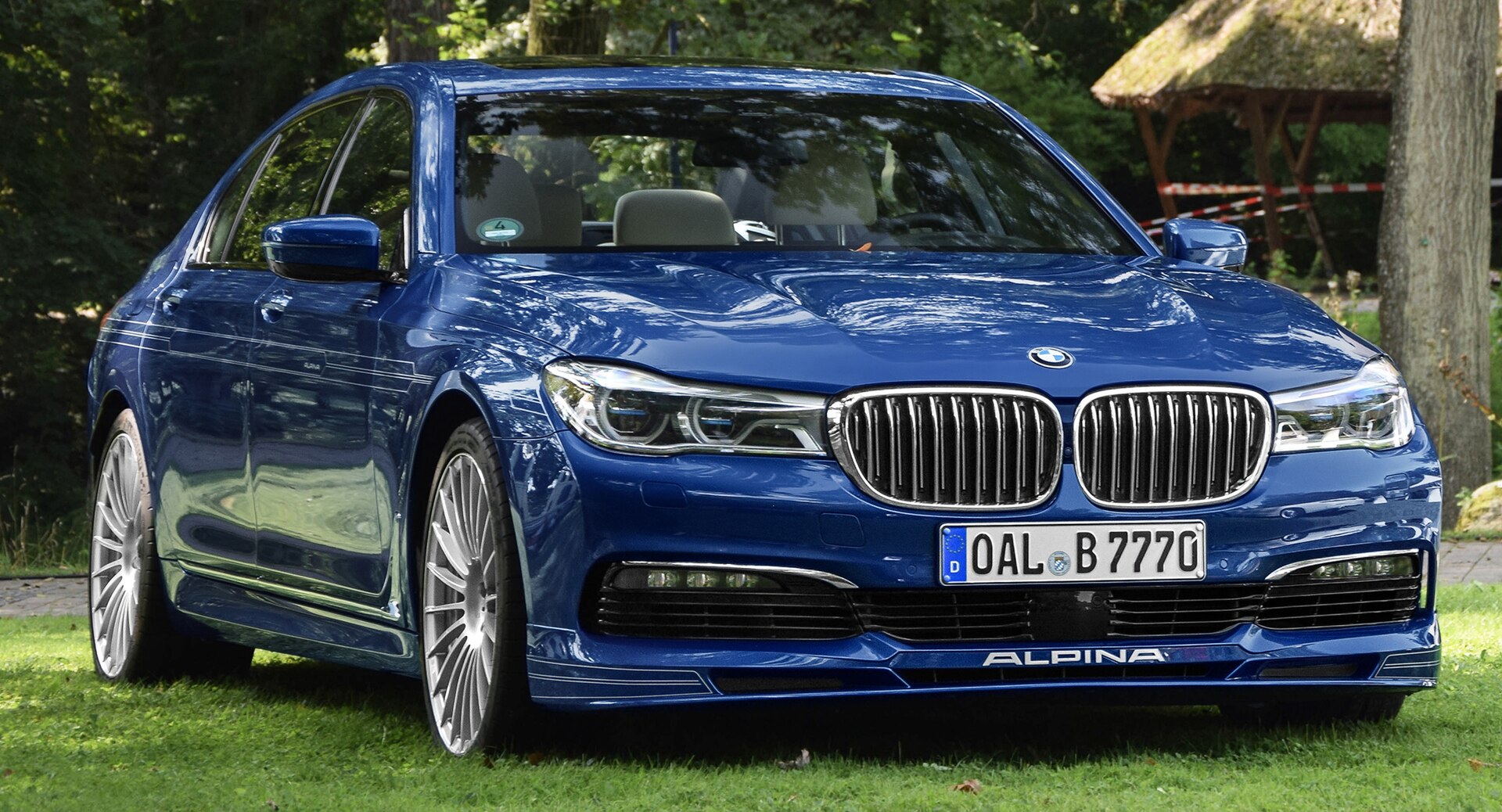
Alpina: Burkard Bovensiepen's BMW-Based Car Maker From Buchloe
Alpina is the small German company that turned BMWs into fast, refined touring cars. Burkard Bovensiepen founded it on 1 January 1965, it began building complete cars in 1978, and since 1983 the German Federal Motor Transport Authority has registered it as a car manufacturer rather than a tuner. Its cars, from the B7 Turbo of the 1970s to the B10 BiTurbo and the modern B7, were built on BMW bodies with Alpina engines, chassis and interiors. In March 2022 BMW announced it would take over the Alpina brand, and the Bovensiepen family's car programme in Buchloe ended with 2025.
Key takeaways
- Alpina Burkard Bovensiepen KG was founded on 1 January 1965 in Kaufbeuren, Bavaria, with eight employees, and later moved to Buchloe.
- The company won the European Touring Car Championship and the Spa 24 Hours in 1970, and the ADAC GT Masters in 2011.
- The B10 BiTurbo of 1989 had 265 kW (360 PS) and was described as the fastest production saloon of its day; 507 were built.
- BMW agreed to buy the brand rights on 10 March 2022; Alpina built around 2,000 cars in 2021, its best year.
Alpina at a glance
| Fact | Value |
|---|---|
| Founded | 1 January 1965, Kaufbeuren (Bavaria) |
| Founder | Burkard Bovensiepen (1936–2023) |
| Home | Buchloe, Ostallgäu, from around 1970 |
| Status | Registered car manufacturer (KBA) since 1983 |
| Base cars | BMW saloons, coupés, Touring estates and SUVs |
| Racing titles | European Touring Car Championship 1970, Spa 24 Hours 1970, ADAC GT Masters 2011 |
| Output | about 1,700 cars (2014), around 2,000 (2021) |
| Owner of the brand | BMW Group (agreement of 10 March 2022) |
Origins: carburettors from a typewriter works
Burkard Bovensiepen was born on 1 September 1936 into an industrial family from the Rhineland. His father, Otto Rudolf Bovensiepen, ran an office-machine business under the Alpina name. The firm made typewriters, and it ended in the late 1960s after a move into textiles failed.
The car business began as a side project. In 1962 Bovensiepen developed a twin Weber carburettor set for the BMW 1500. BMW's sales chief Paul G. Hahnemann praised it, and from 1964 BMW gave cars fitted with the Alpina system its full factory guarantee. On 1 January 1965 Bovensiepen founded Alpina Burkard Bovensiepen KG with eight employees, working from an outbuilding of the typewriter factory in Kaufbeuren. Gains on the stock market paid for the start. The early work was carburettors, camshafts and revised cylinder heads, and the logo of 1967 shows exactly that. By 1970 the company had seventy employees and had moved to Buchloe.

Racing years, 1968–1988
Racing built the name. Alpina-prepared BMWs were strong from 1968 to 1977, and 1970 was the best season. That year the team won the European Touring Car Championship, the Spa 24 Hours, the German hill-climb championship and several rally and circuit titles. Drivers of Alpina cars in this period included Niki Lauda and Derek Bell. Alpina also entered the German DTM in 1987 and 1988.
In 1988 the company withdrew from racing. It gave limited capacity and new restrictions as reasons, and it needed the space for its own road cars. It came back two decades later. At the end of 2007 it announced a GT3 car based on the B6 S, the B6 GT3 raced from 2009, and in 2011 Alexandros Margaritis and Dino Lunardi won the ADAC GT Masters in it.

From tuner to manufacturer
Alpina worked as a tuner from 1963 to 1977 and became a car maker in 1978, building complete cars on BMW products. Since 1983 its cars have been registered with the Kraftfahrt-Bundesamt in Flensburg as Alpinas, not as BMWs. They kept BMW warranties, BMW dealers could service them, and some dealers sold them.
The production method stayed the same for decades. Alpina built or modified the engine, BMW fitted it to the body on its own line, and the car went back to Buchloe for final assembly and the interior. The modern B7 shows this well: it was built on the Dingolfing line with the 7 Series, but its 4.4-litre twin-turbo V8 was hand-assembled in Buchloe first.
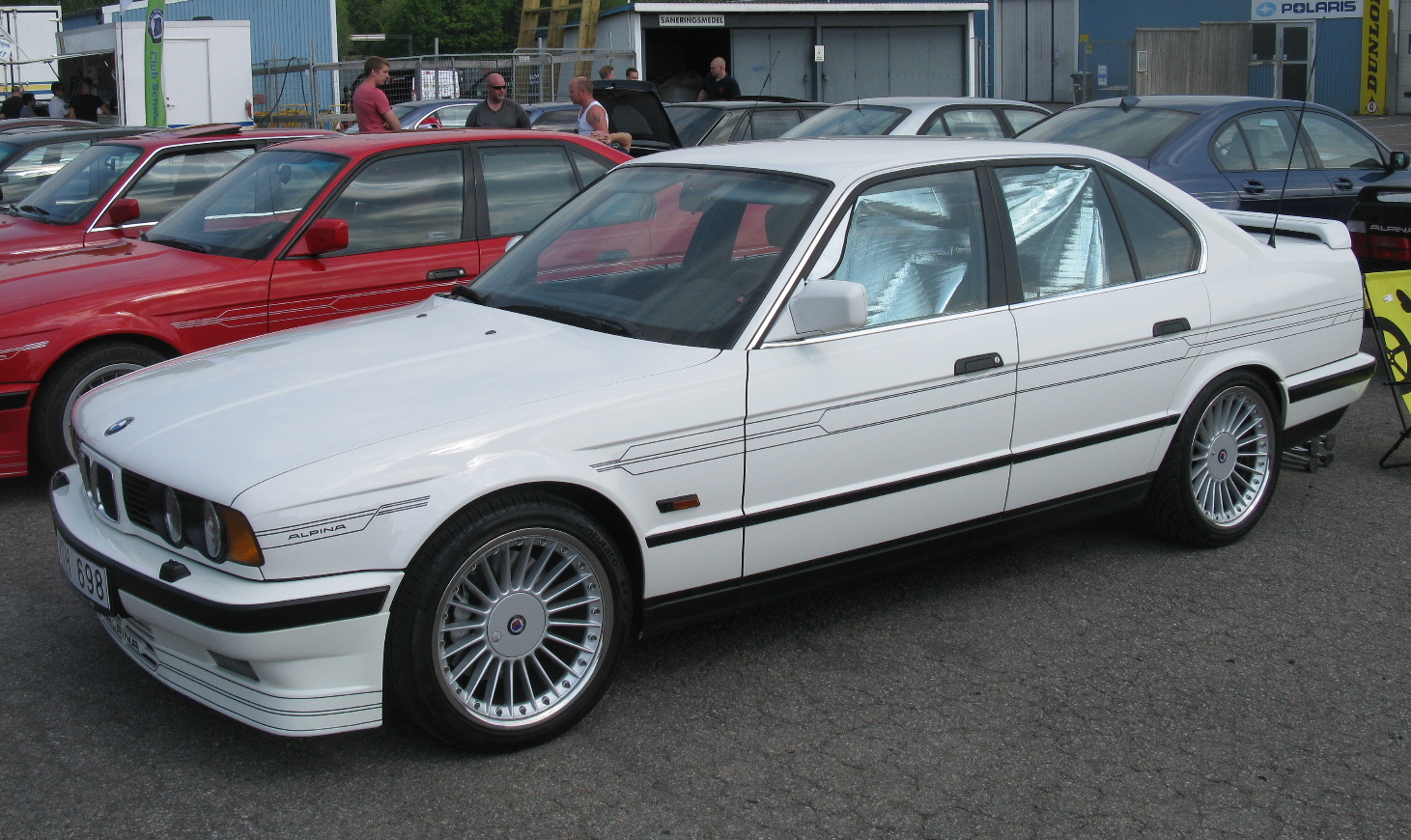
Alpina favoured torque and long-distance comfort over lap times. It used ZF automatic gearboxes with its Switch-Tronic buttons on the steering wheel, and Alpina claims it was the first to put shift buttons there. The look was just as consistent: 20-spoke wheels with hidden valves, Alpina Blue and Alpina Green paint, gold or silver decor stripes and a numbered plate inside each car.
Landmark cars: B7 Turbo, B10 BiTurbo and the Roadster V8
The B7 Turbo of 1978–1982 was based on the E12 5 Series. Its 3.0-litre turbocharged six gave 221 kW (300 PS), and the German Wikipedia article calls the four-door the fastest saloon in the world at the time. Only sixty of the later B7 S Turbo, with 3.5 litres and 243 kW (330 PS), were built.
The B10 BiTurbo was shown at the Geneva Motor Show in March 1989. It used the E34 535i and its M30 six-cylinder, rebuilt with forged Mahle pistons and two water-cooled Garrett T25 turbochargers. Power rose from 155 kW (211 PS) in the 535i to 265 kW (360 PS), 110 kW more, and torque from 305 to 520 Nm. Alpina claimed more than 290 km/h, and Road & Track measured 288.4 km/h. Its base price was nearly twice that of the M5. Production ended in August 1994, after BMW stopped making the M30, and 507 cars were built.
The 1990s and 2000s brought V8 and V12 cars. The B12 5.7 coupé of 1992–1996, based on the 8 Series, had 306 kW (416 PS). The Roadster V8 of 2002–2003, based on the BMW Z8, had 280 kW (381 PS); 555 were built, and 450 of them went to the United States. The supercharged B7 of 2003 had 368 kW (500 PS), and the G30-based B5 of 2017 had 447 kW (608 PS), with 0–100 km/h in 3.5 seconds.

The BMW takeover
On 10 March 2022 BMW announced that it would acquire the Alpina trademark rights, though not shares in the company. The cooperation agreement between the two firms ran until 31 December 2025, and until then the Bovensiepen company continued to develop, build and sell BMW Alpina cars. The press release gave the reasons: electric drive and new rules on emissions, software and driver assistance made the risks much higher for a small-series maker.
The deal followed strong years. Alpina built about 1,700 cars in 2014 with around 200 staff, and around 2,000 in 2021, its most successful year. In 2014 about 600 cars were sold in Germany and about 400 each in the United States and Japan. In 2022 the company employed around 300 people in Buchloe.
After 2025 the Buchloe site keeps service, parts and accessories for existing Alpinas and works on development for BMW. The family also keeps its wine business, and Andreas and Florian Bovensiepen plan new mobility projects under the Bovensiepen name. Burkard Bovensiepen died on 12 October 2023. The parent company's own story is told in the history of BMW.

Which Alpina to choose
For buyers the range divides into three groups. The early carburettor and turbo cars, such as the B7 Turbo, are rare collector cars built in dozens or hundreds. The B10 BiTurbo is the best-known classic: 507 cars, a manual gearbox and a clear technical story. The later V8 saloons and Touring estates are the practical choice, with automatic gearboxes and BMW service. The Alpina B7 BiTurbo G12 is covered in detail, the surviving models are in the Alpina catalogue, and the power converter turns the kW, PS and hp figures used in different markets into one unit.
Alpina timeline
| Year | Event |
|---|---|
| 1962 | Weber carburettor kit for the BMW 1500 |
| 1965 | Alpina Burkard Bovensiepen KG founded (1 January) |
| 1970 | European Touring Car Championship and Spa 24 Hours wins; move to Buchloe |
| 1978 | First complete Alpina cars; B7 Turbo |
| 1983 | Registered as a car manufacturer with the KBA |
| 1988 | Withdrawal from racing |
| 1989 | B10 BiTurbo shown in Geneva |
| 2002 | Roadster V8 based on the BMW Z8 |
| 2011 | ADAC GT Masters title with the B6 GT3 |
| 2022 | BMW agrees to buy the brand rights (10 March) |
| 2025 | End of the Bovensiepen vehicle programme (31 December) |
Landmark Alpina models
| Model | Years | Why it matters |
|---|---|---|
| B7 Turbo | 1978–1982 | 221 kW (300 PS) 5 Series, one of the first complete Alpinas |
| B10 BiTurbo | 1989–1994 | 265 kW (360 PS) twin-turbo saloon; 507 built |
| B12 5.7 | 1992–1996 | V12 coupé based on the 8 Series |
| Roadster V8 | 2002–2003 | Z8-based roadster; 555 built |
| B5 (G30) | 2017 onward | 447 kW (608 PS), 0–100 km/h in 3.5 s |
Photo gallery


FAQ
Is Alpina a tuner or a car maker?
A car maker. Since 1983 the German Federal Motor Transport Authority has registered Alpina cars as Alpinas, not as modified BMWs.
Who founded Alpina?
Burkard Bovensiepen, on 1 January 1965, in Kaufbeuren in Bavaria. The company later moved to Buchloe.
Does BMW own Alpina?
BMW agreed on 10 March 2022 to buy the Alpina brand rights. The Bovensiepen company built the cars until the end of 2025 and keeps service and parts in Buchloe.
What was the fastest classic Alpina?
The B10 BiTurbo of 1989, with 265 kW (360 PS). Alpina claimed more than 290 km/h, and Road & Track measured 288.4 km/h.
Sources
- Wikipedia - Alpina (accessed 24 Oct 2026)
- Wikipedia (DE) - Alpina Burkard Bovensiepen (accessed 24 Oct 2026)
- Wikipedia - Alpina B10 Biturbo (accessed 24 Oct 2026)
- Wikipedia - Bovensiepen family (accessed 24 Oct 2026)
- BMW Group - Expanding the portfolio: BMW Group acquires the ALPINA brand (10 March 2022) (accessed 24 Oct 2026)
Found a mistake? Report an error