
 BMW Isetta
Specs, engines and history
Published Sources (4) Report an error
By Sarah Whitmore, Senior Automotive Writer
- Built
- 1955–1962
- Top power
- 10 kW (14 PS)
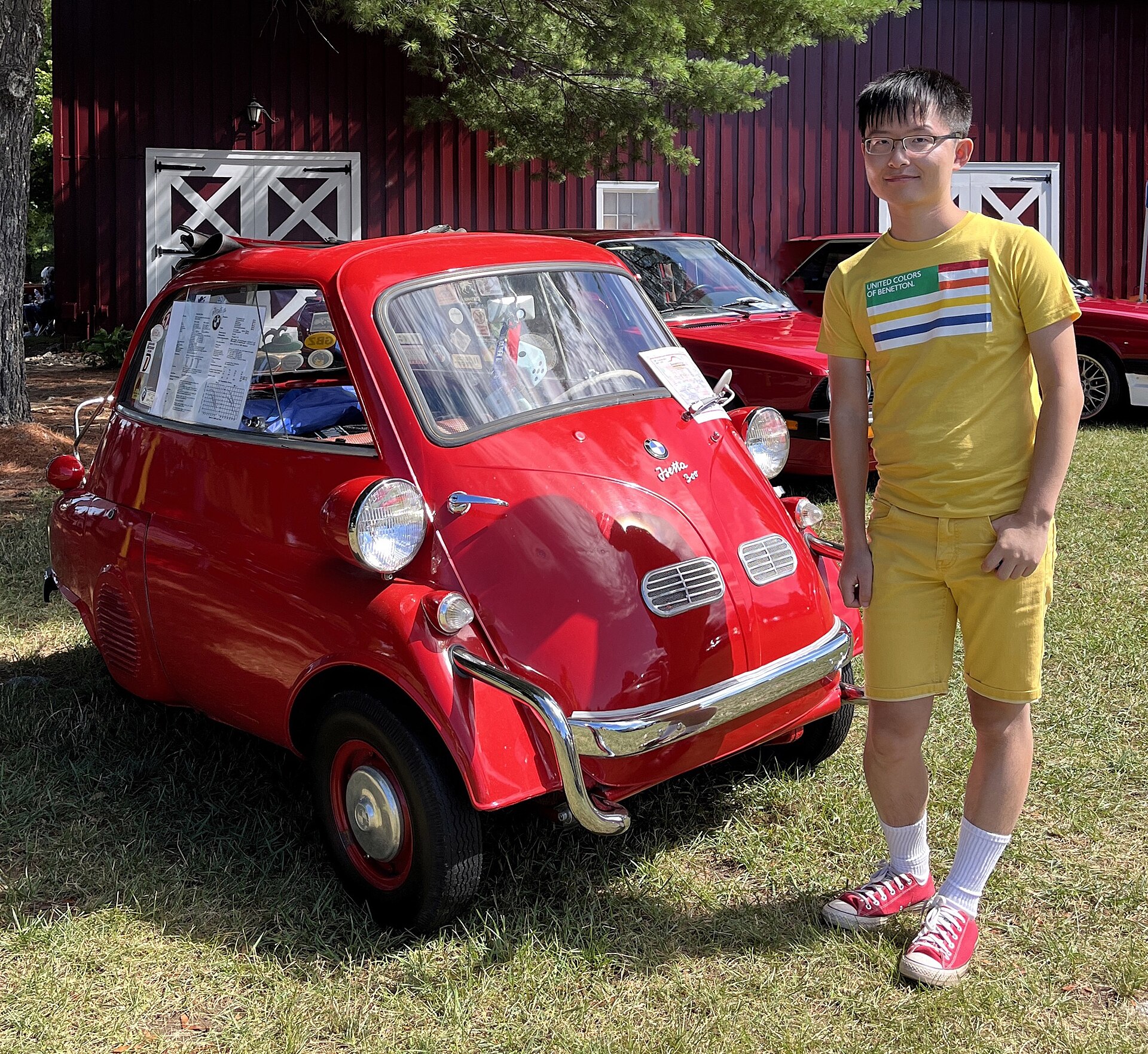
The BMW Isetta is the two-seat bubble car that BMW built in Munich from 1955 to 1962 under licence from the Italian firm Iso. BMW replaced Iso's two-stroke with a four-stroke single from its R 25 motorcycle: 247 cc and 8.8 kW (12 PS) in the Isetta 250, 297 cc and 9.6 kW (13 PS) in the 300. With 161,728 built, it carried BMW through the mid-1950s.
In short
- Built from spring 1955 to May 1962; more than 10,000 in the first year and just under 40,000 in the peak year of 1957.
- Engines: 247 cc single with 8.8 kW (12 PS) in the Isetta 250, 297 cc with 9.6 kW (13 PS) in the Isetta 300; top speed 85 km/h.
- Starting price DM 2,580 in 1955; fuel use about 3 L/100 km.
- Licence builders abroad added about 41,000 more according to Hagerty, including a three-wheeler made in Brighton.
Specs by version
Engines
| Version | Engine | Power | Torque | Gearbox | Drive | Production years |
|---|---|---|---|---|---|---|
| Isetta 250 | 0.2 l · 1 cyl · Petrol 247 cc | 9 kW 12 PS12 hp | - | Manual | Rear-wheel drive | 1955–1962 |
| Isetta 300 | 0.3 l · 1 cyl · Petrol 297 cc | 10 kW 14 PS13 hp | 18 Nm13 lb-ft | Manual | Rear-wheel drive | 1956–1962 |
| Isetta 300 Cabriolet | 0.3 l · 1 cyl · Petrol 297 cc | 10 kW 14 PS13 hp | - | Manual | Rear-wheel drive | 1956–1962 |
Performance
Show all 3 versions
| Version | Top speed |
|---|---|
| Isetta 250 | 85 km/h53 mph |
| Isetta 300 | 85 km/h53 mph |
| Isetta 300 Cabriolet | 85 km/h53 mph |
Dimensions and weight
Show all 1 versions
| Version | Length | Kerb weight | Boot |
|---|---|---|---|
| Isetta 250 | 2,285 mm90.0 in | 350 kg772 lb | 80 l2.8 cu ft |
Verified Manufacturer and type-approval data from our catalog · Sources and methodology
BMW Isetta at a glance
| Specification | BMW Isetta |
|---|---|
| Years | March or April 1955 to May 1962 |
| Production total | 161,728 (Wikipedia, Motor1, Hagerty); production table sums to 161,360 |
| Plant | Munich, Germany |
| Body styles | Motocoupé with front door, Export with sliding windows, cabriolet, light van |
| Designers | Ermenegildo Preti and Pierluigi Raggi (Iso, 1953) |
| Layout | single-cylinder engine at the rear, rear-wheel drive, narrow-track rear wheels |
| Engines | 247 cc and 297 cc four-stroke singles from the BMW R 25 motorcycle |
| Power | 8.8 kW (12 PS) at 5,800 rpm; 9.6 kW (13 PS) at 5,200 rpm |
| Kerb weight | about 350 kg (340-360 kg depending on version) |
| Top speed | 85 km/h (53 mph) |
| 0-97 km/h (60 mph) | 35 s (250) and 32 s (300), Car & Classic |
| Price new | DM 2,580 in 1955 (Isetta 250) |
Why BMW needed a bubble car
In the early 1950s BMW was in a difficult position. Its 501 and 502 saloons restored the brand's image but did nothing for its finances, and motorcycle profits could not support them. By 1954 the company needed a cheap, saleable car and could not afford to design one from scratch.
The answer came from Milan. Iso, run by Renzo Rivolta and whose roots were in refrigeration equipment and motorcycles, had shown its Isetta to the press in Turin in November 1953. BMW opened talks in the middle of 1954 and bought the licence together with the body tooling. The Italian car itself ended in 1955 after about 1,000 had been built, although Iso's Spanish operation continued until 1958. The history of Iso follows the Milan company from the Isetta to its V8 grand tourers.

Isetta 250 and 300 engines and performance
Iso's prototype used a 236 cc split-single two-stroke with 7.0 kW (9.5 hp), good for about 75 km/h. In 1954 three Isettas took the top three places in the economy class of the Mille Miglia, averaging more than 70 km/h over 1,600 km. BMW kept the egg-shaped body and replaced the engine with the 247 cc four-stroke single of its R 25 motorcycle, producing 8.8 kW (12 PS) at 5,800 rpm. Top speed rose to 85 km/h.
The engine choice suited German licence rules. A motorcycle licence was enough to drive the Isetta 250, and when a 1956 change limited new class IV licences to machines under 250 cc, BMW already had the 300 on sale. Its 297 cc engine, with a 72 mm bore and 73 mm stroke, made 9.6 kW (13 PS) at 5,200 rpm and 18.4 Nm, and it fell into a 300 cc tax class. Top speed stayed at 85 km/h, but Car & Classic gives the 300 a slightly quicker 0-60 mph time of 32 seconds against 35 for the 250. Fuel use was about 3 L/100 km, and Wikipedia describes the Isetta as the first mass-production car to reach that figure.
| Version | Years | Engine | Power | Notes |
|---|---|---|---|---|
| Isetta 250 | 1955-1962 | 247 cc single | 8.8 kW (12 PS) | motorcycle-licence car in Germany |
| Isetta 300 | 1956-1962 | 297 cc single | 9.6 kW (13 PS) | from late 1955 or February 1956 |
| Export (Moto Coupé DeLuxe) | from late 1956 | 247 or 297 cc | as above | sliding side windows, longer by 7 cm |
| Cabriolet | from 1956 | 247 or 297 cc | as above | canvas roll-back roof |
| BMW 600 | 1957-1959 | 582 cc flat-twin | 14.3 kW (19.5 PS) | four seats, DM 3,985, about 34,000 built |

Front door, swing-out steering column and narrow rear track
The whole front of the car is a single door, hinged on one side, and the steering wheel and column swing out with it so the driver and passenger can step straight in. The front door also served as the main crash structure, and Hagerty notes that the canvas roof doubled as an emergency exit if a collision jammed it. Iso had set the rear wheels close together, 480 mm apart on the original, so no differential was needed.
The Iso original was about 2.29 m long and 1.37 m wide, and its front wheels sat much further apart than the rear ones. Brakes were drums all round without a servo, and Car & Classic lists an 80-litre luggage space.
Standard, Export, cabriolet and the 600
In 1956 a sliding side window replaced the swivelling one, and the Moto Coupé DeLuxe, also called the Export, arrived in October or November 1956 with a reshaped roof, sliding windows and a full-width front bumper that added 7 cm. A cabriolet with a roll-back roof followed in 1956. BMW also offered a light van, the Lasten-Isetta, with 250 kg payload, a tropical version with extra door ventilation, a US version with bigger bumpers and lights, and a narrow-track version for Switzerland and the Netherlands that was taxed as a three-wheeler.
The BMW 600 of 1957 stretched the idea to about 2.90 m and four seats, with a 582 cc flat-twin of 14.3 kW (19.5 PS) and a new semi-trailing-arm rear suspension. At DM 3,985 it cost more than a basic Volkswagen Beetle, and about 34,000 were built in two years (Motor1 says nearly 35,000) before the BMW 700 replaced it in 1959.

Licence-built Isettas from Brighton, Suresnes and Brazil
Iso sold licences widely. VELAM built Isettas at Suresnes, near Paris, from June 1955 to January 1958, and Romi in Brazil started on 5 September 1956 and made about 3,000 by 1961, first with Iso engines and from 1958 with BMW's 300 cc unit. Metalmecánica in Argentina assembled 798 Isetta-based cars from 1959.
Isetta of Great Britain began in Brighton in April 1957. Right-hand drive upset the weight balance, so the car needed a 27 kg (60 lb) counterweight, and a three-wheeled version sold better there than the four-wheeler. Car production in Brighton ended in 1962, engine production in 1964.
Isetta rivals and the end of production in 1962
The Isetta had direct German competition from the Messerschmitt KR200, a tandem-seat cabin scooter, and from 1957 the Fiat Nuova 500 brought a rear-engined four-seat layout to the same end of the market. About 130,000 West Germans owned an Isetta by 1962, the year BMW stopped production in May, with the BMW 700 taking over as the entry-level model.
The Isetta remained the best-selling single-cylinder car in the world. Its front-door layout returned in 2022 in the Swiss Microlino electric city car. Other BMW models of the period are in the BMW catalogue.
BMW Isetta today: what to check when buying
Structural rust is the expensive problem. Car & Classic points to the floor pan, chassis members, battery compartment, wheel wells and body folds, and warns that restoring the chassis and floor of a neglected car can cost more than GBP 15,000-20,000 (guide read in November 2026). Water entering past a poor windscreen seal or door seal rots the floor from inside, so check both seals and the lower door surround.
The front door needs particular attention. Look for play in the hinges, stiffness in the steering column's swivel joint, cracks around the hinge points and a door that does not latch fully. On the engine, listen for knocking from the bottom end, make sure the oil pressure light goes out promptly, and check the fan belt, because a broken belt causes rapid overheating. Cabriolet roofs split and let water into the rear body. No dated valuation was found, so compare recent auction results for the exact version.
BMW Isetta in our rankings
- No. 1 of 131 · Smallest coupes (2,285 mm)
- No. 1 of 124 · Lightest coupes (350 kg)
- No. 1 of 49 · Smallest convertibles and roadsters (2,285 mm)
- No. 1 of 731 · Smallest cars (2,285 mm)
- No. 1 of 568 · Lightest cars (350 kg)
- No. 697 of 1344 · Longest-running car nameplates (7 years · top 59%)
Shorter than 99% of ranked coupes in the 1CARS catalog (No. 1 of 131).
FAQ
Who made the original Isetta?
The Italian company Iso, owned by Renzo Rivolta, with design by Ermenegildo Preti and Pierluigi Raggi. It was shown in November 1953. BMW bought the licence and body tooling in 1954 and built its own version from 1955.
How many BMW Isettas were built?
161,728 in Germany between 1955 and May 1962, according to Wikipedia, Motor1 and Hagerty; the year-by-year table on Wikipedia adds up to 161,360. Licence builders abroad made about 41,000 more.
How fast is a BMW Isetta?
Both the 250 and the 300 reach about 85 km/h (53 mph). The 250 produces 8.8 kW (12 PS) and the 300 9.6 kW (13 PS), and Car & Classic quotes 0-60 mph in 35 and 32 seconds respectively.
How much did a BMW Isetta cost new?
The Isetta 250 cost DM 2,580 in 1955, according to Motor1, which put it within reach of motorcycle owners moving up to a closed car. The four-seat BMW 600 that followed in 1957 was listed at DM 3,985.
Did the Isetta save BMW?
It gave BMW a car that sold in large numbers when its 501 and 502 saloons were losing money. More than 10,000 sold in the first year and nearly 40,000 in 1957, but the BMW 700 of 1959 secured the company's finances in the longer term.
Data sources
Data checked by an editor against the sources below.
- Wikipedia - BMW Isetta
- Bmwgroup-classic - Product Description Page.ad 1181 1.bmw Isetta Model Series
- Motor1 - Bmw Isetta 1955 Historie Microlino
- Carandclassic - Bmw Isetta Models And Specs


