Iso — from the Isetta bubble car to V8 Iso Rivolta grand tourers
Iso was an Italian company from Bresso, near Milan, that made two very different kinds of vehicle. In the 1950s it built scooters, motorcycles and the Isetta, the egg-shaped microcar that BMW later made famous. In the 1960s and early 1970s, under the name Iso Rivolta, it built fast grand tourers with American V8 engines, among them the IR 300, the Grifo, the Fidia and the Lele. The company was founded by the engineer Renzo Rivolta, and car production ended on 31 December 1974. Zagato revived the name in 2017.
Key takeaways
- Renzo Rivolta bought the refrigeration company Isothermos in Genoa in 1939 and moved it to Bresso in 1942.
- The Isetta of 1953, designed by Ermenegildo Preti and Pierluigi Raggi, was licensed to BMW, VELAM and Romi; BMW sold 161,728.
- The Iso Rivolta IR 300 of 1962 combined a Bertone body drawn by Giorgetto Giugiaro with a Chevrolet Corvette V8; 797 were built.
- The Grifo, engineered by Giotto Bizzarrini, reached 413 cars, 90 of them with 7.0-litre engines.
Iso at a glance
| Fact | Value |
|---|---|
| Founded | 1939 (Isothermos); Iso Autoveicoli SpA from 1952 |
| Founder | Renzo Rivolta (1908–1966) |
| Plant | Bresso, near Milan |
| Early products | Refrigeration units, scooters, motorcycles, the Isetta |
| GT cars | IR 300 / 340, Grifo, Fidia, Lele |
| Engines | Chevrolet V8 (to 1971), Ford V8 (from 1972) |
| End | Car production ended 31 December 1974 |
| Revival | ISO Rivolta by Zagato (2017), GTZ (2019) |
Isothermos, scooters and Iso Autoveicoli
Renzo Rivolta was born on 5 September 1908 in Desio, Italy. In 1939 the engineer bought Isothermos in Bolzaneto, Genoa, a maker of heaters and refrigeration units. After a bombing raid destroyed the Genoa offices in 1942, the company moved to Bresso, north of Milan.
After the Second World War Rivolta turned the business to two-wheelers. The first Iso scooter had a twin-cylinder engine inspired by the Puch 125. By 1950 Iso Autoveicoli was the third-largest maker of two-wheelers in Italy, behind Vespa and Lambretta. The company was registered as Iso Autoveicoli SpA in 1952.
The Isetta: a bubble car for Europe
By 1952 the engineers Ermenegildo Preti and Pierluigi Raggi had designed it. The Isetta, launched in 1953, used the engine of the Isomoto 200 motorcycle: a 236 cc two-stroke split-single with 7.0 kW (9.5 hp). Rivolta called it "half motorcycle and half car".
In 1954 Iso entered several Isettas in the Mille Miglia, and they took the top three places in the economy class. The car still sold poorly in Italy. Iso made only some 1,000 there before Italian production ended in 1955, and built the Isetta in Spain until 1958. Rivolta therefore sold licences:
| Licensee | Country | Start | Notes |
|---|---|---|---|
| VELAM | France | June 1955 | New body, built at Suresnes |
| BMW | Germany | April 1955 | Own 247 cc, later 300 cc, four-stroke engines; 161,728 sold |
| Romi | Brazil | 1956 | Some 3,000 built until 1961 |
| Dunsfold Tools | United Kingdom | 1957 | Built in the former Brighton railway works; cars until 1962 |
For BMW the Isetta became the top-selling single-cylinder car in the world. Iso itself ended its microcar and motorcycle business at the start of 1957 and turned to bigger plans.
Iso Rivolta: the IR 300 and the GT idea
Iso Rivolta was founded at the beginning of 1957. Its first car, the IR 300, was shown at the 1962 Turin Motor Show. Bertone built the body from sketches by Giorgetto Giugiaro, and Giotto Bizzarrini developed a pressed-steel chassis. At the rear it used a De Dion axle with parallel radius arms and a Watt's linkage. The engine was the 5,350 cc Chevrolet Corvette 327 V8:
| Model | Power | Top speed | Built |
|---|---|---|---|
| IR 300 | 220 kW (295 hp) | 218 km/h | 797 |
| IR 340 | 250 kW (335 hp) | 228 km/h | 167 |
The formula of an Italian body and chassis with an American V8 stayed with Iso until the end. The IR 300 and its versions were built until 1970.

The Grifo, the A3/C and Bizzarrini
In 1963 Iso showed two versions of a new sports car at the Turin show: the road-going Grifo A3/L by Bertone and the A3/C racing car. Bizzarrini, hired as track engineer, developed the A3/C, whose body by Piero Drogo's Carrozzeria Sports Cars was held together by 1,700 rivets. An Iso won its class at Le Mans in 1965.
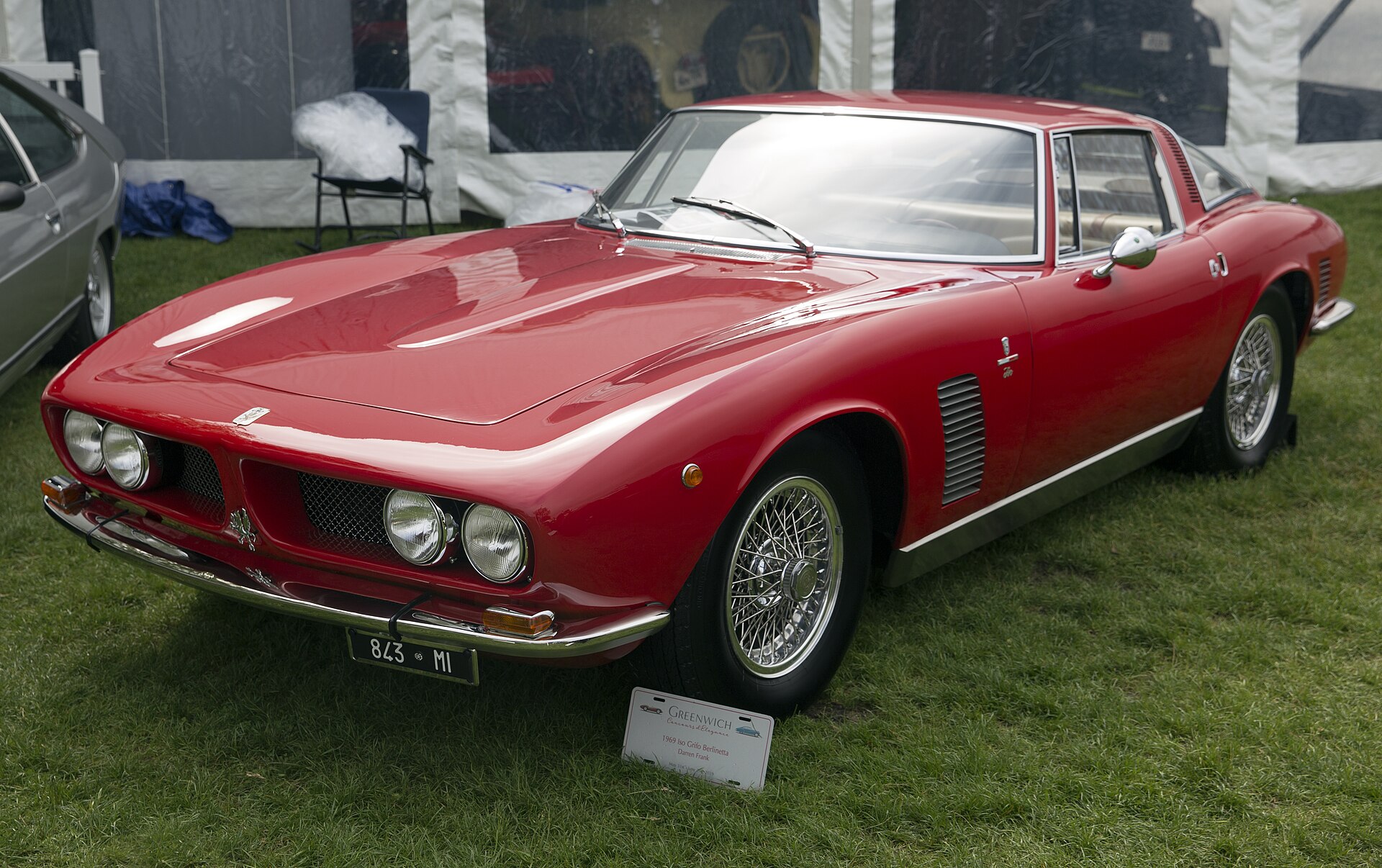
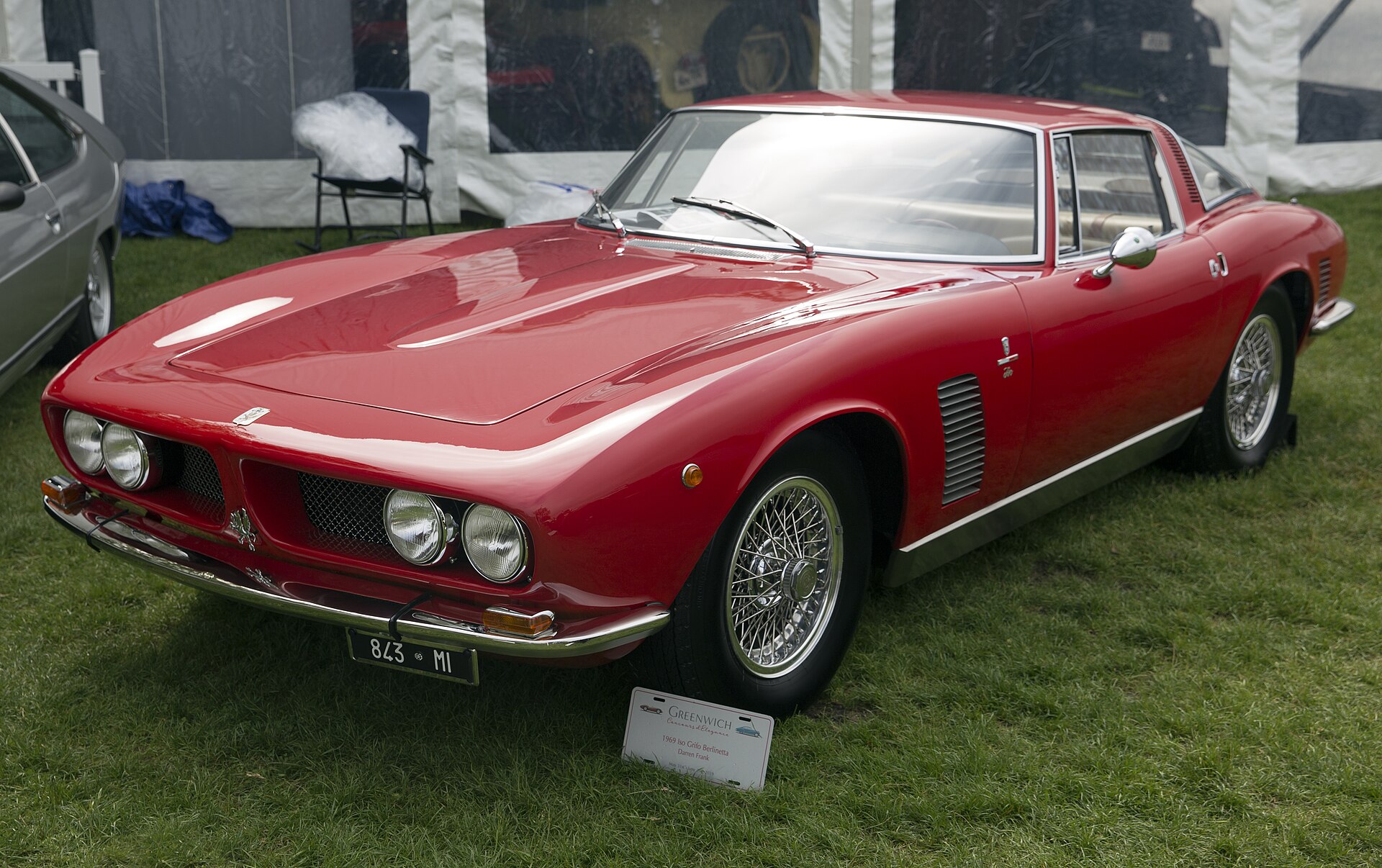
The Grifo itself went into production in 1965 and stayed until 1974. Giugiaro styled it at Bertone. With the 5.4-litre Chevrolet 327 it had 220 kW (300 hp) as standard and could pass 275 km/h. The 1968 7 Litri used the 7.0-litre Chevrolet 427 with an advertised minimum of 324 kW (435 hp), and Iso claimed 300 km/h for it. The Series II of 1970 had a new nose with hidden headlights and the 7.4-litre 454 V8.
In total 413 Grifos were built: 330 of the first series and 83 of the second, 90 of them with 7-litre engines. The Iso Grifo has its own page on 1cars, linked below.

Fidia, Lele and the end of Iso
Renzo Rivolta died suddenly on 20 August 1966, aged 57. His son Piero Rivolta, then about 25, took over. Two more models followed. The Fidia of 1968 was a luxury saloon with 221 or 257 kW (300 or 350 PS). The Lele of 1969 was a 2+2 coupé designed by Marcello Gandini.
At the end of 1971 Iso switched from Chevrolet to Ford Cleveland V8s because of General Motors' payment terms, and the Grifo IR8 and Fidia IR10 followed in 1972–1974. In 1972 Iso also took over Siata Spring assembly lines in Cagliari through a partnership with ORSA. In early 1973 the company was listed on the NYSE, and the Iso-Marlboro Formula One team was formed with Philip Morris and Frank Williams. The oil crisis of 1973 added financial pressure, and car production ended on 31 December 1974.

The Zagato revival
In 2017 Zagato revived the brand as ISO Rivolta. Its Vision concept was made for the video game Gran Turismo and, according to the company, adopted by more than 120,000 players. A road car, the GTZ, followed from 2019 with 485 kW (659 PS), in a planned run of only 19 cars.
The Iso cars listed on 1cars are in the Iso catalogue, and the best-known model has its own page on the Iso Grifo, Bizzarrini and the Chevrolet V8. The company that made the Isetta famous is covered in the history of BMW, and the source of the IR 300 engine in the history of the Chevrolet Corvette. For another post-war microcar, see the Messerschmitt KR200 bubble car.

Iso timeline
| Year | Event |
|---|---|
| 1939 | Renzo Rivolta buys Isothermos in Genoa |
| 1942 | Move to Bresso after a bombing raid |
| 1952 | Registered as Iso Autoveicoli SpA |
| 1953 | Isetta launched |
| 1954 | Isetta class win in the Mille Miglia |
| 1955 | BMW Isetta (April) and VELAM Isetta (June) |
| 1957 | Iso Rivolta founded; microcars and motorcycles end |
| 1962 | IR 300 shown in Turin |
| 1963 | Grifo A3/L and A3/C shown |
| 1965 | Grifo production begins; class win at Le Mans |
| 1966 | Renzo Rivolta dies (20 August) |
| 1968 | Fidia and Grifo 7 Litri |
| 1969 | Lele by Gandini |
| 1972 | Ford V8 models |
| 1974 | Car production ends (31 December) |
| 2017 | Zagato revives the brand |
Landmark Iso models
| Model | Years | Why it matters |
|---|---|---|
| Isetta | 1953–1955 (Italy) | Microcar licensed to BMW, VELAM and Romi |
| IR 300 | 1962–1970 | First Iso Rivolta GT; Giugiaro body, Chevrolet V8 |
| Grifo | 1965–1974 | Bizzarrini-engineered GT; 413 built |
| Fidia | 1968–1974 | Luxury saloon with a V8, Ford-engined IR10 from 1972 |
| Lele | From 1969 | 2+2 coupé designed by Marcello Gandini |
Photo gallery

FAQ
Did Iso invent the Isetta?
Yes. The Isetta was designed for Iso by Ermenegildo Preti and Pierluigi Raggi and built by Iso from 1953. BMW built it under licence from 1955.
What engines did Iso Rivolta cars use?
Chevrolet V8s until the end of 1971, mainly the 5.4-litre 327 and the 7.0-litre 427, then Ford Cleveland V8s from 1972.
How many Iso Grifos were made?
413: 330 of the first series and 83 of the second series, 90 of them with 7-litre engines.
Who designed the Iso Grifo?
Giorgetto Giugiaro at Bertone styled it, and Giotto Bizzarrini engineered the mechanical parts.
When did Iso stop making cars?
Car production ended on 31 December 1974. Zagato revived the name as ISO Rivolta in 2017.
Sources
- Wikipedia — Iso (automobile) (accessed 24 Oct 2026)
- Wikipedia — Iso Grifo (accessed 24 Oct 2026)
- Wikipedia — Isetta (accessed 24 Oct 2026)
- Wikipedia — Iso Rivolta IR 300 (accessed 24 Oct 2026)
- Wikipedia — Renzo Rivolta (accessed 24 Oct 2026)
Found a mistake? Report an error