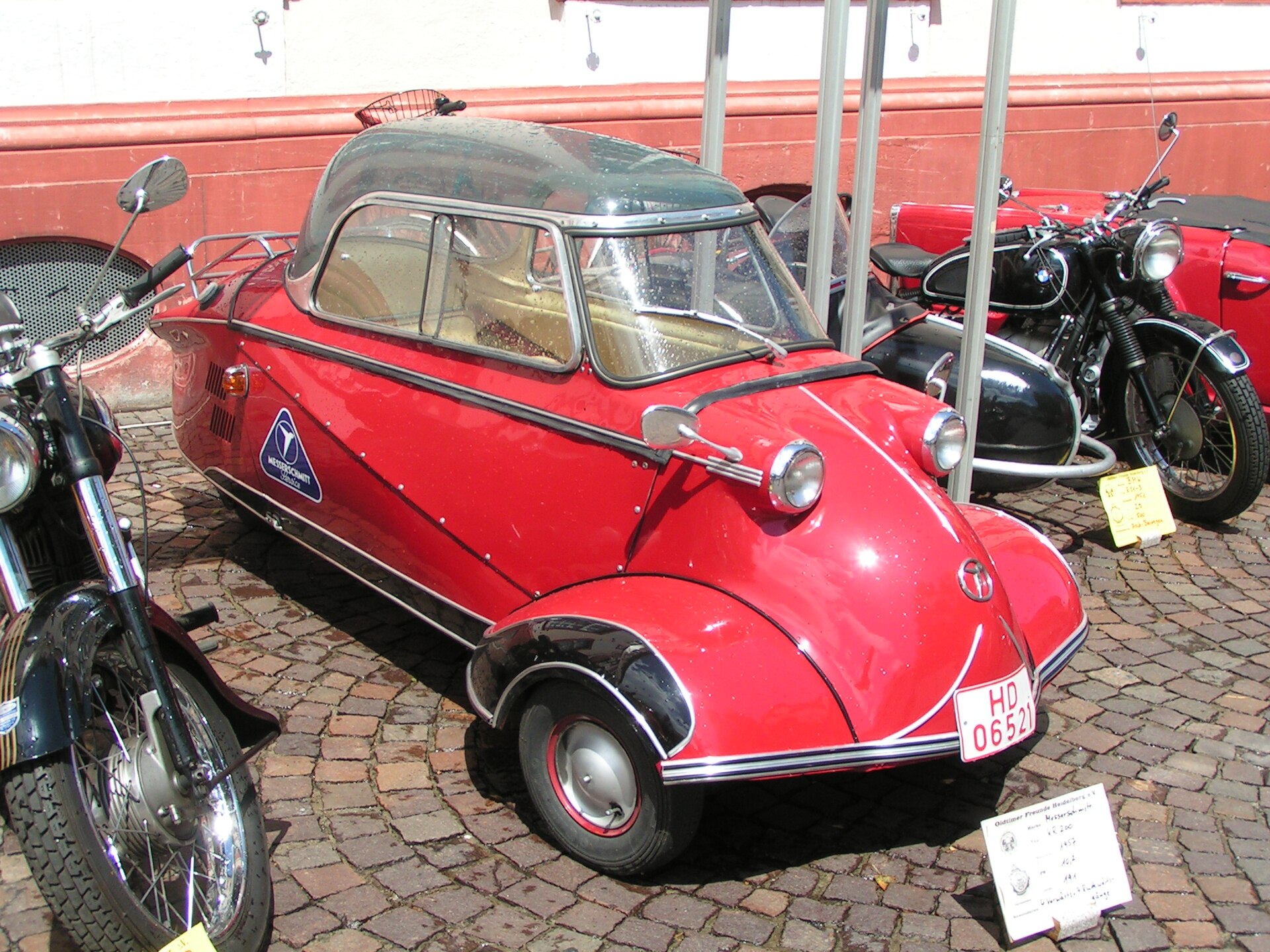
 Messerschmitt KR200
Specs, engines and history
Published Sources (1) Report an error
By Felix Hartmann, Automotive Technology & EV Contributor
- Built
- 1955–1964
- Top power
- 7 kW (10 PS)
Messerschmitt is best known as a German aircraft maker, but in the 1950s its name also appeared on small three-wheeled cars. After the war the company was temporarily not allowed to build aircraft, and its idle plant in Regensburg needed work. In January 1952 the aircraft engineer Fritz Fend, who had built single-seat "Flitzer" three-wheelers for disabled drivers in Rosenheim since 1948, brought his idea for a small two-seater to Messerschmitt. The result, the KR175, was shown at the Geneva Motor Show in 1953. KR stands for Kabinenroller, or "cabin scooter". When Messerschmitt could build aircraft again in 1956, it sold the car business to Fend, who continued it with Valentin Knott as FMR (Fahrzeug- und Maschinenbau GmbH Regensburg).
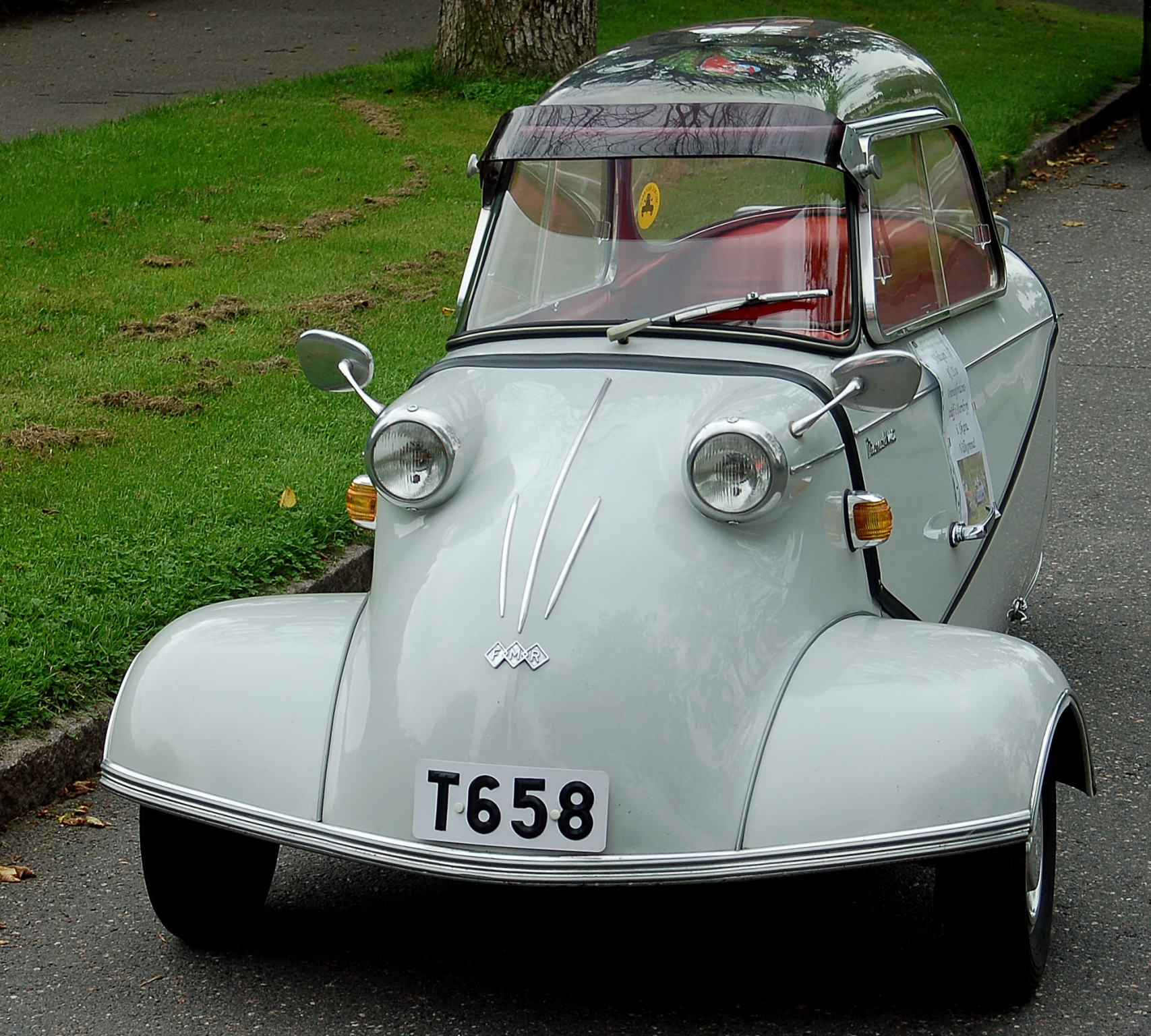
The KR200 is the Messerschmitt car people picture: a narrow three-wheeler with two seats one behind the other, an aircraft-style Plexiglas canopy and handlebar steering. Built in Regensburg from 1955 to 1964, it replaced the KR175 on the same basic frame. A 191 cc Fichtel & Sachs single-cylinder two-stroke of about 7.4 kW (10 PS) drives the single rear wheel, and the engine can run backwards to give four reverse gears. Almost 12,000 were built in the first year.
Specs by version
Engines
Dimensions and weight
Show all 1 versions
| Version | Kerb weight |
|---|---|
| 191 cc | 230 kg507 lb |
Verified Manufacturer and type-approval data from our catalog · Sources and methodology
In short
- Built by Messerschmitt and then FMR in Regensburg from 1955 to 1964; English Wikipedia gives about 41,190 in the infobox and 30,286 in the text.
- 191 cc Fichtel & Sachs single-cylinder two-stroke, air-cooled, 7.2–7.5 kW (9.7–10.2 PS), driving the rear wheel.
- Tandem seats, side-hinged Plexiglas canopy, handlebar steering, kerb weight 230–240 kg.
- Price in West Germany: 2,395 DM in 1955 (German Wikipedia), about 2,500 DM at launch (English Wikipedia).
Messerschmitt KR200 at a glance: maker, production years (1955–1964), purpose
| Parameter | Value |
|---|---|
| Maker | Messerschmitt, Regensburg; from 1956–1957 FMR (Fahrzeug- und Maschinenbau GmbH Regensburg) |
| Production | 1955 – 1964 |
| Built | about 41,190 (infobox) or 30,286 (text), both English Wikipedia |
| Purpose | low-cost two-seat economy car (microcar) |
| Body | three-wheeled cabin car with canopy; Kabrio, Roadster and Sport versions |
| Layout | rear engine, rear-wheel drive (single rear wheel) |
| Engine | Fichtel & Sachs single-cylinder two-stroke, 191 cc, air-cooled |
| Power | 7.2 kW (9.7 bhp) infobox; 7.4 kW (10 PS) text; 7.5 kW (10.2 PS) at 5,250 rpm (German Wikipedia) |
| Gearbox | four forward speeds; four reverse by running the engine backwards |
| Wheelbase | 2,029 mm (English Wikipedia); 2,030 mm (German Wikipedia) |
| Length × width × height | 2,819 × 1,219 × 1,199 mm |
| Kerb weight | 230 kg (English Wikipedia); 240 kg without driver (German Wikipedia) |
| Designer | Fritz Fend |
| Predecessor | Messerschmitt KR175 |
Development and production history
Fend's first vehicles were single-seat Flitzer invalid carriages. German Wikipedia counts 98 Flitzer 100s built between March 1949 and March 1950 and 154 later cars with a 98 cc Riedel engine, which reached 75 km/h. Willy Messerschmitt agreed to build only a two-seater, and prototypes called FK 150 were made in mid-1952 with a 150 cc Fichtel & Sachs engine. Series production of the KR175 began in Regensburg in January 1953. German Wikipedia counts 1,609 KR175s in 1953 and 8,644 in 1954; the launch price was 2,100 DM.
The KR200 replaced it in 1955. It kept the KR175 frame but had a bigger engine, a reworked rear suspension, hydraulic shock absorbers on all three wheels and a new canopy. Almost 12,000 KR200s were built in the first year, the best annual figure of any Messerschmitt cabin scooter.
In 1956, about a year after West Germany joined NATO, Messerschmitt was again allowed to build aircraft and lost interest in the cars. Fend and Valentin Knott, a supplier of brakes and hubs, formed FMR, which German Wikipedia dates as running production from 15 January 1957. Sales fell as the German economy boomed and the demand for basic transport shrank; in Britain, the Mini was becoming more popular. Production was heavily reduced in 1962 and ended in 1964.
Design and engineering
The tandem seating is the key to the design. It gave the car a narrow body with a small frontal area that tapers towards the back like an aircraft fuselage, and it kept the weight in the middle of the car, which helped the handling. It also meant that no separate left-hand-drive version was needed for export.
The KR200's larger curved windscreen forms the front pillars together with the side window frames, which made the canopy simpler and cheaper than the KR175's. The canopy is hinged at the side, and German Wikipedia mentions nicknames such as Schneewittchensarg ("Snow White's coffin"). The wiper is electric.
Instead of a steering wheel the driver holds a steering bar. Turning it acts directly on the front track rods, a system English Wikipedia calls "reminiscent of that of an aircraft". The two front wheels steer, and the single rear wheel is driven. Tyres are 4.00×8. The brake pedal operates mechanical brakes by cables.

Engine and drivetrain: two-stroke single and the reverse trick
The engine is a 191 cc Fichtel & Sachs single-cylinder two-stroke, air-cooled and mounted at the rear. The two Wikipedia articles give slightly different outputs: 7.2 kW (9.7 bhp), 7.4 kW (10 PS) and 7.5 kW (10.2 PS) at 5,250 rpm. The power converter shows how the old PS and bhp figures relate.
The gearbox has four forward gears and a sequential ratchet change. There is no normal reverse gear. To back up, the driver stops the engine and restarts it running the other way by pushing the ignition key further than usual, which gives four reverse gears. A mechanical reverse gear was available as an extra. With about 7.4 kW and 230 kg, the KR200 has about 32 kW per tonne; the power-to-weight calculator compares that with a modern city car.


Messerschmitt KR200 specifications
| Data | KR175 | KR200 |
|---|---|---|
| Years | 1953–1955 | 1955–1964 |
| Engine | single-cylinder two-stroke, 173 cc | single-cylinder two-stroke, 191 cc |
| Power | 6.6 kW (9 PS) at 5,250 rpm | 7.5 kW (10.2 PS) at 5,250 rpm |
| Top speed | 80 km/h | about 90 km/h |
| Weight without driver | 220 kg | 240 kg |
| Length × width × height | 2,820 × 1,220 × 1,200 mm | 2,820 × 1,220 × 1,200 mm |
| Wheelbase | 2,030 mm | 2,030 mm |
| Price (West Germany) | 2,100 DM at launch; 2,470 DM in 1955 | 2,395 DM in 1955 |
Figures in this table are from German Wikipedia. English Wikipedia gives a top speed of over 90 km/h in one place and about 105 km/h in another.
Variants and derivatives: Kabrio, Roadster, Sport and Tg500
| Version | Years | Notes |
|---|---|---|
| KR200 | 1955–1964 | cabin car with Plexiglas canopy |
| KR200 Export | — | more luxurious trim, not a different market version |
| KR201 Roadster | 1957–1964 | open roadster, built in very small numbers |
| KR200 Kabrio Limousine | from February 1958 | cloth convertible top |
| KR200 Sport | — | no roof, cut-down windscreen; 2,200 DM in 1958; the rarest type after the Super |
| KR200 Super | 1955 | modified record car |
| FMR Tg500 | 1957–1961 | four-wheeled derivative; 320–950 built (German Wikipedia); 3,650 DM in 1958–1960 |
On 29–30 August 1955 a modified KR200 Super ran for 24 hours at the Hockenheimring. With about 9.6 kW (13 PS) and closer upper gears, it averaged 103 km/h over the 24 hours. English Wikipedia counts 22 international class records; German Wikipedia counts 25 records in the 350 cc class, including a 2-hour record of 108 km/h, set by six drivers including Fritz Fend.
In service: operation and legacy
Britain was the KR200's largest export market, where Cabin Scooters (Assemblies) Ltd was the sole concessionaire. Demand for such basic economy transport shrank as the German economy boomed, and in Britain buyers turned to the Mini. Today owners' clubs for the cars exist in Britain, Germany and Australia, where The Australian Microcar and Scooter Club looks after them, and the Bruce Weiner Microcar Museum lists the KR200 among its entries.
Preservation and collecting today
Original KR200 Sport models are rare today, German Wikipedia notes, and the Roadster was built in very small numbers. Because the production totals conflict, no exact survival figure is given here, and no reliable public price data was found for this article.
Which Messerschmitt to choose:
- For the classic look: a KR200 cabin car with the bubble canopy.
- For open-air driving: a Kabrio Limousine with the cloth roof, or the rare KR201 Roadster.
- For rarity: an original KR200 Sport.
- For four wheels: the FMR Tg500, the four-wheeled derivative.
More cars of the time are in the 1950s classics and the classic cars section. All models of the brand are in the Messerschmitt catalogue.
Photo gallery

Messerschmitt KR200 in our rankings
- No. 393 of 912 · Longest-running car nameplates (9 years · top 49%)
- No. 124 of 124 · Most powerful German cars (7 kW)
- No. 858 of 859 · Most powerful cars (7 kW)
In production longer than 51% of ranked nameplates in the 1CARS catalog (No. 393 of 912).
FAQ
How does the Messerschmitt KR200 reverse?
The driver stops the engine and restarts it running backwards by pushing the ignition key further than usual; all four gears then work in reverse. A mechanical reverse gear was an option.
What engine does the KR200 have?
A 191 cc Fichtel & Sachs single-cylinder two-stroke, air-cooled, with 7.2–7.5 kW (9.7–10.2 PS) depending on the source.
How many Messerschmitt KR200s were built?
English Wikipedia gives about 41,190 in its infobox and 30,286 in its text; almost 12,000 were built in the first year.
Who designed the Messerschmitt KR200?
The aircraft engineer Fritz Fend, who developed it from his Flitzer invalid carriage and the KR175.
How fast is the KR200?
About 90 km/h according to German Wikipedia; a modified car averaged 103 km/h for 24 hours at Hockenheim in 1955.
Data sources
Data checked by an editor against the sources below.