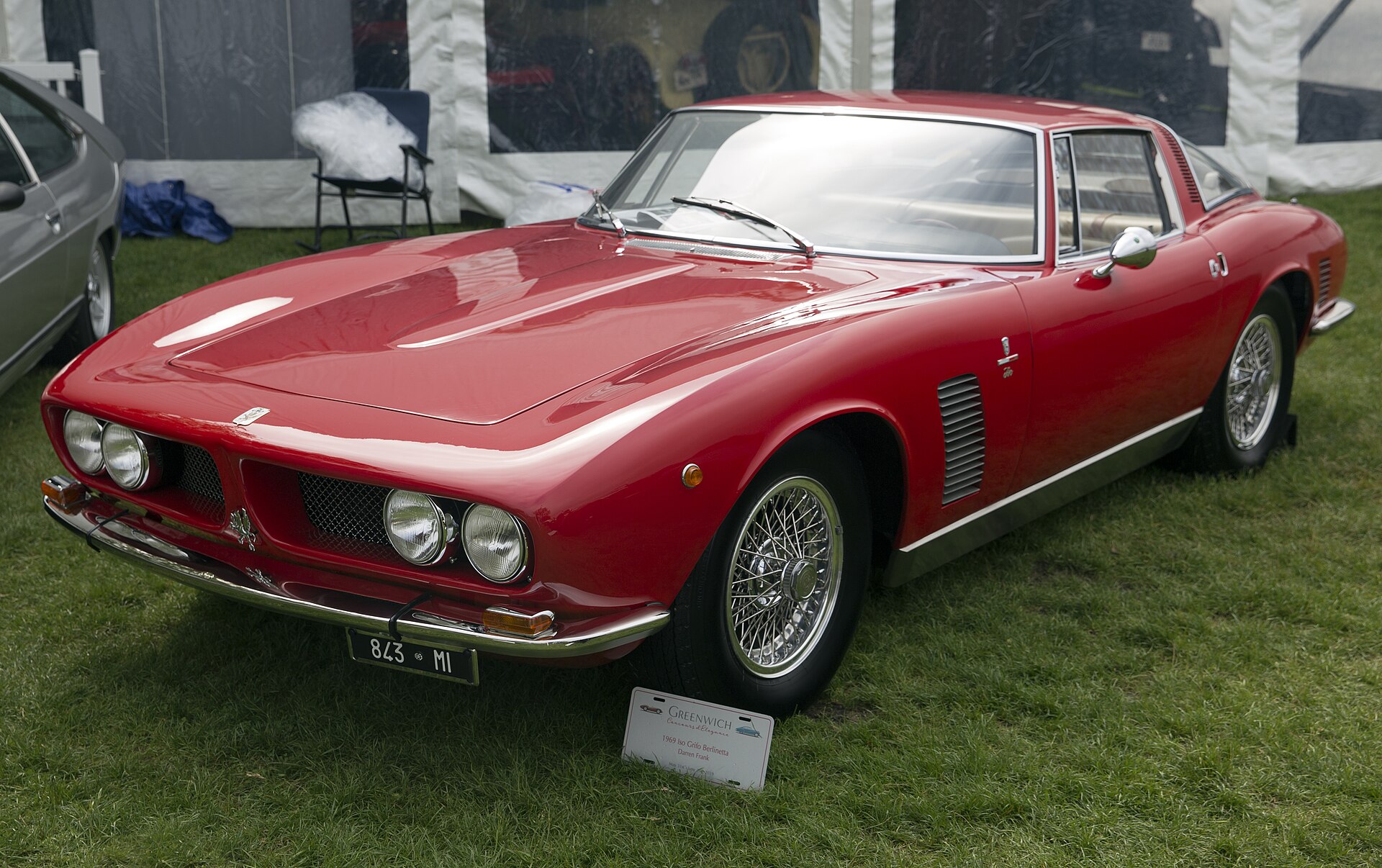
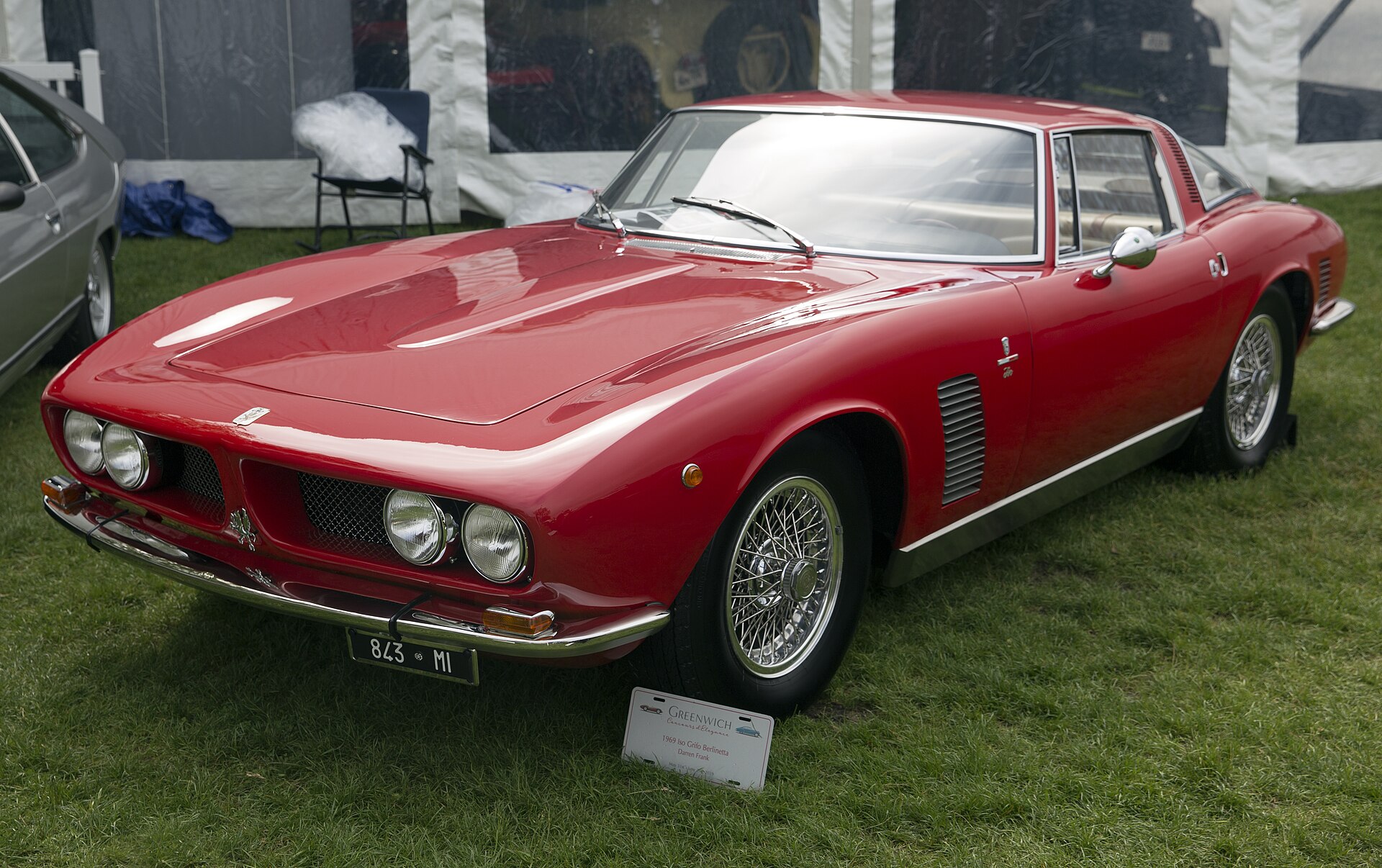
 Iso Grifo
Specs, engines and history
Published Sources (1) Report an error
By Felix Hartmann, Automotive Technology & EV Contributor
- Built
- 1965–1974
- Top power
- 324 kW (441 PS)
Iso was an Italian maker based in Bresso near Milan. Its roots go back to Isothermos, a maker of electric heaters and chillers in Bolzaneto near Genoa, which the engineer Renzo Rivolta bought in 1939; after bombing destroyed the Genoa offices, the company moved to Bresso in 1942. After the war Iso built motorcycles, and in 1953 it launched the Isetta bubble car, which was later built under licence by BMW (160,000 cars) and others. From 1962 Iso Rivolta turned to fast grand tourers with Chevrolet V8 engines: the Rivolta GT, the Grifo, the Fidia saloon and the Lele. Car production ended on 31 December 1974.
The Grifo is the Iso most collectors know. Built at Bresso from 1965 to 1974, this two-door coupé combined an Italian chassis designed by Giotto Bizzarrini and a body styled by Giorgetto Giugiaro at Bertone with American V8 power. Only 413 were made, 90 of them with the 7-litre engine. The Chevrolet 327 cars gave about 224–261 kW (300–350 hp), and the 7 Litri had at least 324 kW (435 hp), with a factory top speed claim of 300 km/h.
Specs by version
Verified Manufacturer and type-approval data from our catalog · Sources and methodology
In short
- Built at Bresso, Italy, 1965–1974; 413 cars (330 Series I, 83 Series II), 90 of them 7-litre.
- Chevrolet V8 engines: 5.4 l 327 with 224–261 kW (300–350 hp), 7.0 l 427 with 324 kW (435 hp); later 7.4 l Chevrolet 454 and 5.8 l Ford 351.
- Design: mechanicals by Giotto Bizzarrini, styling by Giorgetto Giugiaro at Bertone.
- Racing version A3/C: 22 made, 9th overall at Le Mans in 1965.
Iso Grifo at a glance: maker, production years (1965–1974), purpose
| Parameter | Value |
|---|---|
| Maker | Iso Rivolta (Iso Motors from 1973), Bresso, Italy |
| Production | 1965 – 1974 |
| Built | 413 (330 Series I, 83 Series II); 90 with 7-litre engines |
| Purpose | high-performance grand tourer |
| Body | two-door coupé; targa versions in small numbers |
| Layout | front engine, rear-wheel drive |
| Engines | Chevrolet 327 5.4 l V8; Chevrolet 427 7.0 l V8; Chevrolet 454 7.4 l V8; Ford 351 5.8 l V8 |
| Power | 224–261 kW (300–350 hp) with the 327; at least 324 kW (435 hp) with the 427 |
| Gearbox | Borg-Warner four-speed manual; ZF five-speed; three-speed automatic |
| Wheelbase | 2,500 mm |
| Length × width × height | 4,430 × 1,770 × 1,200 mm |
| Kerb weight | 1,430–1,610 kg |
| Designers | Giotto Bizzarrini (chassis), Giorgetto Giugiaro at Bertone (body) |
Development and production history
Renzo Rivolta commissioned the Grifo A3/L in 1963 as a faster, sportier companion to the Rivolta GT. Bertone showed the A3/L prototype at the 1963 Turin Motor Show, and Iso unveiled an unpainted A3/C competition version there too. The road car used the chassis of the GT 300 and entered production in 1965. That base car, the Iso Rivolta GT (IR 300) of 1962, was a luxury coupé styled by Bertone from Giugiaro's sketches and powered by a Chevrolet Corvette V8; with 221, 250 or 257 kW (300, 340 or 350 PS) it reached 205–258 km/h.
The partnership with Bizzarrini then broke down over the use of the Grifo name. Iso continued with the road-going Grifo GL, while Bizzarrini went on with the competition A3/C; only 22 A3/C cars were made before the split. Iso's own story ended in the 1970s. The company had listed on the New York Stock Exchange in 1973, and English Wikipedia names the cost of its Formula One team, falling sales, the 1973 oil crisis and strong rivals as reasons for its collapse. Iso stopped building cars on 31 December 1974.

Design and engineering
Giorgetto Giugiaro styled the Grifo at Bertone, and the shape changed little over nine years. The coupé is low: 1,200 mm high on a 2,500 mm wheelbase and 4,430 mm long. The first targa-top Grifo, car number 97, was shown at the October 1966 Turin Motor Show. In 1970 the Series II arrived with a sleeker nose and hidden headlights.
Under the body sits the chassis of the Iso GT 300, with the V8 at the front driving the rear wheels. Weights range from 1,430 to 1,610 kg depending on version, and Bizzarrini was responsible for the mechanical design. Another Bertone designer, Marcello Gandini, later designed the Iso Lele.

Engine and drivetrain: Chevrolet and Ford V8s
The standard engine was the 5.4-litre Chevrolet 327 V8, with 224 kW (300 hp) in standard form and up to 261 kW (350 hp) in the stronger versions. English Wikipedia says the 327 car reached 110 km/h in first gear and could pass 275 km/h. In 1968 Iso added the 7.0-litre Chevrolet 427 Tri-Power L71, with an advertised minimum of 324 kW (435 hp) at 5,800 rpm; Iso claimed 300 km/h for this 7 Litri. The Series II IR-9 "Can Am" used the 7.4-litre Chevrolet 454, and from 1972 the IR-8 had a 5.8-litre Ford 351 V8.
Most cars had a Borg-Warner four-speed manual. A ZF five-speed was used in some targas and in 23 Series II cars, and a three-speed automatic was listed. With 324 kW and about 1,430 kg, the 7-litre car has about 227 kW per tonne. The power-to-weight calculator and the power converter put those figures against modern cars.
Iso Grifo specifications
| Version | Engine | Power | Top speed (claim) |
|---|---|---|---|
| Grifo GL (Series I) | Chevrolet 327, 5.4 l V8 | 224–261 kW (300–350 hp) | over 275 km/h |
| Grifo 7 Litri | Chevrolet 427, 7.0 l V8 | 324 kW (435 hp) at 5,800 rpm | 300 km/h |
| Grifo IR-9 "Can Am" (Series II) | Chevrolet 454, 7.4 l V8 | not stated in the source | - |
| Grifo IR-8 (from 1972) | Ford 351, 5.8 l V8 | not stated in the source | - |
| Data | Value |
|---|---|
| Wheelbase | 2,500 mm |
| Length / width / height | 4,430 / 1,770 / 1,200 mm |
| Kerb weight | 1,430–1,610 kg |
| Gearboxes | Borg-Warner 4-speed; ZF 5-speed; 3-speed automatic |
Variants and derivatives: GL, 7 Litri, targa and A3/C
| Version | Years | Built / notes |
|---|---|---|
| Grifo A3/L | 1963 | prototype by Bertone |
| Grifo GL Series I | 1965–1970 | 330 Series I cars in total |
| Grifo targa (Series I) | from 1966 | 14 built |
| Grifo 7 Litri | 1968–1970 | part of the 90 seven-litre cars |
| Grifo Series II | 1970–1974 | 83 built; hidden headlights; 23 with five speeds, 4 targas |
| Grifo IR-8 | 1972–1974 | Ford 351 V8 |
| Grifo A3/C | 1964–1965 | competition car, 22 made |

In service: the A3/C at Le Mans and the end of Iso
The A3/C was built by Piero Drogo's Sports Cars in Modena under Bizzarrini's supervision, on a much smaller budget than Ferrari's racing cars. At Le Mans in 1964, Edgar Berney and Pierre Noblet finished 14th overall despite a two-hour stop to repair the brakes. In 1965 an A3/C finished 9th overall.
English Wikipedia names the 1973 oil crisis, which cut demand for large-engined cars, as the main reason for the end. Iso went bankrupt in 1974. By then the Grifo had been joined by the Fidia saloon of 1968 and the Lele 2+2 of 1969, and from 1972 the range also used Ford V8s in the IR-6 Lele, IR-8 Grifo and IR-10 Fidia. Atelier Zagato revived the Iso Rivolta name in 2017, and the GTZ of 2019 onwards, limited to 19 cars, has 485 kW (659 PS) and a top speed of 298 km/h.
Preservation and collecting today
With 413 cars made, every Grifo is rare, and English Wikipedia describes them as desirable collectibles today. The rarest are the Series II targas (4 built) and the Series II five-speed cars (23). The 7-litre cars, 90 in all, are the most powerful. No reliable public price data in euros was found for this article, so no market values are given.
Which Grifo to choose:
- For the original shape: a Series I GL with the 327 V8.
- For the most power: a 7 Litri with the 427.
- For open-air driving: one of the 14 Series I or 4 Series II targas.
- For racing history: an A3/C, the Le Mans car.
More Italian grand tourers are in the 1960s classics and the classic cars section. Iso models are listed in the Iso catalogue.
Iso Grifo in our rankings
- No. 3 of 94 · Most powerful cars of the 1960s (324 kW)
- No. 246 of 859 · Most powerful cars (324 kW · top 29%)
- No. 65 of 154 · Most powerful V8 cars (324 kW · top 43%)
- No. 137 of 313 · Most powerful coupes (324 kW · top 44%)
- No. 56 of 127 · Most powerful Italian cars (324 kW · top 45%)
- No. 395 of 912 · Longest-running car nameplates (9 years · top 49%)
More powerful than 96% of ranked cars of the 1960s in the 1CARS catalog (No. 3 of 94).
FAQ
How many Iso Grifos were built?
413 between 1965 and 1974: 330 Series I and 83 Series II cars, 90 of them with the 7-litre engine.
What engine does the Iso Grifo have?
Chevrolet V8s: the 5.4-litre 327 with 224–261 kW (300–350 hp) and the 7.0-litre 427 with 324 kW (435 hp); later cars used the 7.4-litre Chevrolet 454 or the 5.8-litre Ford 351.
Who designed the Iso Grifo?
Giotto Bizzarrini designed the mechanicals, and Giorgetto Giugiaro styled the body at Bertone.
How fast is the Iso Grifo?
The 327 car could pass 275 km/h, and Iso claimed 300 km/h for the 7 Litri.
Why did Iso stop making cars?
The company went bankrupt in 1974; the oil crisis, falling sales and the cost of its Formula One team are given as causes.
Data sources
Data checked by an editor against the sources below.