
 BMW i7
Specs, engines and history
Published Sources (2) Report an error
By Oleksandr Hnatiuk, Automotive Editor & Used Car Specialist
- Built
- 2022–present
- Top power
- 500 kW (680 PS)
Which i7 to choose
Our verdict · Oleksandr Hnatiuk
For long-distance work the i7 60 xDrive is the strongest all-rounder: 400 kW, all-wheel drive and up to 727 km WLTP for EUR 140,100 in Germany in 2026. The i7 50 xDrive has the same battery and the longest rated range, 728 km, for EUR 18,700 less. The M70 makes sense only if acceleration matters more than range: it is the quickest i7 and the least efficient, at 19.7 to 22.9 kWh/100 km WLTP. On the used market, cars built before mid-2026 have the 101.7 kWh battery and 195 kW charging, and the eDrive50 is the only rear-wheel-drive i7. Every other BMW model, electric or not, is listed in the BMW catalogue. For the closest rival, read BMW i7 vs Mercedes-Benz EQS.
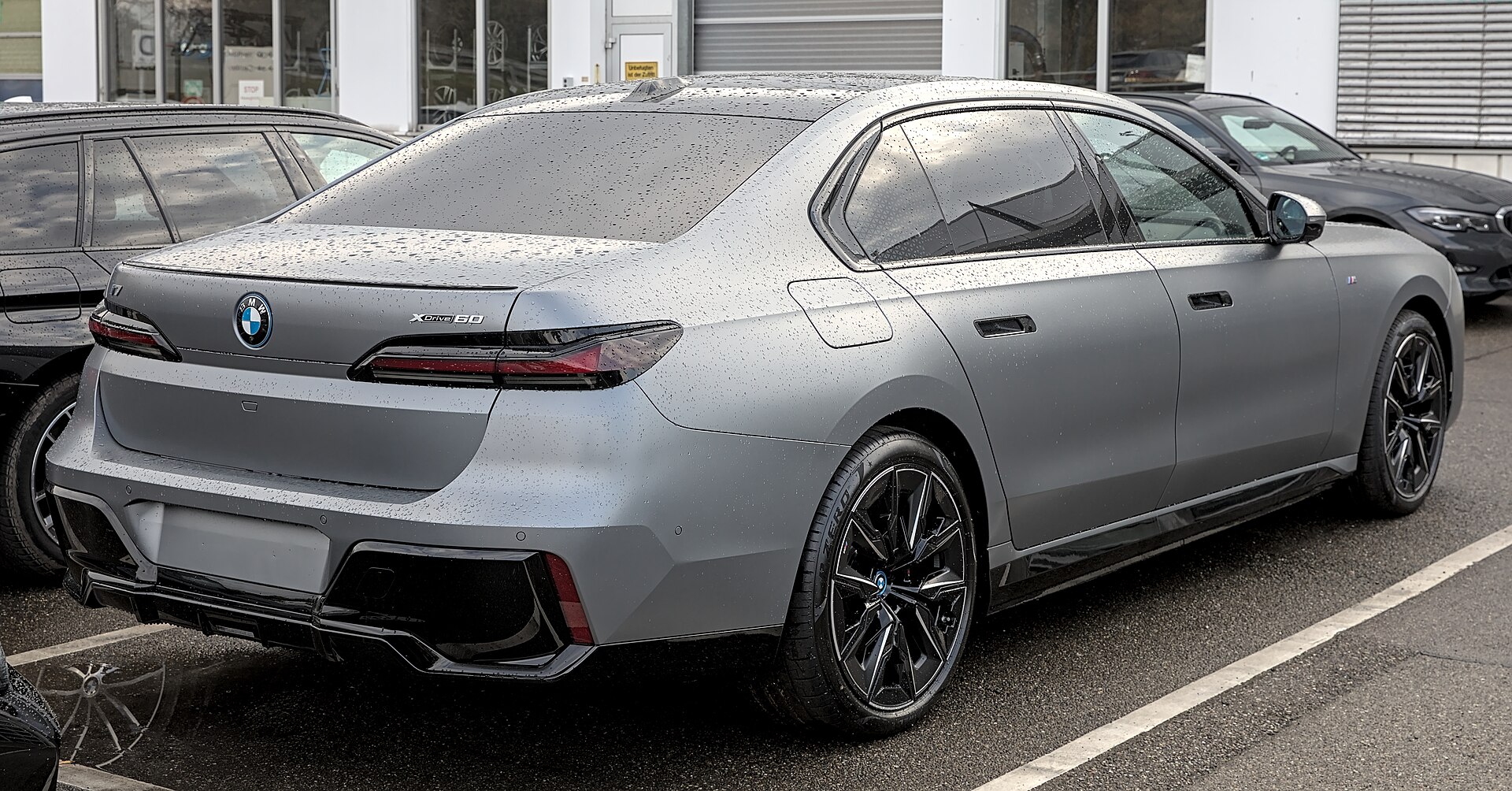
The BMW i7 is the battery-electric version of the seventh-generation 7 Series (G70), built at Dingolfing in Germany since July 2022. It shares its body, cabin and assembly line with the petrol, diesel and plug-in hybrid 7 Series. Before the 2026 facelift it used a 101.7 kWh usable battery; the updated car switches to 112.5 kWh and quotes up to 728 km WLTP.
In short
- One generation (G70) since 2022 on the CLAR platform; eDrive50, xDrive60 and M70 xDrive from 335 kW (455 PS) to 485 kW (659 PS).
- 5,391 mm (212.2 in) long on a 3,215 mm wheelbase, 500-litre boot, kerb weight 2,595 to 2,770 kg.
- Facelift revealed on 22 April 2026: 112.5 kWh net, 250 kW DC charging, still a 400-volt system, M70 raised to 500 kW (680 PS).
- German list prices for the facelift from EUR 121,400 (i7 50 xDrive) to EUR 182,400 (M70) in 2026.
Size at a glance
| Dimensions | BMW i7 G70 |
|---|---|
| Length | 5,391 mm212.2 in |
| Width | 1,950 mm76.8 in |
| Height | 1,544 mm60.8 in |
| Wheelbase | 3,215 mm126.6 in |
| Boot | 500 L17.7 cu ft |
Specs by version
Engines
| Version | Engine | Power | Torque | Gearbox | Drive | Production years |
|---|---|---|---|---|---|---|
| eDrive50 101.7 kWh | Electric | 335 kW 455 PS449 hp | 650 Nm479 lb-ft | 1-sp Single-speed | Rear-wheel drive | 2023–2026 |
| i7 50 xDrive 112.5 kWh | Electric | 335 kW 455 PS449 hp | 660 Nm487 lb-ft | 1-sp Single-speed | All-wheel drive | 2026 |
| xDrive60 101.7 kWh | Electric | 400 kW 544 PS536 hp | 745 Nm549 lb-ft | 1-sp Single-speed | All-wheel drive | 2022–2026 |
| i7 60 xDrive 112.5 kWh | Electric | 400 kW 544 PS536 hp | 745 Nm549 lb-ft | 1-sp Single-speed | All-wheel drive | 2026 |
| M70 xDrive 101.7 kWh | Electric | 485 kW 659 PS650 hp | 1,100 Nm811 lb-ft | 1-sp Single-speed | All-wheel drive | 2023–2026 |
| M70 xDrive 112.4 kWh | Electric | 500 kW 680 PS671 hp | - | 1-sp Single-speed | All-wheel drive | 2026 |
Performance
Show all 6 versions
| Version | 0–100 km/h | Top speed | Fuel consumption | Range |
|---|---|---|---|---|
| eDrive50 101.7 kWh | 5.5 s 0–62 mph | 205 km/h127 mph | - | - |
| i7 50 xDrive 112.5 kWh | 5.5 s 0–62 mph | 210 km/h130 mph | 18.1 kWh/100 km29.1 kWh/100 mi | 728 km452 mi |
| xDrive60 101.7 kWh | 4.7 s 0–62 mph | 240 km/h149 mph | - | 625 km388 mi |
| i7 60 xDrive 112.5 kWh | 4.8 s 0–62 mph | 240 km/h149 mph | 18.2 kWh/100 km29.3 kWh/100 mi | 727 km452 mi |
| M70 xDrive 101.7 kWh | 3.7 s 0–62 mph | 250 km/h155 mph | - | 560 km348 mi |
| M70 xDrive 112.4 kWh | 3.8 s 0–62 mph | 250 km/h155 mph | 19.7 kWh/100 km31.7 kWh/100 mi | 686 km426 mi |
Dimensions and weight
Show all 6 versions
| Version | Length | Width | Height | Wheelbase | Kerb weight | Boot | Battery |
|---|---|---|---|---|---|---|---|
| eDrive50 101.7 kWh | 5,391 mm212.2 in | 1,950 mm76.8 in | 1,544 mm60.8 in | 3,215 mm126.6 in | 2,595 kg5,721 lb | 500 l17.7 cu ft | 102 kWh |
| i7 50 xDrive 112.5 kWh | 5,391 mm212.2 in | 1,950 mm76.8 in | 1,544 mm60.8 in | 3,215 mm126.6 in | - | 500 l17.7 cu ft | 112 kWh |
| xDrive60 101.7 kWh | 5,391 mm212.2 in | 1,950 mm76.8 in | 1,544 mm60.8 in | 3,215 mm126.6 in | 2,640 kg5,820 lb | 500 l17.7 cu ft | 102 kWh |
| i7 60 xDrive 112.5 kWh | 5,391 mm212.2 in | 1,950 mm76.8 in | 1,544 mm60.8 in | 3,215 mm126.6 in | - | 500 l17.7 cu ft | 112 kWh |
| M70 xDrive 101.7 kWh | 5,391 mm212.2 in | 1,950 mm76.8 in | 1,544 mm60.8 in | 3,215 mm126.6 in | 2,695 kg5,941 lb | 500 l17.7 cu ft | 102 kWh |
| M70 xDrive 112.4 kWh | 5,391 mm212.2 in | 1,950 mm76.8 in | 1,544 mm60.8 in | 3,215 mm126.6 in | - | 500 l17.7 cu ft | 112 kWh |
Verified Manufacturer and type-approval data from our catalog · Sources and methodology
BMW i7 at a glance
| Specification | BMW i7 |
|---|---|
| Segment and body | luxury four-door saloon, five seats |
| Production | since July 2022, Dingolfing, Germany |
| Platform | CLAR, shared with the combustion 7 Series |
| Drive | rear motor (eDrive50) or two motors and all-wheel drive |
| Power | 335 kW (455 PS) to 485 kW (659 PS); facelift M70 500 kW (680 PS) |
| Battery | 101.7 kWh net (105.7 kWh gross); 112.5 kWh net from 2026 |
| WLTP range | 488-625 km; facelift 566-728 km |
| Charging | 195 kW DC, 11 kW AC (22 kW optional); facelift 250 kW DC, 22 kW AC |
| Length and wheelbase | 5,391 mm and 3,215 mm |
| Boot | 500 l (540 l in combustion 7 Series) |
| EPA range (US, 2024) | 274-321 miles (441-517 km) |
| Price from | EUR 121,400 in Germany (i7 50 xDrive, 2026) |
An electric 7 Series on the same line as the V8
BMW did not give its electric flagship a separate body. The G70 was designed from the start to carry three kinds of drive: combustion engines, a plug-in hybrid and the battery pack of the i7. The car is built on the same Dingolfing line as the 740d, 750e and 760i. Production began in July 2022 with the i7 xDrive60, which reached customers from November 2022. The rear-wheel-drive eDrive50 and the M70 xDrive followed in May 2023.
Sharing the body with the combustion cars has a clear upside and one cost. The i7 keeps the long-wheelbase proportions that chauffeur-driven buyers expect, and it offers an optional 31.3-inch theatre screen for the rear seats. The battery under the floor takes some space: the boot holds 500 litres, against 540 litres in the combustion cars. China was expected to take about 45 percent of all 7 Series sales, which is why the long body and rear-seat equipment matter so much.

Battery and motors from launch to 2026
The original pack holds 105.7 kWh gross and 101.7 kWh usable and runs at about 376 volts nominal. BMW kept a 400-volt system even after the 2026 update, while Mercedes uses 800 volts in its newest electric saloons. The eDrive50 uses one motor on the rear axle; the other versions add a second motor at the front.
| Version | Years | Power | Torque | 0-100 km/h | WLTP range |
|---|---|---|---|---|---|
| i7 eDrive50 (RWD) | 2023-2026 | 335 kW (455 PS) | 650 Nm | 5.5 s | 575-611 km |
| i7 xDrive60 | 2022-2026 | 400 kW (544 PS) | 745 Nm | 4.7 s | 591-625 km |
| i7 M70 xDrive | 2023-2026 | 485 kW (659 PS) | 1,100 Nm | 3.7 s | 488-560 km |
| i7 50 xDrive (facelift) | from 2026 | 335 kW (455 PS) | 660 Nm | 5.5 s | 591-728 km |
| i7 60 xDrive (facelift) | from 2026 | 400 kW (544 PS) | 745 Nm | 4.8 s | 581-727 km |
| i7 M70 xDrive (facelift) | from 2026 | 500 kW (680 PS) | 1,015-1,100 Nm | 3.8 s | 566-686 km |
The facelifted car drops the rear-drive model, so every i7 now has xDrive. Top speeds are 210 km/h for the i7 50, 240 km/h for the i7 60 and 250 km/h for the M70. Torque figures for the new M70 vary between sources: one German outlet lists 1,015 Nm, another 1,100 Nm.


Charging times before and after the facelift
At launch the i7 accepted up to 195 kW on a CCS charger and took about 34 minutes from 10 to 80 percent, according to InsideEVs Germany. AC charging on the early cars runs at 11 kW as standard, with 22 kW as an option in Europe; a full charge at 11 kW takes about 11 hours for the xDrive60. InsideEVs Germany lists 22 kW AC as standard on the facelift. The 2026 car uses round cells from BMW's sixth-generation eDrive technology, packed in conventional modules rather than cell-to-pack. Peak DC power rises to 250 kW, the current to 630 amps, and the 10 to 80 percent stop falls to 28 or 29 minutes depending on the source.
BMW i7 EPA range and US prices
In the United States the i7 is rated on 19-, 20- and 21-inch wheels. For model year 2024 the EPA gave the eDrive50 321 miles (517 km) on 19-inch wheels, the xDrive60 317 miles (510 km) and the M70 291 miles (468 km) on 21-inch wheels. Consumption ranged from 374 Wh per mile for the most frugal versions to 438 Wh per mile for the M70 on 20-inch wheels, equal to about 23 to 27 kWh/100 km. Base prices in 2023 were USD 105,700 for the eDrive50, USD 124,200 for the xDrive60 and USD 168,500 for the M70, plus USD 995 destination. For the facelift BMW quotes up to 563 km (350 miles) EPA.
The 2026 facelift with Neue Klasse screens
BMW revealed the updated 7 Series and i7 on 22 April 2026. Orders opened on 28 May 2026 and production at Dingolfing started in July 2026. Outside, the car gets new lights with optional crystal elements, a reshaped illuminated grille and bonnet, new tail lamps and the first 22-inch wheels on a 7 Series. The dashboard follows the Neue Klasse layout first seen in the iX3: Panoramic Vision across the base of the windscreen, a 17.9-inch central touchscreen, a 3D head-up display and a 14.6-inch screen for the front passenger. The rear theatre screen stays on the options list.
German prices went up with the bigger battery. The previous i7 started at EUR 115,900; the facelift costs EUR 121,400 as an i7 50 xDrive, EUR 140,100 as an i7 60 xDrive and EUR 182,400 as an M70 in 2026. The two lower versions are rated to tow 2,000 kg (4,409 lb).
BMW i7 against the EQS and the i5
The main rival is the Mercedes-Benz EQS, which uses a dedicated electric platform and a liftback body instead of a saloon boot. Mercedes moved the facelifted EQS to 800 volts in April 2026, quoting up to 926 km WLTP and up to 350 kW of DC power. The i7 answers with a more traditional saloon shape, a longer cabin and the option of a combustion twin for buyers who are not ready to switch. Within BMW, the BMW i5 uses the same idea one size down: an electric version of a combustion saloon. The previous 7 Series generations are covered in our guide to the BMW 7 Series E23, E32 and E38.
Photo gallery

Popular comparisons
BMW i7 in our rankings
- No. 1 of 87 · Heaviest sedans (2,695 kg)
- No. 3 of 110 · Most torque: sedans (1,100 Nm)
- No. 4 of 66 · Quickest sedans, 0–100 (3.7 s)
- No. 6 of 126 · Longest-range electric cars (728 km)
- No. 8 of 129 · Longest sedans (5,391 mm)
- No. 8 of 120 · Widest sedans (1,950 mm)
Heavier than 98% of ranked sedans in the 1CARS catalog (No. 1 of 87).
FAQ
What is the range of the BMW i7?
The facelifted i7 introduced in 2026 reaches up to 728 km WLTP as an i7 50 xDrive and 727 km as an i7 60 xDrive. Cars built from 2022 to 2026 with the 101.7 kWh battery are rated at up to 625 km WLTP.
How fast does the BMW i7 charge?
Since the 2026 facelift the i7 charges at up to 250 kW and needs about 28 to 29 minutes from 10 to 80 percent. Earlier cars peak at 195 kW and take about 34 minutes for the same charge.
How much does the BMW i7 cost?
In Germany the facelifted BMW i7 costs from EUR 121,400 in 2026 as an i7 50 xDrive, EUR 140,100 as an i7 60 xDrive and EUR 182,400 as an M70. The pre-facelift car started at EUR 115,900; US prices for 2023 began at USD 105,700.
Is the BMW i7 an 800-volt car?
No. Both the original i7 and the 2026 facelift use a 400-volt system. The 2026 car gets new round cells with 112.5 kWh net capacity, but BMW did not switch to 800 volts.
Where is the BMW i7 built?
At BMW's Dingolfing plant in Bavaria, on the same line as the combustion and plug-in hybrid 7 Series. Production started in July 2022; the facelifted car followed in July 2026.
Data sources
Data checked by an editor against the sources below.
- Wikipedia - BMW 7 Series (G70)
- Insideevs - Bmw I7 Facelift2026 Daten Preise


