
BMW i7 vs Mercedes-Benz EQS: electric luxury saloons
Updated Report an error By Felix Hartmann

BMW · 2022–present
i7 G70
- Power
- 400 kW544 PS
- 0–100 km/h
- 4.7 s
- Top speed
- 240 km/h
- Kerb mass
- 2,640 kg

Mercedes-Benz · 2021–present
EQS V297
Price from €97,806 (2021)
- Power
- 385 kW523 PS
- 0–100 km/h
- 4.3 s
- Top speed
- 210 km/h
- Kerb mass
- 2,784 kg
At a glance
Who suits what, worked out from the catalog figures of the versions above.
Categories won: i7 G70 0 EQS V297 1
- City EQS V297 Length: 5,216 mm vs 5,391 mm
- Performance Too close to call Power per tonne: 152 kW/t vs 138 kW/t
- Off-road Too close to call Drive and body: All-wheel drive · Sedan vs All-wheel drive · Liftback
Verdict Opinion
On paper the EQS wins most of the measurable contests. It goes further on a charge, charges faster, carries 110 litres more luggage and is available with rear-wheel drive from EUR 94,403.
The i7 is the better car for buyers who want a conventional long saloon with a separate boot, a 2,000 kg towing limit, the rear theatre screen and the 500 kW M70, the most powerful version of both updated ranges.
- Felix Hartmann
The EQS was revealed on 15 April 2021 and has been built since May 2021 at Factory 56 in Sindelfingen, on a platform designed only for electric cars. BMW took the opposite route: the i7 is the battery-electric version of the G70 7 Series, successor to the 7 Series G11/G12, and has been built since July 2022 at Dingolfing on the same line as the combustion cars.
Both cars were updated within eight days of each other in April 2026. BMW kept its 400-volt system and fitted a 112.5 kWh battery; Mercedes moved the Mercedes-Benz EQS to 800 volts with 112 or 122 kWh. The figures below are for the updated cars, with earlier ones where used buyers need them.
BMW i7 vs Mercedes-Benz EQS: range, charging and space
Body and dimensions
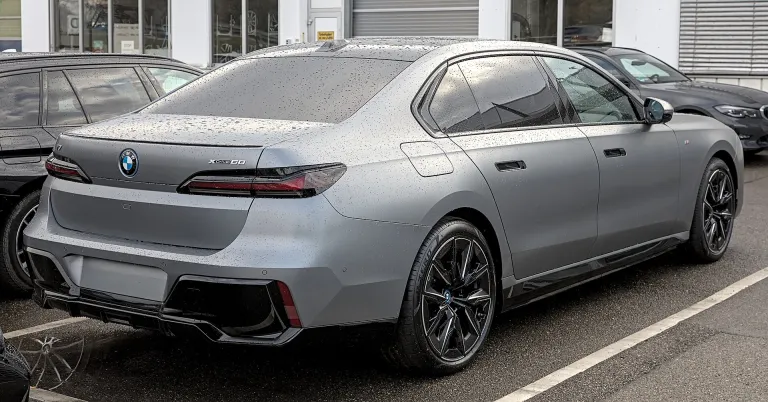
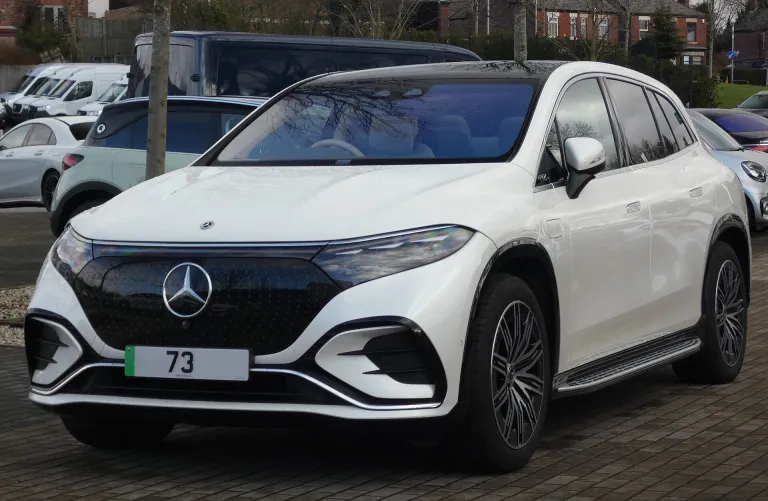
The i7 is a four-door saloon 5,391 mm (212.2 in) long on a 3,215 mm wheelbase. The EQS is a five-door liftback 5,216 mm (205.4 in) long on a 3,210 mm wheelbase, so the BMW is 175 mm longer while the distance between the axles is almost identical. The Mercedes was shaped for low drag, with a Cd of 0.20, and offers rear-axle steering of up to 10 degrees.
Power and acceleration after the 2026 updates
Every updated i7 has two motors and xDrive: the i7 50 xDrive with 335 kW (455 PS) and 5.5 seconds to 100 km/h, the i7 60 xDrive with 400 kW (544 PS) and 4.8 seconds, and the M70 xDrive with 500 kW (680 PS) and 3.8 seconds. Mercedes still offers rear-wheel drive. The EQS 400 has 270 kW (367 PS) and needs 6.2 seconds, the EQS 450+ 300 kW (408 PS) and 5.9 seconds. The 4MATIC models reach 350 kW (476 PS) and 4.5 seconds as the EQS 500, and 430 kW (585 PS) and 4.1 seconds as the EQS 580.
Battery and WLTP range
The updated i7 uses 112.5 kWh net and is rated at 566 to 728 km WLTP. The EQS 400 has 112 kWh and 810 km, while the 450+, 500 4MATIC and 580 4MATIC share 122 kWh; the 450+ reaches 926 km and the two 4MATIC versions 869 km. Before its update the i7 used 101.7 kWh for 488 to 625 km.
Charging: 400 against 800 volts
The facelifted i7 charges at up to 250 kW DC and needs 28 or 29 minutes from 10 to 80 percent, depending on the source; the early car managed 195 kW and about 34 minutes. The 800-volt EQS peaks at 350 kW and needs 27 minutes for its 122 kWh pack, or 25 minutes in the EQS 400. On older 400-volt chargers the EQS splits its battery into two halves that each accept up to 175 kW.
Boot, towing and safety
The EQS holds 610 litres against 500 litres in the i7, whose battery costs 40 litres compared with the combustion 7 Series. The i7 50 and i7 60 may tow 2,000 kg (4,409 lb); the updated EQS is rated at 1,600 kg with rear-wheel drive and 1,700 kg with 4MATIC. Euro NCAP gave the EQS 450+ five stars in 2021. No Euro NCAP result has been published for the G70.
German prices in 2026
The i7 starts at EUR 121,400 for the i7 50 xDrive and costs EUR 140,100 as an i7 60 xDrive and EUR 182,400 as an M70 in Germany in 2026. The EQS costs EUR 94,403 as an EQS 400, EUR 108,635 as a 450+ and EUR 134,732 as a 580 4MATIC. That makes the 430 kW EQS 580 EUR 5,368 cheaper than the 400 kW i7 60.
Race Stats side by side
Each figure is a 0–100 score from the catalog numbers, the same as on the 1CARS Race cards. PI is the overall performance index (100–999) and its class D–S.
| Stat | i7 G70 | EQS V297 |
|---|---|---|
| PI | A · 607 | B · 585 |
| Power | 63 | 60 |
| Grip | 55 | 54 |
| Handling | 37 | 35 |
| Top speed | 54 | 42 |
| Launch | 67 | 71 |
Grip and handling are estimates from drive type, weight, height and body (hover a figure to see where it comes from). 1CARS Race
Who wins a race?
Quarter-mile (402 m) drag from a standing start, dry road, no reaction time - the 1CARS Race physics on the catalog figures of these versions.
- 1 EQS V297580 4MATIC · electric · 385 kW (523 PS) 12.71 sat 175 km/h
- 2 i7 G70xDrive60 101.7 kWh · electric · 400 kW (544 PS) 13.15 sat 168 km/h · +0.44 s
Size and weight
Side view to scale, all cars from the front bumper.
| i7 G70 | EQS V297 | |
|---|---|---|
| Length | 5,391 mm212.2 in | 5,216 mm205.4 in −175 mm −6.9 in −3.2% |
| Width | 1,950 mm76.8 in | 1,926 mm75.8 in † −24 mm −0.9 in −1.2% |
| Height | 1,544 mm60.8 in | 1,512 mm59.5 in † −32 mm −1.3 in −2.1% |
| Wheelbase | 3,215 mm126.6 in | 3,210 mm126.4 in −5 mm −0.2 in −0.2% |
| Kerb weight | 2,640 kg5,820 lb | 2,784 kg6,138 lb +144 kg +317 lb +5.5% |
| Fits a standard garage? | Too long and too wide | Too long and too wide |
Difference vs i7 G70 (±). Garage check: a standard single garage takes a car up to about 5.0 m (16 ft 5 in) long and 1.9 m (6 ft 3 in) wide (width as listed in the catalog; some makers include the mirrors). Leave about 0.6 m (2 ft) to open the doors. † from another version of this generation.
Full specifications
| BMW i7 | Mercedes-Benz EQS | |
|---|---|---|
| General | ||
| Version | xDrive60 101.7 kWh · electric · 400 kW (544 PS) | 580 4MATIC · electric · 385 kW (523 PS) |
| Production years | 2022–present | 2021–present |
| Body | Sedan | Liftback |
| Class | Luxury car | No data |
| Country | Germany | Germany |
| Performance | ||
| Power Why it matters: More power means stronger acceleration and easier overtaking, especially with a full load. | 400 kW (544 PS) 536 hp Better | 385 kW (523 PS) 516 hp |
| Power, all versions | 335–500 kW (455–680 PS) 449–671 hp | 215–560 kW (292–761 PS) 288–751 hp |
| Torque Why it matters: Torque is the pulling force you feel when accelerating from low revs, towing or climbing hills. | 745 Nm 549 lb-ft | No data |
| 0–100 km/h Why it matters: A shorter 0–100 km/h time means quicker getaways and safer merging onto fast roads. | 4.7 s | 4.3 s Better |
| Top speed Why it matters: Top speed hints at how relaxed the car is at motorway speeds, even if you never reach it. | 240 km/h 149 mph Better | 210 km/h 130 mph |
| Power per tonne | 152 kW/t 184 hp/ton calculated Better | 138 kW/t 168 hp/ton calculated |
| Engine and transmission | ||
| Fuel | Electric | Electric |
| Gearbox | 1-speed single-speed | 1-speed single-speed |
| Drive | All-wheel drive | All-wheel drive |
| Dimensions and weight | ||
| Length | 5,391 mm 212.2 in | 5,216 mm 205.4 in |
| Width | 1,950 mm 76.8 in | 1,926 mm 75.8 in † |
| Height | 1,544 mm 60.8 in | 1,512 mm 59.5 in † |
| Wheelbase | 3,215 mm 126.6 in | 3,210 mm 126.4 in |
| Kerb weight Why it matters: A lighter car is usually more agile and uses less energy. | 2,640 kg 5,820 lb Better | 2,784 kg 6,138 lb |
| Boot Why it matters: A bigger boot fits more luggage, shopping or a pram. | 500 l 17.7 cu ft | No data |
| Economy and running costs | ||
| Fuel cost per year | No data | €860/year estimated |
| Electric | ||
| Battery Why it matters: A bigger battery usually gives more range, but takes longer to charge fully. | 102 kWh | No data |
| Electric range Why it matters: A longer range means fewer charging stops on long journeys. | 625 km 388 mi | No data |
| Energy use | No data | 19.2 kWh/100 km |
| Safety | ||
| Euro NCAP | No data | ★★★★★ (2021) |
| Price | ||
| Price | No data | from €97,806 (2021) |
These cars do not differ in the data we have.
Equal rows hidden (4): Country, Fuel, Gearbox, Drive.
Better marks the stronger figure - only for measurable specs (power, torque, 0–100 km/h, consumption, boot, weight).
Estimated at 15,000 km a year with fuel at €0.30/kWh electricity. † from another version of this generation.
In plain words
Mercedes-Benz EQS is quicker: 0–100 km/h in 4.3 s against 4.7 s for BMW i7. BMW i7 is 175 mm longer than Mercedes-Benz EQS (5,391 mm vs 5,216 mm). BMW i7 is lighter by 144 kg (2,640 kg vs 2,784 kg). Mercedes-Benz EQS is the older design (from 2021); BMW i7 arrived in 2022. On the catalog figures, the Mercedes-Benz EQS is the pick for city.
Which one to choose
Choose the BMW i7 if you are driven more than you drive, want the look of a regular 7 Series, tow a heavy trailer or want the M70's 500 kW.
Choose the Mercedes-Benz EQS if range and charging time decide, if you need the bigger liftback boot or want rear-wheel drive for less money.
The EQS also meets its American rival in Mercedes-Benz EQS vs Tesla Model S, and the combustion flagships are compared in Audi A8 vs BMW 7 Series.
Frequently asked questions
Which has the longer range, the BMW i7 or the Mercedes EQS?
The EQS. Since the April 2026 updates the EQS 450+ is rated at up to 926 km WLTP with 122 kWh, while the best i7, the i7 50 xDrive with 112.5 kWh, reaches 728 km.
Which charges faster?
The EQS, which moved to an 800-volt system in 2026 and charges at up to 350 kW, 10 to 80 percent in 27 minutes. The facelifted i7 stays at 400 volts and peaks at 250 kW, needing 28 or 29 minutes.
Is the BMW i7 a separate model from the 7 Series?
No. It is the electric version of the G70 7 Series, with the same body and cabin, built on the same Dingolfing line as the 740d, 750e and 760i.
Which is cheaper in Germany?
The EQS. It starts at EUR 94,403 for the rear-wheel-drive EQS 400 in 2026, while the cheapest i7, the i7 50 xDrive, costs EUR 121,400.