
 BMW 507
Specs, engines and history
Updated Published Sources (2) Report an error
By Felix Hartmann, Automotive Technology & EV Contributor Reviewed by Oleksandr Hnatiuk

- Built
- 1955–1959
- Top power
- 110 kW (150 PS)
- New price
- from about €13,549 (1956)
The BMW 507 is a two-seat roadster designed by Albrecht von Goertz and built by hand in Munich from November 1956 to 1959. Its 3.2-litre aluminium V8 produced 110 kW (150 PS). Shown in New York in 1955 and priced far above plan, it found only 252 buyers, lost BMW money on every car and is now one of the most valuable German classics.
In short
- Idea of US importer Max Hoffman, styled by Albrecht von Goertz, chassis by Fritz Fiedler on a shortened 503 frame.
- 3,168 cc OHV V8, two Zenith carburettors, four-speed manual; a period test recorded 0–100 km/h in 11.1 s and 196 km/h.
- 252 cars plus two prototypes; Series I cars (34) had a large fuel tank behind the seats.
- Owners included Elvis Presley, John Surtees, Fred Astaire and Alain Delon; the design inspired the BMW Z8.

Size at a glance
| Dimensions | BMW 507 |
|---|---|
| Length | 4,380 mm172.4 in |
| Width | 1,650 mm65.0 in |
| Height | 1,257 mm49.5 in |
| Wheelbase | 2,480 mm97.6 in |
Specs by version
Engines
| Version | Engine | Power | Gearbox | Drive | Production years |
|---|---|---|---|---|---|
| 3.2 M507/1 110 kW (150 PS) Roadster | 3.2 l · 8 cyl M507/1 | 110 kW 150 PS148 hp | 4-sp Manual | Rear-wheel drive | 1956 |
Performance
Show all 1 versions
| Version | 0–100 km/h | Top speed |
|---|---|---|
| 3.2 M507/1 110 kW (150 PS) Roadster | 11.1 s 0–62 mph | 196 km/h122 mph |
Dimensions and weight
Show all 1 versions
| Version | Length | Width | Height | Wheelbase | Kerb weight |
|---|---|---|---|---|---|
| 3.2 M507/1 110 kW (150 PS) Roadster | 4,380 mm172.4 in | 1,650 mm65.0 in | 1,257 mm49.5 in | 2,480 mm97.6 in | 1,330 kg2,932 lb |
Verified Manufacturer and type-approval data from our catalog · Sources and methodology
BMW 507 at a glance

| Fact | Value |
|---|---|
| Maker | BMW, Munich (Germany) |
| Debut | Waldorf-Astoria, New York, summer 1955 |
| Production | November 1956 – 1959 |
| Built | 252 (plus 2 prototypes) |
| Body | Two-seat roadster, optional detachable hardtop |
| Engine | 3.2-litre aluminium V8, 110 kW (150 PS) |
| Price in Germany | DM 26,500, later DM 29,950 |
How the 507 came about
In 1954 Max Hoffman, BMW's importer in the USA, saw a gap between expensive cars such as the Mercedes-Benz 300 SL and cheaper British roadsters. He persuaded BMW to build a sports car from its large 501 and 502 saloons and rejected the early designs by Ernst Loof. On his advice BMW hired the young German-American designer Albrecht von Goertz in November 1954 to style both the 503 coupé and cabriolet and the 507 roadster.

Fritz Fiedler designed the rolling chassis using existing parts wherever possible. The frame came from the 503, shortened from a 2,835 mm to a 2,480 mm wheelbase, and the steel was thickened from 1.75 mm to 2.5 mm after test cars flexed too much. The car was presented to the press and dealers at the Waldorf-Astoria hotel in New York in 1955. More about the company is in BMW's history.
Design and hand-built body
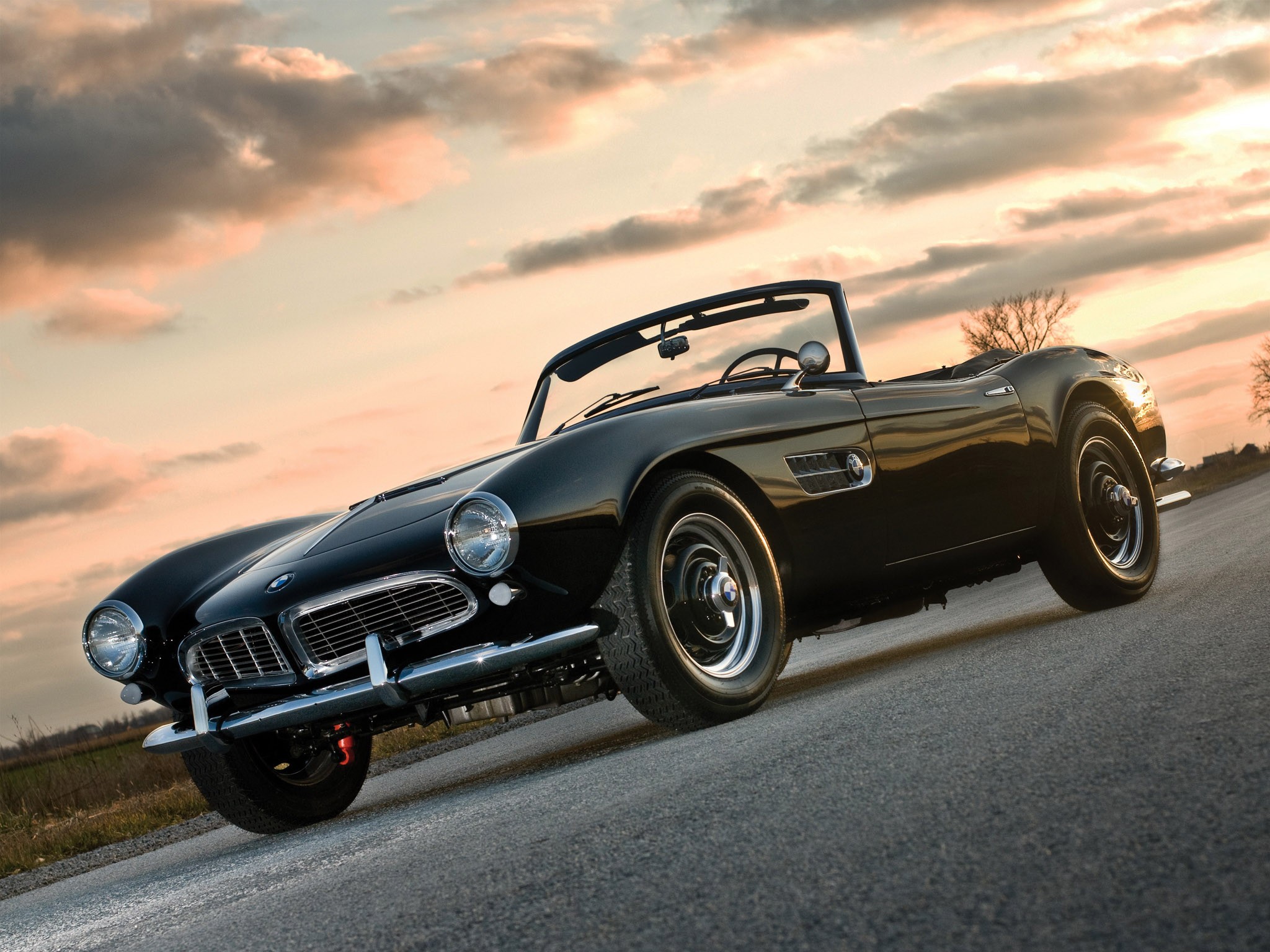
Goertz gave the 507 a long bonnet, a low waist, a short tail and a wide version of BMW's kidney grille set horizontally, with chromed vents behind the front wheels. The body was formed almost entirely from aluminium by hand, so no two cars are exactly the same. A soft top was standard and a detachable hardtop was available.
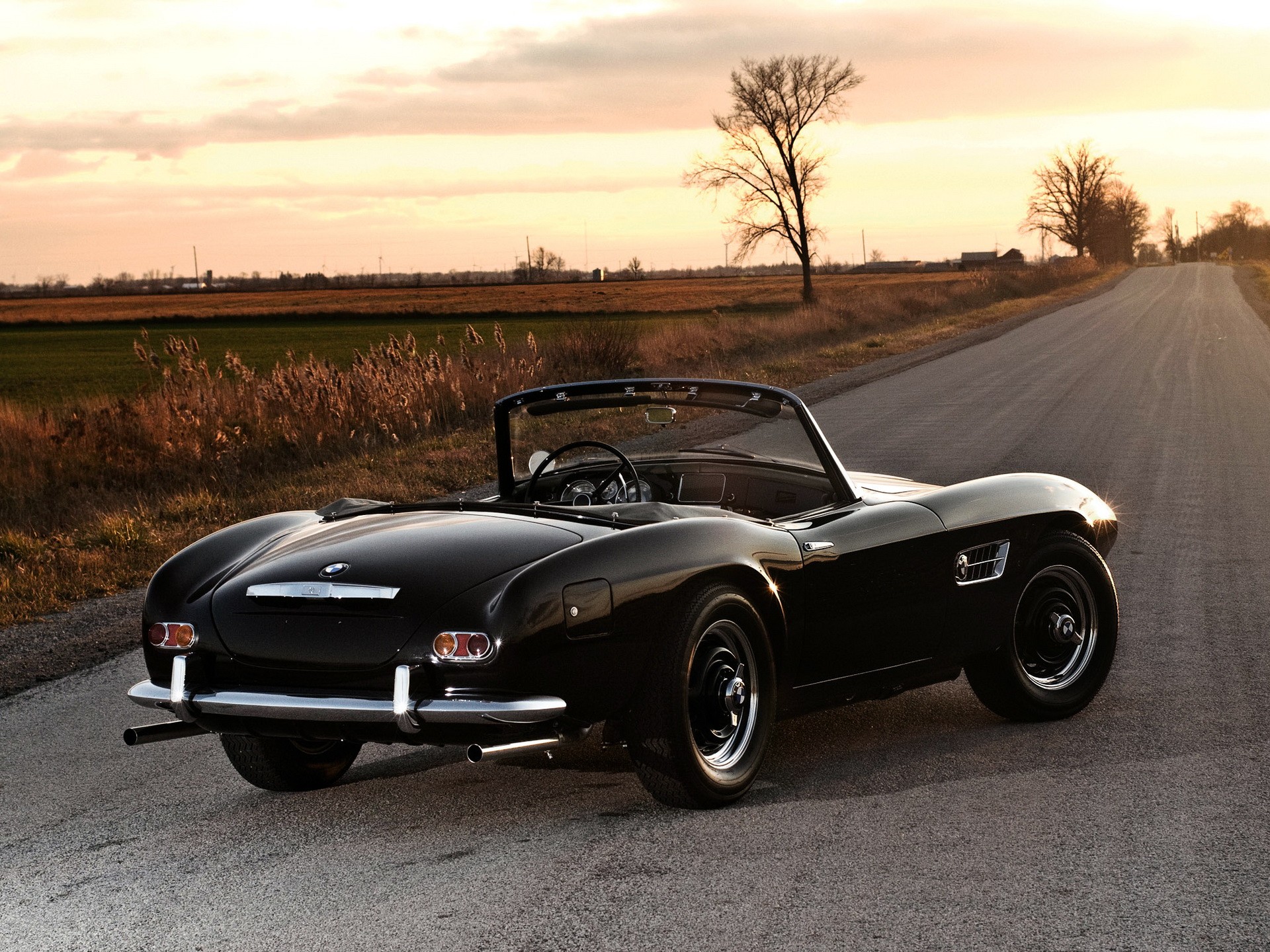
The cabin is simple and elegant: a thin-rimmed steering wheel, large round speedometer and rev counter and a dashboard clock, according to the old 1cars text. Series I cars, 34 built in 1956 and early 1957, had a 110-litre aluminium fuel tank behind the seats that left almost no luggage space. From Series II the tank moved under the boot floor and held 66 litres.
V8 engine, gearbox and chassis
The 507 used BMW's aluminium-alloy OHV V8, also found in the 502 and 503, here with 3,168 cc, a 7.8:1 compression ratio and two Zenith 32NDIX carburettors. It produced 110 kW (150 PS DIN) at 5,000 rpm. Power reached the rear wheels through a close-ratio four-speed manual gearbox, with a 3.70:1 final drive as standard and 3.42:1 or 3.90:1 as options.

Front suspension uses double wishbones with torsion bars and an anti-roll bar; at the rear there is a live axle located by torsion bars, a Panhard rod and a transverse A-arm. The brakes were Alfin drums of 284.5 mm, with optional servo assistance, and late cars had Girling front disc brakes and Pirelli Cinturato radial tyres.
| Parameter | Metric | Imperial |
|---|---|---|
| Engine | 3,168 cc OHV V8 | 193 cu in |
| Power | 110 kW (150 PS) at 5,000 rpm | about 148 bhp |
| Gearbox | 4-speed manual | – |
| 0–100 km/h (Motor Revue test) | 11.1 s | – |
| Top speed (same test) | 196 km/h | 122 mph |
| Length | 4,380 mm | 172.4 in |
| Width | 1,650 mm | 65.0 in |
| Height | 1,257 mm | 49.5 in |
| Wheelbase | 2,480 mm | 97.6 in |
| Kerb weight | about 1,330 kg | 2,932 lb |
| Fuel tank | 110 l (Series I), 66 l (Series II) | 29 / 17.4 US gal |
Price, losses and production
Hoffman had hoped for a much lower price and sales of 5,000 cars a year. The finished 507 cost DM 26,500 in Germany, later DM 29,950, and roughly twice Hoffman's figure in the USA. Hand building made each car expensive to produce, and BMW lost money on every one. Sales stayed below a tenth of the 300 SL's.

| Year | Event |
|---|---|
| 1954 | Hoffman proposes the roadster; Goertz hired in November |
| 1955 | Debut at the Waldorf-Astoria in New York |
| 1956 | Production starts in November; Series I cars |
| 1957 | Series II with the tank under the boot floor |
| 1959 | Production ends after 252 cars; BMW's losses reach DM 15 million |
| 1959–1960 | Herbert Quandt's investment saves BMW; the 700 and later the New Class follow |
The 507 was not the only cause of BMW's crisis, but the big V8 cars were a heavy burden. The small BMW 700 and, from 1962, the New Class 1500 saloon restored the company's finances.
Famous owners: Elvis Presley and John Surtees
Elvis Presley bought a white 1957 car, chassis 70079, while serving with the US Army in Germany. It had been a BMW press car, raced by Hans Stuck and used in the 1959 film "Hula-Hopp, Conny". Presley later had it painted red, and in the USA it received a Chevrolet V8. BMW announced a full restoration in July 2014 and returned the car to its original white.

John Surtees received his 507 in 1957 from Count Domenico Agusta after winning the 1956 500cc motorcycle world championship for MV Agusta. Surtees worked with Dunlop to fit disc brakes, and his car eventually had discs on all four wheels. In July 2018 it set the auction record for the model. Other owners included Fred Astaire, Alain Delon, King Constantine II of Greece and Prince Rainier of Monaco.
Rivals of the 1950s
| Model | Years | Engine | Power | Built |
|---|---|---|---|---|
| BMW 507 | 1956–1959 | 3.2 V8 | 110 kW (150 PS) | 252 |
| Mercedes-Benz 300 SL Roadster | 1957–1963 | 3.0 straight-six, fuel injection | 158 kW (215 PS) | 1,858 |
| Jaguar XK150 | 1957–1961 | 3.4–3.8 straight-six | 142–198 kW (190–265 hp) | about 9,400 |
| Chevrolet Corvette C1 | 1953–1962 | 3.9 six, 4.3–5.4 V8 | up to 268 kW (360 hp) | about 69,000 |
Compared with the 300 SL Roadster's 158 kW, the BMW had 48 kW less, and its power-to-weight ratio of about 83 kW per tonne was modest even then. The Mercedes was faster and more advanced, the Jaguar and Corvette far cheaper. The BMW sat in between on price but won on rarity and looks. Compare classic sports cars in the 1cars comparison tool, browse the 1950s classics section or see the best sports cars list.

Legacy and collecting the 507 today
Around 200 cars are believed to survive. The 507 influenced later BMW roadsters, most clearly the Z8 of 1999–2003 with its horizontal kidneys and chromed side vents, and also the Z3 and Z4. A 507 trades in the multi-million-euro range at major auctions, and cars with a documented history, original engine and matching numbers command the highest prices. Buyers should check the aluminium body for corrosion where it meets the steel frame, the originality of the engine and gearbox, and whether the car has been converted to disc brakes, which many owners did. Every BMW model in the database is in the BMW catalogue.

BMW 507 in our rankings
- No. 125 of 395 · Lightest cars (1,330 kg · top 32%)
- No. 189 of 531 · Smallest cars (4,380 mm · top 36%)
- No. 11 of 25 · Lightest convertibles and roadsters (1,330 kg · top 44%)
- No. 287 of 645 · Biggest engines: cars (3,168 cc · top 45%)
- No. 15 of 32 · Longest convertibles and roadsters (4,380 mm · top 47%)
- No. 29 of 49 · Biggest engines: convertibles and roadsters (3,168 cc · top 60%)
Lighter than 68% of ranked cars in the 1CARS catalog (No. 125 of 395).
BMW 507 photos 13



BMW 507 videos 2

Test drive

Video overview
FAQ
How many BMW 507 were made?
BMW built 252 production cars between November 1956 and 1959, plus two prototypes. About 34 were early Series I cars with the large fuel tank behind the seats. Around 200 are believed to survive.
What engine does the BMW 507 have?
It has a 3,168 cc aluminium-alloy OHV V8 with two Zenith carburettors, producing 110 kW (150 PS) at 5,000 rpm. A close-ratio four-speed manual gearbox drives the rear wheels.
Who designed the BMW 507?
Albrecht von Goertz, a German-born designer working in the USA, styled the 507 and the 503 after being hired in November 1954. Fritz Fiedler engineered the chassis, and importer Max Hoffman proposed the car.
Did Elvis Presley own a BMW 507?
Yes. Presley bought a white 1957 507, chassis 70079, while stationed in Germany. It was later repainted red and fitted with a Chevrolet engine, and BMW restored it to original condition after 2014.
Why did the BMW 507 fail commercially?
Hand-built aluminium bodies made it expensive, so its price was almost twice the planned figure. Only 252 were sold, BMW lost money on each one, and the company came close to bankruptcy in 1959.
Data sources
Data checked by an editor against the sources below.
- The text of this article (1cars archive)
- Wikipedia - BMW 507


