 Alfa Romeo Alfasud
Specs, engines and history
Published Sources (1) Report an error
By Felix Hartmann, Automotive Technology & EV Contributor
- Built
- 1971–1989
- Top power
- 77 kW (105 PS)
Which Alfasud to buy
Our verdict · Felix Hartmann
- For the purest design: an early four-door saloon, as Giugiaro first drew it, though these are the cars most affected by rust.
- For driving: a ti or a Sprint with the 1.5 engine and five-speed gearbox.
- For practicality: the three- or five-door hatchback from 1981-1982.
- For collectors: the 1983 Quadrifoglio Verde with 77 kW (105 PS) and TRX wheels, or the rare Giardinetta estate.
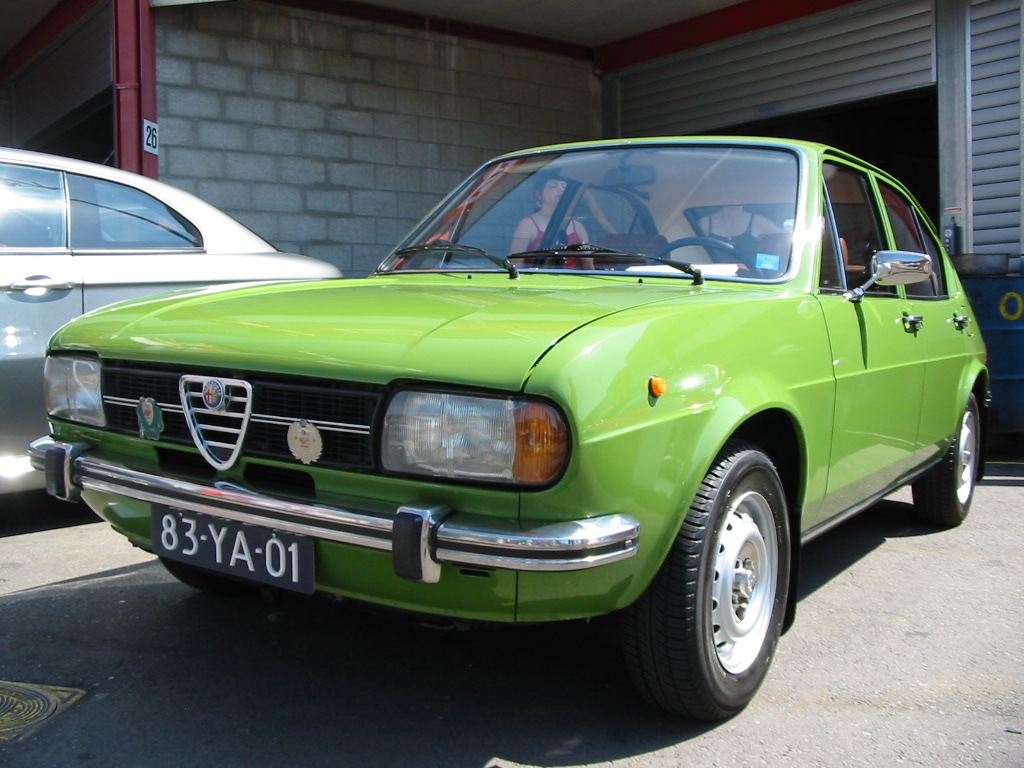
The Alfa Romeo Alfasud is the small family car that Alfa Romeo built at a new plant in Pomigliano d'Arco, near Naples, from 1971 to 1989. Styled by Giorgetto Giugiaro and engineered by Rudolf Hruska, it combined front-wheel drive with a water-cooled flat-four boxer engine, a low bonnet and four disc brakes. About 893,719 saloons and hatchbacks and 121,434 Sprint coupés were made, but the car is remembered as much for its handling as for its rust.
In short
- Small family car (C-segment), front-wheel drive, built at Pomigliano d'Arco in southern Italy; one generation with updates in 1977 and 1980.
- Body styles: four-door saloon, two-door ti, three-door Giardinetta estate, Sprint coupé, three- and five-door hatchbacks.
- Boxer four-cylinder engines from 1.2 to 1.5 litres, 46-77 kW (63-105 PS); four- and five-speed manual gearboxes.
- Replaced by the Alfa Romeo 33 (1983), which kept its floorpan, and by the Arna; the Sprint lived on until 1989.
Alfa Romeo Alfasud at a glance
| Specification | Alfa Romeo Alfasud |
|---|---|
| Segment | Small family car (C-segment) |
| Production | 1971-1983 (saloon and hatchbacks), 1976-1989 (Sprint) |
| Plant | Pomigliano d'Arco, Italy; also assembled in Malaysia, Malta and South Africa |
| Styling | Giorgetto Giugiaro, Italdesign |
| Engineering | Rudolf Hruska |
| Layout | Front engine, front-wheel drive |
| Engines | Flat-four boxer, 1,186-1,490 cc |
| Power range | 46-77 kW (63-105 PS) |
| Kerb weight | about 810-865 kg |
| Built | 893,719 saloons and hatchbacks, 121,434 Sprints |
The Alfasud sits in our Alfa Romeo catalogue next to the later 33, and other cars of the era are in the classic cars section.
A new factory in the south
The name says where the car came from. Industria Napoletana Costruzioni Autoveicoli Alfa Romeo-Alfasud S.p.A. was registered in Naples on 18 January 1968, with Alfa Romeo holding 90% and Finmeccanica, part of the state holding IRI, the remaining 10%. Work on the plant began in April 1968 on the site of a Second World War aircraft engine factory.
The four-door saloon was shown at the Turin Motor Show in 1971. Its packaging was advanced for the time: the flat-four sat low in the nose, which allowed a low bonnet line, a low centre of gravity and a slippery shape. Suspension used MacPherson struts at the front and a beam axle with a Watt's linkage at the rear, with rack-and-pinion steering and disc brakes all round, mounted inboard at the front.

Generations and versions
There was only one generation. The range grew in steps, with a revised Super in late 1977 and a bigger facelift in 1980.
| Generation | Code | Years | Body styles | Engines | Power (kW / hp) |
|---|---|---|---|---|---|
| Alfasud (pre-facelift) | - | 1971-1980 | 4-door saloon, 2-door ti, 3-door Giardinetta | 1.2, 1.3, 1.35, 1.5 boxer | from 46 kW (63 PS) |
| Alfasud (facelift) | - | 1980-1984 | 4-door saloon, 3- and 5-door hatchback | 1.2, 1.35, 1.5 boxer | up to 77 kW (105 PS) |
| Alfasud Sprint / Sprint | - | 1976-1989 | 2-door coupé with hatchback | 1.3, 1.5 boxer | from 56 kW (76 PS) |
The key dates:
- 1973: the two-door ti arrives, with a five-speed gearbox.
- 1974-1975: the SE appears and is replaced by the Lusso, shown in Brussels in January 1975; the base car becomes the "normale".
- May 1975: the three-door Giardinetta estate.
- March 1976: a five-speed four-door, the "5m", is shown at Geneva.
- September 1976: the Sprint coupé, with a lower, more angular Giugiaro body and a hatchback.
- Late 1977: the Super replaces the 5m, with new bumpers, a revised dashboard and new seats.
- May 1978: the Sprint and ti receive 1.3 and 1.5 engines; the Sprint Veloce follows in 1979.
- 1980: facelift with plastic bumpers, a new instrument panel and revised head- and tail-lights.
- 1981: a three-door hatchback in SC or ti trim; the two-door ti and the Giardinetta leave most markets.
- 1982: a five-door hatchback replaces the four-door saloon; the Gold Cloverleaf tops the range.
- 1983: the Quadrifoglio Verde on Michelin TRX tyres.
Engines, transmissions and performance
| Engine | Displacement | Years | Power |
|---|---|---|---|
| 1.2 boxer | 1,186 cc | 1971-1983 | 46-50 kW (63-68 PS) |
| 1.3 boxer | 1,286 cc | 1976/1977-1983 | 50-56 kW (68-76 PS) |
| 1.35 boxer | 1,350 cc | 1978-1983 | 58 kW (79 PS) |
| 1.5 boxer | 1,490 cc | 1978-1984 | 63-77 kW (85-105 PS) |
Every Alfasud engine is a water-cooled flat-four with two belt-driven overhead camshafts. The 1.2 ti with a Weber twin-choke carburettor produced 50 kW (68 PS) and reached 160 km/h (99 mph). The 1980 ti 1.5 with twin carburettors made 71 kW (96 PS), and the 1983 Quadrifoglio Verde 77 kW (105 PS).
Early cars had a four-speed manual. The five-speed arrived with the ti in 1973, the 5m saloon in 1976 and the Sprint.


The Alfasud Sprint
The coupé arrived in September 1976. Giugiaro gave it a lower, more angular body than the saloon, and it opened at the back like a hatchback. It shared the saloon's floorpan, front-wheel drive and boxer engines, starting with a 1.3 rated at 56 kW (76 PS) and the five-speed gearbox from day one. In May 1978 it received the 1.3 and 1.5 engines also used in the ti, and in 1979 the Sprint Veloce added a double twin-choke carburettor set-up.
When the saloon gave way to the 33 in 1983, the coupé dropped the Alfasud name and continued as the Alfa Romeo Sprint until 1989. Over 13 years, 121,434 were built, which makes the Sprint the longest-lived member of the family.
Dimensions, space and boot
| Parameter | Metric | Imperial |
|---|---|---|
| Length (saloon) | 3,890 mm | 153.1 in |
| Length (Giardinetta) | 3,935-3,975 mm | 154.9-156.5 in |
| Width | 1,590 mm | 62.6 in |
| Height | 1,370 mm | 53.9 in |
| Wheelbase | 2,455 mm | 96.7 in |
| Kerb weight | 810-865 kg | 1,786-1,907 lb |
At under 3.9 metres and well below 900 kg, the Alfasud was compact and light even by 1970s standards. Our sources do not give a boot volume. To picture its footprint next to a modern car, try the size comparison tool.
Running costs
No official fuel consumption figures appear in our sources, so none are quoted here. The engines are small, from 1.2 to 1.5 litres, and the cars are light, which kept running costs modest in period. Today the bigger cost on most surviving cars is bodywork rather than fuel.
Trims and equipment
The range followed a typical Italian ladder: the base "normale", the Lusso and later the Super, the sporty ti, and at the top the Gold Cloverleaf and Quadrifoglio Verde. The Super of late 1977 brought new bumpers, a revised dashboard and new seat options; the 1980 facelift added plastic bumpers and a new instrument panel. The 1983 Quadrifoglio Verde ran on Michelin TRX tyres in the unusual 190/55 VR 340 size.

Safety
The Alfasud predates Euro NCAP, which began crash testing in 1997, and no crash ratings exist. What the car did offer was a capable chassis: four disc brakes, rack-and-pinion steering and a low centre of gravity, the qualities that made it a staple of one-make racing. Ayrton Senna owned a 1.5 ti and, according to the Wikipedia article, drove it to his first Formula One test with Williams.
Reliability and known issues: rust
The Alfasud's weak point is well documented: corrosion. The reasons usually given are inferior recycled steel and a factory about 15 km from the Bay of Naples, where early bodies were left outdoors in salty air before painting. Engineers filled box sections with synthetic foam to stop rust, but the foam later turned out to trap moisture. Anyone looking at a surviving car should treat the condition of the body as the deciding factor.
Motorsport and derivatives
A dedicated Alfasud racing series began in 1975, followed by the Trofeo Alfasud in 1976 and the Trofeo Europa in 1977; Gerhard Berger is its best-known graduate. The ti took class wins at the Monte Carlo Rally in 1979, 1980 and each year from 1982 to 1985. Derivatives ranged from the 1971 Caimano concept to the one-off four-wheel-drive Bimotore and the Minari kit car.
Rivals
| Model | Engines | Power (kW / hp) | Boot (l) | Price from (EUR) |
|---|---|---|---|---|
| Alfa Romeo Alfasud (1971-1984) | 1.2-1.5 boxer petrol | 46-77 kW (63-105 PS) | - | - |
| Volkswagen Golf Mk1 (1974-1983) | 1.1-1.8 petrol, 1.5-1.6 diesel | 37-82 kW (50-112 PS) | - | - |
| Fiat 128 (1969-1985) | 1.1-1.3 petrol | 40-55 kW (55-75 PS) | - | - |
Period prices are not comparable with today's money, so the price column is left empty.
Photo gallery

Alfa Romeo Alfasud in our rankings
- No. 222 of 1082 · Longest-running car nameplates (18 years · top 22%)
- No. 923 of 1011 · Most powerful cars (77 kW · top 92%)
- No. 139 of 146 · Most powerful Italian cars (77 kW · top 96%)
In production longer than 78% of ranked nameplates in the 1CARS catalog (No. 222 of 1082).
FAQ
How many Alfasuds were built?
893,719 saloons and hatchbacks from 1972 to 1983 and 121,434 Sprint coupés from 1976 to 1989.
What engine does the Alfasud have?
A water-cooled flat-four boxer with belt-driven twin overhead camshafts, from 1,186 cc to 1,490 cc and 46-77 kW (63-105 PS).
Why did the Alfasud rust so badly?
Sources point to recycled steel of poor quality, bodies left outdoors in salty air near the Bay of Naples before painting, and foam in the box sections that trapped moisture.
What replaced the Alfasud?
The Alfa Romeo 33 replaced the five-door in 1983 and kept the Alfasud floorpan; the three-door was replaced a year later by the Arna, built with Nissan. The Sprint continued as the Alfa Romeo Sprint until 1989.
Data sources
Data checked by an editor against the sources below.