 Hyundai Staria
Specs, engines and history
Published Sources (3) Report an error
By Felix Hartmann, Automotive Technology & EV Contributor
- Built
- 2021–present
- Top power
- 200 kW (272 PS)
Which Staria to choose
Our verdict · Felix Hartmann
- For a family or a shuttle business: the 2.2 diesel with the eight-speed automatic, with AWD for rough roads or towing.
- For VIP transport: the Lounge or the Lounge Limousine with its high roof and rear screen.
- For quiet running and low energy costs: the Staria Electric, if the 400 km estimate suits daily distances.
- To compare sizes and engines with other vans: try our comparison page.
- For a more car-like alternative: the Kia Carnival on the same platform, or the Toyota Alphard as a luxury rival.
Other Hyundai models are listed in our Hyundai catalogue.
The Hyundai Staria is a large minivan and panel van that replaced the Starex (H-1) in 2021. It is 5.26 m long, moved from rear-wheel drive to a front-wheel-drive platform shared with the Kia Carnival, and seats from two to eleven people. Diesel, V6 petrol, LPG and hybrid engines are offered, and the battery-electric Staria Electric followed in 2026.
In short
- Code US4, built since 2021 in Ulsan and, from July 2022, in Jeonju, South Korea.
- Engines: 2.2 CRDi diesel with 130 kW (177 PS), 3.5 V6 petrol with 200 kW (272 PS), 3.5 LPi and a 1.6 turbo hybrid with 180 kW (245 PS).
- Staria Electric (2026): 84 kWh battery, 160 kW (218 PS), up to 400 km WLTP (estimate), 800-volt charging.
- Versions from a two-seat Load van to the seven-seat Lounge and Lounge Limousine.
Size at a glance
| Dimensions | Hyundai Staria US4 |
|---|---|
| Length | 5,255 mm206.9 in |
| Width | 1,995 mm78.5 in |
| Height | 1,990 mm78.3 in |
| Wheelbase | 3,275 mm128.9 in |
Running cost
Fuel · Staria US4 2.2 CRDi
about 2,100 EUR fuel a year at 15,000 km
8.5 l/100 km · diesel at 1.65 EUR/l · change mileage, fuel price or version
Specs by version
Engines
| Version | Engine | Power | Torque | Gearbox | Production years |
|---|---|---|---|---|---|
| Hybrid · 1 version | |||||
| 1.6 T-GDi Hybrid | 1.6 l · 4 cyl · Hybrid 1,598 cc | 180 kW 245 PS241 hp | 367 Nm271 lb-ft | 6-sp Automatic | - |
| Electric · 1 version | |||||
| Staria Electric | Electric | 160 kW 218 PS215 hp | 350 Nm258 lb-ft | Single-speed | 2026 |
| Diesel · 2 versions | |||||
| 2.2 CRDi | 2.2 l · 4 cyl · Diesel 2,199 cc | 130 kW 177 PS174 hp | 431 Nm318 lb-ft | 6-sp Manual | 2021 |
| 2.2 CRDi automatic | 2.2 l · 4 cyl · Diesel 2,199 cc | 130 kW 177 PS174 hp | 431 Nm318 lb-ft | 8-sp Automatic | 2021 |
| Petrol · 1 version | |||||
| 3.5 MPi V6 | 3.5 l · 6 cyl · Petrol 3,470 cc | 200 kW 272 PS268 hp | 331 Nm244 lb-ft | 8-sp Automatic | 2021 |
| LPG / CNG · 1 version | |||||
| 3.5 LPi V6 | 3.5 l · 6 cyl · LPG / CNG 3,470 cc | 177 kW 241 PS237 hp | 310 Nm229 lb-ft | 8-sp Automatic | 2021 |
Performance
Show all 5 versions
| Version | 0–100 km/h | Top speed | Fuel consumption | CO₂ |
|---|---|---|---|---|
| Hybrid · 1 version | ||||
| 1.6 T-GDi Hybrid | 10.2 s 0–62 mph | - | - | - |
| Electric · 1 version | ||||
| Staria Electric | - | 184 km/h114 mph | - | - |
| Diesel · 2 versions | ||||
| 2.2 CRDi | 12.5 s 0–62 mph | 185 km/h115 mph | 8.5 l/100 km27.7 mpg US · 33.2 mpg UK | 222 g/km |
| 2.2 CRDi automatic | 12.4 s 0–62 mph | - | 8.5 l/100 km27.7 mpg US · 33.2 mpg UK | 222 g/km |
| Petrol · 1 version | ||||
| 3.5 MPi V6 | 8.9 s 0–62 mph | 210 km/h130 mph | - | - |
Dimensions and weight
Show all 6 versions
| Version | Length | Width | Wheelbase | Kerb weight |
|---|---|---|---|---|
| Hybrid · 1 version | ||||
| 1.6 T-GDi Hybrid | 5,255 mm206.9 in | 1,995 mm78.5 in | 3,275 mm128.9 in | - |
| Electric · 1 version | ||||
| Staria Electric | 5,255 mm206.9 in | 1,995 mm78.5 in | 3,275 mm128.9 in | - |
| Diesel · 2 versions | ||||
| 2.2 CRDi | 5,255 mm206.9 in | 1,995 mm78.5 in | 3,275 mm128.9 in | 2,302 kg5,075 lb |
| 2.2 CRDi automatic | 5,255 mm206.9 in | 1,995 mm78.5 in | 3,275 mm128.9 in | 2,302 kg5,075 lb |
| Petrol · 1 version | ||||
| 3.5 MPi V6 | 5,255 mm206.9 in | 1,995 mm78.5 in | 3,275 mm128.9 in | - |
| LPG / CNG · 1 version | ||||
| 3.5 LPi V6 | 5,255 mm206.9 in | 1,995 mm78.5 in | 3,275 mm128.9 in | - |
Verified Manufacturer and type-approval data from our catalog · Sources and methodology
Hyundai Staria at a glance
| Parameter | Value |
|---|---|
| Production | since 2021 |
| Code and platform | US4, Hyundai-Kia N3 (shared with the Kia Carnival) |
| Bodies | five-door minivan, five-door panel van |
| Length / width | 5,255 mm / 1,995 mm |
| Height | 1,990–2,030 mm (2,200 mm Lounge Limousine) |
| Wheelbase | 3,275 mm |
| Kerb weight | 1,990–2,390 kg |
| Seats | 2, 3, 5, 7, 9 or 11 depending on version |
| Engines | 2.2 diesel, 3.5 V6 petrol, 3.5 LPG, 1.6 turbo hybrid, electric |
| Power | 130–200 kW (177–272 PS) |
| Drive | front-wheel drive or all-wheel drive |
| Predecessor | Hyundai Starex / H-1 |
From Starex to Staria
The old Starex drove its rear wheels. Hyundai designed its successor from scratch on the N3 platform, the same base as the fourth-generation Kia Carnival. The first images were released on 18 March 2021, and the design is credited to Joon Seo.
Compared with the Grand Starex, the new van grew in every direction:
- 84 mm longer and 77 mm wider;
- 65–70 mm taller (sources differ), with ground clearance down by 30 mm;
- 73 mm more wheelbase.
Passenger versions replace the old live rear axle with a multi-link set-up, while some cargo and basic versions keep a rigid axle. The cabin is up to 1,379 mm high. The older generations are described in our Hyundai H-1 Grand Starex article.
Design and dimensions
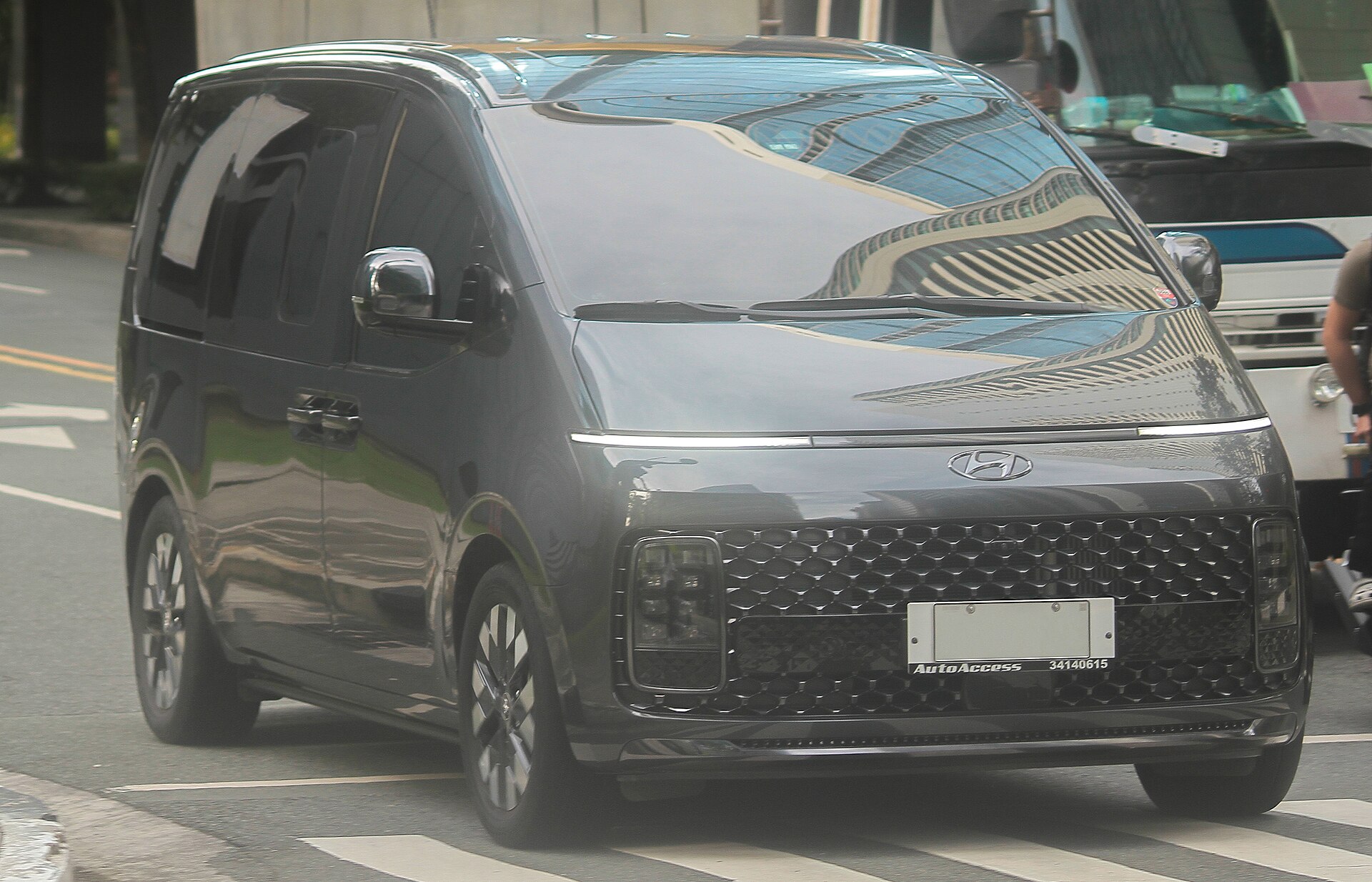
The Staria's look is unusual for a commercial vehicle. A thin light strip runs across the full width of the nose, the side windows reach very low, and the rear has tall, narrow lamps. The 3,275 mm wheelbase leaves room for four rows of seats.
The van version can carry up to about 5,000 litres of cargo. In the electric MPV, Hyundai quotes 431 litres of luggage space for the seven-seat version with all rows in use (435 litres in another part of the same release) and 1,303 litres in the nine-seat Wagon.

Engines and performance
| Engine | Power | Torque | Gearbox | 0–100 km/h | Top speed |
|---|---|---|---|---|---|
| 2.2 R CRDi diesel | 130 kW (177 PS) | 431 Nm | 6-speed manual or 8-speed automatic | 12.4–13.5 s | 185 km/h |
| 3.5 Smartstream V6 MPi petrol | 200 kW (272 PS) | 331 Nm | 8-speed automatic | 8.9 s | 210 km/h |
| 3.5 Smartstream LPi (LPG) | 177 kW (240 PS) | 310 Nm | 8-speed automatic | – | – |
| 1.6 T-GDi hybrid (system) | 180 kW (245 PS) | 367 Nm | 6-speed automatic | 10.2 s (FWD) | – |
| Electric, 84 kWh | 160 kW (218 PS) | 350 Nm | single speed | – | 184 km/h |
In Australia the diesel with all-wheel drive was standard at launch. The hybrid pairs a 1.6-litre turbo engine with an electric motor and is the quickest combustion version after the V6.
Staria Electric (2026)
Hyundai presented the Staria Electric at the Brussels Motor Show on 9 January 2026. It uses an 84 kWh lithium-ion battery and a 160 kW (218 PS) motor driving the front wheels, with 350 Nm. Hyundai estimates a WLTP range of up to 400 km, before final homologation.
Charging is one of its strengths. The 800-volt system takes the battery from 10 to 80 percent in about 20 minutes at a fast charger, and the on-board AC charger handles 11 kW. The electric van can tow 2,000 kg braked and 750 kg unbraked, and supply power to external devices through vehicle-to-load. Production is in Ulsan. Hyundai scheduled sales in Korea and Europe for the first half of 2026, in seven-seat Luxury and nine-seat Wagon forms.
Versions: Lounge, Limousine, Camper and Load
| Version | Launched | Key points |
|---|---|---|
| Staria (Tourer, Cargo) | 2021 | basic MPV and van, up to 11 seats |
| Staria Lounge (Premium) | 9 August 2021 | 7 or 9 seats, 18-inch wheels, 64-colour ambient lighting |
| Lounge Limousine | 19 April 2022 | 2,200 mm high roof, electric side step, 25-inch rear screen |
| Lounge Camper | 19 April 2022 | Camper 11 and four-seat Camper 4 |
| Staria Load | with the range | panel van with 2 or 5 seats (Australia, New Zealand) |
| ST1 | 14 March 2024 | electric truck derived from the Staria |
The seven-seat Lounge has second-row seats that recline into a relaxation position at the touch of a button. In the nine-seat Premium, the second-row seats swivel 180 degrees to face the third row.

Plants, markets and the 2025 facelift
The Staria is built at Ulsan Plant 4 and, since July 2022, at Jeonju. Local assembly at Inokom in Kulim, Malaysia, began in October 2025. Market launches followed quickly after the Korean debut:
- Australia on 5 August 2021, with the diesel and all-wheel drive standard;
- Indonesia in August 2021 and South Africa on 5 November 2021;
- the Philippines and Taiwan in 2022, and several European countries.
In South Africa the Staria Panel Van replaced the H1 van in July 2022. ANCAP tested the Staria in 2021, with 85 percent for adult occupants, 86 percent for children and 74 percent for safety assist. A facelift was unveiled in Korea on 17 December 2025. Its most visible changes are a full-width light bar and larger 12.3-inch screens.
Hyundai Staria in our rankings
- No. 6 of 18 · Fastest Korean cars (210 km/h)
- No. 9 of 19 · Quickest Korean cars, 0–100 (8.9 s)
- No. 17 of 420 · Longest cars (5,255 mm · top 5%)
- No. 48 of 403 · Widest cars (1,995 mm · top 12%)
- No. 39 of 304 · Heaviest cars (2,302 kg · top 13%)
- No. 27 of 78 · Biggest batteries: electric cars (84 kWh · top 35%)
Longer than 95% of ranked cars in the 1CARS catalog (No. 17 of 420).
FAQ
Is the Hyundai Staria the new Starex?
Yes. The Staria replaced the Starex (sold as the H-1 in many export markets) in 2021, switching to a front-wheel-drive platform.
How many seats does the Staria have?
Two to eleven, depending on the version: two or five in the Load van, seven or nine in the Lounge and up to eleven in the basic MPV and the Camper 11.
What engine is in the Hyundai Staria?
Mainly a 2.2-litre diesel with 130 kW (177 PS) and 431 Nm. A 3.5 V6 petrol, an LPG V6, a 1.6 turbo hybrid and an electric motor are also offered.
What is the range of the Staria Electric?
Hyundai estimates up to 400 km in the WLTP cycle with the 84 kWh battery, before final homologation.
How long is the Hyundai Staria?
5,255 mm, with a 3,275 mm wheelbase; it is 1,995 mm wide and 1,990–2,030 mm high in standard form.
Data sources
Data checked by an editor against the sources below.
- Wikipedia - Hyundai Staria
- Hyundai - Staria Electric Debut
- EEA CO₂ monitoring (European Environment Agency, CC BY 4.0)