Hyundai H-1 Grand Starex — Generations, Specs and History
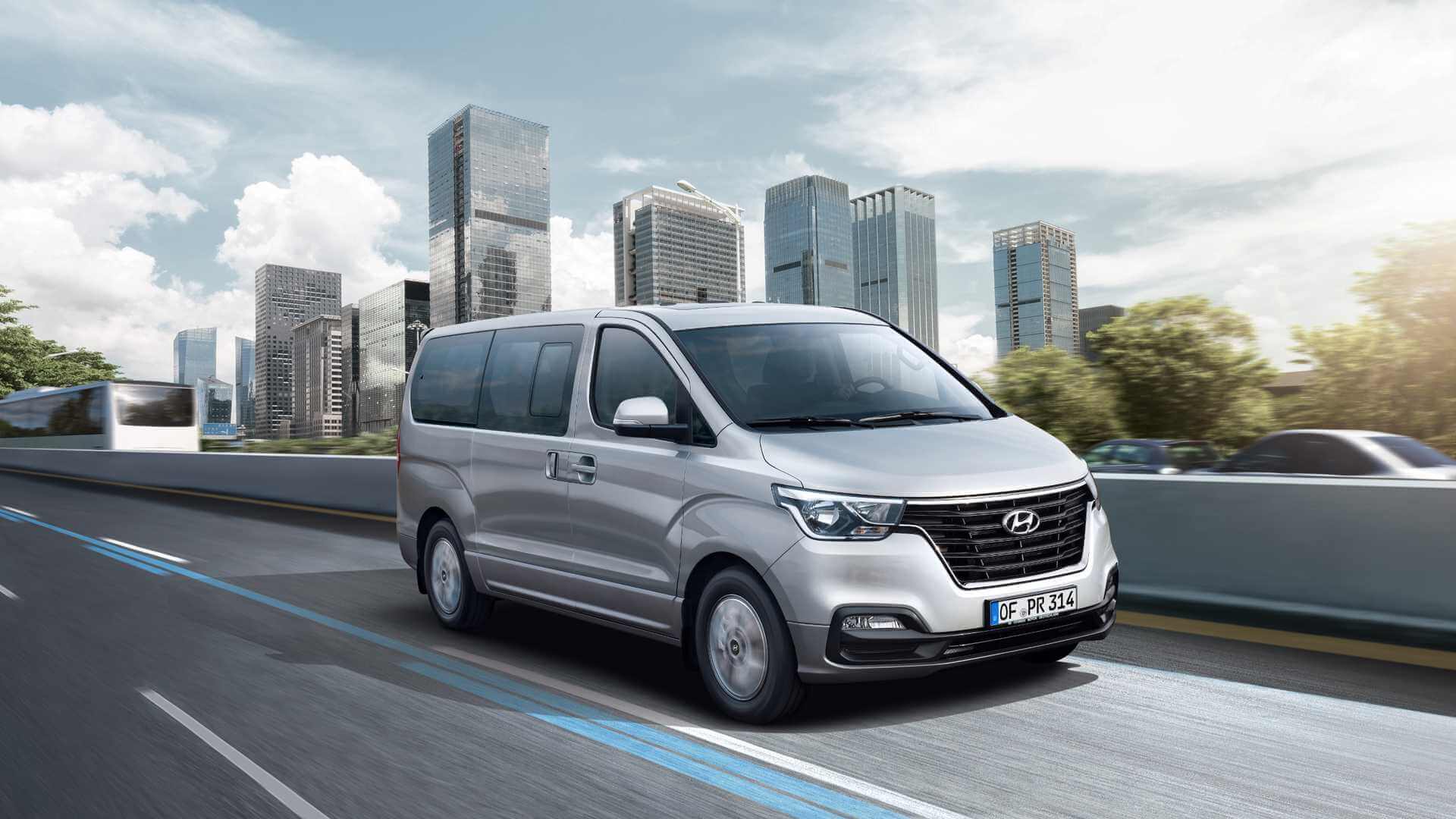
The Hyundai H-1 is a versatile van and minibus from Hyundai Motor Company, offered in many passenger and commercial versions. Its first generation, widely known as the Hyundai Starex, appeared in 1996. Two generations were built, and the second received a substantial update in 2018 that kept it on sale until the Hyundai Staria replaced it in 2021. Depending on the market, it has been sold as the H-1, Starex, Grand Starex, iLoad, iMax or i800.
Key takeaways
- First generation (A1) 1996–2007; second generation (TQ) 2007–2021, with a major update in 2018.
- Rear-wheel drive with a longitudinal front engine; the first generation was also offered with 4WD.
- Second-generation 2.5 CRDi diesels with about 100–129 kW (136–175 PS), depending on market and gearbox, and a 2.4 petrol engine.
- Seven to twelve seats, depending on version, and around 842 litres of luggage space in the eight-seat passenger version.
Hyundai H-1 at a glance
More Hyundai models are listed in our Hyundai catalogue, and the company's story is told in our history of Hyundai.
| Generation | Code | Years | Names | Engines |
|---|---|---|---|---|
| First | A1 | 1996–2007 | Starex, H-1 | 2.5 diesels, 2.4 petrol, 3.0 V6 (Korea) |
| Second | TQ | 2007–2021 | H-1, Grand Starex, iLoad, iMax, i800 | 2.5 CRDi diesel, 2.4 petrol |
| Successor | — | 2021 onwards | Staria | — |
First generation (1996–2007)
The story goes back to 1986, when Hyundai introduced the H-100, sold in Korea as the Hyundai Grace. It was not an independent design: it was built under licence from Mitsubishi and derived from the Mitsubishi Delica. In 1996 Hyundai presented its successor, the Starex, which kept some familiar features but brought a long list of improvements and proved very popular.
The first-generation Starex had no elaborate styling details — logical for a vehicle of its type and era — but it stood out with an unusual front bumper divided into four large sections. It was built with long and short wheelbases, as a three- or six-seat van and as a seven-, nine- or twelve-seat passenger vehicle with two or three rows of seats. The first update changed the engine range and the grille and bumper; a more noticeable facelift for 2005 replaced the distinctive bumper with a more massive one with a recess for a much larger grille, which became the dominant element of the front, and enlarged the headlights.
Engines evolved steadily: a naturally aspirated 2.5 diesel at launch, then a 2.4 petrol engine, an intercooled turbodiesel, a 3.0 V6 petrol for Korea and, from 2003, a 2.5 common-rail turbodiesel; the facelifted model used a 2.4 petrol engine. The design was reliable. Power went through a four-speed automatic or a five-speed manual gearbox, and besides the standard rear-wheel-drive version there was a 4WD model with a part-time front axle. The rear axle was a rigid beam on either coil or leaf springs.
Second generation (2007–2021)
The second generation was unveiled in 2007 and in some markets was called the Grand Starex. Its exterior was thoroughly reworked and differed greatly from its predecessor: the front became stricter, with attractive lines. Inside there is plenty of space. Passenger versions have eight seats in many markets, and twelve-seat versions exist elsewhere. Unlike most rivals, the middle row can slide lengthways.
Like all minibuses, the H-1 is designed more for passengers than luggage. Its quoted luggage volume is over 800 litres measured to the roof; loaded to the window line, the usable space is closer to 400 litres. The most common engine is the 2.5 diesel, and a 2.4 petrol engine was also offered. About three-quarters of cars have an automatic gearbox; manuals also exist. All versions are rear-wheel drive.
The updated H-1 (2018–2021)
The 2018 update, which in South Korea also introduced Urban and Limousine versions, changed the front considerably and made the van more attractive and modern.
Exterior
The updated model is easy to tell from the front. It has new projector headlights with integrated LED daytime running lights, and adaptive LED headlights with cornering lights are optional. The grille was redesigned: depending on the version, its centre is black or chrome, while the surround is always chrome. Together with the new lights it gives the van a more assertive look. The front bumper is smoother, with a black plastic insert holding an auxiliary grille, two fog lamps and an extra plastic trim. The bonnet has smoother shapes, and the windscreen has rounded sides.
The sides changed less. Flared front and rear wheel arches make the van look more serious, and grey or black plastic trims replace the mouldings along the bottom. There is a sliding door on each side. The front doors are unchanged, with a dividing pillar and a small triangular window. The mirrors have LED indicators, electric adjustment, heating and power folding as standard. Standard wheels are 16-inch steel, with 17-inch alloys optional, and ground clearance is a decent 190 mm. At the rear, new LED tail lights suit the van's businesslike character, and the huge tailgate makes it easy to load bulky items. A large spoiler at the top carries an LED brake light and an additional mirror, and the number-plate recess holds the rear camera and chrome badges. Some versions let the tailgate be opened from inside, with the key fob or with a sensor under the rear bumper.
Interior
The cabin also changed, with leather upholstery, real wood inserts and polished metal on upmarket versions; from the driver's seat it can feel like driving a limousine. The seats have extensive electric adjustment, heating and ventilation. The four-spoke steering wheel is comfortable to grip and carries quick-access buttons. The classic instrument panel is easy to read, with three analogue dials and a speedometer with a small monochrome trip-computer display in the centre. Ergonomics, practicality and build quality are good.
The console layout is unusual. The upper panel has an 8-inch touchscreen that looks as if it were bolted onto the dashboard; it plays video and shows navigation maps and the surround-view cameras. Below it are the climate controls, flanked by wood-trimmed air vents. The gear lever sits on a separate pod integrated into the dashboard, as in many vans. The front seats are comfortable with clear side support. Depending on the version, the cabin seats up to nine in three rows of paired seats. The rear seats can be folded to turn the minibus into a crew van. With eight seats, the luggage compartment holds 842 litres, and a full-size spare wheel is stored under the floor.
Engines and transmissions
| Engine | Power (kW / PS) | Torque | Gearbox | Notes |
|---|---|---|---|---|
| 2.5 CRDi WGT (some markets) | 100 kW / 136 PS | 343 Nm | 6-speed manual | About 7.5 l/100 km; 0–100 km/h 17.6 s; 168 km/h |
| 2.5 CRDi WGT | 103 kW / 140 PS | 353 Nm | Manual | — |
| 2.5 CRDi VGT (some markets) | 125 kW / 170 PS | 441 Nm | 5-speed automatic | About 9 l/100 km; 0–100 km/h 14.4 s; 180 km/h |
| 2.5 CRDi VGT | Up to 129 kW / 175 PS | 451 Nm | 5-speed automatic | — |
| 2.4 petrol | 124 kW / 169 PS | — | — | Some markets, also LPG |
The diesels are four-cylinder units with turbocharging, common-rail injection and 16 valves; the VGT has a variable-geometry turbocharger. All versions drive the rear wheels, and higher trims have an automatic locking differential.
Chassis
The H-1 has a classic layout: a monocoque body with a longitudinal front engine. The front suspension is independent with MacPherson struts, and the rear is a rigid axle with coil springs and links. Steering is a recirculating-ball design with hydraulic assistance, and all four wheels have disc brakes, ventilated at the front.
Safety and equipment
The H-1 is aimed at budget-conscious buyers, so it does not have an abundance of safety systems, but the essentials are there and higher trims add active safety features. Depending on the version, they include front and side airbags for the front row, curtain airbags, a rear camera or surround-view system, automatic door locking, stability control, an immobiliser, keyless entry, an alarm, ISOFIX mounts, navigation, rain and light sensors, adaptive cruise control, adaptive headlights, parking sensors and parking assistance, hill-start assist, tyre-pressure monitoring, automatic emergency braking, ABS and forward collision warning.
Depending on the market, a typical entry version has two airbags, 16-inch steel wheels, ESP and ABS, fog lamps, a heated steering wheel and front seats, an auxiliary cabin heater, a light sensor, heated electric mirrors, a six-speaker audio system, front electric windows and cruise control. Higher trims add side airbags, 17-inch alloy wheels, mixed upholstery, a rear camera, sliding windows in the rear doors, separate front and rear climate control and rear parking sensors.
What owners say
Owners praise the H-1's decent performance, large, roomy cabin, good seating position and visibility, traction control and pleasant looks, as well as modest fuel consumption and a big luggage area; it is also easy to modify. On the downside, rear-wheel drive can make it easy to get stuck in winter, there is no armrest, noise insulation is mediocre, the second row locks in only two positions, the climate controls are not intuitive, the dashboard looks dated and the rear axle can whine at 110–140 km/h. Otherwise it is a good family vehicle for the money.
Rivals
The H-1 competes with the Volkswagen Caravelle, Peugeot Traveller and Citroën SpaceTourer.
Verdict
The 2018 update came at the right time, making the H-1 look more serious, modern and stylish in its final years. It offers a relatively low price, good lighting, decent ground clearance, a roomy cabin and solid build quality, plus strong, responsive engines, a good suspension and reasonable standard equipment. Rear-wheel drive makes winter driving harder, and an armrest, better insulation and more flexible seating are missing, but overall the H-1 offers good value for money.
FAQ
Is the Hyundai H-1 the same as the Starex and Grand Starex?
Yes. The same vehicle is sold as the H-1 in Europe, the Starex or Grand Starex in South Korea and other markets, and the iLoad or iMax in Australia.
What engine does the Hyundai H-1 have?
Most second-generation H-1s have a 2.5 CRDi diesel with about 100–129 kW (136–175 PS), depending on market and gearbox.
Is the Hyundai H-1 rear-wheel drive?
Yes. The second generation is rear-wheel drive; the first generation was also offered with 4WD.
What replaced the Hyundai H-1?
The Hyundai Staria, launched in 2021.