 Hyundai i40
Specs, engines and history
Published Sources (1) Report an error
By Sarah Whitmore, Senior Automotive Writer
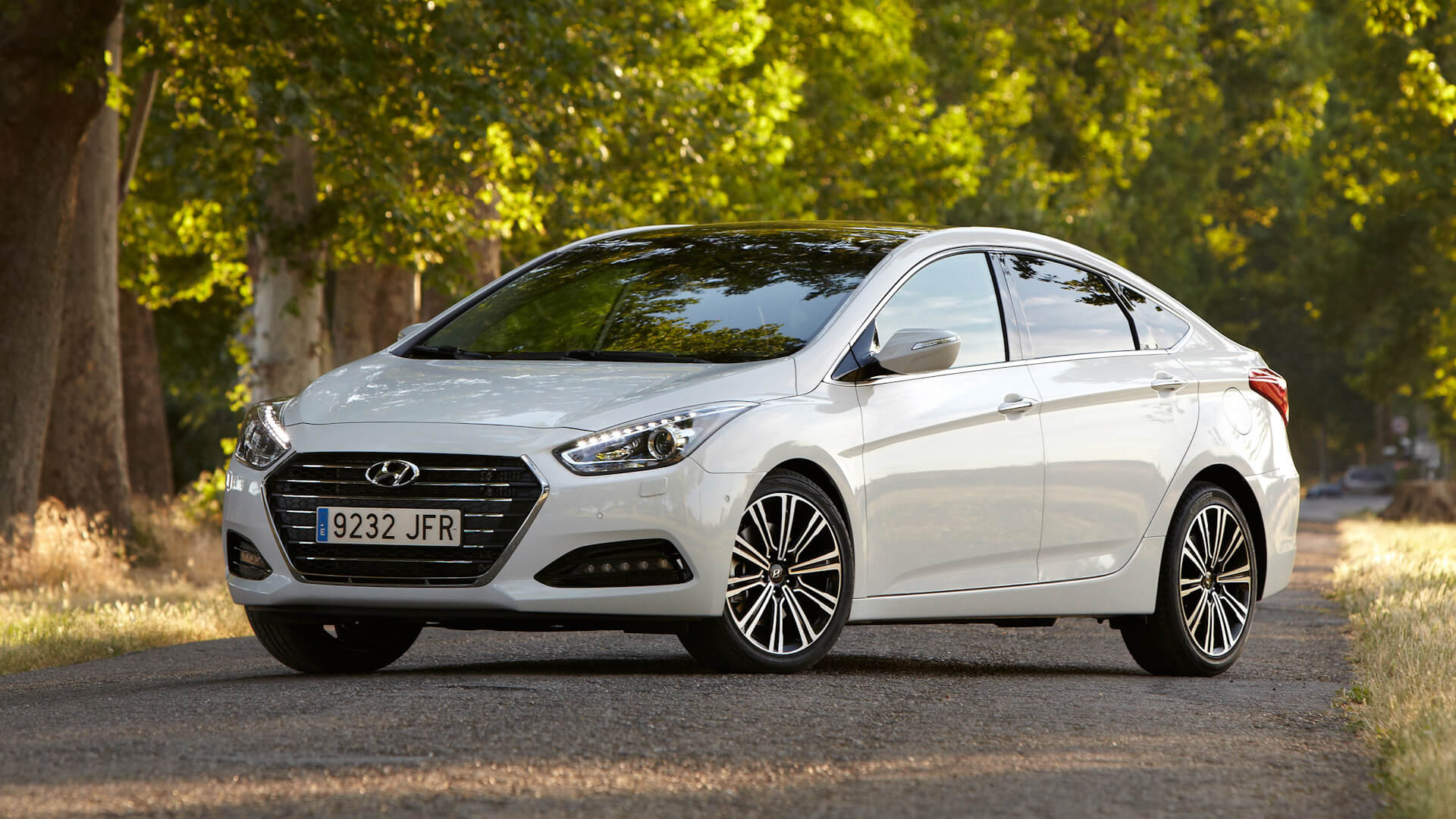
The Hyundai i40 is a mid-size family car that the South Korean company built from 2011 to 2019, offered as a four-door saloon and a five-door estate called the i40 Tourer. It was designed specifically for Europe: the car was developed at Hyundai's European technical centre in Rüsselsheim, Germany, under designer Thomas Bürkle, who had previously worked at BMW. As a result, it was tailored closely to the tastes of demanding European buyers.
In short
- One generation, built 2011–2019 in Ulsan, South Korea, and facelifted in 2015.
- The estate went on sale first, in September 2011; the saloon was unveiled at the Barcelona motor show the same year.
- Engines included 1.6 and 2.0 GDi petrol units of up to 131 kW (178 PS) and a 1.7 CRDi diesel of up to 104 kW (141 PS), which gained a seven-speed dual-clutch gearbox after the facelift.
- The saloon's boot holds 503 litres and the Tourer's 553 litres, or about 1,720 litres with the seats folded.
Hyundai i40 at a glance
The i40 was the first Hyundai car developed specifically for the European market. In Europe it took over from the Sonata, and Hyundai unusually launched the estate first, with the saloon following a few months later. The 2015 facelift did not change the car dramatically but improved it in many details, including a new dual-clutch gearbox for the diesel. Production ended in 2019. More of the brand's range is in our Hyundai catalogue; the smaller Hyundai i30 Fastback shows the brand's later European design.
Exterior
The first thing you notice is a large hexagonal grille in Hyundai's corporate style - a wide "shark's mouth" ready to swallow air at any speed. The bonnet and headlights recall some Japanese premium models, but with distinctive touches such as LED position lights. Xenon headlights were reserved for the most expensive version. The facelift brought a revised front bumper with large fog lights made up of rows of LEDs, set back slightly so they do not disturb the overall look.
The side view was left almost untouched by the facelift; only the wheels and front wheel arches changed, the latter becoming more pronounced. A high waistline flows neatly into the pointed tips of the tail lights. Base versions have 16-inch wheels, with up to 18-inch wheels optional, and ground clearance is an average 147 mm.
The rear of the saloon has LED tail lights, a boot-lid spoiler and a distinctive bumper. The design team did not try to reinvent a shape that buyers already liked, so the changes were small: chrome trims with extra brake lights (base versions have reflectors) and twin exhausts below the bumper. The Tourer looks hardly different but arguably more striking, with elongated tail lights, a wide roof spoiler and a chrome strip above the number plate.
Interior and practicality
The cabin is well finished, with soft plastics and some leather trim, and the ergonomics are good: every control is easy to reach. Gloss-black "piano" trim adds a touch of class. The driver has a four-spoke multifunction steering wheel with buttons on each spoke, although the leather rim tends to wear quickly. The instruments, stylish for their time, combine a round display set into a large analogue dial with a vertical trip-computer screen.
There is less room than in the Sonata because of the shorter wheelbase, but the cabin is still spacious. The top-spec version has very comfortable front seats with stronger side bolsters, and the front seats have electric adjustment and three-stage heating. The centre console carries the infotainment system in one of two forms: base versions have many buttons and a simple display, while more expensive ones have a larger screen and fewer buttons, with the climate display integrated into it. Buttons for seat heating and ventilation sit at the bottom. The tunnel holds a large gear lever, an electronic parking brake, buttons for the safety systems and a covered compartment with cupholders.
The rear bench has two-stage heating and a fold-down armrest; two adults travel comfortably, three is possible but tighter. The saloon's boot holds 503 litres, though the loading lip is high and there are no pockets, straps or organisers. The Tourer offers 553 litres, rising to about 1,720 litres with the rear backrests folded - although the floor is not completely flat. A full-size spare and basic tools are under the floor.
Engines and transmissions
| Engine | Power (kW / PS) | Torque | Gearbox |
|---|---|---|---|
| 1.6 GDi petrol | 99 kW / 135 PS | 165 Nm | 6-speed manual |
| 2.0 MPi petrol | 112 kW / 152 PS or 122 kW / 166 PS | 192 / 201 Nm | 6-speed manual or 6-speed automatic |
| 2.0 GDi petrol | 121 kW / 164 PS or 131 kW / 178 PS | 203 / 214 Nm | 6-speed manual or 6-speed automatic |
| 1.7 CRDi diesel | 85 kW / 116 PS or 100 kW / 136 PS | 280 / 324 Nm | 6-speed manual or 6-speed automatic |
| 1.7 CRDi diesel (after 2015) | 104 kW / 141 PS | 340 Nm | 7-speed dual-clutch |
According to published figures, the 1.6 takes the i40 from 0 to 100 km/h in about 11.3 seconds, with a top speed of 197 km/h and consumption of around 6.6 l/100 km. The 2.0 MPi needs 10.3–10.7 seconds depending on the gearbox, reaches 202 km/h and uses 7.6–7.8 l/100 km. The 131 kW (178 PS) 2.0 GDi reaches 100 km/h in about 10 seconds and 211 km/h, using about 7.7 l/100 km. The post-facelift 104 kW (141 PS) diesel needs 10.8 seconds, tops out at 203 km/h and uses only about 5.1 l/100 km. All versions are front-wheel drive; the base 1.6 comes only with a manual gearbox.
Chassis
The i40 shares its underpinnings with the Hyundai Sonata of the time, with MacPherson struts at the front and a multi-link rear suspension. Steering has electric assistance, and the brakes are ventilated discs.
Safety and equipment
The i40 has up to nine airbags, including knee airbags under the dashboard and curtain airbags along the whole window line. The windscreen pillars and roof structure use hot-formed high-strength steel, heated to 900°C during manufacture, which reduces the risk of injury even in a rollover. The bonnet was designed to absorb energy in a collision with a pedestrian, and the body has defined crumple zones. Equipment includes ABS with EBD, brake assist, ISOFIX mounts, an electronic parking brake with auto hold, stability control, emergency stop signalling, belt pretensioners, an immobiliser, hill-start assist, Lane Keep Assist, tyre-pressure monitoring, automatic door locking, cruise control with a speed limiter, heated mirrors and LED daytime running lights.
Depending on the market, base versions have seven airbags, air conditioning, light and rain sensors, electric windows and mirrors, a multifunction steering wheel, a six-speaker audio system and heated front seats. The top-spec version adds dual-zone climate control, cruise control, a reversing camera, keyless entry and start, bi-xenon headlights, a panoramic roof, a colour-screen infotainment system with navigation and voice control, and 17-inch alloy wheels.
Strengths and weaknesses
Owners praise the attractive styling and modern lights, good comfort, reasonable fuel consumption, effective seat heating in winter, a soft suspension and clear instruments, and they consider the car good value for money. Complaints include low ground clearance, paint quality, mediocre sound insulation, engines that feel weak, an unreliable reversing camera, some trim materials, limited visibility and a lack of storage spaces. The i40 is handsome but does not quite reach the executive class. As a used car, a diesel is often the more economical and robust choice. Rivals included the Mazda 6, Toyota Camry, Volkswagen Passat and Ford Mondeo.
Hyundai i40 in our rankings
In production longer than 47% of ranked nameplates in the 1CARS catalog (No. 462 of 912).
FAQ
Where was the Hyundai i40 designed?
At Hyundai's European technical centre in Rüsselsheim, Germany, under designer Thomas Bürkle.
How many generations of the Hyundai i40 are there?
One, built from 2011 to 2019 and facelifted in 2015.
Was the Hyundai i40 available as an estate?
Yes. The i40 Tourer estate actually went on sale first, in September 2011, followed by the saloon.
How big is the Hyundai i40 boot?
503 litres in the saloon and 553 litres in the Tourer, which expands to about 1,720 litres with the rear seats folded.
What gearbox does the Hyundai i40 diesel have?
Before 2015 a six-speed manual or automatic; after the facelift the 104 kW (141 PS) 1.7 CRDi came with a seven-speed dual-clutch transmission.
Data sources
Data checked by an editor against the sources below.