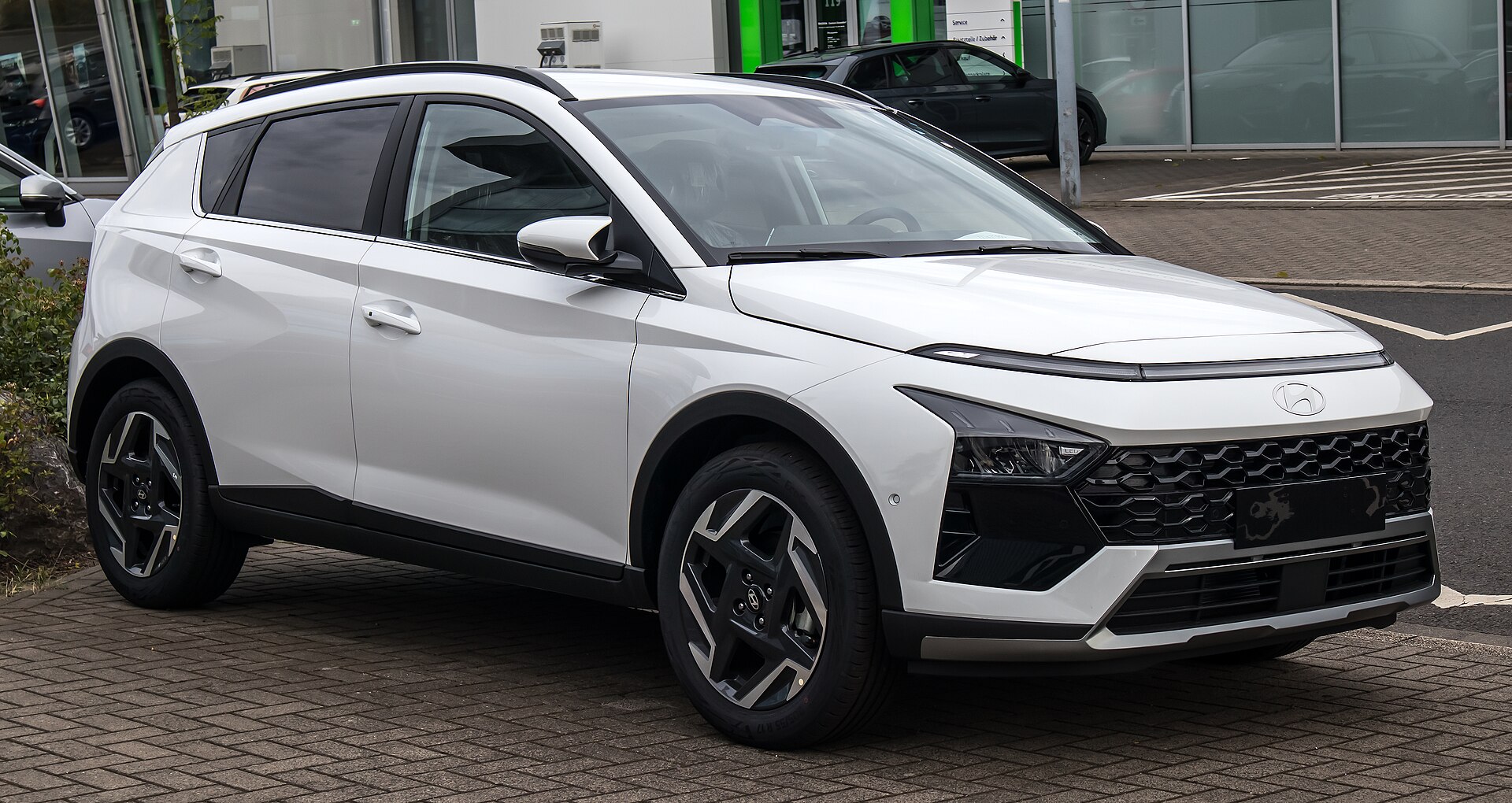
 Hyundai Bayon
Specs, engines and history
Published Sources (2) Report an error
By Sarah Whitmore, Senior Automotive Writer
- Built
- 2021–present
- Top power
- 88 kW (120 PS)
Which Bayon to choose
Our verdict · Sarah Whitmore
- For a low price: the 1.0 T-GDI Select with the manual gearbox.
- For town traffic: the DCT automatic version.
- For more power: a used 1.0 T-GDi 120 with 88 kW from 2021 to 2024.
- For more boot space: a version without mild hybrid, with the full 411 litres.
The Bayon's technical sister is covered in our guide to the Hyundai i20, and the next size up in the article on the Hyundai Kona. All versions are listed in the Hyundai catalogue.
The Hyundai Bayon is a small crossover hatchback revealed in March 2021 and named after the French city of Bayonne. It is the smallest SUV in Hyundai's European range, below the Kona, and shares its mechanical base with the third-generation i20. Like the i20 it is front-wheel drive only. A facelift was revealed on 18 January 2024; ADAC lists the updated car from June 2024.
In short
- One generation (internal code BC3) since 2021; predecessor in spirit: the i20 Active.
- Engines: 1.2 MPi with 62 kW (84 PS), 1.0 T-GDi turbo with 66, 74 or 88 kW (90, 100 or 120 PS), partly as a 48-volt mild hybrid.
- 4,180 mm long on a 2,580 mm wheelbase, boot 411 to 1,205 litres (ADAC).
- German list price from €23,900 for the 1.0 T-GDI Select, valid from November 2025.
Size at a glance
| Dimensions | Hyundai Bayon BC3 |
|---|---|
| Length | 4,180 mm164.6 in |
| Width | 1,775 mm69.9 in |
| Height | 1,500 mm59.1 in |
| Wheelbase | 2,580 mm101.6 in |
| Boot | 411 L14.5 cu ft |
Running cost
Fuel · Bayon BC3 1.0 T-GDI 90
about 1,500 EUR fuel a year at 15,000 km
5.8 l/100 km · petrol at 1.75 EUR/l · change mileage, fuel price or version
Specs by version
Engines
| Version | Engine | Power | Torque | Gearbox | Drive | Production years |
|---|---|---|---|---|---|---|
| 1.2 MPi 84 | 4 cyl · Petrol | 62 kW 84 PS83 hp | 118 Nm87 lb-ft | 5-sp Manual | Front-wheel drive | 2021 |
| 1.0 T-GDI 90 | 3 cyl · Petrol G3LK | 66 kW 90 PS89 hp | 172 Nm127 lb-ft | 6-sp Manual | Front-wheel drive | 2025 |
| 1.0 T-GDi 100 48V | 3 cyl · Petrol | 74 kW 101 PS99 hp | 172 Nm127 lb-ft | 6-sp Manual | Front-wheel drive | 2021 |
| 1.0 T-GDi 120 48V | 3 cyl · Petrol | 88 kW 120 PS118 hp | 200 Nm148 lb-ft | 6-sp Manual | Front-wheel drive | 2021 |
Performance
Show all 4 versions
| Version | 0–100 km/h | Top speed |
|---|---|---|
| 1.2 MPi 84 | 13.5 s 0–62 mph | 165 km/h103 mph |
| 1.0 T-GDI 90 | 11.9 s 0–62 mph | 174 km/h108 mph |
| 1.0 T-GDi 100 48V | 10.7 s 0–62 mph | 183 km/h114 mph |
| 1.0 T-GDi 120 48V | 10.4 s 0–62 mph | 185 km/h115 mph |
Dimensions and weight
Show all 1 versions
| Version | Length | Width | Height | Wheelbase | Kerb weight | Boot | Fuel tank |
|---|---|---|---|---|---|---|---|
| 1.0 T-GDI 90 | 4,180 mm164.6 in | 1,775 mm69.9 in | 1,500 mm59.1 in | 2,580 mm101.6 in | 1,175 kg2,590 lb | 411 l14.5 cu ft | 40 l10.6 gal US |
Verified Manufacturer and type-approval data from our catalog · Sources and methodology
Hyundai Bayon at a glance
| Specification | Hyundai Bayon |
|---|---|
| Production | since 2021 |
| Internal code | BC3 |
| Base | third-generation Hyundai i20 |
| Body | five-door crossover hatchback |
| Drive | front-wheel drive |
| Engines | 1.2 MPi (4-cyl.), 1.0 T-GDi (3-cyl. turbo), 1.4 MPi in some markets |
| Power | 62 to 88 kW (84 to 120 PS) |
| Gearboxes | 5- and 6-speed manual, 6-speed clutchless manual (iMT), 7-speed DCT, 6-speed automatic |
| Length / wheelbase | 4,180 mm / 2,580 mm |
| Boot | 411 l, 1,205 l with the rear seat folded |
Origins and the i20 connection
Hyundai presented the Bayon in March 2021 as a crossover version of the third-generation i20, replacing the i20 Active in spirit. It has no all-wheel drive and shares its mechanical base with the hatchback. Hyundai placed the Bayon below the Kona, so it is the brand's smallest European SUV.
Autonotizen.de drove the Bayon in April 2021 and noted that versions without the mild-hybrid system have a 411-litre boot, because the lithium-ion battery of the 48-volt cars sits under the floor.

Engines and performance
| Version | Power | Torque | 0–100 km/h | Top speed | Gearbox |
|---|---|---|---|---|---|
| 1.2 MPi | 62 kW (84 PS) | 118 Nm | 13.5 s | 165 km/h | 5-speed manual |
| 1.4 MPi | 74 kW (100 PS) | 134 Nm | 12.6 s | 176 km/h | 6-speed manual or automatic |
| 1.0 T-GDi 100 (mild hybrid) | 74 kW (100 PS) | 172 Nm | 10.7 s | 183 km/h | 6-speed manual, iMT or 7-speed DCT |
| 1.0 T-GDi 120 (mild hybrid) | 88 kW (120 PS) | 200 Nm | 10.4 s | 185 km/h | 6-speed manual or iMT |
| 1.0 T-GDI 90 (from 2025) | 66 kW (90 PS) | 172 Nm | 11.9 s | 174 km/h | 6-speed manual or DCT |
The first four lines are pre-facelift data from Wikipedia; the 1.4 MPi is not part of the European range. With the DCT the 1.0 T-GDi 100 needs 11.7 seconds and reaches 181 km/h. Since November 2025 ADAC lists only the 66 kW (90 PS) 1.0 T-GDI in Germany, with a WLTP consumption of 5.8 l/100 km and 131 g/km of CO2 for the manual version.

Gearboxes and the 48-volt system
The Bayon has an unusually wide choice of transmissions for a small car. Wikipedia lists five- and six-speed manuals, a six-speed clutchless manual (Hyundai's iMT, where the clutch is operated electronically), a six-speed torque-converter automatic for the 1.4 MPi and a seven-speed dual-clutch gearbox (DCT).
The 1.0 T-GDi with 74 or 88 kW was sold as a mild hybrid. Its small lithium-ion battery sits under the boot floor, which costs some luggage space: Autonotizen.de gives 411 litres only for the versions without this system. The facelifted 66 kW engine listed by ADAC since November 2025 produces the same 172 Nm as the earlier 74 kW mild hybrid.
The 2024 facelift
Hyundai revealed the facelift on 18 January 2024. Changes include:
- a new LED daytime running light across the full width of the front;
- a redesigned front fascia and new bumpers at both ends;
- new alloy wheel designs;
- more interior and safety equipment.
Wikipedia also reports that a second-generation Bayon is to be unveiled in India.

Dimensions and practicality
| Dimension | Value (ADAC, 1.0 T-GDI 90) |
|---|---|
| Length | 4,180 mm |
| Width | 1,775 mm (2,040 mm with mirrors) |
| Height | 1,500 mm |
| Wheelbase | 2,580 mm |
| Kerb weight | 1,175 kg |
| Boot | 411 to 1,205 l |
| Fuel tank | 40 l |
Folding the rear seat adds 794 litres of luggage space. The 2,580 mm wheelbase is the same as that of the Kia Stonic. With a 40-litre tank and 5.8 l/100 km WLTP, the 1.0 T-GDI 90 has a theoretical range of about 690 km.
Bayon compared with the Kia Stonic
The Bayon and the Kia Stonic come from the same group and use the same 1.0 T-GDI engine family. ADAC data of the 2025 facelifts allow a direct comparison.
| Figure | Hyundai Bayon 1.0 T-GDI 90 | Kia Stonic 1.0 T-GDI 100 |
|---|---|---|
| Power | 66 kW (90 PS) | 74 kW (100 PS) |
| Torque | 172 Nm | 172 Nm |
| 0–100 km/h | 11.9 s | 11.0 s |
| Length | 4,180 mm | 4,165 mm |
| Boot | 411 l | 352 l |
| Price (ADAC) | €23,900 (from November 2025) | €23,790 (from December 2025) |
- The Bayon is 15 mm longer and has 59 l more boot space than the Stonic.
- The Stonic has 8 kW more and is 0.9 seconds quicker to 100 km/h, for €110 less in the late-2025 ADAC lists.
- Weight per kW: 17.8 kg per kW for the Bayon (1,175 kg and 66 kW) and 16.3 kg per kW for the Stonic (1,205 kg and 74 kW).
Safety
Euro NCAP tested a Bayon 1.0 T-GDi in 2021. It scored 76 percent for adult occupants, 82 percent for children, 76 percent for pedestrians and 67 percent for safety assistance. The star rating is not given in the sources used here.
Sales
Hyundai sold 15,404 Bayons in Europe in 2021, 20,486 in 2022, 27,793 in 2023 and 28,241 in 2024. Turkey added between 5,067 and 17,581 per year in the same period. By our calculation that is 91,924 European sales in the first four years.
Prices in Germany
| Version | List price (ADAC) | Valid |
|---|---|---|
| 1.0 T-GDI Select, 66 kW | €23,900 | from November 2025 |
| 1.0 T-GDI Prime DCT, 66 kW | €30,600 | from November 2025 |
The gap between the cheapest and the dearest Bayon in the November 2025 list is €6,700. All current German versions use the same 66 kW engine; trim and gearbox make the difference.
Photo gallery


Hyundai Bayon in our rankings
- No. 8 of 99 · Lightest SUVs and crossovers (1,175 kg)
- No. 16 of 146 · Smallest SUVs and crossovers (4,180 mm · top 11%)
- No. 79 of 420 · Smallest cars (4,180 mm · top 19%)
- No. 54 of 304 · Lightest cars (1,175 kg · top 19%)
- No. 72 of 256 · Most economical cars (5.8 l/100 km · top 29%)
- No. 28 of 77 · Most economical SUVs and crossovers (5.8 l/100 km · top 37%)
Lighter than 91% of ranked SUVs and crossovers in the 1CARS catalog (No. 8 of 99).
FAQ
Is the Hyundai Bayon an SUV?
It is a crossover version of the i20 with front-wheel drive only. Hyundai markets it as its smallest SUV.
Where does the name Bayon come from?
From the French city of Bayonne.
How big is the Bayon boot?
411 litres and 1,205 litres with the rear seat folded, according to ADAC.
Is the Bayon a hybrid?
The 1.0 T-GDi was offered as a 48-volt mild hybrid. There is no full hybrid in the range covered here.
What does the Bayon cost in Germany?
ADAC lists the 1.0 T-GDI Select at €23,900 from November 2025.
Data sources
Data checked by an editor against the sources below.