 Hyundai Kona
All generations, specs and history
Published Sources (2) Report an error
By Felix Hartmann, Automotive Technology & EV Contributor
- Built
- 2017–present
- Generations
- 2 · OS to SX2
Timeline
Kona generations
Click a generation for its own page


- Kona I (OS) 2017–2023 · SUV
- Kona II (SX2) Current 2023–now · SUV
Newest first · 2 generations since 2017
All generations by year: Kona II (SX2) (2023–now) · Kona I (OS) (2017–2023)
Which one is mine?
Pick the year of first registration to see which generation it is.
- SX2 2023–present
- OS 2017–2023
The Hyundai Kona is a compact crossover from the South Korean company Hyundai. It was revealed in June 2017 and went on sale in Western Europe at the end of that year, with a bold design that looks like no other Hyundai SUV. The name comes from the Kona district on the western side of the island of Hawaii; in Portugal the car is sold as the Kauai. In March 2018 Hyundai added the Kona Electric, shown at the Geneva motor show.
In short
- First generation (OS) revealed in Seoul in June 2017, on a platform derived from the Hyundai i30; facelifted in September 2020.
- Engines included a 88 kW (120 PS) 1.0 turbo, a 130 kW (177 PS) 1.6 turbo, a 2.0 petrol, 1.6 diesels and a hybrid; the Kona Electric offered 100 kW (136 PS) or 150 kW (204 PS).
- Front-wheel drive is standard, and optional all-wheel drive can send up to 50% of the torque to the rear.
- The sporty Kona N arrived in 2021, and an all-new second generation was revealed in December 2022.
Safety
-
SX2 · NHTSA 2025
US NCAP (NHTSA)
-
OS · NHTSA 2022
US NCAP (NHTSA)
Stars from different years and organisations are not directly comparable: test protocols change every few years.
Hyundai Kona at a glance
Hyundai wanted to surprise buyers with the Kona, and it succeeded: the styling stands out in any traffic. The first generation was offered with petrol, diesel, hybrid and fully electric powertrains, making it one of the most versatile small SUVs of its time. The September 2020 facelift brought revised styling and a 48-volt mild-hybrid system for the 1.0-litre engine, and in April 2021 Hyundai added the high-performance Kona N. The second generation, revealed in December 2022 and launched in 2023, was designed as an electric vehicle first and then adapted for petrol and hybrid versions; it is about 150 mm longer. More of the brand's range is in our Hyundai catalogue, and the electric version is covered in Hyundai Kona Electric.
Exterior
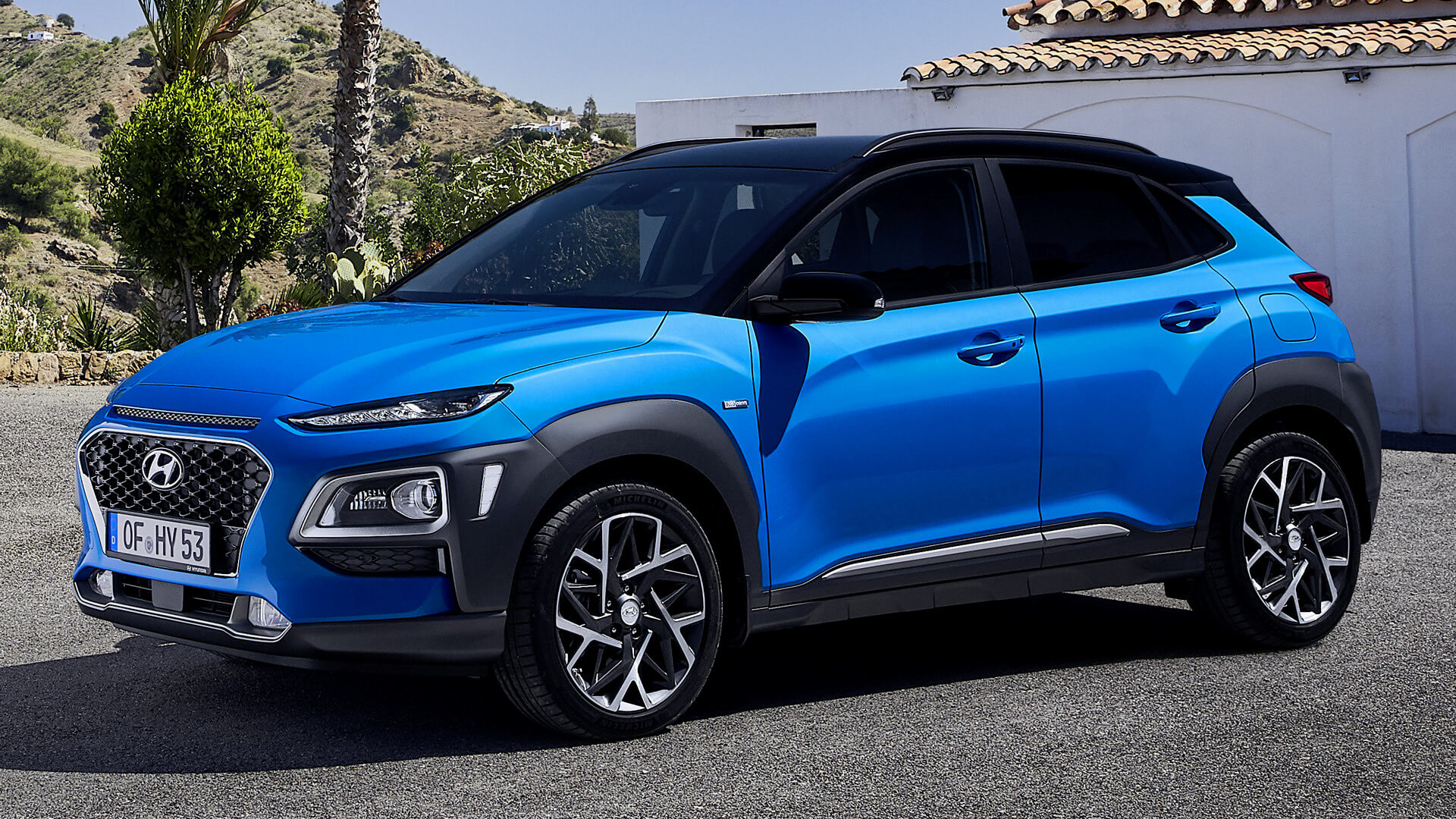
The Kona is anything but plain. The front is short, with a sculpted bonnet and, at the top, very slim LED daytime running lights with a thin intake slot between them - so slim they are easy to miss. The main grille sits lower and shares the large trapezoidal mesh design of other Hyundai models. Beside the wheel arches are extra openings that contain the main headlights. The lower bumper has more sculpting, another intake slot and fog lights at the sides, and the bottom of the bumper is finished in unpainted plastic.
The sides have flowing sculpting, stylish mirrors and wheels, and a wide band of plastic cladding along the lower body, which also forms the wheel-arch extensions, plus a slim chrome strip. The door handles are small and elongated. The mirrors are narrow but give a good view, and even the base version has electric adjustment, heating and indicator repeaters. Base models have 17-inch alloy wheels, with 18- or 19-inch wheels optional depending on the market, and ground clearance is 180 mm.
At the rear, the sculpted bumper has slim lights, several light units and plastic and metal inserts. The rear window, spoiler, LED tail lights split between the body and tailgate and the chrome badge show the family resemblance to Hyundai's i30 and ix35. The tailgate has a large handle and a small chrome strip, and the bumper has a sporty curved top and a large diffuser - but no visible exhaust.
Interior and practicality
The cabin has sporty touches but a fairly restrained design, and it varies with the version. Hyundai moved the infotainment screen out of the dashboard and placed it in a separate, tablet-like unit on top. Base versions have a 5-inch display, while 7- or 8-inch touchscreens with Android Auto and Apple CarPlay are optional, along with physical buttons and knobs for everything from audio to navigation.
Below the screen are two rectangular air vents with the hazard switch between them, then the dual-zone climate control or air conditioning, and a small panel for the heated mirrors and windscreen. Charging options include a wireless pad, two 12-volt sockets, USB and AUX. Around the gear lever are buttons for the seat heating and ventilation, blind-spot monitoring and adaptive cruise control. The parking brake is a traditional mechanical lever, with two small cupholders beside it.
The instrument cluster is simple, with a colour trip-computer screen between the speedometer and rev counter, and a pop-up head-up display is available behind the instruments. The three-spoke leather steering wheel is heated on many versions, and the audio system has at least eight speakers on better versions. Some versions offer a sunroof, leather upholstery, sports seats with good side support and seat stitching in the body colour. Three people can sit in the back, with access to 12-volt and USB sockets and seat heating on some versions. The boot holds 361 litres, which is reasonable for the class, rising to 1,143 litres with the rear seats folded.
Engines and transmissions (first generation)
| Engine | Power (kW / PS) | Torque | Gearbox | 0–100 km/h | Consumption |
|---|---|---|---|---|---|
| 1.0 T-GDi petrol (3-cyl) | 88 kW / 120 PS | 172 Nm | 6-speed manual or 7-speed DCT | 12.0 s | 5.2 l/100 km |
| 1.6 T-GDi petrol (4-cyl) | 130 kW / 177 PS | 265 Nm | 7-speed DCT | 7.7 s | 6.7 l/100 km |
| 2.0 MPi petrol (4-cyl) | 110 kW / 149 PS | 179 Nm | 6-speed automatic | - | - |
| 1.6 CRDi diesel (4-cyl) | 85 or 100 kW / 115 or 136 PS | - | 7-speed DCT | - | - |
| Kona Electric | 100 kW / 136 PS, 39.2 kWh | - | single-speed | - | about 300 km range |
| Kona Electric | 150 kW / 204 PS, 64 kWh | - | single-speed | - | about 470 km range |
Engine availability depended on the market. The 1.0 T-GDi reaches 181 km/h and the 1.6 T-GDi 210 km/h. The 2.0 petrol and the diesels were less common. A 1.6 hybrid was also offered. The Kona Electric with the 39.2 kWh battery can be fully charged from a household socket in about 6 hours 10 minutes, or to 80% in 54 minutes at a 100 kW charger. The 64 kWh version looks almost the same, with minor differences at the front.
Although the Kona is front-wheel drive as standard, an all-wheel-drive system with a multi-plate clutch is optional on some engines, sending up to 50% of the torque to the rear wheels.
Chassis
The first-generation Kona uses a B-segment platform derived from the Hyundai i30. Front suspension uses MacPherson struts, while the rear depends on the version: front-wheel-drive models have a torsion beam and all-wheel-drive models a multi-link axle. More than half of the body is made of advanced high-strength steel.
Safety and equipment
Hyundai paid close attention to safety. Even the standard car has front airbags and curtain airbags, and the top-spec version has a driver's knee airbag, a front centre airbag and rear side airbags in addition. Weak points of the body were reinforced with new structures. Depending on the version, the Kona offers adaptive LED headlights, adaptive cruise control, forward collision avoidance, blind-spot monitoring, driver-attention warning, lane-departure warning, traffic-sign recognition, navigation and a surround-view camera, plus stability control. In Euro NCAP's 2017 test, the 1.0 T-GDi scored 87% for adult and 85% for child occupant protection.
Strengths and weaknesses
Owners praise the striking design, modern technology, comfort and build quality, the pleasant cabin, strong engines and good safety, as well as the all-wheel-drive system and suspension. Criticisms include modest performance in some versions and limited ground clearance. Rivals include the Nissan Juke, Honda HR-V, Opel Mokka X, Kia Stonic, Peugeot 2008 and Volkswagen T-Roc.
Image credits · Photos from Wikimedia Commons under free licences
- Hyundai Kona I (OS) · Photo: Vauxford / Wikimedia Commons, CC BY-SA 4.0
- Hyundai Kona II (SX2) · Photo: Damian B Oh / Wikimedia Commons, CC BY-SA 4.0
Hyundai Kona in our rankings
- No. 432 of 912 · Longest-running car nameplates (9 years · top 49%)
- No. 171 of 305 · Oldest car models still on sale (9 years · top 60%)
- No. 332 of 345 · Cars with the most generations (2 generations)
In production longer than 51% of ranked nameplates in the 1CARS catalog (No. 432 of 912).
FAQ
When did the Hyundai Kona come out?
It was revealed in Seoul in June 2017 and went on sale in Western Europe at the end of 2017.
Is there an electric Hyundai Kona?
Yes. The Kona Electric offered 100 kW (136 PS) with a 39.2 kWh battery or 150 kW (204 PS) with a 64 kWh battery.
Is the Hyundai Kona four-wheel drive?
It is front-wheel drive as standard, with optional all-wheel drive on some versions that can send up to 50% of the torque to the rear.
How big is the Hyundai Kona boot?
The first generation holds 361 litres, or 1,143 litres with the rear seats folded; the second generation offers 466 litres.
Where does the name Kona come from?
From the Kona district on the western side of the island of Hawaii.
Data sources
Data checked by an editor against the sources below.
- Wikipedia - Hyundai Kona
- NHTSA 5-Star Safety Ratings (US NCAP) — U.S. Government work, public domain