
 Kia Carnival
All generations, specs and history
Updated Published Sources (7) Report an error
By Sarah Whitmore, Senior Automotive Writer Reviewed by Oleksandr Hnatiuk

- Built
- 1998–present
- Generations
- 4 · Carnival I to KA4
- Top power
- 216 kW (294 PS)
- New price
- from about €28,115 (2006)
Timeline
Carnival generations
Click a generation for its own page


YP and KA4 overlapped in 2020–2021, so KA4 sits on a second lane
- Carnival I 1998–2005 · Minivan / MPV · 93–145 kW (126–197 PS)
- Carnival VQ 2006–2014 · Minivan / MPV · 179 kW (243 PS)
- Carnival YP 2014–2021 · Minivan / MPV · 147–206 kW (200–280 PS)
- Carnival KA4 Current 2020–now · Minivan / MPV · 149–216 kW (203–294 PS)
Newest first · 4 generations since 1998
-
2020

-
2014

-
2006
-
1998

All generations by year: Carnival KA4 (2020–now) · Carnival YP (2014–2021) · Carnival VQ (2006–2014) · Carnival I (1998–2005)
Which one is mine?
Pick the year of first registration to see which generation it is.
- KA4 2020–present
- YP 2014–2021
- VQ 2006–2014
- Carnival I 1998–2005
Which Kia Carnival to buy: verdict
Our verdict · Sarah Whitmore
For a big family that needs real space, the fourth-generation Carnival is the one to choose: it is roomier, safer and better equipped than the YP. The 1.6 hybrid makes most sense for town and mixed driving, the diesel for long distances with a full load, and the V6 for buyers who want smooth power. A used YP 2.2 diesel is the budget choice, provided the sliding doors and gearbox are in good order.
The Kia Carnival is a large front-wheel-drive people carrier, sold as the Sedona in North America and other markets. Four generations have been built since 1998. The current KA4 model, launched in 2020 and facelifted in late 2023, is 5,155 mm long, seats up to eleven and offers V6, diesel and, since 2024, a 1.6 turbo hybrid.
In short
- Generations: first (1998–2005), second (2006–2014), third YP (2014–2020) and fourth KA4 (since 2020).
- Current engines: 3.5 V6 petrol with up to 216 kW (294 PS), 2.2 diesel with 149 kW (202 PS) and a 1.6 T-GDi hybrid with 180 kW (245 PS) system output.
- Space: 627 litres behind the third row and up to 2,905 litres with the rear seats folded, according to spec data.
- Safety: the fourth generation scored 90 % for adult occupants in its 2021 ANCAP test.

Specs by version
Engines
| Version | Engine | Gearbox | Drive | Production years |
|---|---|---|---|---|
| KA4 · 2020–present | ||||
| KA4 · 3.5 L 6 cyl Automatic (S8) · 2026 (EPA) | 3.5 l · 6 cyl 3,500 cc | 8-sp Automatic | Front-wheel drive | 2026 |
| KA4 · 3.5 L 6 cyl Automatic (S8) · 2025 (EPA) | 3.5 l · 6 cyl 3,500 cc | 8-sp Automatic | Front-wheel drive | 2025 |
| KA4 · 3.5 L 6 cyl Automatic (S8) · 2024 (EPA) | 3.5 l · 6 cyl 3,500 cc | 8-sp Automatic | Front-wheel drive | 2024 |
| KA4 · 3.5 L 6 cyl Automatic (S8) · 2023 (EPA) | 3.5 l · 6 cyl 3,500 cc | 8-sp Automatic | Front-wheel drive | 2023 |
| KA4 · 3.5 L 6 cyl Automatic (S8) · 2022 (EPA) | 3.5 l · 6 cyl 3,500 cc | 8-sp Automatic | Front-wheel drive | 2022 |
Performance
Show all 5 versions
| Version | Fuel consumption |
|---|---|
| KA4 · 2020–present | |
| KA4 · 3.5 L 6 cyl Automatic (S8) · 2026 (EPA) | 11.2 l/100 km21.0 mpg US · 25.2 mpg UK |
| KA4 · 3.5 L 6 cyl Automatic (S8) · 2025 (EPA) | 11.2 l/100 km21.0 mpg US · 25.2 mpg UK |
| KA4 · 3.5 L 6 cyl Automatic (S8) · 2024 (EPA) | 10.7 l/100 km22.0 mpg US · 26.4 mpg UK |
| KA4 · 3.5 L 6 cyl Automatic (S8) · 2023 (EPA) | 10.7 l/100 km22.0 mpg US · 26.4 mpg UK |
| KA4 · 3.5 L 6 cyl Automatic (S8) · 2022 (EPA) | 10.7 l/100 km22.0 mpg US · 26.4 mpg UK |
Verified Manufacturer and type-approval data from our catalog · Sources and methodology
Safety
-
KA4 · NHTSA 2024
US NCAP (NHTSA)
Full NHTSA rating
Stars from different years and organisations are not directly comparable: test protocols change every few years.
The Carnival at a glance: a minivan built for big families
Kia launched the Carnival in 1998 as its first large MPV, and it has stayed a front-wheel-drive, sliding-door people carrier ever since. The car is built at Kia's Gwangmyeong plant in South Korea, with assembly in China, Malaysia, Vietnam, India and other countries for local markets. In the USA it was called the Sedona until the fourth generation, when the global Carnival name took over. Kia's story is told in the history of Kia, and every model of the brand is in the Kia catalogue.

In Europe the Carnival was sold until 2012, when the second generation was withdrawn from the UK because of low sales. Later generations have concentrated on Asia, North America and Australia, where large MPVs still sell well.
Kia Carnival generations from 1998 to today
| Generation | Code | Years | Body styles | Engines | Power (hp / kW) |
|---|---|---|---|---|---|
| First | – | 1998–2005 | MPV, 7 seats | 2.5 V6, 3.5 V6 petrol; 2.9 turbo-diesel | 93–145 kW (126–198 PS) |
| Second | VQ (China) | 2006–2014 | MPV, short and long wheelbase | 2.7, 3.5, 3.8 V6; 2.9 and 2.2 diesel | up to 179 kW (243 PS) |
| Third | YP | 2014–2020 | MPV, 7–11 seats | 3.3 V6 GDI; 2.2 CRDi diesel | 147–206 kW (200–280 PS) |
| Fourth | KA4 | 2020– | MPV, 7–11 seats | 3.5 V6, 2.0 turbo, 2.2 diesel, 1.6 turbo hybrid | 149–216 kW (202–294 PS) |
First generation (1998–2005)
In Europe the original Carnival had a 2.5-litre KV6 petrol engine of 120 kW (163 PS), later 110 kW (150 PS). The alternative was a 2.9-litre turbo-diesel with 93 kW (126 PS), replaced by a common-rail version in 2001. North American Sedonas used a 3.5-litre Hyundai V6 with 145 kW (198 PS). A facelift arrived in February 2001, and the car was also built in Malaysia as the Naza Ria.
Second generation (2006–2014)
The second Carnival grew to more than 5.1 metres in its long-wheelbase form. It came with a wide range of V6 engines, topped by a 3.8-litre Lambda V6 with 179 kW (243 PS) in North America. In the UK the 2.9 diesel was replaced by a 2.2 CRDi with 141 kW (192 PS). This generation earned a 2006 Top Safety Pick from the IIHS and five stars from NHTSA in frontal and side impacts. It also gave Hyundai a twin, the Entourage of 2006–2009.
Third generation, YP (2014–2020)
The YP made its world debut at the New York motor show in April 2014. It is built on a new, stiffer and slightly longer platform. According to the old 1cars text, Kia claimed a 36 % gain in torsional rigidity, and more than 75 % of the body is high-strength steel. Engines are the 3.3-litre Lambda V6 with direct injection, 206 kW (280 PS) and 336 Nm, and a 2.2-litre CRDi diesel with 147 kW (200 PS) and 440 Nm. Early cars had a six-speed automatic, replaced in many markets by an eight-speed unit from 2018.
The suspension uses MacPherson struts at the front and a multi-link axle on a separate subframe at the rear, with ventilated front discs. The cabin offers up to eight seats in the American version, sliding second-row seats and a maximum luggage space of about 2,200 litres.
Fourth generation, KA4 (since 2020)
The KA4 was revealed in June 2020 on Hyundai-Kia's new mid-size platform. It is 40 mm longer than the YP and has a 30 mm longer wheelbase, at 3,090 mm. The design moved closer to an SUV, with a long bonnet and a wide grille. A facelift was revealed on 27 October 2023 for the 2025 model year, bringing the first hybrid Carnival.
KA4 engines: V6, turbo four, diesel and hybrid
| Engine (fourth generation) | Power | Torque | Gearbox |
|---|---|---|---|
| 2.0 T-GDi petrol, four-cylinder | 171 kW (233 PS) | 353 Nm | 8-speed automatic |
| 3.5 MPi petrol V6 | 200 kW (272 PS) | 331 Nm | 8-speed automatic |
| 3.5 GDi petrol V6 | 216 kW (294 PS) | 355 Nm | 8-speed automatic |
| 2.2 CRDi diesel | 149 kW (202 PS) | 441 Nm | 8-speed automatic |
| 1.6 T-GDi hybrid (from 2024) | 180 kW (245 PS) system | 368 Nm system | 6-speed automatic |
Every Carnival drives the front wheels; there is no all-wheel-drive version. The 3.5 MPi accelerates from 0 to 100 km/h in 8.5 seconds and the diesel in 10.7 seconds, both with a top speed of 190 km/h. The hybrid's petrol engine alone gives 132 kW (180 PS) and 265 Nm; the electric motor fills the gap at low revs.

Size, seats and luggage space
| Parameter | Metric | Imperial |
|---|---|---|
| Length | 5,155 mm | 203.0 in |
| Width | 1,995 mm | 78.5 in |
| Height | 1,775 mm | 69.9 in |
| Wheelbase | 3,090 mm | 121.7 in |
| Kerb weight | 2,080–2,155 kg | 4,586–4,751 lb |
| Boot, all seats in use | 627 l | 22.1 cu ft |
| Boot, rear seats folded | 2,905 l | 102.6 cu ft |
| Fuel tank | 72 l | 19.0 US gal |
These figures are for the facelifted fourth generation. Depending on the market, it seats seven, eight, nine or eleven people: Thailand and Malaysia had eleven-seat versions, while North America offers seven or eight. At 5.16 metres long and almost 2 metres wide, the Carnival needs a big space, so check your garage or parking space with the garage fit tool before buying.

Hybrid, diesel or V6: fuel figures
The hybrid is the most economical version. A UK spec database lists combined figures of about 7.4 l/100 km for the 1.6 hybrid, 7.6 l/100 km for the 2.2 diesel and 11.1 l/100 km for the 3.5 V6. The matching CO2 figures are 116, 146 and 189 g/km. In daily use a heavy MPV with eight people on board will use more. The fuel cost calculator turns these figures into the cost of a family trip.

Equipment and cabin features
Equipment varies widely by market, but the Carnival has always been a well-equipped family car. For the YP generation, the old 1cars text lists curtain airbags and blind-spot monitoring on the base car. Higher trims add a panoramic roof, a powered tailgate and power sliding doors, plus mirrors that fold out as the driver approaches. Second-row seats slide on rails and have leg rests, and the seat fabric is antibacterial and stain-resistant. The fourth generation adds large digital screens, more driver assistance systems and, in some markets, reclining "VIP" seats in the second row.

ANCAP results for the YP and KA4
The fourth-generation Carnival was tested by ANCAP in 2021 using the same protocols as Euro NCAP. It scored 90 % for adult occupant protection, 88 % for child occupants, 68 % for vulnerable road users and 82 % for safety assistance. The YP was rated by ANCAP in 2015 and again in 2016, when its frontal-offset result improved from 10.48 to 14.29 points out of 16. Euro NCAP has not published a result for the Carnival.

Buying a used Carnival: checks
A used Carnival has often had a hard life with children and heavy loads. Check that the sliding doors open and close smoothly on their rollers and motors, that the automatic gearbox changes cleanly, and that the diesel's emissions system has been looked after. On any version, ask for a full service record with regular oil changes.

Rivals: how the Carnival compares
| Model | Engines | Power (hp) | Boot (l) | Price from (EUR) |
|---|---|---|---|---|
| Kia Carnival (KA4) | 1.6 hybrid, 2.2 diesel, 3.5 V6 | 202–294 | 627 | not sold in the EU |
| Toyota Sienna | 2.5 hybrid | 245 | – | not sold in the EU |
| Honda Odyssey | 3.5 V6 | 280 | – | not sold in the EU |
| Chrysler Pacifica | 3.6 V6, plug-in hybrid | 260–287 | – | not sold in the EU |
Against American and Japanese minivans, the Carnival offers a diesel and the widest choice of seat layouts, but no all-wheel drive, which the Toyota Sienna and Chrysler Pacifica offer. Inside Kia's range, the seven-seat Kia Sorento and the Kia Telluride are the SUV alternatives with all-wheel drive.


Kia Carnival evolution in numbers
Did you know?
- The Kia Carnival has been around for 28 years: 4 generations in our catalog since 1998.
- The longest-running generation is the Carnival VQ (2006–2014): 8 years.
- The biggest jump in power came with the Carnival VQ: up to 179 kW (243 PS), 34 kW more than the Carnival I.
Most powerful version, kW
Figures from the 1cars catalog: power is the strongest version of each generation; generations without the figure are left out.
Kia Carnival: first vs latest generation
| Spec | Carnival I | Carnival KA4 | Change |
|---|---|---|---|
| Years | 1998–2005 | 2020–present | 22 years apart |
| Most powerful version | 145 kW (197 PS) | 216 kW (294 PS) | +71 kW (+49%) |
Oldest and newest generation in the 1cars catalog. Power is the strongest version of each; other rows are shown only when both generations have the figure.
Image credits · Photos from Wikimedia Commons under free licences
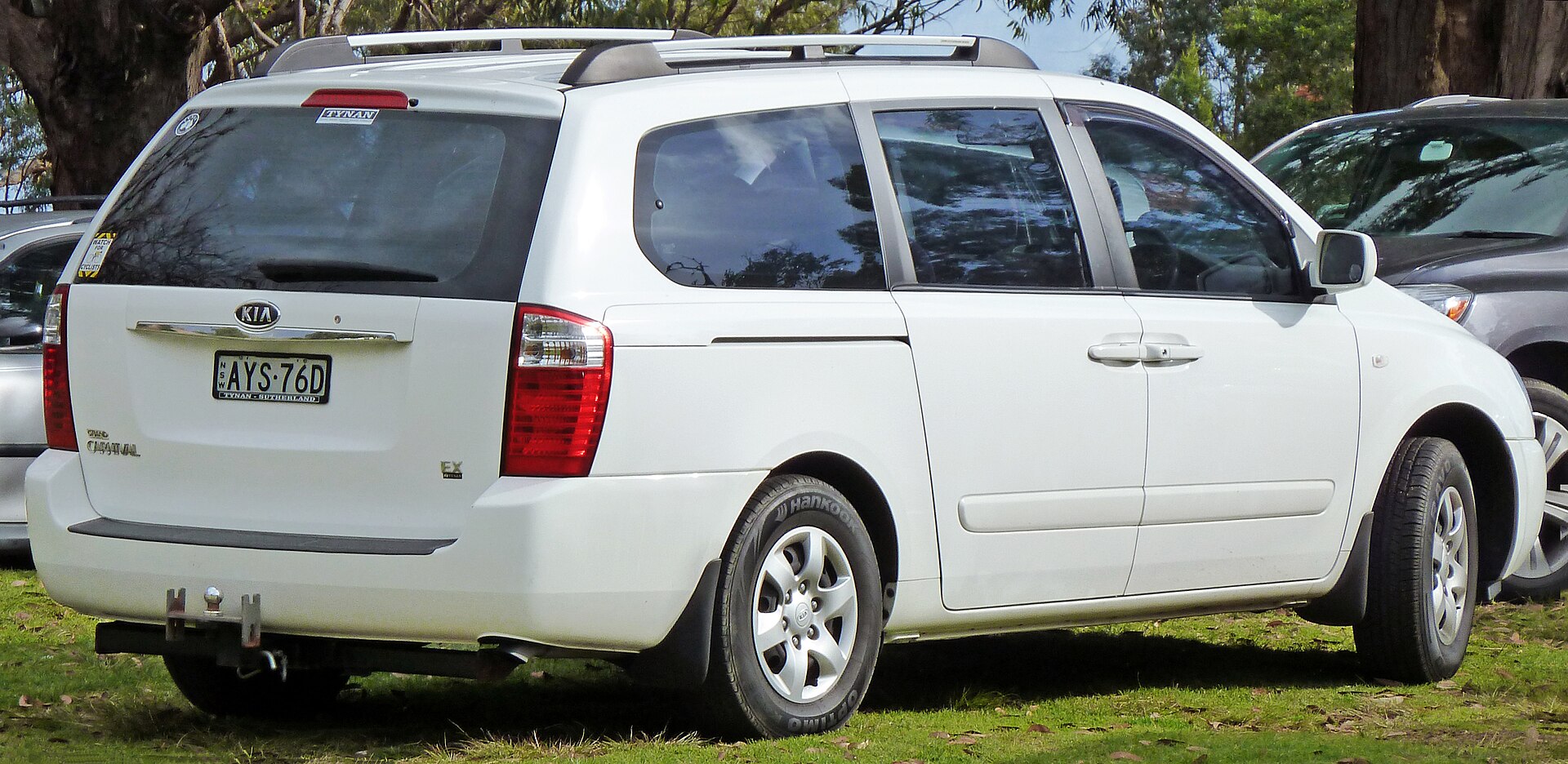
- Kia Carnival VQ · Photo: OSX / Wikimedia Commons, Public domain
Kia Carnival in our rankings
- No. 3 of 26 · Most powerful minivans and MPVs (216 kW)
- No. 96 of 1144 · Longest-running car nameplates (28 years · top 9%)
- No. 72 of 381 · Oldest car models still on sale (28 years · top 20%)
- No. 14 of 47 · Most powerful Korean cars (216 kW · top 30%)
- No. 134 of 448 · Cars with the most generations (4 generations · top 37%)
- No. 285 of 709 · Biggest engines: cars (3,500 cc · top 42%)
In production longer than 91% of ranked nameplates in the 1CARS catalog (No. 96 of 1144).
Kia Carnival photos 25


FAQ
How many generations of the Kia Carnival are there?
There are four: the first generation (1998–2005), the second (2006–2014), the third YP (2014–2020) and the fourth KA4, launched in June 2020 and facelifted in October 2023. In the USA the first three were sold as the Kia Sedona.
What is the fuel consumption of the Kia Carnival?
Spec data for the facelifted fourth generation lists about 7.4 l/100 km for the 1.6 hybrid, 7.6 l/100 km for the 2.2 diesel and 11.1 l/100 km for the 3.5 V6. Real use with a full load is higher.
Is the Kia Carnival available with all-wheel drive or as a hybrid?
All Carnivals are front-wheel drive; Kia has never offered all-wheel drive. A 1.6 T-GDi hybrid with a combined 180 kW (245 PS) and a six-speed automatic joined the range with the 2024 facelift.
How many seats does the Kia Carnival have?
Depending on the market and version, the Carnival seats seven, eight, nine or eleven people. North American cars have seven or eight seats, while eleven-seat versions were sold in Thailand and Malaysia.
What are the main rivals of the Kia Carnival?
Its main rivals are the Toyota Sienna, Honda Odyssey and Chrysler Pacifica in North America, and large MPVs and seven-seat SUVs elsewhere. The Carnival stands out with its diesel option and its many seat layouts.
Data sources
Data checked by an editor against the sources below.
- The text of this article (1cars archive)
- Wikipedia - Kia Carnival
- US EPA fueleconomy.gov - 49437.shtml
- US EPA fueleconomy.gov - 47784.shtml
- US EPA fueleconomy.gov - 46503.shtml
- US EPA fueleconomy.gov - 45304.shtml
- NHTSA 5-Star Safety Ratings (US NCAP) — U.S. Government work, public domain


