 Fiat Bravo
Specs, engines and history
Published Sources (2) Report an error
By Felix Hartmann, Automotive Technology & EV Contributor
- Built
- 2007–2014
- Top power
- 121 kW (165 PS)
Which Bravo to choose
Our verdict · Felix Hartmann
- For a lively petrol: the 1.4 T-Jet 120 or, from 2010, the MultiAir 140 with 103 kW and 230 Nm.
- For high mileage: the 1.6 Multijet 120 with 300 Nm, or the 2.0 Multijet 165 for the most pulling power.
- For a simple, cheap car: the 1.4 Fire with 66 kW and no turbocharger.
- For an automatic: only the Dualogic automated manual was offered, with the T-Jet 120 or 1.6 Multijet 120.
Rivals such as the Volkswagen Golf can be checked against it in the car comparison tool. The Fiat catalogue shows the current range; the company is covered in our history of Fiat.
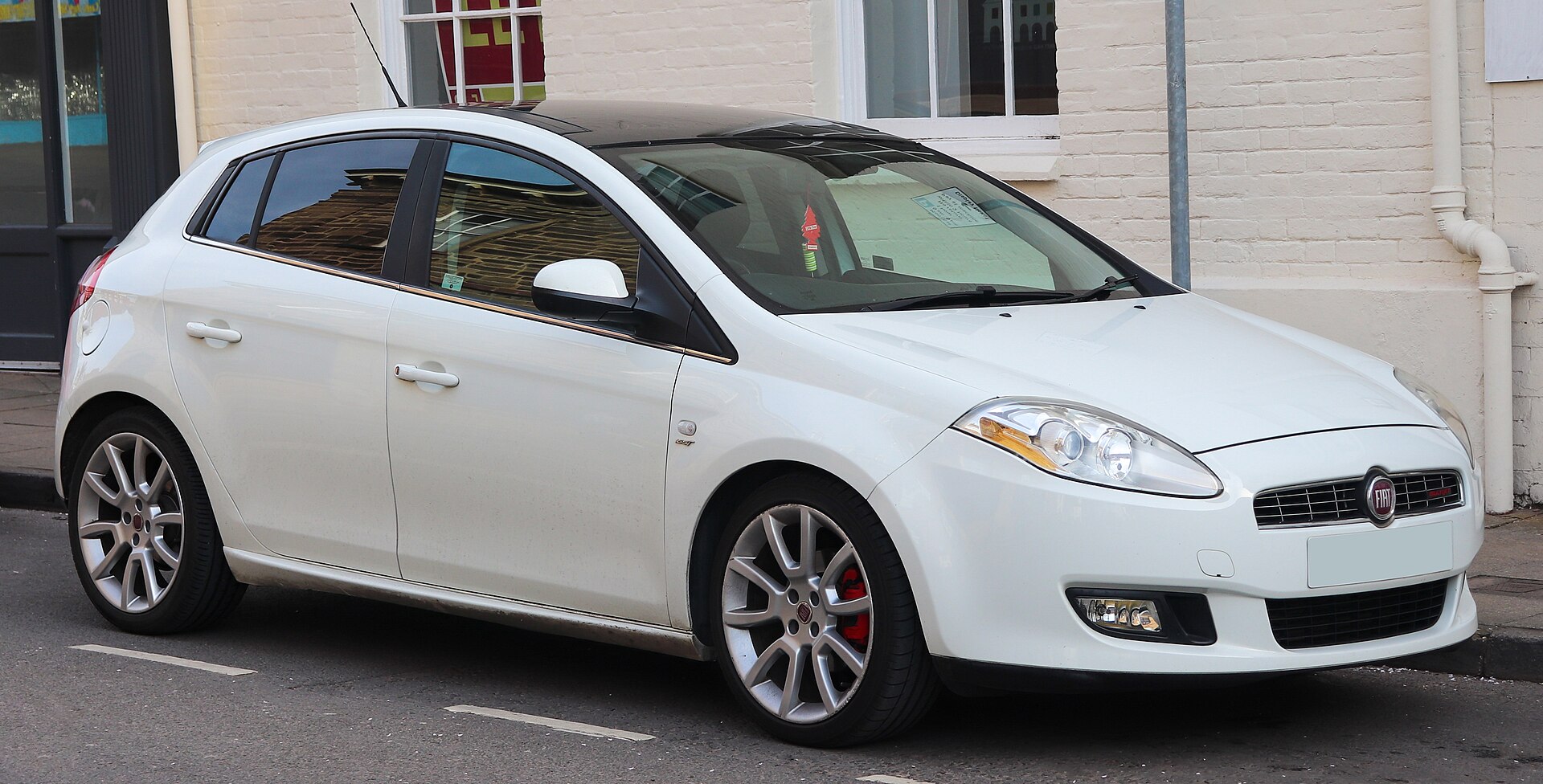
The Fiat Bravo of 2007–2014 is a five-door compact hatchback that replaced the Fiat Stilo. Fiat's Cassino works in Italy built it until July 2014, and a Brazilian version stayed in production until 2016. Engines ranged from 66 kW to 121 kW, including the new 1.4 T-Jet turbo petrol and Multijet diesels. German prices started at €15,400 at the April 2007 launch, and Euro NCAP awarded five stars.
In short
- Launched on 21 April 2007; five-door hatchback only, on the Fiat C2 platform of the Stilo.
- Petrol 1.4 Fire, T-Jet and MultiAir; diesel 1.6, 1.9 and 2.0 Multijet: 66–121 kW.
- Five Euro NCAP stars in 2007, after more than 15,000 virtual crash tests during development.
- Boot of 400 litres, 1,175 litres with the rear seats folded.
Size at a glance
| Dimensions | Fiat Bravo II |
|---|---|
| Length | 4,336 mm170.7 in |
| Width | 1,792 mm70.6 in |
| Height | 1,498 mm59.0 in |
| Wheelbase | 2,600 mm102.4 in |
| Boot | 400 L14.1 cu ft |
Specs by version
Engines
| Version | Engine | Power | Torque | Drive | Production years |
|---|---|---|---|---|---|
| Diesel · 6 versions | |||||
| 1.6 Multijet 90 | 4 cyl · Diesel | 66 kW 90 PS89 hp | - | Front-wheel drive | - |
| 1.6 Multijet 105 | 4 cyl · Diesel | 77 kW 105 PS103 hp | - | Front-wheel drive | - |
| 1.6 Multijet 120 | 4 cyl · Diesel | 88 kW 120 PS118 hp | 300 Nm221 lb-ft | Front-wheel drive | - |
| 1.9 Multijet 8V 120 | 4 cyl · Diesel | 88 kW 120 PS118 hp | - | Front-wheel drive | 2007 |
| 1.9 Multijet 16V 150 | 4 cyl · Diesel | 110 kW 150 PS148 hp | 305 Nm225 lb-ft | Front-wheel drive | 2007–2008 |
| 2.0 Multijet 165 | 4 cyl · Diesel | 121 kW 165 PS162 hp | 360 Nm266 lb-ft | Front-wheel drive | 2008–2012 |
| Petrol · 4 versions | |||||
| 1.4 16V 90 | 4 cyl · Petrol | 66 kW 90 PS89 hp | 128 Nm94 lb-ft | Front-wheel drive | 2007 |
| 1.4 T-Jet 120 | 4 cyl · Petrol | 88 kW 120 PS118 hp | 206 Nm152 lb-ft | Front-wheel drive | 2007 |
| 1.4 MultiAir Turbo 140 | 4 cyl · Petrol | 103 kW 140 PS138 hp | 230 Nm170 lb-ft | Front-wheel drive | 2010–2014 |
| 1.4 T-Jet 150 | 4 cyl · Petrol | 110 kW 150 PS148 hp | 230 Nm170 lb-ft | Front-wheel drive | 2007–2010 |
Dimensions and weight
Show all 10 versions
| Version | Length | Width | Height | Wheelbase | Boot |
|---|---|---|---|---|---|
| Diesel · 6 versions | |||||
| 1.6 Multijet 90 | 4,336 mm170.7 in | 1,792 mm70.6 in | 1,498 mm59.0 in | 2,600 mm102.4 in | 400 l14.1 cu ft |
| 1.6 Multijet 105 | 4,336 mm170.7 in | 1,792 mm70.6 in | 1,498 mm59.0 in | 2,600 mm102.4 in | 400 l14.1 cu ft |
| 1.6 Multijet 120 | 4,336 mm170.7 in | 1,792 mm70.6 in | 1,498 mm59.0 in | 2,600 mm102.4 in | 400 l14.1 cu ft |
| 1.9 Multijet 8V 120 | 4,336 mm170.7 in | 1,792 mm70.6 in | 1,498 mm59.0 in | 2,600 mm102.4 in | 400 l14.1 cu ft |
| 1.9 Multijet 16V 150 | 4,336 mm170.7 in | 1,792 mm70.6 in | 1,498 mm59.0 in | 2,600 mm102.4 in | 400 l14.1 cu ft |
| 2.0 Multijet 165 | 4,336 mm170.7 in | 1,792 mm70.6 in | 1,498 mm59.0 in | 2,600 mm102.4 in | 400 l14.1 cu ft |
| Petrol · 4 versions | |||||
| 1.4 16V 90 | 4,336 mm170.7 in | 1,792 mm70.6 in | 1,498 mm59.0 in | 2,600 mm102.4 in | 400 l14.1 cu ft |
| 1.4 T-Jet 120 | 4,336 mm170.7 in | 1,792 mm70.6 in | 1,498 mm59.0 in | 2,600 mm102.4 in | 400 l14.1 cu ft |
| 1.4 MultiAir Turbo 140 | 4,336 mm170.7 in | 1,792 mm70.6 in | 1,498 mm59.0 in | 2,600 mm102.4 in | 400 l14.1 cu ft |
| 1.4 T-Jet 150 | 4,336 mm170.7 in | 1,792 mm70.6 in | 1,498 mm59.0 in | 2,600 mm102.4 in | 400 l14.1 cu ft |
Verified Manufacturer and type-approval data from our catalog · Sources and methodology
Fiat Bravo at a glance
| Parameter | Value |
|---|---|
| Production | 2007–July 2014 (Italy); 2010–June 2016 (Brazil) |
| Plants | Cassino (Piedimonte San Germano), Italy; Betim, Brazil |
| Platform | Fiat C2 (shared with the Stilo) |
| Body | five-door hatchback, front-wheel drive |
| Length / width / height | 4,336 / 1,792 / 1,498 mm |
| Wheelbase | 2,600 mm |
| Kerb weight | 1,205–1,360 kg |
| Boot | 400 l; 1,175 l with seats folded |
| Power | 66–121 kW (90–165 PS) |
| Euro NCAP | five stars (2007) |
| Predecessor / successors | Fiat Stilo / Fiat Tipo and 500X |
Design and development
Fiat introduced the Bravo to the press in Rome in January 2007 and gave it a public debut in Geneva that March. The car was styled at Centro Stile Fiat, with Alberto Dilillo named as designer. Austria's Magna Steyr engineered a large part of the body.
Development relied on computer-aided engineering and simulation on a very large scale, which allowed a tight schedule. According to Fiat, more than 15,000 virtual crash tests were run, plus 60 physical crash tests and hundreds of component tests. The name went back to the three-door Bravo of 1995, while the Stilo's C2 platform provided the base.

Engines: T-Jet, MultiAir and Multijet
The Bravo introduced Fiat's new 1.4 T-Jet turbo petrol line, offered in two outputs. Diesels were Multijet units of 1.6, 1.9 and 2.0 litres. From 2010 the 1.4 MultiAir Turbo 140 took the place of the T-Jet 150 in the range.
| Version | Years | Power | Torque | Fuel |
|---|---|---|---|---|
| 1.4 Fire 16V 90 | – | 66 kW (90 PS) | 128 Nm | petrol |
| 1.4 T-Jet 120 | – | 88 kW (120 PS) | 206 Nm | petrol |
| 1.4 T-Jet 150 | 2007–2010 | 110 kW (150 PS) | 230 Nm | petrol |
| 1.4 MultiAir Turbo 140 | 2010–2014 | 103 kW (140 PS) | 230 Nm | petrol |
| 1.6 Multijet 90/105/120 | – | 66/77/88 kW (90/105/120 PS) | 290–300 Nm | diesel |
| 1.9 Multijet 8V 90/120 | – | 66/88 kW (90/120 PS) | 225–255 Nm | diesel |
| 1.9 Multijet 16V 150 | 2007–2008 | 110 kW (150 PS) | 305 Nm | diesel |
| 2.0 Multijet 165 | 2008–2012 | 121 kW (165 PS) | 360 Nm | diesel |
Kerb weights run from 1,205 to 1,360 kg. Even at the top weight, the 2.0 Multijet offers about 89 kW per tonne, while the 1.4 Fire at the lowest weight has about 55 kW per tonne. The power-to-weight calculator works this out for any version.
Gearboxes were five- or six-speed manuals. A six-speed Dualogic automated manual was offered with the 1.4 T-Jet 120 and the 1.6 Multijet 120. The power converter translates these figures into hp.

Safety and equipment
Euro NCAP published its result on 1 March 2007: five stars, with 33 points for adult occupants. Child occupant protection scored 36 points and pedestrian protection 16 points. Every Bravo had ABS with brake-force distribution and ESP with hill holder, ASR and MSR, as well as belt tensioners and adjustable head restraints on all seats. Active front head restraints were optional.
German trims at launch were:
- Active: electric front windows, height-adjustable driver's seat, split rear bench and remote central locking;
- Dynamic: adds manual air conditioning, CD radio, 16-inch wheels and fog lights;
- Emotion: adds two-zone climate control, alloy wheels, rear electric windows and a multifunction steering wheel;
- Sport: 17-inch alloys, sports suspension, side skirts and a body-coloured roof spoiler.
Prices and markets
In Germany the Bravo went on sale on 21 April 2007. The 2007 prices started at €15,400 for the 1.4 with 66 kW and €19,000 for the 1.9 Multijet with 88 kW. The 110 kW diesel cost €22,000 in Dynamic trim, and the Sport package added €1,600 in 2007.
In Australia the car was sold as the Fiat Ritmo, because Mazda Australia owned the Bravo name for a commercial vehicle. Sales there were slow: 463 cars in total before it was withdrawn a year after launch.
Brazil built its own Bravo at Betim from 2010 to June 2016, with a 1.8 E.torQ engine of 95 kW (129 PS) among others.
| Year | Brazilian sales |
|---|---|
| 2010 | 318 |
| 2011 | 11,828 |
| 2012 | 10,438 |
| 2013 | 9,065 |
| 2014 | 4,437 |
| 2015 | 2,786 |
| 2016 | 1,969 |
| 2017 | 60 |
European production ended at Cassino in July 2014. In Europe its successors were the Fiat Tipo and the Fiat 500X crossover.
The first Bravo and Brava (1995–2001)
The name first appeared in 1995 on a pair of compact hatchbacks. The Bravo was a three-door and the Brava a five-door with a sloping fastback rear. Together they were voted European Car of the Year 1996. They were built at Cassino and Rivalta in Italy, and the Brava also in Brazil, Turkey and Poland.
| Engine | Power |
|---|---|
| 1.2 16V (from 1999) | 60 kW (82 PS) |
| 1.4 12V (to 1999) | 59 kW (80 PS) |
| 1.6 16V | 76 kW (103 PS) |
| 1.8 16V | 83 kW (113 PS) |
| 2.0 20V HGT | 108 kW (147 PS); 114 kW (155 PS) from 1999 |
Both earned two stars in safety tests. The Fiat Stilo replaced them in 2001, and the Bravo name returned on the Stilo's successor in 2007.
Fiat Bravo in our rankings
- No. 14 of 49 · Biggest boot: hatchbacks (400 l · top 29%)
- No. 129 of 420 · Smallest cars (4,336 mm · top 31%)
- No. 21 of 65 · Most torque: hatchbacks (360 Nm · top 36%)
- No. 27 of 67 · Longest hatchbacks (4,336 mm · top 41%)
- No. 27 of 66 · Widest hatchbacks (1,792 mm · top 43%)
- No. 48 of 106 · Most powerful hatchbacks (121 kW · top 46%)
Bigger boot than 71% of ranked hatchbacks in the 1CARS catalog (No. 14 of 49).
FAQ
When was the Fiat Bravo made?
The second Bravo was built in Italy from 2007 to July 2014 and in Brazil until June 2016. The first Bravo and Brava were sold in Europe from 1995 to 2001.
What engines does the Fiat Bravo have?
Petrol 1.4 Fire, 1.4 T-Jet and 1.4 MultiAir turbo, and 1.6, 1.9 and 2.0 Multijet diesels, from 66 to 121 kW.
How safe is the 2007 Fiat Bravo?
Euro NCAP awarded it five stars in March 2007, with 33 points for adult occupant protection.
What replaced the Fiat Bravo?
In Europe, the Fiat Tipo and the Fiat 500X. The Bravo itself had replaced the Stilo.
How big is the Fiat Bravo's boot?
400 litres with the seats up and 1,175 litres with the split rear seatbacks folded.
Data sources
Data checked by an editor against the sources below.
- Wikipedia - Fiat Bravo (2007)
- Autozine - Fiat Bravo Haalt 5 Sterren Bij Euroncap