 Fiat Multipla
Specs, engines and history
Published Sources (1) Report an error
By Felix Hartmann, Automotive Technology & EV Contributor
- Built
- 1998–2010
- Top power
- 88 kW (120 PS)
Which Multipla to buy: verdict
Our verdict · Felix Hartmann
- Most practical engine: a 1.9 JTD 115 or 1.9 Multijet (85-88 kW), with 200 Nm or more from low revs.
- For the original design: a 1998-2004 car; the facelift is easier to live with visually but lost the shape that made the Multipla famous.
- For low fuel costs where CNG is available: a Bipower, after checking the gas system and tank certification.
- For collectors: a well-kept early ELX with the twin sunroofs and coloured seats.
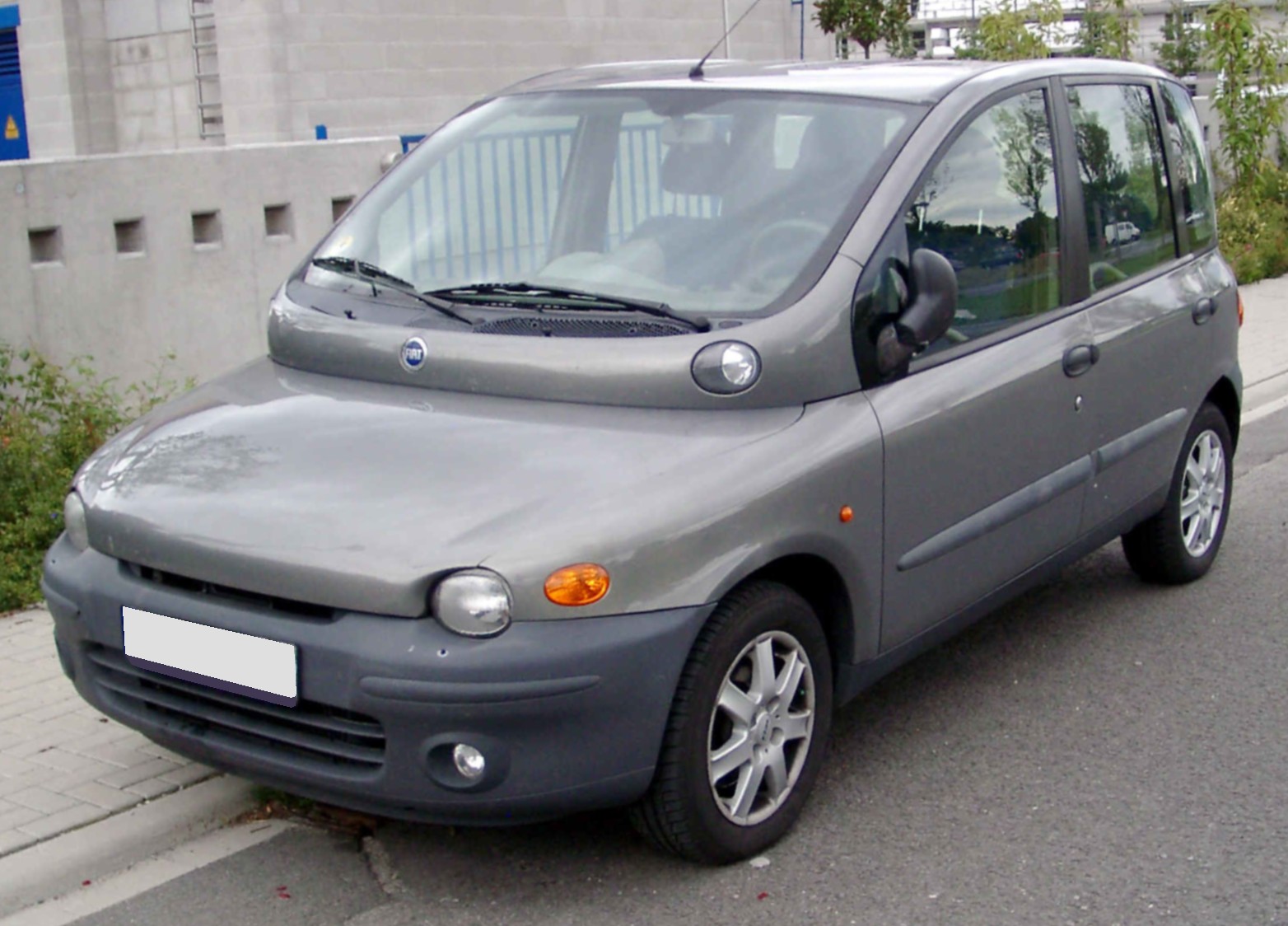
The Fiat Multipla is a compact MPV that Fiat built in Italy from 1998 to 2010, best known for seating six people in two rows of three on a body under 4.1 metres long. It is the car people still argue about: Top Gear named it Car of the Year in 2000, and the Daily Telegraph put it second in a list of the 100 ugliest cars in 2008. There was only one generation (Type 186), toned down by a facelift in 2004 and later built under licence in China by Zotye.
In short
- Compact MPV with a 3+3 seating layout, built in Turin (Mirafiori) and, for the gas version, in Arese near Milan.
- One generation, Type 186, sold from November 1998 to 2010; facelift in 2004 lengthened the car from 3,994 to 4,080 mm.
- Engines: 1.6 16V petrol, 1.9 JTD and 1.9 Multijet diesels, plus petrol/CNG Bipower and CNG-only Blupower versions, from 68 kW (92 PS) to 88 kW (120 PS).
- Boot: 430 litres with all six seats in place, up to 1,900 litres with the rear three seats removed.
Fiat Multipla at a glance
| Specification | Fiat Multipla (Type 186) |
|---|---|
| Segment | Compact MPV |
| Body | five-door MPV, six seats in two rows of three |
| Production | 1998-2010 (Europe); 2008-2013 under licence in China (Zotye) |
| Plants | Turin Mirafiori and Arese (Milan), Italy; Quzhou, China (Zotye) |
| Platform | Fiat C1, derived from the Bravo/Brava |
| Designer | Roberto Giolito, Centro Stile Fiat |
| Length / wheelbase | 3,994 mm (4,080 mm from 2004) / 2,666 mm |
| Kerb weight | 1,300-1,490 kg |
| Power range | 68-88 kW (92-120 PS) |
| Predecessor / successor | Fiat 600 Multipla / Fiat 500L |
The Multipla sits in our Fiat catalogue next to the Bravo and Brava it was built from.
Design and concept
Roberto Giolito and the Fiat design centre started from an unusual brief: six seats, a short body and a wide cabin. The answer was a car 1,871 mm wide, almost as wide as a large executive saloon, but shorter than the three-door Bravo it was based on. The famous "step" below the windscreen, with a second row of lights at its base, is the visual result of a tall glasshouse placed on a low, wide body.
Fiat showed the concept at the Paris Motor Show in October 1996 and the production car at the IAA in Frankfurt in autumn 1997. Italian sales began in November 1998; most other markets followed about a year later. The name came from the 1950s Fiat 600 Multipla, a six-seat people carrier on the 600 platform.
At launch the press praised the cabin rather than the looks. Top Gear gave the Multipla its Car of the Year award in 2000, and Jeremy Clarkson's "Car Years" programme named it Family Car of the Moment in July 2000. In 1999 the Museum of Modern Art in New York included it in the exhibition "Different Roads: Automobiles for the Next Century".

Generations and model history
There was only one Multipla generation. Fiat kept the Type 186 in production for twelve years and changed its face once.
| Generation | Code | Years | Body styles | Engines | Power (kW / hp) |
|---|---|---|---|---|---|
| Multipla (original) | 186 | 1998-2004 | 5-door MPV, 6 seats | 1.6 16V petrol, 1.6 Bipower and Blupower CNG, 1.9 JTD | 68-85 kW (91-113 hp) |
| Multipla (facelift) | 186 | 2004-2010 | 5-door MPV, 6 seats | 1.6 16V petrol, 1.6 Bipower, 1.9 JTD, 1.9 Multijet | 68-88 kW (91-120 hp) |
| Zotye Multiplan / M300 (China) | - | 2008-2013 | 5-door MPV | petrol; M300 EV electric | not covered here |
The 2004 facelift gave the Multipla a more conventional front end, meant to tone down the original styling and attract more buyers; Italian sales had been strong, sales elsewhere weaker. Length grew from 3,994 to 4,080 mm. Critics did not praise the new face either. The original SX and ELX trims were replaced by Dynamic, Dynamic Family and Dynamic Plus in June 2004.
In China, Zotye Auto assembled the Multipla from kits as the Multiplan from December 2008 to September 2010, then built a more localised version called the Langyue (M300) from October 2010. An electric M300 EV with a 35.2 kWh battery and about 201 km of range was used as a taxi; Zotye sold 220 of them.

Engines, transmissions and performance
| Engine | Fuel | Displacement | Power | Torque | Years |
|---|---|---|---|---|---|
| 1.6 16V (100) | petrol | 1,581 cc | 78 kW (106 PS) | 148 Nm | 1998-2000 |
| 1.6 16V (100) | petrol | 1,596 cc | 76 kW (103 PS) | 145 Nm | 2000-2010 |
| 1.6 Blupower | CNG only | 1,581 cc | 70 kW (95 PS) | 133 Nm | 1998-2002 |
| 1.6 Bipower | petrol/CNG | 1,581 cc | 68 kW (92 PS) | 130 Nm | - |
| 1.9 JTD 105 | diesel | 1,910 cc | 77 kW (105 PS) | 200 Nm | 1998-2000 |
| 1.9 JTD 110 | diesel | 1,910 cc | 81 kW (110 PS) | 200 Nm | 2000-2001 |
| 1.9 JTD 115 | diesel | 1,910 cc | 85 kW (115 PS) | 203 Nm | 2001-2006 |
| 1.9 Multijet | diesel | 1,910 cc | 88 kW (120 PS) | 206 Nm | 2006-2010 |
Every Multipla has front-wheel drive and a five-speed manual gearbox. The common-rail 1.9 JTD delivers its 200 Nm from 1,500 rpm, which suits a car that often carries six people. The 1.6 petrol engine needs revs, with peak torque at 4,000 rpm.
The Multipla is also a footnote in alternative fuels. The Blupower version, launched with the car, was described as the first production car to run only on compressed natural gas: it had no petrol system at all, four cylinders held a nominal 35 kg of gas, and the range was about 670 km. The later Bipower could run on petrol or CNG, and Fiat also offered a petrol/LPG version (Gpower). These gas versions were built at Arese.
Dimensions, space and boot
| Parameter | Metric | Imperial |
|---|---|---|
| Length (1998-2004) | 3,994 mm | 157.2 in |
| Length (2004-2010) | 4,080 mm | 160.6 in |
| Width | 1,871 mm | 73.7 in |
| Height | 1,670 mm | 65.7 in |
| Wheelbase | 2,666 mm | 105.0 in |
| Kerb weight | 1,300-1,490 kg | 2,866-3,285 lb |
| Boot, 6 seats in place | 430 l | 15 cu ft |
| Boot, rear seats removed | 1,900 l | 67 cu ft |
The 3+3 layout is the whole point of the car. Rival compact MPVs of the time had two front seats; the Multipla had three across the front. All three rear seats could be folded, or taken out to turn the car into a van with 1,900 litres of space. With six seats in use the boot still holds 430 litres.
The width that makes this possible also has a cost in narrow streets and parking garages. Before buying, check a space with our garage fit tool.

Fuel economy and running costs
Our sources give no official fuel consumption figures for the Multipla, so we do not quote any. The useful published figure is the range of the CNG-only Blupower: about 670 km on its four gas cylinders. Running costs of a Multipla today depend mostly on the condition of the individual car and on local fuel and gas prices.
Trims and equipment
At launch the range had two trims. The SX was the basic model with petrol or diesel engines. The ELX added air conditioning, twin electric sunroofs, alloy wheels, electric rear windows and wipe-clean coloured seat fabrics. In June 2004, with the facelift, Fiat replaced them with Dynamic, Dynamic Family and Dynamic Plus.
Safety
Euro NCAP tested the Multipla in 2001. Our sources do not give the detailed scores, so we do not quote a star rating here; the result is in the Euro NCAP archive. Remember that a 2001 rating is not comparable with today's tests, which add pedestrian protection, active safety and many more crash configurations. For current figures, see our safety ratings section.
Reliability and known issues
We found no sourced data on specific faults of the Multipla, so we list none. As with any car built between 1998 and 2010, condition matters more than model year: look for service records, especially on the diesels, and inspect the gas tanks and certification on Bipower and Blupower cars.
Rivals
| Model | Engines | Power (hp) | Boot (l) | Price from (EUR) |
|---|---|---|---|---|
| Fiat Multipla (1998-2010) | 1.6 petrol, 1.6 CNG, 1.9 diesel | 91-120 | 430-1,900 | not sourced |
| Renault Scénic | not covered here | - | - | - |
| Opel Zafira | not covered here | - | - | - |
| Citroën Xsara Picasso | not covered here | - | - | - |
The table names the usual compact MPV competitors of the period without figures: our sources for this article cover only the Multipla. None of them offered three seats in the front row. You can put the Multipla next to any of them in our comparison tool.
Photo gallery

Fiat Multipla in our rankings
- No. 350 of 1082 · Longest-running car nameplates (12 years · top 35%)
- No. 888 of 1011 · Most powerful cars (88 kW · top 89%)
- No. 135 of 146 · Most powerful Italian cars (88 kW · top 93%)
- No. 25 of 26 · Most powerful minivans and MPVs (88 kW · top 97%)
In production longer than 65% of ranked nameplates in the 1CARS catalog (No. 350 of 1082).
FAQ
How many seats does the Fiat Multipla have?
Six, in two rows of three. The front row has three individual seats, and the rear seats can be folded or removed.
When was the Fiat Multipla built?
From 1998 to 2010 in Italy, with a facelift in 2004. Zotye built licensed versions in China from 2008 to 2013.
How big is the Fiat Multipla boot?
430 litres with all six seats in place and up to 1,900 litres with the rear three seats removed.
Why is the Multipla called ugly?
The original front end has a second set of lights at the base of the windscreen, on a step between bonnet and glass. The Daily Telegraph ranked it second in its 100 ugliest cars list in 2008, even though Top Gear had named it Car of the Year in 2000.
What replaced the Fiat Multipla?
The Fiat 500L is usually named as its successor.
Data sources
Data checked by an editor against the sources below.