 McLaren W1
Specs, engines and history
Published Sources (1) Report an error
By Felix Hartmann, Automotive Technology & EV Contributor
- Built
- 2025–present
- Top power
- 938 kW (1,275 PS)
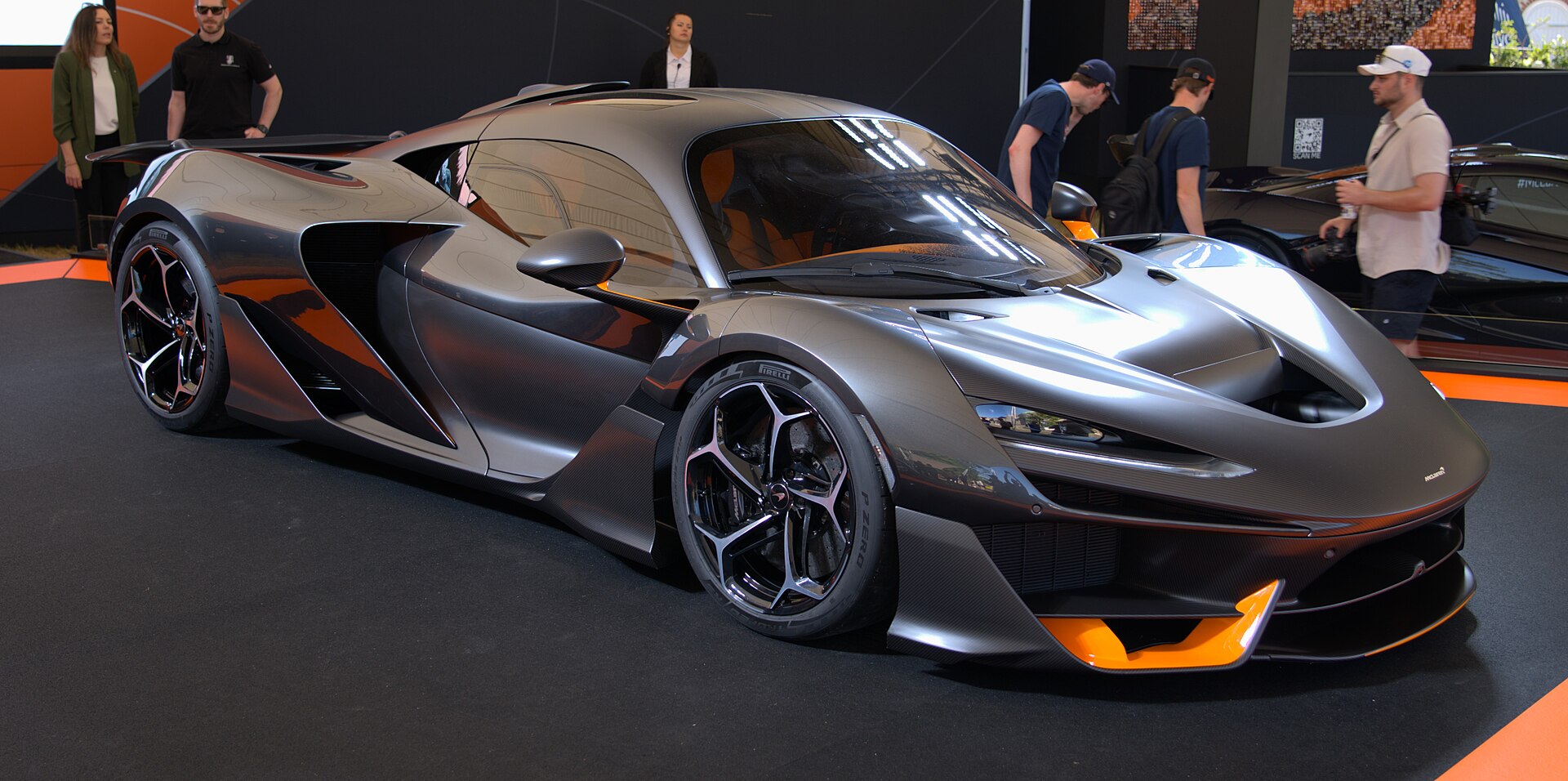
The McLaren W1 is a limited-production hybrid hypercar built in Woking, Surrey, and the successor to the McLaren P1. Unveiled on 6 October 2024, it combines a 4.0-litre twin-turbo V8 with an electric motor for 938 kW (1,275 PS) and 1,340 Nm, and it relies on ground-effect aerodynamics that can generate up to 1,000 kg of downforce. Only 399 cars are planned.
In short
- Unveiled on 6 October 2024; production in Woking (United Kingdom) planned for 2025 and listed by Wikipedia from January 2026; 399 cars.
- 3,988 cc MHP-8 twin-turbo V8 with a flat-plane crank, plus an E-module electric motor of up to 255 kW (347 PS): 938 kW (1,275 PS) at 9,000 rpm and 1,340 Nm in total.
- Eight-speed dual-clutch gearbox with electric reverse, rear-wheel drive, hydraulic electronic differential.
- 1,399 kg dry, 0–100 km/h in 2.7 seconds, 0–200 km/h in about 5.8 seconds, top speed 350 km/h.
McLaren W1 at a glance
| Specification | McLaren W1 |
|---|---|
| Production | from 2025–2026, Woking (United Kingdom) |
| Cars planned | 399 |
| Body | two-door coupé with anhedral (upward-opening) doors; mid-engine, rear-wheel drive |
| Platform | McLaren Carbon Fibre Lightweight Architecture (MCLA) |
| Engine | MHP-8 3,988 cc twin-turbo V8, flat-plane crank |
| Electric motor | E-module, radial flux: up to 255 kW (347 PS) |
| System power | 938 kW (1,275 PS) at 9,000 rpm |
| System torque | 1,340 Nm at 4,500 rpm |
| Gearbox | eight-speed dual-clutch, electric reverse |
| Dry weight | 1,399 kg |
| Predecessor | McLaren P1 |
The W1 is the third car in McLaren's line of top models after the McLaren F1 and the McLaren P1. The full range is in the McLaren catalogue, and the company's background is in our history of McLaren.
History and lineage
McLaren presented the W1 on 6 October 2024 as the successor to the P1 (model code P18), the hybrid hypercar of 2013. Like the F1 of the 1990s and the P1, it is a limited-series car that shows the most advanced technology McLaren can put into a road car. Production was first planned to start in 2025; Wikipedia lists it from January 2026. All 399 cars are built in Woking.
The design team was led by chief design officer Tobias Sühlmann, with João Dias as principal exterior designer, Patrick Carton as exterior designer and Alex Alexiev as principal interior designer.

F1, P1 and W1: three generations
The W1 is the third car in a line of McLaren top models built in small numbers, each with the most advanced technology of its time.
| Specification | McLaren F1 | McLaren P1 | McLaren W1 |
|---|---|---|---|
| Years | 1992–1998 | 2013–2015 | from 2025–2026 |
| Cars built | 106 in total (71 road cars) | 375 | 399 planned |
| Engine | 6.1-litre BMW V12 | 3.8-litre twin-turbo V8 + electric motor | 4.0-litre twin-turbo V8 + E-module |
| Power | 461 kW (627 PS) | 674 kW (916 PS) | 938 kW (1,275 PS) |
| Torque | 650 Nm | 900 Nm | 1,340 Nm |
| Top speed | 386.4 km/h (1998 record run, modified prototype) | 350 km/h (limited) | 350 km/h (estimated) |
The McLaren F1, conceived by Gordon Murray with a central driving position, set a production-car speed record of 386.4 km/h in 1998, and its racing version, the F1 GTR, won the 24 Hours of Le Mans in 1995. The P1, unveiled at the Geneva motor show in 2013, introduced hybrid power to the line with a 4.7 kWh battery and 0–100 km/h in 2.8 seconds. Compared with the P1, the W1 has about 264 kW (359 PS) more, 440 Nm more torque and a dry weight of 1,399 kg.


Design and aerodynamics
The W1 is a two-door coupé with upward-opening anhedral doors. Its shape is driven by aerodynamics. McLaren took ground-effect ideas from Formula 1: the underbody is shaped to speed up the air flowing beneath the car and create downforce. To make this work, the floor and the footwells sit higher than in the P1, leaving more room for air to pass underneath.
The active aerodynamic system includes an adjustable front splitter and the Active Long Tail rear wing. The wing is moved by electric motors; it can rise, drop and rotate, working as a downforce aid, as an air brake and as a drag-reduction system (DRS) on straights. In wind-tunnel tests the W1 produced up to 1,000 kg of downforce.
| Dimension | McLaren W1 |
|---|---|
| Length | 4,635 mm |
| Width | 2,191 mm |
| Height | 1,182 mm |
| Wheelbase | 2,680 mm |
| Fuel tank | 62 litres |
Powertrain
The engine is the MHP-8, a 3,988 cc twin-turbo V8 with a flat-plane crankshaft, mounted lengthwise behind the cabin. It works with the E-module, a radial-flux electric motor with its own control unit. The E-module sits next to the gearbox and delivers up to 255 kW (347 PS); its main task is to sharpen the response to the accelerator.
Together the two produce 938 kW (1,275 PS) at 9,000 rpm and 1,340 Nm at 4,500 rpm. The new eight-speed dual-clutch gearbox was developed by McLaren and has no mechanical reverse gear — the electric motor drives the car backwards. A hydraulic electronic differential distributes the torque between the rear wheels to improve traction in mid-corner.
The battery is small, with 1.384 kWh of capacity, and the on-board charger can bring it to 80% in 22 minutes.
| Figure | McLaren W1 |
|---|---|
| Combined power | 938 kW (1,275 PS) at 9,000 rpm |
| Combined torque | 1,340 Nm at 4,500 rpm |
| Electric motor | up to 255 kW (347 PS) |
| Battery | 1.384 kWh |
| 0–100 km/h | 2.7 s |
| 0–200 km/h | about 5.8 s |
| Top speed | 350 km/h (estimated) |
| Power-to-weight | 670 kW (911 PS) per tonne, dry |
Chassis and cooling
The W1 is built on the McLaren Carbon Fibre Lightweight Architecture (MCLA). With a dry weight of 1,399 kg it is light for a car of this power: 670 kW (911 PS) per tonne.
Cooling is handled by three separate water-glycol circuits running at different temperatures. A high-temperature circuit with four radiators serves the engine, a low-temperature circuit cools the charge air, and a third circuit looks after the E-module, the battery, the charger and the DC/DC converter. Including air-conditioning and oil cooling, the car has ten heat exchangers. The battery uses a second-generation dielectric immersion cooling system, in which the cells sit in a non-conductive fluid.
Legacy
The W1 continues a sequence that began with the F1 in the 1990s and continued with the P1 in 2013: one technically extreme McLaren in each generation, built in small numbers. Compared with the P1, it has a much more powerful hybrid system and adds ground-effect aerodynamics. For McLaren's other track-focused cars, see the McLaren Senna.
McLaren W1 in our rankings
- No. 2 of 109 · Most powerful British cars (938 kW)
- No. 14 of 859 · Most powerful cars (938 kW · top 2%)
- No. 12 of 313 · Most powerful coupes (938 kW · top 4%)
- No. 12 of 239 · Most powerful cars of the 2020s (938 kW · top 6%)
- No. 910 of 912 · Longest-running car nameplates (1 year)
- No. 303 of 305 · Oldest car models still on sale (1 year)
More powerful than 98% of ranked British cars in the 1CARS catalog (No. 2 of 109).
FAQ
How powerful is the McLaren W1?
Its 4.0-litre twin-turbo V8 and E-module electric motor produce 938 kW (1,275 PS) at 9,000 rpm and 1,340 Nm together.
How many McLaren W1s will be built?
Production is limited to 399 cars, all built in Woking.
How fast is the McLaren W1?
0–100 km/h takes 2.7 seconds, 0–200 km/h about 5.8 seconds, and the estimated top speed is 350 km/h.
What car does the W1 replace?
It is the successor to the McLaren P1 and follows the McLaren F1 in the line of the brand's top models.
How much downforce does the W1 make?
Up to 1,000 kg, according to wind-tunnel testing, thanks to ground-effect aerodynamics and the Active Long Tail rear wing.
Data sources
Data checked by an editor against the sources below.