 McLaren Speedtail
Specs, engines and history
Published Sources (1) Report an error
By Felix Hartmann, Automotive Technology & EV Contributor
- Built
- 2020
- Top power
- 772 kW (1,050 PS)
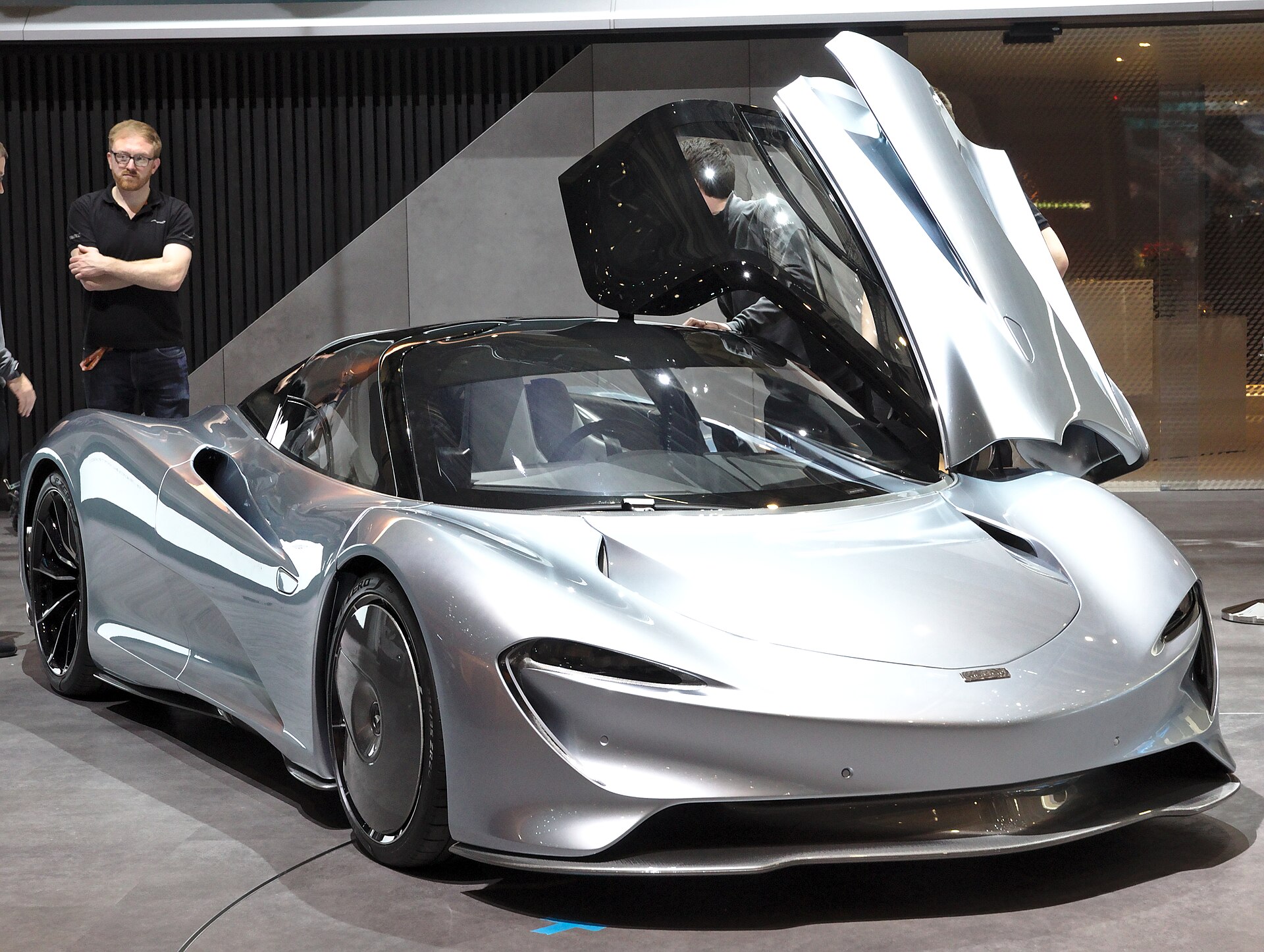
The McLaren Speedtail is a hybrid hypercar that McLaren Automotive revealed in October 2018 and built in Woking in a run of 106 cars, with deliveries from 2020. Its design was aimed at minimum drag and maximum speed: McLaren claims 403 km/h, the highest figure for any of its road cars. Its three-seat cabin, with the driver in the middle, is a direct reference to the McLaren F1 of the 1990s.
In short
- Unveiled on 26 October 2018; 106 cars built at the McLaren Technology Centre in Woking, deliveries from February 2020.
- 4.0-litre M840T twin-turbo V8 with 556 kW (756 PS) plus an electric motor; combined 772 kW (1,050 PS) and 1,150 Nm.
- Seven-speed dual-clutch gearbox, rear-wheel drive, dry weight 1,430 kg, kerb weight 1,597 kg.
- 0–300 km/h in 12.8 seconds and a claimed top speed of 403 km/h, McLaren's fastest road car.
Speedtail at a glance
| Specification | McLaren Speedtail |
|---|---|
| Production | 2020, Woking (United Kingdom) |
| Cars built | 106 |
| Body | two-door coupé with dihedral doors, three seats |
| Layout | rear mid-engine, rear-wheel drive, parallel hybrid |
| Engine | M840T 4.0-litre twin-turbo V8, 556 kW (756 PS), 800 Nm |
| Electric motor | permanent-magnet motor, about 228 kW (310 PS) |
| Combined output | 772 kW (1,050 PS), 1,150 Nm |
| Gearbox | seven-speed Graziano dual-clutch |
| Weight | 1,430 kg dry, 1,597 kg kerb |
| Dimensions | 5,137 mm long, 1,120 mm high, 2,730 mm wheelbase |
The Speedtail belongs to McLaren's Ultimate Series, together with the McLaren F1, the McLaren P1 and the McLaren Senna. All models are in the McLaren catalogue.
Concept and development
The Speedtail was the fourth model in McLaren's Ultimate Series, after the F1, the P1 and the Senna, and part of the company's business plan for new models, called Track22 by Wikipedia and Track25 in the launch coverage. Wikipedia names Rob Melville and Alex Alexiev as its designers. McLaren confirmed the production run of 106 cars in November 2018 — the launch report on GTspirit points out that this is the same number as the McLaren F1 — and the car was announced with all build slots already taken. About 35% of them were bought by customers in the United States.
Development included high-speed testing at the Johnny Bohmer Proving Grounds, on the former Space Shuttle landing runway at the Kennedy Space Center in Florida, and on test tracks in Germany, Spain and Italy. According to Wikipedia, the XP2 prototype reached its terminal velocity more than 30 times. Production in the UK started after the high-speed test programme was finished in December 2019, and the first cars were due to be delivered in Woking in February 2020.
Hybrid powertrain and performance
The combustion engine is the M840T 4.0-litre twin-turbo V8 known from the 720S, upgraded to 556 kW (756 PS) and 800 Nm. It works with a permanent-magnet electric motor in a parallel hybrid system. Wikipedia lists the motor at about 228 kW (310 PS) in its specification box and 229 kW (312 PS) in the text. The combined output is 772 kW (1,050 PS) and 1,150 Nm.
The battery is small: a 1.647 kWh lithium-ion pack, designed for maximum power rather than electric range. It charges while the car is driven, and a wireless charging pad keeps it topped up when the car is parked. Power goes to the rear wheels through a seven-speed Graziano dual-clutch gearbox.
| Item | Figure |
|---|---|
| Combined output | 772 kW (1,050 PS) |
| Combined torque | 1,150 Nm |
| 0–300 km/h | 12.8 s |
| Top speed (McLaren claim) | 403 km/h |
| Dry weight | 1,430 kg |
| Kerb weight | 1,597 kg |
McLaren quotes 0–300 km/h in 12.8 seconds and a top speed of 403 km/h. For maximum speed the driver selects Velocity mode. The Velocity Active Chassis Control lowers the car by 35 mm, and the camera mirrors retract into the body.

Aerodynamics and the teardrop shape
Everything about the body is aimed at reducing drag, and its long, narrow tail follows the shape of a teardrop. At 5,137 mm, the Speedtail is very long for a two-door car. The front wheels, 20-inch rims with ten spokes, are hidden behind fixed carbon-fibre covers that stay still while the wheel turns and smooth the airflow along the sides. Intakes in the nose feed the radiators, and a snorkel supplies air to the engine.
There are no conventional door mirrors. Instead, high-definition cameras on the front wings extend when the ignition is turned on and retract in Velocity mode. At the rear, McLaren did not fit a wing. Hydraulically operated control surfaces made of flexible carbon fibre are built into the rear clamshell itself. McLaren chose them over a traditional spoiler because they create less drag.

Design and the three-seat cabin
The Speedtail is built around a carbon-fibre monocoque, and the passenger seats are integrated into the structure. Access is through dihedral doors, as on other McLarens.
Inside, the driver sits in the centre, slightly ahead of two passenger seats placed on either side — the layout McLaren first used on the F1. The central position gives the driver a clear view forward. The glass is electrochromic and darkens at the push of a button, so the car has no sun visors. The engine start button and the controls for the doors and mirror cameras are placed in the roof above the driver's head, and two high-definition displays show the camera images.
The materials were chosen to save weight and to show off new techniques. They include "Titanium Deposition Carbon Fibre", in which a titanium layer only a micron thick is fused into the weave, and thin-ply carbon fibre with layers about 30 microns thick. The leather, from the Bridge of Weir Leather Company in the launch car, has a "directional" finish strong enough to be used on the floor instead of carpet, and parts of the badge can be made of 18-carat white gold. As with the F1, owners were offered tailored luggage.

Ownership and road legality
In the United States it does not meet federal safety standards, mainly because of its camera mirrors and the lack of side airbags. According to Wikipedia, American owners can only import it under the "Show or Display" exemption, which limits use to 2,500 miles (about 4,000 km) in any 12 months and requires approval; McLaren does not help with the process.
Legacy
The Speedtail is McLaren's fastest road car and its most direct tribute to the F1. It combines a hybrid powertrain, a low-drag body and a central driving position in one car. More of the company's background is in our history of McLaren.
Photo gallery

McLaren Speedtail in our rankings
- No. 5 of 109 · Most powerful British cars (772 kW)
- No. 26 of 859 · Most powerful cars (772 kW · top 4%)
- No. 23 of 313 · Most powerful coupes (772 kW · top 8%)
- No. 19 of 239 · Most powerful cars of the 2020s (772 kW · top 8%)
More powerful than 96% of ranked cars in the 1CARS catalog (No. 26 of 859).
FAQ
How many McLaren Speedtails were built?
106 cars — the same number as the McLaren F1 — all assembled in Woking. Deliveries began in 2020.
How fast is the McLaren Speedtail?
McLaren claims a top speed of 403 km/h and 0–300 km/h in 12.8 seconds.
How powerful is the Speedtail?
The 4.0-litre twin-turbo V8 and the electric motor together produce 772 kW (1,050 PS) and 1,150 Nm.
Why does the Speedtail have three seats?
The driver sits in the centre with a passenger on each side, a layout taken from the McLaren F1. It gives the driver a central view of the road.
Does the Speedtail have mirrors?
It uses cameras instead of door mirrors. They extend when the car is started and retract in Velocity mode to reduce drag.
Data sources
Data checked by an editor against the sources below.