 Lotus Mark VI
Specs, engines and history
Published Sources (1) Report an error
By Felix Hartmann, Automotive Technology & EV Contributor
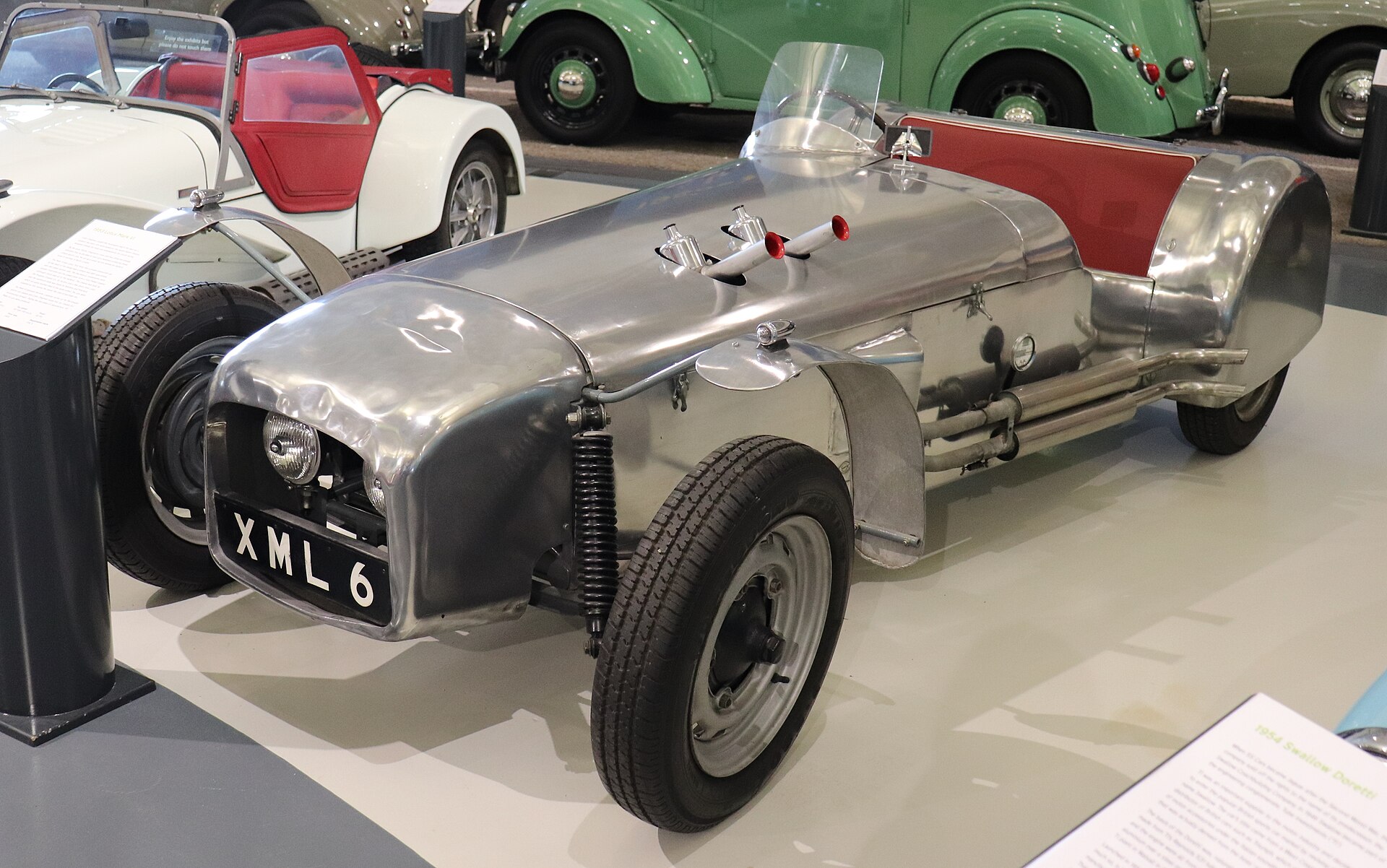
The Lotus Mark VI is the small open sports car that Colin Chapman introduced in 1952 and that is described as the first production car of Lotus. Built until 1957, it combined a very light space frame with an aluminium body and was sold to customers as a kit, so they could fit the engine and gearbox of their choice. About 100 to 110 were made, and the Mark VI became a frequent winner in British club racing before the Lotus Seven replaced it.
In short
- Built 1952–1957; about 110 cars according to Wikipedia's infobox (about 100 by 1955 according to the text).
- Semi-space frame chassis weighing only 25 kg, aluminium body; sold as a kit.
- Standard engine: 1,172 cc Ford 10 side-valve, 37 kW (50 bhp) at 5,000 rpm, 77 Nm; three-speed Ford gearbox.
- Weight 432 kg, top speed about 150 km/h; successor: the Lotus Seven.
Lotus Mark VI at a glance
| Specification | Lotus Mark VI |
|---|---|
| Production | 1952–1957 |
| Cars built | about 100–110 |
| Body | open two-seater, aluminium panels on a semi-space frame; front engine, rear-wheel drive |
| Engine (standard test car) | Ford E93A 1,172 cc side-valve four-cylinder |
| Power | 37 kW (50 bhp) at 5,000 rpm |
| Torque | 77 Nm at 3,000 rpm |
| Gearbox | three-speed manual (Ford) |
| Weight | 432 kg |
| Top speed | about 150 km/h |
| Predecessor / successor | Mark V / Seven |
The Mark VI is where the road-car history of Lotus begins; the full story is told in our history of the Lotus car company. All Lotus models are listed in the Lotus catalogue.
History: from trials specials to a series car
Before the Mark VI, Colin Chapman had built several cars for trials and road racing. In 1952 he introduced the Mark VI, the first Lotus that was made in a series for customers. To keep costs down, it used many mechanical parts from the Ford Prefect, which were cheap and easy to find.
The car was a success with amateur racers. By 1955 about 100 had been built, and Wikipedia's infobox gives a total of about 110. Production ended in 1957, when the Lotus Seven took over as the company's entry-level model.
Space frame and kit form
The heart of the Mark VI is its chassis: a semi-space frame of small steel tubes, six feet long and weighing only 25 kg. The prototype chassis was built by the Progress Chassis Company, and the aluminium body was made by the panel beaters Williams and Prichard.
Lotus sold the Mark VI as a kit. Customers received the chassis and body and could install their own engine and gearbox. The frame had mounting points for several engines:
- the 1,172 cc Ford 10;
- the 1,250 cc or 1,500 cc MG TF engine;
- the 1,500 cc Ford Consul engine;
- Coventry Climax engines.
This made each Mark VI slightly different, depending on what its owner could afford or wanted to race.


Engine and performance
Wikipedia's data for the standard car refers to the Ford E93A engine: a 1,172 cc side-valve four-cylinder with two valves per cylinder and no supercharging. It produces 37 kW (50 bhp) at 5,000 rpm and 77 Nm at 3,000 rpm, a specific output of about 32 kW (43 bhp) per litre. Power goes to the rear wheels through a three-speed Ford manual gearbox.
With a weight of only 432 kg, even this modest engine made the car lively: 0–60 mph took 15 seconds and the top speed was about 150 km/h.
| Parameter | Metric | Imperial |
|---|---|---|
| Engine capacity (Ford 10) | 1,172 cc | 71.5 cu in |
| Power | 37 kW at 5,000 rpm | 50 bhp |
| Torque | 77 Nm at 3,000 rpm | 57 lb-ft |
| Chassis weight | 25 kg | 55 lb |
| Car weight | 432 kg | 952 lb |
| Top speed | 150 km/h | 93 mph |
Racing record
On British circuits the Mark VI was a frequent winner. It often beat more powerful and more expensive cars thanks to its light weight, its handling and its acceleration. The car still appears in historic racing: in 2009 the musician Chris Rea drove a Mark VI at the Goodwood Revival.
From Mark VI to Seven
The Mark VI's direct successor was the Lotus Seven of 1957, which replaced it as Lotus's entry-level model. The Seven looks similar but uses a different tubular frame. It was also sold mainly as a kit in Britain, because under the purchase tax rules of the time kits avoided a tax surcharge — as long as no assembly instructions were included. This lasted until 1973, when the UK introduced VAT.
The early Seven Series 1 used the same 1,172 cc Ford side-valve engine as the standard Mark VI, here with 27 kW (36 bhp), and weighed about 500 kg. More than 2,500 original Sevens were sold. In 1973 Lotus sold the rights to Caterham Cars, which still builds its version, the Caterham 7.
| Year | Event |
|---|---|
| 1952 | Mark VI introduced by Colin Chapman |
| 1955 | About 100 cars built |
| 1957 | Production ends; Lotus Seven takes over |
| 1973 | Lotus sells the Seven rights to Caterham |
Legacy
The Mark VI established the ideas that defined Lotus for decades: a light frame, simple and cheap mechanical parts and good handling instead of brute power. Its successor, the Seven, has been described as "the embodiment of the Lotus philosophy of performance through low weight and simplicity" — a philosophy that began with the Mark VI. Later Lotus cars such as the Elise follow the same principle.
Lotus Mark VI in our rankings
In production longer than 23% of ranked nameplates in the 1CARS catalog (No. 626 of 912).
FAQ
Was the Mark VI the first Lotus?
It is described as the first production car of Lotus. Colin Chapman had built several earlier one-off trials and racing cars.
How many Lotus Mark VIs were built?
About 100 by 1955 and about 110 in total, according to Wikipedia.
What engine did the Mark VI use?
Customers chose their own. The standard reference car had a 1,172 cc Ford 10 side-valve engine with 37 kW (50 bhp); MG, Ford Consul and Coventry Climax engines could also be fitted.
What replaced the Mark VI?
The Lotus Seven, introduced in 1957 as Lotus's new entry-level model.
Data sources
Data checked by an editor against the sources below.