 Lotus Elite (Type 14)
Specs, engines and history
Published Sources (1) Report an error
By Felix Hartmann, Automotive Technology & EV Contributor
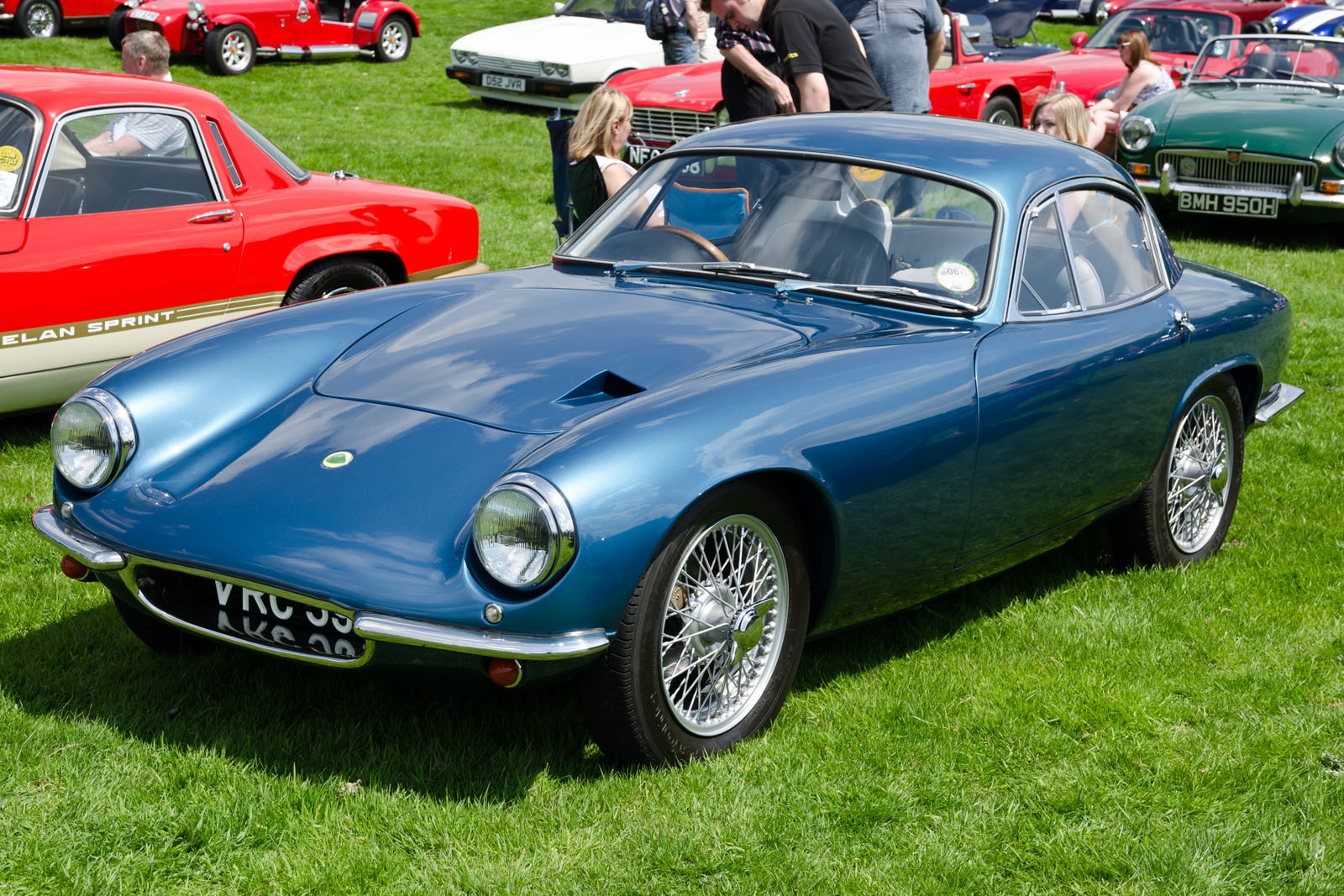
- Built
- 1958–1963
- Top power
- 63 kW (86 PS)
The Lotus Elite Type 14 is a small two-seat coupé that Lotus built from 1957 to 1963. Its whole load-bearing structure is a fibreglass monocoque — an unusual solution for a road car. Shown at the London Motor Show at Earls Court in 1957, it combined a light and aerodynamic body with a 1.2-litre Coventry Climax engine. The Elite won its class at Le Mans six times, but it was expensive to build and Lotus lost money on every car. Between 1,030 and 1,047 were made.
In short
- Built 1957/1958–1963; shown at Earls Court in 1957 (chassis 1006); 1,030 or 1,047 cars depending on the source.
- Glass-reinforced plastic monocoque with a bonded steel front subframe; kerb weight only 503.5 kg; drag coefficient 0.29.
- 1,216 cc Coventry Climax FWE four-cylinder: 56 kW (75 hp) standard, 63 kW (85 hp) in the SE of 1960.
- Six class wins at the 24 Hours of Le Mans and two wins in the Index of Thermal Efficiency.
Lotus Elite (Type 14) at a glance
| Specification | Lotus Elite (Type 14) |
|---|---|
| Production | 1957/1958–1963 |
| Cars built | 1,030 or 1,047, by source |
| Body | two-seat fixed-head coupé; front engine, rear-wheel drive |
| Structure | fibreglass (GRP) monocoque with bonded steel front subframe |
| Engine | Coventry Climax FWE, 1,216 cc, all-aluminium inline-four |
| Power | 56 kW (75 hp) standard; 63 kW (85 hp) SE |
| Gearbox | four-speed manual (ZF S 4-12 in the SE) |
| Kerb weight | 503.5 kg |
| Drag coefficient | Cd 0.29 |
| Dimensions | 3,759 × 1,506 × 1,181 mm, wheelbase 2,242 mm |
The Elite is one of the early Lotus road cars; its story is part of our history of the Lotus car company. All Lotus models are listed in the Lotus catalogue.
History of the Elite
The Elite was developed in about a year, with help from selected racing customers who tested parts of the car. The first car, chassis number 1006, was shown at the London Motor Show at Earls Court in 1957. Production started in 1957 or 1958, according to different sources, and ran until 1963.
The project was ambitious for a small company. The car was not built around a steel or aluminium chassis like other sports cars of the time: instead, the body itself carried all the loads. This made the Elite unusually light and stiff, but it also made it hard and costly to build. According to Wikipedia, the price was set too low and Lotus lost money on each car. Selling it as a kit, which reduced the price and avoided Purchase Tax, has been described as "perhaps the greatest mistake of all".
Design and the fibreglass monocoque
The original shape was drawn by Peter Kirwan-Taylor. Frank Costin, at the time chief aerodynamicist at the aircraft maker de Havilland, helped refine it. The result is remarkably slippery: the Elite has a drag coefficient of 0.29.
Costin brought experience from the aircraft industry to motor racing. He had already shaped the aerodynamic body of the Lotus Mark VIII of 1954 at the request of his brother Mike, and in 1956 he designed the body of the Vanwall, the car that went on to win the first Grand Prix constructors' championship. He later co-founded the Marcos company with Jem Marsh and designed the Costin Amigo. On the Elite he applied the same approach — a smooth, low shape with as little drag as possible — to a closed road car.
The structure is a monocoque made entirely of glass-reinforced plastic, with only a steel subframe bonded in at the front. The first 250 or 280 shells were made by Maximar Mouldings in Pulborough, Sussex. Production then moved to the Bristol Aeroplane Company, which made the rest of the bodies. Of the Series 2 cars, the first 31 still had Maximar bodies.
The car is small: 3,759 mm long, 1,506 mm wide and 1,181 mm high on a 2,242 mm wheelbase, and it weighs just 503.5 kg.
Engine and versions
The Elite uses the Coventry Climax FWE, a 1,216 cc all-aluminium four-cylinder engine. In standard form it produces 56 kW (75 hp). The engine is economical: Wikipedia gives 8.1 l/100 km, and The Motor recorded 6.97 l/100 km in its 1960 road test, along with a top speed of 179.9 km/h.
The engine has an unusual background. Coventry Climax, a company from Coventry in England founded in 1903 as Lee Stroyer and later called Coventry Simplex, originally designed the FW ("Feather Weight") family as a light engine for portable fire pumps. Walter Hassan and Harry Mundy developed it: the first FW had 1,020 cc, a single overhead camshaft and all-aluminium construction, and its valve clearance was set with shims, so it needed no regular adjustment. In 1953 the 1,098 cc FWA was adapted for motor racing, and it first ran at Le Mans in 1954. The 1,216 cc FWE was designed specifically for the Lotus Elite, and over its development its output ranged from 56 to 78 kW (75 to 105 bhp) — the higher figures belonging to the racing Super versions.
| Version | Year | Engine changes | Power |
|---|---|---|---|
| Elite (standard) | from 1957/1958 | Coventry Climax FWE, 1,216 cc | 56 kW (75 hp) |
| Elite SE | 1960 | twin SU carburettors, cast alloy intake manifold, ZF S 4-12 gearbox | 63 kW (85 hp) |
| Super 95 | — | 10.5:1 compression, two Weber 40 DCOE carburettors | not stated |
| Super 100 / Super 105 | — | racing versions: high-lift camshaft, steel timing gear, ported head, fabricated exhaust | not stated |
The SE also received Lucas PL700 headlights and a silver roof. Early engines suffered from a resonance at about 4,000 rpm, which was cured by fitting a diaphragm-spring clutch. One Elite was used as a test car for the new Lotus-Ford Twin Cam engine.
| Parameter | Metric | Imperial |
|---|---|---|
| Engine capacity | 1,216 cc | 74 cu in |
| Power (standard) | 56 kW | 75 hp |
| Kerb weight | 503.5 kg | 1,110 lb |
| Wheelbase | 2,242 mm | 88.3 in |
| Length | 3,759 mm | 148.0 in |
| Top speed (The Motor, 1960) | 179.9 km/h | 111.8 mph |

Chassis and running gear
The front suspension uses transverse wishbones; at the rear Lotus fitted Chapman struts. The Series 2 added triangulated trailing radius arms at the rear. The car stops with 241 mm Girling disc brakes, mounted inboard at the rear and usually without a servo. Factory cars ran on Pirelli Cinturato 155HR15 tyres on wire wheels.
The Elite had its weak points. The rear suspension mounting points could pull out of the fibreglass, quality control was poor and many parts of the drivetrain needed frequent greasing.
Racing: Le Mans class wins
The Elite came from a racing background: the FW engine family had first raced at Le Mans in 1954 in a Kieft and also powered Lotus's Eleven sports racer. The light, aerodynamic Elite was successful in racing. It won its class at the 24 Hours of Le Mans six times and took two wins in the Index of Thermal Efficiency, which rewarded fuel-efficient performance. In Britain, David Hobbs won 15 of 18 races over two seasons with an Elite fitted with the Hobbs Mecha-Matic automatic gearbox, and in Australia Leo Geoghegan won the 1960 Australian GT Championship.
Lotus also built the LX prototype in 1960, a one-off with a 2.0-litre Coventry Climax FPF engine that reportedly reached 280 km/h in testing. It was meant for Le Mans but did not race there, because the lead driver, Innes Ireland, left before the event.
| Year | Event |
|---|---|
| 1957 | Elite shown at Earls Court (chassis 1006) |
| 1957/1958 | Production starts; first bodies by Maximar |
| 1960 | Elite SE with 63 kW (85 hp); LX prototype; Leo Geoghegan wins the Australian GT Championship |
| 1963 | End of production |

Legacy
The Elite showed what a lightweight, aerodynamic road car could be, and its racing record made the young company's name at Le Mans. Its commercial problems — too low a price, a costly structure and quality issues — were a hard lesson for Lotus. The Elite name later returned on a different Lotus model in the 1970s. For the brand's later road cars, see the Lotus Esprit and the Lotus Elise.
Lotus Elite (Type 14) in our rankings
- No. 631 of 912 · Longest-running car nameplates (5 years · top 77%)
- No. 813 of 859 · Most powerful cars (63 kW · top 95%)
- No. 105 of 109 · Most powerful British cars (63 kW · top 97%)
- No. 308 of 313 · Most powerful coupes (63 kW · top 99%)
In production longer than 23% of ranked nameplates in the 1CARS catalog (No. 631 of 912).
FAQ
What is special about the Lotus Elite Type 14?
Its load-bearing monocoque is made entirely of fibreglass, with only a small steel subframe at the front. It weighs just 503.5 kg.
What engine does the Lotus Elite have?
A 1,216 cc Coventry Climax FWE four-cylinder with 56 kW (75 hp), or 63 kW (85 hp) in the SE version.
How many Lotus Elites were built?
Between 1,030 and 1,047, depending on the source, from 1957/1958 to 1963.
How aerodynamic is the Elite?
Its drag coefficient is 0.29, thanks to a shape refined by Frank Costin, an aerodynamicist from the aircraft industry.
Did the Lotus Elite race?
Yes. It won its class at Le Mans six times and took two Index of Thermal Efficiency wins.
Data sources
Data checked by an editor against the sources below.