 Lamborghini Temerario
Specs, engines and history
Published Sources (1) Report an error
By Felix Hartmann, Automotive Technology & EV Contributor
- Built
- 2024–present
- Top power
- 677 kW (920 PS)
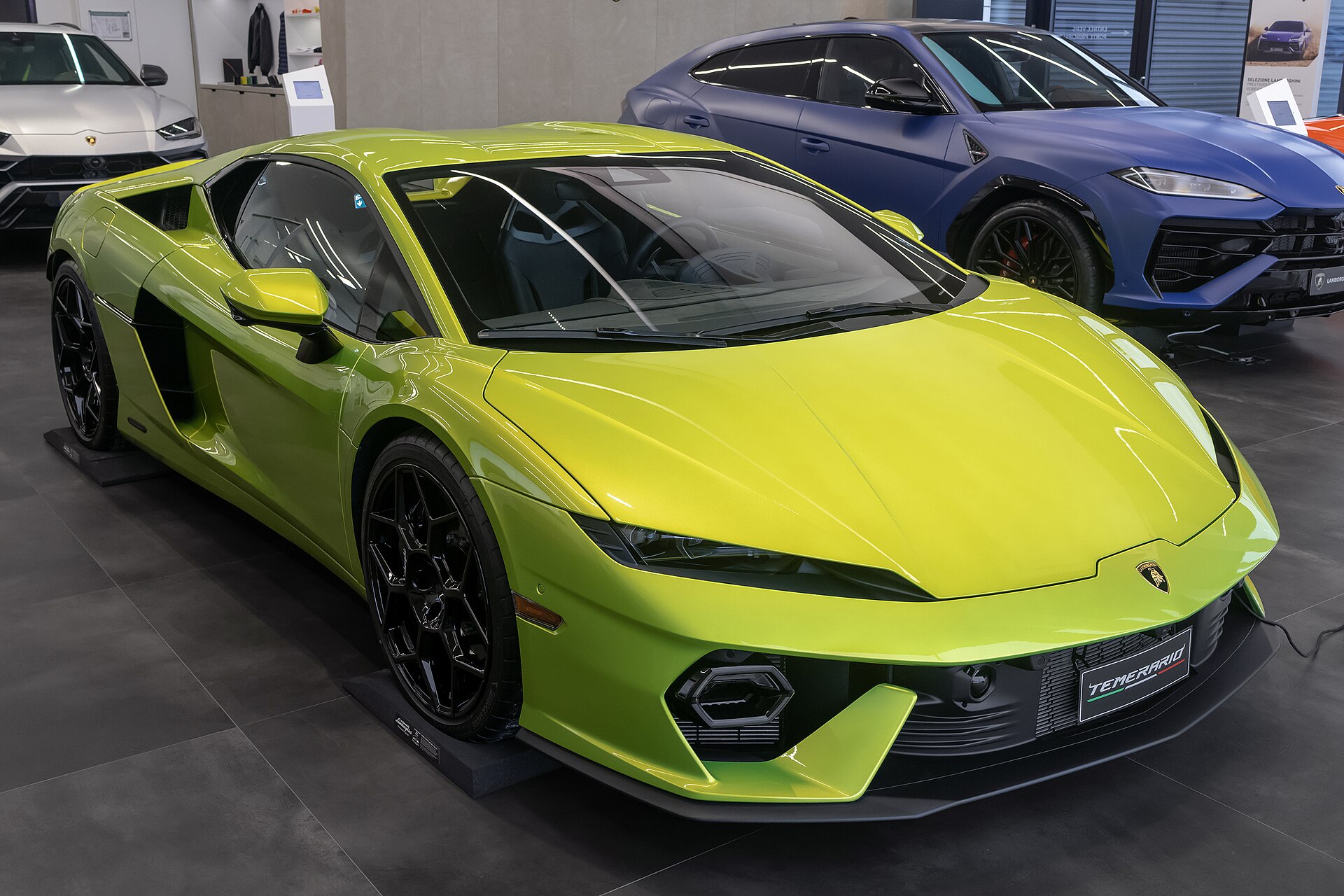
The Lamborghini Temerario is the mid-engined plug-in hybrid supercar that replaced the Huracán. Unveiled on 16 August 2024 at Monterey Car Week and built in Sant'Agata Bolognese from 2025, it swaps the Huracán's naturally aspirated V10 for a new 4.0-litre twin-turbo V8 that revs to 10,250 rpm, combined with three electric motors. Its total output is 677 kW (920 PS), and Lamborghini claims 0–100 km/h in 2.7 seconds and a top speed of 343 km/h.
In short
- Unveiled on 16 August 2024 at Monterey Car Week; production in Sant'Agata Bolognese from 2025 (81 cars in 2024, 546 in 2025).
- 3,995 cc twin-turbo flat-plane V8 (L411) with 588 kW (800 PS) at 9,000–9,750 rpm and 730 Nm; redline 10,250 rpm.
- Three axial-flux electric motors and a 3.8 kWh battery; 677 kW (920 PS) combined, four-wheel drive, eight-speed dual-clutch gearbox.
- The first mid-engined V8 Lamborghini since the Jalpa of 1981; a GT3 race version entered competition in 2026.
Lamborghini Temerario at a glance
| Specification | Lamborghini Temerario |
|---|---|
| Production | from 2025, Sant'Agata Bolognese (Italy) |
| Designer | Mitja Borkert |
| Body | two-door coupé |
| Layout | longitudinal mid-engine, four-wheel drive, plug-in hybrid |
| Engine | L411 3,995 cc V8, two turbochargers in the vee, flat-plane crankshaft |
| Engine power | 588 kW (800 PS) at 9,000–9,750 rpm |
| Engine torque | 730 Nm at 4,000–7,000 rpm |
| System power | 677 kW (920 PS) |
| Battery | 3.8 kWh lithium-ion |
| Gearbox | eight-speed dual-clutch, transverse, behind the engine |
| Dry weight | 1,690 kg |
| Predecessor | Huracán |
Before the Temerario, the only Lamborghini with a twin-turbo V8 was the Lamborghini Urus SUV. All models of the brand are in the Lamborghini catalogue.
Name and launch
The Temerario takes its name from a fighting bull. Chief executive Stephan Winkelmann explained: "Temerario is the name of a fighting bull that fought in 1875, and Temerario means fierce, courageous." The name was announced in July 2024, and the car was unveiled on 16 August 2024 during Monterey Car Week in California. It was designed by Lamborghini's head of design Mitja Borkert.
Production started at Sant'Agata Bolognese at the end of 2024: Wikipedia lists 81 cars built in 2024 and 546 in 2025. Lamborghini's personalisation department, Ad Personam, has since shown several individually built cars:
- Temerario Porto Cervo: presented in Porto Cervo, Sardinia, in a grey Ad Personam livery.
- Temerario Portofino: unveiled on 26 February 2026 in Blu Uranus paint, with a blue two-tone interior, diamond-cut matte titanium wheels of 20 and 21 inches and blue brake calipers.
- Temerario Tricolore: shown at Monterey Car Week 2026, white with a stripe in the colours of the Italian flag.
These cars were built by Ad Personam on the standard Temerario as a base.
Engine: a twin-turbo V8 for 10,000 rpm
The Temerario's engine, code L411, is a new 4.0-litre (3,995 cc) V8 with a flat-plane crankshaft and a "hot vee" layout, with the two turbochargers placed between the cylinder banks. It has titanium connecting rods and a short stroke, and it is mechanically unrelated to the Volkswagen Group's 4.0 TFSI V8 used in other models of the group.
On its own the V8 produces 588 kW (800 PS) between 9,000 and 9,750 rpm and 730 Nm between 4,000 and 7,000 rpm. Its redline is 10,250 rpm; Lamborghini describes the Temerario as the first of its cars that can safely rev beyond 10,000 rpm.
| Figure | Lamborghini Temerario |
|---|---|
| V8 engine | 588 kW (800 PS) at 9,000–9,750 rpm, 730 Nm |
| Rear electric motor | 110 kW (150 PS) at 3,500 rpm, 300 Nm |
| System output | 677 kW (920 PS) |
| 0–100 km/h | 2.7 s (claimed) |
| Top speed | 343 km/h (claimed) |
| Braking 100–0 km/h | 32 m |

Hybrid system and gearbox
The Temerario is a plug-in hybrid with three axial-flux electric motors. One sits between the engine and the gearbox and produces 110 kW (150 PS) at 3,500 rpm and 300 Nm; the other two drive the front axle, giving the car four-wheel drive. The 3.8 kWh lithium-ion battery is taken from the Lamborghini Revuelto.
The gearbox also comes from the Revuelto: it is an adapted eight-speed dual-clutch transmission, mounted transversely behind the engine. The combined output of the whole system is 677 kW (920 PS).

Body and dimensions
The Temerario is a two-door coupé, noticeably larger than the Huracán. It is 4,706 mm long, 1,996 mm wide and 1,201 mm high, with a 2,658 mm wheelbase. Wikipedia gives a dry weight of 1,690 kg.
| Dimension | Temerario | Huracán (for comparison) |
|---|---|---|
| Length | 4,706 mm | 4,459–4,567 mm |
| Width | 1,996 mm | 1,924–1,956 mm |
| Height | 1,201 mm | 1,165–1,248 mm |
| Wheelbase | 2,658 mm | 2,620 mm |
From the Huracán to the Temerario
The technical change from the Huracán is large. The Huracán had a naturally aspirated V10 without any electric assistance, and its Sterrato version was confirmed as the brand's last non-hybrid model. The Temerario has eight cylinders, two turbochargers, three electric motors and a battery that can be charged from the mains.
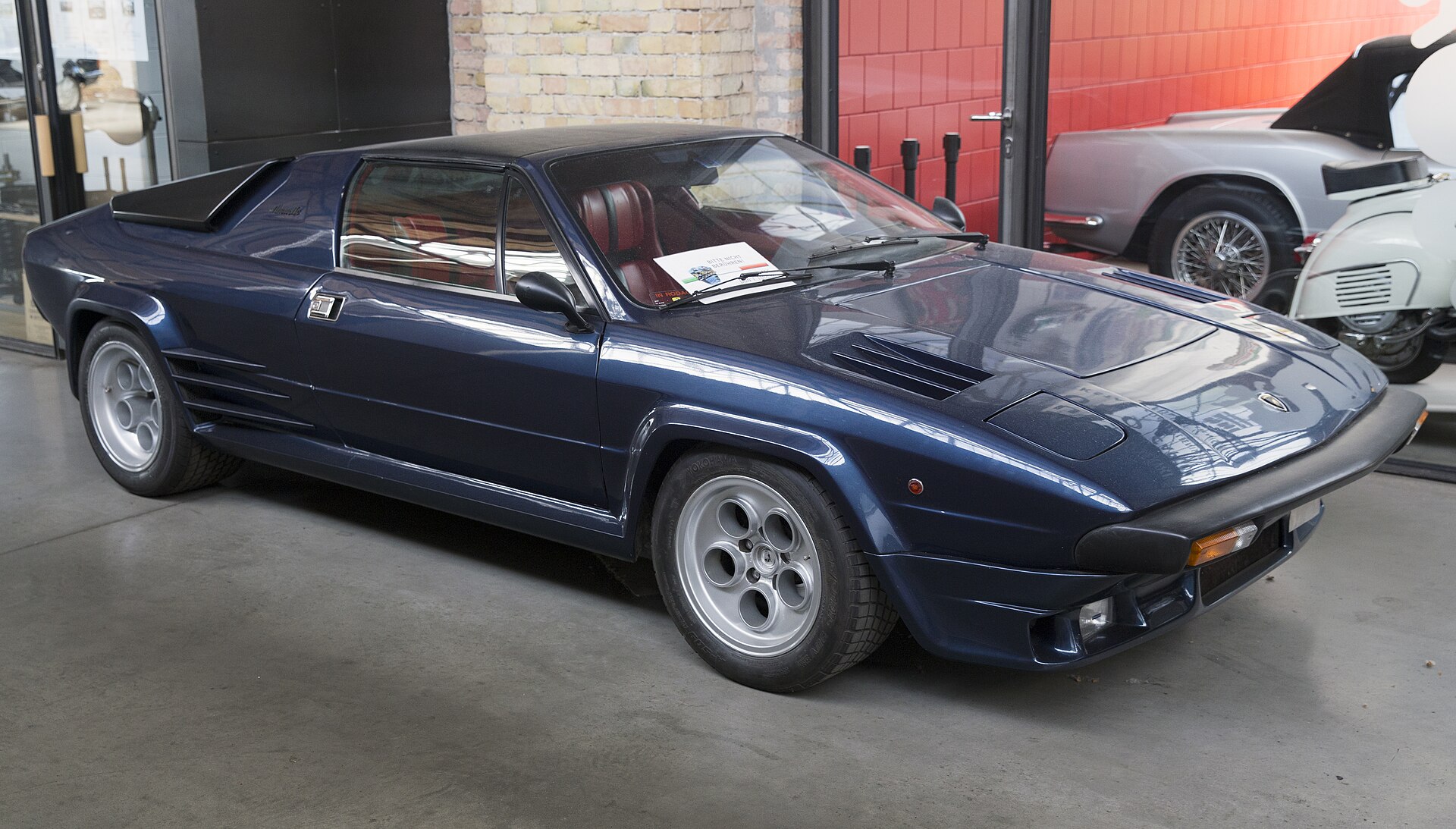
It is also a return to the V8 for Lamborghini's mid-engined cars. The last such model was the Jalpa of 1981, and the Temerario is the second Lamborghini with a twin-turbo V8 after the Urus. Wikipedia lists the Audi Nuvolari as a related model.

Racing: Temerario GT3 and Super Trofeo
The Temerario GT3 replaced the Huracán GT3 EVO 2 from the 2026 season. Lamborghini describes it as its first racing car designed, developed and built entirely in-house. It uses the same twin-turbo V8 as the road car, but without electric motors, which GT3 rules do not allow.
Its first season brought mixed results. The car finished tenth in GTD Pro at the 2026 Sebring 12 Hours, and at the 2026 Spa 24 Hours the Rutronik Racing car finished 19th overall while the Grasser Racing Team entry retired. The first IMSA class win came at Road America, where Andrea Caldarelli and Sandy Mitchell of Pfaff Motorsports won GTD Pro. In the 2026 DTM, Marco Mapelli and Mirko Bortolotti each won a race on the road but lost the wins after post-race checks. A Temerario Super Trofeo for Lamborghini's one-make series was unveiled in August 2025 and is planned for 2027.
Legacy
It is too early to judge the Temerario's place in Lamborghini history, but its technical direction is clear. It shares its battery and gearbox with the Revuelto, so both of Lamborghini's mid-engined supercars now use plug-in hybrid drive, and its V8 revs higher than any earlier Lamborghini engine could safely do. More about the brand is in our history of Lamborghini.
Photo gallery

Lamborghini Temerario in our rankings
- No. 7 of 127 · Most powerful Italian cars (677 kW)
- No. 35 of 859 · Most powerful cars (677 kW · top 5%)
- No. 29 of 313 · Most powerful coupes (677 kW · top 10%)
- No. 23 of 239 · Most powerful cars of the 2020s (677 kW · top 10%)
- No. 866 of 912 · Longest-running car nameplates (2 years · top 96%)
- No. 292 of 305 · Oldest car models still on sale (2 years · top 98%)
More powerful than 95% of ranked cars in the 1CARS catalog (No. 35 of 859).
FAQ
How much power does the Lamborghini Temerario have?
The twin-turbo V8 produces 588 kW (800 PS), and with the three electric motors the system output is 677 kW (920 PS).
Is the Temerario a hybrid?
Yes. It is a plug-in hybrid with three electric motors and a 3.8 kWh battery taken from the Revuelto.
How fast is the Lamborghini Temerario?
Lamborghini claims 0–100 km/h in 2.7 seconds and a top speed of 343 km/h.
What does the name Temerario mean?
Temerario means fierce or courageous; it is the name of a fighting bull that fought in 1875.
Does the Temerario race?
Yes. The Temerario GT3, without the electric motors, replaced the Huracán GT3 EVO 2 in 2026 and won its first IMSA GTD Pro race at Road America. A Super Trofeo version for Lamborghini's one-make series is planned for 2027.
Data sources
Data checked by an editor against the sources below.