 Lamborghini Reventón
Specs, engines and history
Published Sources (1) Report an error
By Felix Hartmann, Automotive Technology & EV Contributor
- Built
- 2007–2009
- Top power
- 493 kW (670 PS)
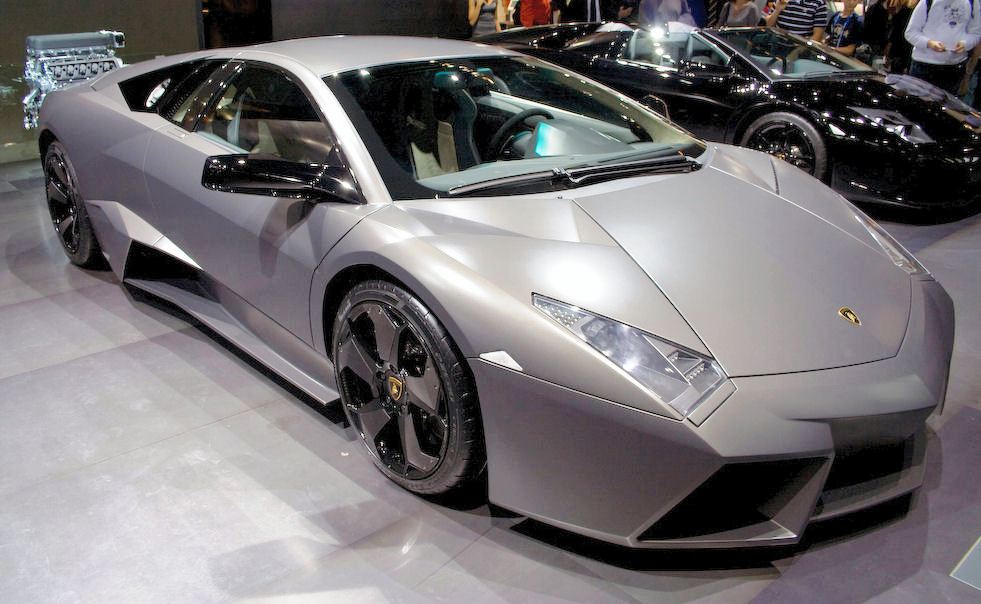
The Lamborghini Reventón is a limited-edition V12 supercar that Lamborghini presented at the Frankfurt motor show in 2007. Under its new carbon-fibre body it is almost entirely a Murciélago LP 640, but its sharp, angular shape — inspired, Lamborghini said, by the fastest aircraft — made it the most extreme-looking Lamborghini of its time. Only 21 coupés were built, one of them for the company museum, followed in 2009 by 15 Roadsters.
In short
- Coupé shown at Frankfurt in 2007: 20 cars for customers plus one museum car (numbered 00/20); Roadster shown at Frankfurt in 2009, 15 built.
- 6,496 cc V12 from the Murciélago: 478 kW (650 PS) at 8,000 rpm in the coupé, 493 kW (670 PS) in the Roadster, 660 Nm at 6,000 rpm.
- Six-speed e-gear automated manual and four-wheel drive; 0–100 km/h in 3.4 seconds.
- Top speed over 340 km/h for the coupé and 330 km/h for the Roadster; Roadster list price €1,100,000 in 2009.
Reventón at a glance
| Specification | Lamborghini Reventón |
|---|---|
| Production | 2007–2009 (coupé), Roadster from 2009, Sant'Agata Bolognese (Italy) |
| Cars built | 21 coupés (including the museum car) and 15 Roadsters |
| Body | two-seat coupé or roadster, carbon-fibre panels |
| Base | Lamborghini Murciélago LP 640 |
| Engine | 6,496 cc V12 |
| Power | 478 kW (650 PS) coupé; 493 kW (670 PS) Roadster |
| Torque | 660 Nm at 6,000 rpm |
| Gearbox | six-speed e-gear automated manual, four-wheel drive |
| Kerb weight | 1,665 kg (coupé), 1,690 kg (Roadster) |
| Top speed | over 340 km/h (coupé), 330 km/h (Roadster) |
The Reventón is listed with the Murciélago family in the Lamborghini catalogue. Later limited Lamborghinis include the Lamborghini Veneno and the Lamborghini Centenario.
Name and concept
Like most Lamborghinis, the Reventón is named after a fighting bull. The bull Reventón became famous in 1943, when it killed the bullfighter Félix Guzmán. In Spanish the word can also mean a burst or a small explosion; in motoring language it is used for a blow-out of a tyre.
The idea was simple: take the proven mechanicals of the Murciélago LP 640 and wrap them in a new body for a very small number of customers. The result was presented at the Frankfurt motor show in 2007. Of the 20 coupés sold, ten went to the United States, seven to Europe, one to Canada and two to Asia. A 21st car, numbered 00/20, was kept by Lamborghini for its museum. Each coupé has its number stamped between the seats.
Design inspired by aircraft
Lamborghini's press release described the Reventón's styling as inspired by "the fastest airplanes". The body is completely new, made of carbon fibre and finished in a matt grey.
The aircraft theme continues inside the cabin. The instrument panel of the Reventón uses three TFT liquid-crystal displays with two display modes, set in a housing milled from solid aluminium and covered in carbon fibre. One of the displays is a "g-force meter" that shows the strength and direction of the acceleration forces acting on the car. The seats are trimmed in black leather and brown Alcantara.


Engine and performance
The engine is the 6,496 cc V12 of the Murciélago LP 640, tuned for the Reventón coupé to 478 kW (650 PS) at 8,000 rpm, slightly more than the 471 kW (640 PS) of the donor car. Torque is unchanged at 660 Nm at 6,000 rpm. Power goes to all four wheels through the six-speed e-gear automated manual, the same system as in the Murciélago.
| Version | Power | Torque | Weight | 0–100 km/h | Top speed |
|---|---|---|---|---|---|
| Reventón coupé (2007) | 478 kW (650 PS) at 8,000 rpm | 660 Nm at 6,000 rpm | 1,665 kg | 3.4 s | over 340 km/h |
| Reventón Roadster (2009) | 493 kW (670 PS) at 8,000 rpm | 660 Nm | 1,690 kg | 3.4 s | 330 km/h |
| For comparison: Murciélago LP 640 | 471 kW (640 PS) at 8,000 rpm | 660 Nm at 6,000 rpm | 1,746 kg | — | 340 km/h |
With a kerb weight of 1,665 kg, the coupé is lighter than the LP 640, which Wikipedia lists at 1,746 kg. It reaches 100 km/h in 3.4 seconds and has a top speed of over 340 km/h.

The Murciélago LP 640 underneath
The donor car was the facelifted Murciélago, presented as the LP 640 at the Geneva motor show in 2006. Its V12 had been enlarged from 6.2 to 6.5 litres, the e-gear automated manual had received a stronger clutch and a launch control function, and the suspension had been revised. The Reventón takes over this package almost unchanged.
The drivetrain is Lamborghini's permanent four-wheel-drive system of that period. The rear differential is integrated with the engine, and a viscous coupling acting as the centre differential sends part of the torque to the front axle; in normal driving about 70% goes to the rear and 30% to the front. Suspension is by independent double wishbones, and the scissor doors also come from the Murciélago.
Reventón Roadster
The open Reventón Roadster was unveiled at the Frankfurt motor show in 2009. It uses the more powerful engine of the Murciélago LP 670-4 SuperVeloce, the track-oriented final version of the Murciélago presented in 2009, with 493 kW (670 PS) at 8,000 rpm. The reinforcements needed for the open body add 25 kg, according to Lamborghini, and the Roadster has deployable roll-over hoops behind the seats. Acceleration to 100 km/h is the same 3.4 seconds; the top speed is 330 km/h.
Fifteen Roadsters were built. The list price was €1,100,000 at launch in 2009, although high demand pushed the prices actually paid well above that figure.

Place in Lamborghini history
The Reventón showed a formula that Lamborghini used again later: a new body in a very small series on the mechanicals of a regular V12 model. Later examples of very limited Lamborghinis include the Lamborghini Sesto Elemento and the Veneno. For the background of the brand, read our history of Lamborghini.
Photo gallery


Lamborghini Reventón in our rankings
- No. 6 of 170 · Most powerful cars of the 2000s (493 kW)
- No. 99 of 859 · Most powerful cars (493 kW · top 12%)
- No. 72 of 313 · Most powerful coupes (493 kW · top 24%)
- No. 32 of 127 · Most powerful Italian cars (493 kW · top 26%)
- No. 840 of 912 · Longest-running car nameplates (2 years · top 96%)
More powerful than 96% of ranked cars of the 2000s in the 1CARS catalog (No. 6 of 170).
FAQ
How many Lamborghini Reventóns were built?
21 coupés — 20 for customers and one for the Lamborghini museum — and 15 Roadsters. Of the 20 customer coupés, ten were delivered to the United States, seven to Europe, one to Canada and two to Asia.
What is the Reventón based on?
The Murciélago LP 640. The 6.5-litre V12, the e-gear gearbox and the four-wheel-drive system with its viscous centre coupling are carried over; the carbon-fibre body and the instrument panel with three TFT displays are new.
How powerful is the Reventón?
The coupé has 478 kW (650 PS) at 8,000 rpm and the Roadster, which uses the engine of the Murciélago LP 670-4 SuperVeloce, 493 kW (670 PS). Both have 660 Nm of torque.
How fast is the Reventón?
Both versions reach 100 km/h in 3.4 seconds. The coupé's top speed is over 340 km/h, the Roadster's 330 km/h.
What does Reventón mean?
It is the name of a famous fighting bull, which killed the bullfighter Félix Guzmán in 1943. In Spanish the word also means a burst or a small explosion, and in motoring it is used for a tyre blow-out.
Data sources
Data checked by an editor against the sources below.