 Lamborghini Espada
Specs, engines and history
Published Sources (1) Report an error
By Felix Hartmann, Automotive Technology & EV Contributor
- Built
- 1968–1978
- Top power
- 257 kW (349 PS)
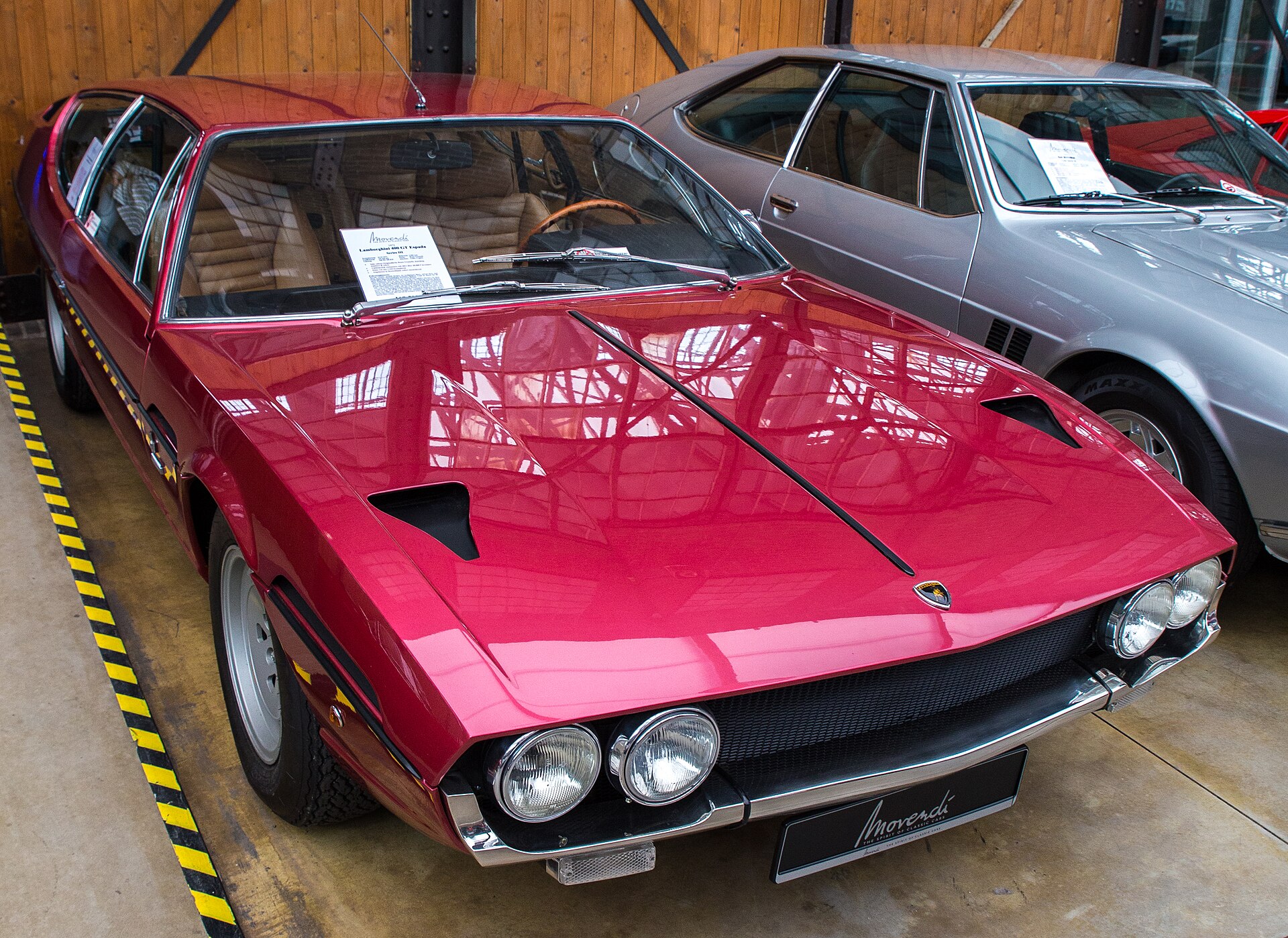
The Lamborghini Espada is a four-seat, front-engined V12 grand tourer that Lamborghini built in Sant'Agata Bolognese from 1968 to 1978. Designed by Marcello Gandini at Bertone and launched at the Geneva Motor Show alongside the Islero, it offered the performance of a Lamborghini V12 with room for four adults. Over ten years in production it became the company's best-selling and longest-lived model of its time, and it held that position until Countach production grew in the mid-1980s.
In short
- Built 1968–1978 in Sant'Agata Bolognese in three series; about 1,220 cars (Wikipedia gives 1,217 in the text and 1,227 in its infobox).
- Front-mounted 3,929 cc V12 with six Weber carburettors: 239 kW (325 PS) in the Series I, 257 kW (350 PS) in the Series II and III.
- Five-speed Lamborghini manual gearbox; a three-speed Chrysler TorqueFlite automatic was optional on late cars (55 built).
- Body by Bertone, styled by Marcello Gandini; the name is Spanish for "sword".
Lamborghini Espada at a glance
| Specification | Lamborghini Espada |
|---|---|
| Production | 1968–1978, Sant'Agata Bolognese (Italy) |
| Series | Series I (1968–1970), Series II (1970–1972), Series III (1972–1978) |
| Cars built | about 1,220 (1,217 or 1,227 depending on the source) |
| Body | four-seat, two-door grand tourer |
| Chassis | steel semi-monocoque, built by Marchesi of Modena; aluminium bonnet |
| Engine | 3,929 cc 60° V12, four overhead camshafts, front-mounted |
| Power | 239 kW (325 PS) to 257 kW (350 PS) |
| Gearbox | five-speed manual; three-speed automatic option |
| Kerb weight | 1,630 kg |
| Dimensions | 4,730 mm long, 1,860 mm wide, 1,185 mm high, 2,650 mm wheelbase |
| Predecessor | 400 GT 2+2 |
The Espada was Lamborghini's family car of the 1970s, built at the same time as the mid-engined Miura and the early Countach. All models are listed in the Lamborghini catalogue, and the story of the company is told in our history of Lamborghini.
Origins: from show car to production
The Espada grew out of two Bertone show cars of 1967, the Lamborghini Marzal and the Bertone Pirana, both drawn by Marcello Gandini. The Espada took from them the idea of a low, wide body with room for four people, combined with Lamborghini's front-mounted V12.
The first prototype was built on the wooden body buck made for the Pirana concept, and it used the engine, gearbox and rear differential of the 400 GT. After Lamborghini's test drivers had finished with it, the prototype was left outside in a field; it has since been restored and is now displayed in the Museo Ferruccio Lamborghini.
The production Espada was presented at the Geneva Motor Show in 1968, together with the Islero. Its name means "sword" in Spanish and refers to the sword used by the matador in a bullfight — another link with the world of fighting bulls that runs through Lamborghini's model names.

Design and construction
The Espada is long and low: 4,730 mm long and only 1,185 mm high. The roofline slopes down to a vertical glass panel in the tail, which the Series I framed with a grille. The design gave space for four adults and their luggage while keeping the proportions of a sports car.
The body was built on a semi-monocoque of pressed sheet steel and square steel tubing, made for Lamborghini by Marchesi of Modena, with an aluminium bonnet. Suspension was fully independent with unequal-length double wishbones, coil springs, dampers and anti-roll bars at both ends. Girling disc brakes with three-piston calipers were fitted to all wheels, solid at first and ventilated from the Series II. Two fuel tanks held 93 litres in total.
The Espada suffered from rust in its steel structure and body. The British journalist Denis Jenkinson reported visible corrosion on a car that had covered only about 16,000 km in 1972.
Engine and gearbox
The Espada uses Lamborghini's 60° V12, developed from the engine of the 400 GT 2+2. It has a displacement of 3,929 cc (bore 82 mm, stroke 62 mm), two chain-driven overhead camshafts per bank, 24 valves and six Weber 40 DCOE carburettors. The engine alone weighs 232 kg.
| Series | Years | Compression | Power |
|---|---|---|---|
| Series I | 1968–1970 | 9.5:1 | 239 kW (325 PS) at 7,200 rpm |
| Series II | 1970–1972 | 10.7:1 | 257 kW (350 PS) at 7,500 rpm |
| Series III | 1972–1978 | 10.7:1 | 257 kW (350 PS) at 7,500 rpm |
The standard gearbox is a five-speed manual designed by Lamborghini, with a hydraulically operated clutch. On the Series III a three-speed Chrysler TorqueFlite automatic was offered as an option from 1974. It reduced both acceleration and top speed and was rarely ordered: only 55 cars were built with it.

The three series
Series I (1968–1970). The first cars had a dashboard inspired by the Marzal, with octagonal instrument housings, Campagnolo alloy wheels with knock-off hubs like those of the Miura, and tail lights from the Fiat 124 Sport Coupé. 186 were built before January 1970.
Series II (1970–1972). Presented at the Brussels Motor Show in 1970, the Series II had more power, ventilated brakes, constant-velocity joints on the rear drive shafts and a new dashboard with a wood-trimmed fascia, a new centre console and a new steering wheel. Ventilation for the rear seats was improved. With 575 cars, it was the most produced version.
Series III (1972–1978). The final series had a redesigned instrument panel trimmed in aluminium, standard air conditioning, power steering, five-stud wheels instead of the knock-off type, a square-mesh grille and tail lights from the Alfa Romeo 1750. A sunroof was optional. From 1975, cars for the United States received large impact bumpers and changes to meet emissions rules, but Lamborghini did not give them a new name.

What Lamborghini says about the Espada
Lamborghini's own history of the model adds several details. The car was launched as the Espada 400 GT at Geneva and became simply the Espada in production. According to the company, the three series were built in these numbers: 186 Series I, 575 Series II and 456 Series III — 1,217 cars in total — and for a long time the Espada was Lamborghini's best-selling model.
Lamborghini also notes that the Marzal's glass gullwing doors were considered too extreme for production and were dropped, that the bodywork was by Bertone, and that the roofline is only about 112 cm from the ground (Wikipedia gives an overall height of 1,185 mm). The Espada was the first production Lamborghini to use hexagonal shapes, a motif that later became one of the brand's design symbols. The glass boot lid and the vertical glass panel below it both span the full width of the car to improve the driver's view to the rear.
The chassis was based on that of the 400 GT, stretched to give more room in the rear. The optional automatic gearbox, made in America, was the first automatic offered on a car built in Sant'Agata. Power steering was optional on the Series II and standard on the Series III, and air conditioning was optional on earlier cars. The most exclusive version was the Espada VIP, of which only 12 were built: it had a television and a bar compartment, and came in bright two-tone colour schemes typical of the period. The car also appeared in several films and in fashion photo shoots of its time.
One-offs and experiments
At the 1968 Turin Motor Show Lamborghini showed an Espada with a hydropneumatic self-levelling rear suspension, called "Lancomatic". According to Wikipedia it was costly, had problems with its seals and ride quality and never went into production; Lamborghini's own history describes the Lancomatic system as an option that few customers chose.
The most unusual Espada is the Faena, a one-off four-door saloon built by Pietro Frua on a 1974 Series II chassis. Its wheelbase was extended by 18 cm, and it weighs almost 2,000 kg. It was first shown at the Turin Motor Show in 1978 and appeared again at Geneva in 1980.

Legacy
The Espada proved that Lamborghini could sell a practical four-seat car in larger numbers than its exotic two-seaters. It was the company's most numerous and longest-running model until the Countach overtook it in the mid-1980s.
Lamborghini has returned to the idea several times. A revival was rumoured in 1999 and again in 2006, and in 2008 the company showed the four-door Estoque concept at the Paris Motor Show, but no production model followed. The four-seat idea finally reached production in a very different form with the Lamborghini Urus.
Photo gallery


Lamborghini Espada in our rankings
- No. 352 of 859 · Most powerful cars (257 kW · top 42%)
- No. 357 of 912 · Longest-running car nameplates (10 years · top 43%)
- No. 68 of 127 · Most powerful Italian cars (257 kW · top 54%)
- No. 191 of 313 · Most powerful coupes (257 kW · top 62%)
More powerful than 58% of ranked cars in the 1CARS catalog (No. 352 of 859).
FAQ
What does Espada mean?
It is Spanish for "sword" — the sword used by the matador in a bullfight.
How many Lamborghini Espadas were built?
About 1,220 in ten years: Wikipedia gives 1,217 in the text and 1,227 in its infobox.
What engine does the Espada have?
A front-mounted 3.9-litre V12 with six Weber carburettors, producing 239 kW (325 PS) in the Series I and 257 kW (350 PS) in later cars.
Who designed the Lamborghini Espada?
Marcello Gandini at Bertone, based on ideas from the Marzal and Pirana show cars of 1967.
Data sources
Data checked by an editor against the sources below.