 Ferrari 849 Testarossa
Specs, engines and history
Published Sources (1) Report an error
By Felix Hartmann, Automotive Technology & EV Contributor
- Built
- 2025–present
- Top power
- 772 kW (1,050 PS)
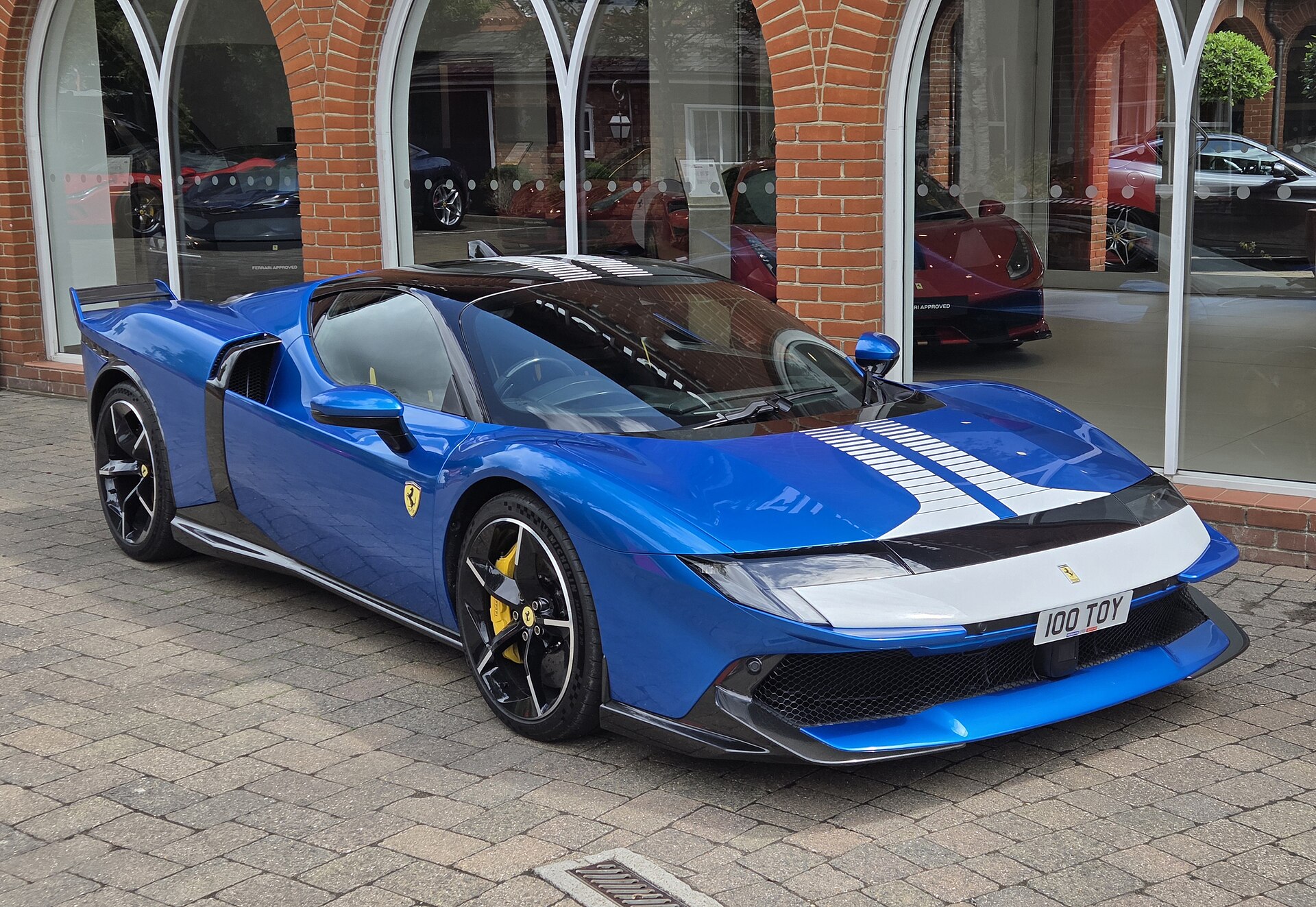
The Ferrari 849 Testarossa is the plug-in hybrid V8 supercar that succeeds the SF90 Stradale at the top of Ferrari's series-production range. Unveiled on 9 September 2025, with production planned from mid-2026 in Maranello, it combines a twin-turbo 4.0-litre V8 with three electric motors and all-wheel drive for a total output of 772 kW (1,050 PS). Its name revives one of the most famous labels in Ferrari's history, and it is offered as a coupé and as an open Spider.
In short
- Unveiled 9 September 2025; production from mid-2026 in Maranello; coupé and Spider; project code F173M.
- 3,990 cc twin-turbo V8 with 610 kW (830 PS) and 842 Nm, plus three electric motors; total output 772 kW (1,050 PS).
- Eight-speed dual-clutch gearbox, all-wheel drive, plug-in battery with about 25 km of electric range.
- Ferrari figures: 0–100 km/h in 2.3 s, 0–200 km/h in 6.35 s, top speed over 330 km/h.
Ferrari 849 Testarossa at a glance
| Specification | Ferrari 849 Testarossa |
|---|---|
| Production | from 2026, Maranello (Italy) |
| Body | two-seat berlinetta; Spider with retractable hard top |
| Engine | F154 FC 3,990 cc V8, two turbochargers, mid-mounted |
| Engine power | 610 kW (830 PS), 842 Nm |
| Electric motors | three, about 162 kW (220 PS) combined |
| System power | 772 kW (1,050 PS) |
| Gearbox | eight-speed dual-clutch, all-wheel drive |
| Battery | 6.5 kWh (Wikipedia) or 7.45 kWh (CAR magazine) |
| Electric range | 25–26 km |
| Dimensions | 4,718 mm long, 2,304 mm wide, 1,225 mm high, 2,650 mm wheelbase |
| Predecessor | SF90 Stradale |
The 849 Testarossa takes over from the Ferrari SF90 Stradale, Ferrari's first series-production plug-in hybrid. All models are listed in the Ferrari catalogue.
Development and reveal
The 849 Testarossa was unveiled to the public on 9 September 2025. Like the SF90 before it, it is a mid-engined plug-in hybrid with a V8 and electric front axle drive, but it was developed as a new model with its own type code, F173M. The design is the work of the Ferrari Styling Centre under Flavio Manzoni. Production in Maranello was planned to start in the middle of 2026.
Two body styles were presented: the berlinetta coupé and the 849 Testarossa Spider with a retractable hard top. Both can be ordered with the Assetto Fiorano performance package. It adds two smaller wings, similar to those of the FXX-K track car, a larger front air dam, carbon fibre wheels and stiffer suspension, and, according to Ferrari, saves about 30 kg.

The name
The name combines a number and a legend. Following Ferrari's tradition, "8" stands for the eight cylinders and "49" for the displacement of each cylinder — about 499 cc, giving 3,990 cc in total. "Testarossa" ("red head") recalls the racing cars of the 1950s and 1960s such as the 500 TR of 1956 and the 250 Testa Rossa, and the Testarossa road car of 1984, one of the best-known Ferraris of its era.

Design
The 849 Testarossa uses the design language introduced on the Ferrari F80, which itself draws on the old Daytona. Ferrari says much of the design, especially the rear, was inspired by the 512 S, its endurance racing prototype of the 1970s. The car is 4,718 mm long, 2,304 mm wide and only 1,225 mm high, on a 2,650 mm wheelbase.
According to Autobuzz's report on the car's Asian debut, the 849 Testarossa produces 415 kg of downforce at 250 km/h, 25 kg more than the SF90, and its cooling efficiency is 15 per cent better. The aerodynamic package includes new channels under the front and rear of the car, twin rear wings, an active rear spoiler and reshaped side intakes.
Inside, the cockpit is focused on the driver, with a new gear selector on a central "keel" and a new steering wheel that combines mechanical buttons with touch controls. Alcantara and recycled aluminium are used throughout, and Apple CarPlay, Android Auto and driver assistance systems such as automatic emergency braking and adaptive cruise control are standard.
The coupé and the Spider share the same basic proportions. The Spider's retractable hard top folds into the body, so the car can be driven as a closed coupé or an open roadster.

Engine and hybrid system
The heart of the car is the F154 FC 3,990 cc twin-turbo V8, which produces 610 kW (830 PS) and 842 Nm on its own. Three electric motors — two at the front and one at the rear — add about 162 kW (220 PS); CAR magazine gives 161 kW. The front motors make all-wheel drive available on demand and allow torque vectoring between the front wheels. Together the system delivers 772 kW (1,050 PS). Power goes to all four wheels through an eight-speed dual-clutch gearbox, the Magna 8DCL900.
| Figure | Ferrari 849 Testarossa |
|---|---|
| Engine | 610 kW (830 PS), 842 Nm |
| Electric motors | about 162 kW (220 PS) |
| Total output | 772 kW (1,050 PS) |
| 0–100 km/h | 2.3 s |
| 0–200 km/h | 6.35 s |
| Top speed | over 330 km/h |
| Braking 100–0 km/h | 28.5 m |
| Braking 200–0 km/h | 108 m |
The battery capacity is given as 6.5 kWh by Wikipedia and as 7.45 kWh by CAR magazine. On electricity alone the car can cover about 25 km (26 km according to Wikipedia), without emissions.
Chassis and brakes
The 849 Testarossa uses carbon-ceramic brakes with discs of 410 mm at the front and 372 mm at the rear. According to the figures published by CAR magazine, it stops from 100 km/h in 28.5 metres and from 200 km/h in 108 metres.
Driving and electronics
Compared with the SF90, the total output rises by about 37 kW (50 PS), and Ferrari says the car is lighter than its predecessor. The gear-change logic of the dual-clutch gearbox was redesigned, and in Race mode the engine sound is given a stronger presence in the cabin. The chassis electronics, including the ABS Evo braking system, are coordinated by Ferrari's FIVE vehicle dynamics system. Depending on the market, the car is delivered on tyres from Michelin, Pirelli or Bridgestone.
The Assetto Fiorano version is aimed at owners who also drive on circuits. Besides the lighter parts and the extra wings, it can be ordered with lightweight racing seats and a special track-inspired paint scheme in Bianco Cervino or Rosso Corsa.
Price
The Italian magazine auto.it lists the 849 Testarossa Spider at €500,000 including VAT in Italy for the 2026 model year.
Legacy and place in the range
The 849 Testarossa continues the line that began with the SF90 Stradale: a mid-engined V8 plug-in hybrid at the top of Ferrari's regular range. By reviving the Testarossa name, Ferrari linked its newest technology to a model that defined the brand in the 1980s. The history of the company is told in our history of Ferrari.
Photo gallery

Ferrari 849 Testarossa in our rankings
- No. 2 of 127 · Most powerful Italian cars (772 kW)
- No. 24 of 859 · Most powerful cars (772 kW · top 4%)
- No. 21 of 313 · Most powerful coupes (772 kW · top 8%)
- No. 18 of 239 · Most powerful cars of the 2020s (772 kW · top 8%)
- No. 907 of 912 · Longest-running car nameplates (1 year)
- No. 300 of 305 · Oldest car models still on sale (1 year)
More powerful than 97% of ranked Italian cars in the 1CARS catalog (No. 2 of 127).
FAQ
What does 849 mean in Ferrari 849 Testarossa?
"8" stands for eight cylinders and "49" for the displacement of one cylinder, about 499 cc.
How much power does the 849 Testarossa have?
772 kW (1,050 PS) in total: 610 kW (830 PS) from the V8 and about 162 kW from three electric motors.
How fast is the Ferrari 849 Testarossa?
Ferrari quotes 0–100 km/h in 2.3 seconds, 0–200 km/h in 6.35 seconds and a top speed of over 330 km/h.
What did the 849 Testarossa replace?
The SF90 Stradale.
Data sources
Data checked by an editor against the sources below.