 Ferrari 250 GT/E 2+2
Specs, engines and history
Published Sources (1) Report an error
By Felix Hartmann, Automotive Technology & EV Contributor
- Built
- 1960–1963
- Top power
- 177 kW (241 PS)
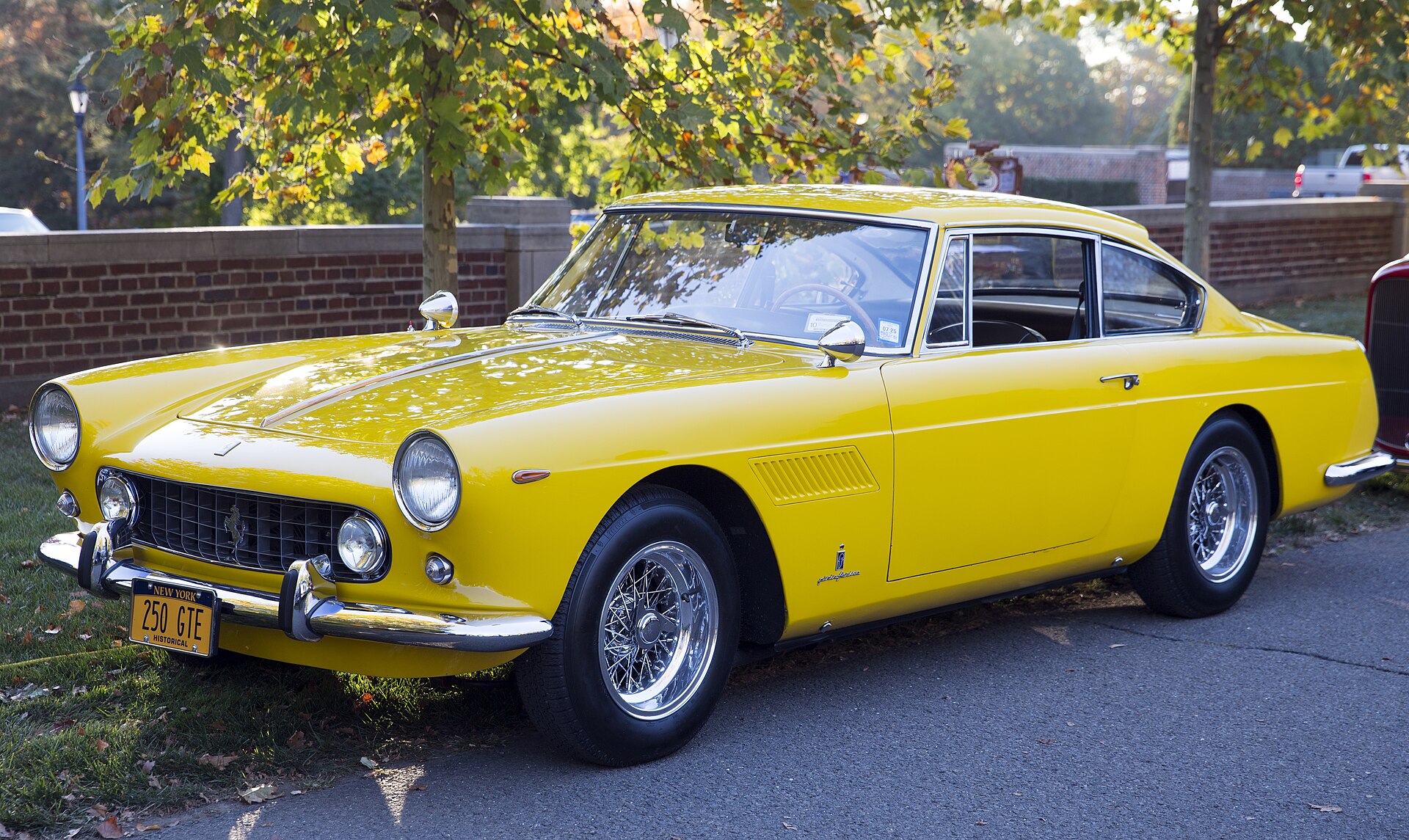
The Ferrari 250 GT/E 2+2, often written 250 GTE, is the four-seat member of Ferrari's 250 family. It made its debut in Paris in 1960 and was built until 1963. It combined the twelve-cylinder engine of the 250 family with a Pinin Farina body that found room for two small rear seats. With 955 cars in three series, its large production run helped Ferrari's finances in the early 1960s.
In short
- Prototypes in 1959, official debut at the Paris motor show in October 1960, production until 1963.
- 955 cars built, all bodied by Pinin Farina: 299 Series I, 356 Series II and 300 Series III.
- 3.0-litre Colombo V12 with 177 kW (240 PS).
- Rear seats made possible by moving the engine forward in the long-wheelbase 250 GT chassis.
At a glance: Ferrari 250 GT/E 2+2
| Specification | Ferrari 250 GT/E 2+2 |
|---|---|
| Production | 1960–1963 |
| Cars built | 955 (299 + 356 + 300) |
| Body | 2+2 coupé by Pinin Farina |
| Chassis | long-wheelbase 250 GT family |
| Engine | Colombo 3.0-litre V12 |
| Power | 177 kW (240 PS) |
| Related model | 330 America (same chassis, 4.0-litre engine) |
The GT/E belongs to the 250 family, which also includes cars such as the Ferrari 250 GT Tour de France. All Ferrari models are in the Ferrari catalogue.
History of the Ferrari 250 GT/E 2+2
Ferrari built the first prototypes of a four-seat 250 in 1959, and the production car followed a year later. All 955 cars were bodied by Pinin Farina. According to Wikipedia, the large production run was an important contributor to Ferrari's financial health in the early 1960s.
Design, packaging and engine
The GT/E is based on the long-wheelbase chassis of the 250 GT. To create space for the rear seats, the designers shifted the engine towards the front. The result is a car with four seats, although the rear ones are small: suitable for children, but tight for adults.
The engine, mounted at the front and driving the rear wheels, is the Colombo V12 used throughout the 250 range, rated in the GT/E at 177 kW (240 PS).


Three series
| Series | Production | Built | Main changes |
|---|---|---|---|
| Series I | 1960–1961 | 299 | original version |
| Series II | from 1961 | 356 | extra gauges, interior changes, revised ventilation |
| Series III | from late 1962 | 300 | thicker headlight bezels, auxiliary lights outboard of the grille, one-piece rear lights, reshaped rear bumpers |
The Series III was shown at the Geneva motor show in 1963, although its production had started at the end of 1962. Series I cars rode on Borrani RW3591 wire wheels; Series II and III cars had Borrani RW3690 wheels as standard.

The 250 family
The GT/E belongs to the Ferrari 250 series, built from 1952 to 1964 and named after the capacity of about 250 cc per cylinder. Most 250 road cars use the Colombo V12: a 60° engine of 2,953 cc with one overhead camshaft per cylinder bank and two valves per cylinder. The family used three wheelbases - 2,400 mm for the short-wheelbase cars, 2,600 mm for the long-wheelbase cars such as the GT/E, and 2,800 mm for the early Europa.
Among its road-going relatives were the 250 GT Coupé Pinin Farina, of which 335 were built between 1958 and 1960, the 250 GT California Spyder and the 250 GT Lusso of 1962. Compared with these two-seaters, the GT/E was the four-seat car of the range. With 955 cars it was built in far larger numbers than the GT Coupé Pinin Farina (335) or the two California Spyder versions (about 50 and 55 cars).
The police car and the Lamborghini story
One GT/E was donated to the police in Rome to celebrate their work against the Mafia. It crashed almost immediately and was replaced by another GT/E, which stayed in service until 1968; its drivers were trained at Maranello.
The 250 family also has a famous link with the birth of Lamborghini. Ferruccio Lamborghini owned several Ferrari 250s. His frustration with Enzo Ferrari's response to his complaints about clutch problems was a key reason for his decision to build his own cars. One of his cars, a 250 GTE, is now on display in the Ferruccio Lamborghini Museum.

Legacy
The GT/E was followed by the 330 America, which used the same chassis and looked very similar but had the larger 4.0-litre engine of the 330 series. For more, see our history of Ferrari.
Successors: 330 America and 330 GT 2+2
At the end of 1963 Ferrari built 50 cars of the 330 America. It used the outgoing GT/E's chassis and looked almost identical to a Series III GT/E, but it had a new 4.0-litre V12 (Tipo 209) with 220 kW (300 PS) at 6,600 rpm. In January 1964 it was followed by the larger 330 GT 2+2, which kept the 220 kW (300 PS) output; 1,099 were built until 1967, when the 365 GT 2+2 took over.
Ferrari 250 GT/E 2+2 in our rankings
- No. 536 of 859 · Most powerful cars (177 kW · top 63%)
- No. 60 of 94 · Most powerful cars of the 1960s (177 kW · top 64%)
- No. 101 of 127 · Most powerful Italian cars (177 kW · top 80%)
- No. 261 of 313 · Most powerful coupes (177 kW · top 84%)
- No. 764 of 912 · Longest-running car nameplates (3 years · top 89%)
More powerful than 37% of ranked cars in the 1CARS catalog (No. 536 of 859).
FAQ
How many Ferrari 250 GTEs were built?
955 cars between 1960 and 1963, all bodied by Pinin Farina: 299 Series I, 356 Series II and 300 Series III.
How much room is in the back of a 250 GTE?
The rear seats are small: suitable for children but tight for adults. Ferrari made room for them by moving the engine forward in the chassis.
What engine does the 250 GTE have?
The 3.0-litre (2,953 cc) Colombo V12 of the 250 family, with one overhead camshaft per bank, listed at 177 kW (240 PS) in the GT/E.
What replaced the 250 GTE?
The 330 America of 1963, 50 cars built on the same chassis with a 4.0-litre V12 of 220 kW (300 PS), followed in 1964 by the 330 GT 2+2.
What is the link between the 250 GTE and Lamborghini?
Ferruccio Lamborghini owned several Ferrari 250s, including a 250 GTE now shown in his museum; his complaints about clutch problems helped persuade him to build his own cars.
Data sources
Data checked by an editor against the sources below.