 Aston Martin DB4 GT Zagato
Specs, engines and history
Published Sources (1) Report an error
By Felix Hartmann, Automotive Technology & EV Contributor
- Built
- 1960–1963
- Top power
- 234 kW (318 PS)
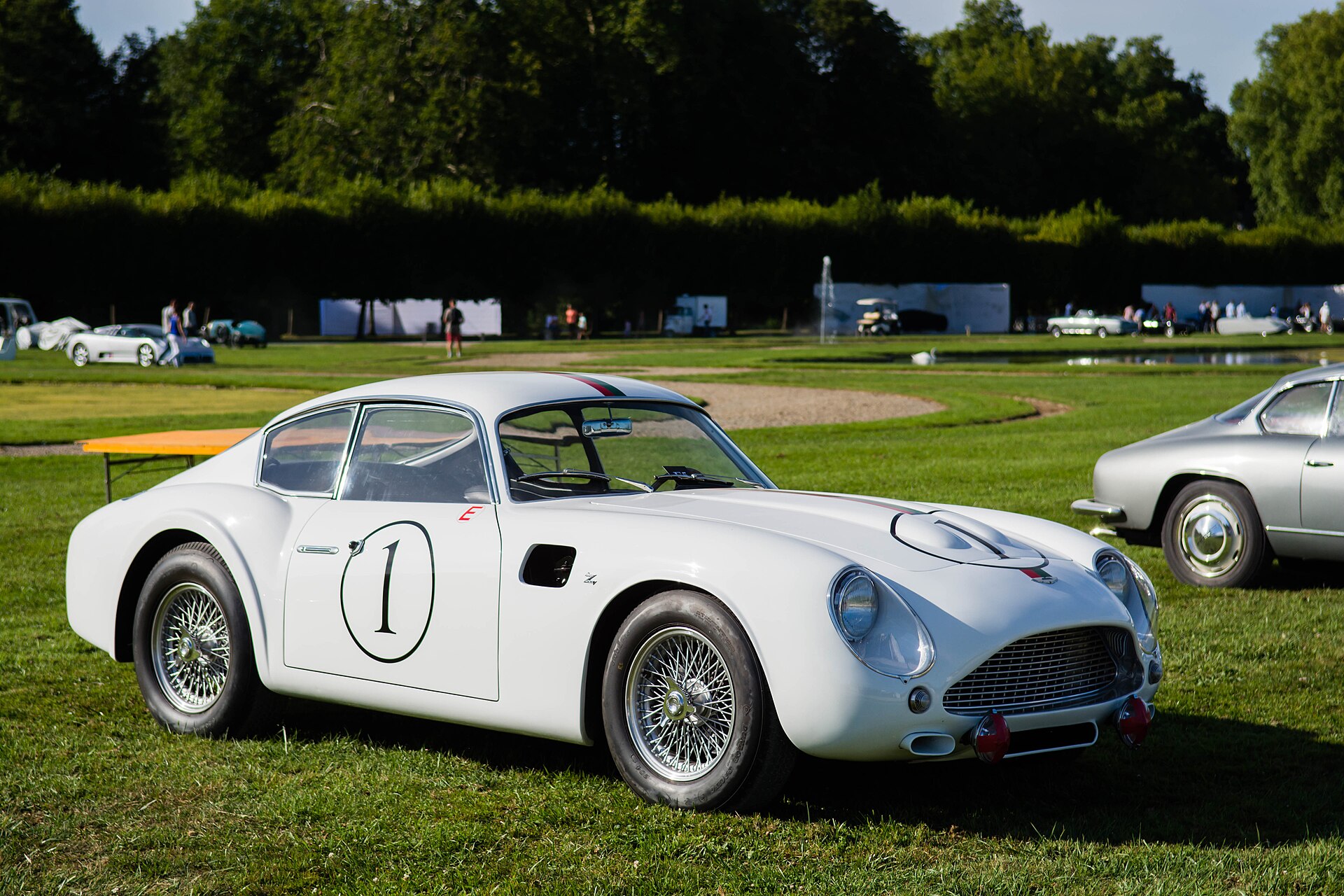
The Aston Martin DB4 GT Zagato is the lightweight, Italian-bodied version of the DB4 GT that Aston Martin built from 1960 to 1963 for road and GT racing. Designed by Ercole Spada at Zagato in Italy and launched at the London Motor Show in October 1960, it combined Aston Martin's twin-plug 3.7-litre straight-six with a lighter body and a more powerful engine. Only 19 original cars were made. Its story continues through approved "Sanction" cars and a continuation series.
In short
- Launched at the London Motor Show in October 1960; produced from 1960 to 1963; 19 original cars, fewer than the 25 planned.
- Body by Zagato, designed by Ercole Spada; about 68 kg lighter than the DB4 GT.
- 3,670 cc twin-plug straight-six with three Weber carburettors: 234 kW (318 PS) at 6,000 rpm and 377 Nm at 5,400 rpm.
- Raced at Le Mans in 1961 and 1962; later Sanction II (1991), Sanction III (2000) and a continuation series of 19 cars from 2019.
Aston Martin DB4 GT Zagato at a glance
| Specification | Aston Martin DB4 GT Zagato |
|---|---|
| Production | 1960–1963 |
| Cars built | 19 originals (plus 4 Sanction II and 2 Sanction III) |
| Designer | Ercole Spada, Zagato |
| Body | two-seat coupé, light alloy panels |
| Engine | 3,670 cc DOHC straight-six, two spark plugs per cylinder |
| Power | 234 kW (318 PS) at 6,000 rpm |
| Torque | 377 Nm at 5,400 rpm |
| Gearbox | David Brown four-speed manual |
| Weight | 1,225–1,250 kg (Wikipedia figures differ) |
| Top speed | about 248 km/h |
| Successor | Aston Martin V8 Zagato |
The Zagato is the rarest member of the DB4 family. All Aston Martin models are listed in the Aston Martin catalogue.
History: from the DB4 GT to the Zagato
The base of the car was the DB4 GT, introduced in September 1959. It was a shorter, lighter and more powerful version of the DB4 coupé, with a twin-plug engine, two distributors and three twin-choke Weber carburettors. It produced 225 kW and reached 246 km/h. Aston Martin built 75 DB4 GTs with the standard body.
For an even lighter racing version, the DB4 GT was sent to Zagato in Italy, which lightened and improved it; the cars were made by modifying DB4 GTs at the Zagato works. The new car was shown at the London Motor Show in October 1960, only about a year after the DB4 GT itself.
Aston Martin planned to build 25 cars. Demand was weaker than expected, however, and production stopped at 19 originals. The chassis numbers are 0176 to 0191, 0193, 0199 and 0200. Four of them - 0182, 0183, 0191 and 0193 - were built to a lightened racing specification known as DP207/209.
Design and construction
The body was designed by Ercole Spada of Zagato. Compared with the DB4 GT, the Zagato has plain oval grilles, Borrani wire wheels and a smoothed rear end without the small tail fins of the standard GT.
To save weight, Zagato replaced many steel parts with aluminium and used Perspex in some places. Parts that were not needed for racing, such as the bumpers, were left off. In total the car was about 68 kg lighter than the DB4 GT. Wikipedia gives a weight of 1,225 kg in its infobox and 1,250 kg in its data table.
| Dimension | DB4 GT Zagato |
|---|---|
| Length | 4,267 mm |
| Width | 1,557 mm |
| Height | 1,270 mm |
| Wheelbase | 2,362 mm |
| Weight | 1,225–1,250 kg |

Engine and running gear
The engine is Aston Martin's all-alloy 3,670 cc straight-six with two overhead camshafts. As in the DB4 GT, it has two spark plugs per cylinder, but the compression ratio was raised to 9.7:1. Three Weber 45 DCOE4 carburettors feed the engine. It produces 234 kW (318 PS) at 6,000 rpm and 377 Nm at 5,400 rpm, more than the 225 kW of the DB4 GT.
Power goes through a four-speed all-synchromesh David Brown gearbox to a hypoid bevel final drive with a ratio of 3.31:1 and a Powr-Lok limited-slip differential. The car has Girling disc brakes on all four wheels, without a servo but with separate master cylinders. Wikipedia gives a top speed of about 248 km/h.
| Figure | DB4 GT | DB4 GT Zagato |
|---|---|---|
| Engine | 3.7-litre twin-plug six | 3.7-litre twin-plug six |
| Compression | 9.0:1 | 9.7:1 |
| Power | 225 kW | 234 kW (318 PS) |
| Top speed | 246 km/h | about 248 km/h |
| Cars built | 75 | 19 |
Racing: 1 VEV and 2 VEV
The best-known Zagatos are the two cars registered 1 VEV (chassis 0182) and 2 VEV (chassis 0183). They were run by John Ogier's Essex Racing Stable with support from the factory.
The racing debut was not a win. At the Goodwood Easter meeting of 1961, Stirling Moss finished third in a Zagato, behind a DB4 GT and the winning Ferrari 250 GT. At the 1961 Le Mans 24 Hours both Essex cars retired. The first win came in July 1961, in a support race at the British Grand Prix: 2 VEV took the lead from a Jaguar E-Type on the last lap.
In 1962 2 VEV crashed and was rebuilt to the DP209 specification. After another accident in 1993, it was returned to its 1962 form. At the 1962 Le Mans race, chassis 0200 retired after nine and a half hours with a blown piston. These races, together with the Essex cars' later history, gave the model its competition record.


Chassis groups at a glance
Because so few cars exist, collectors and historians identify every DB4 GT Zagato by its chassis number. Wikipedia lists the groups as follows:
| Group | Chassis numbers | Notes |
|---|---|---|
| Original road and racing cars | 0176–0191, 0193, 0199, 0200 | 19 cars, 1960–1963 |
| Lightened racing specification (DP207/209) | 0182, 0183, 0191, 0193 | includes 1 VEV and 2 VEV |
| Sanction II | 0192, 0196, 0197, 0198 | completed in 1991 |
| Sanction III | built on DB4/344/R and DB4/424/R | completed in 2000 |
The DB4 GT also received one other Italian body in the same years: a single car styled by Bertone, known as the Bertone Jet.
Sanction II and Sanction III
The four unused chassis numbers - 0192, 0196, 0197 and 0198 - led to a second life for the model. Between 1988 and 1991 four "Sanction II" cars were built as works-approved replicas, with the agreement of Aston Martin. The chassis were delivered between January and April 1989, and all four cars were completed in July 1991. They had an engine enlarged to 4,212 cc with 262 kW (357 PS) at 6,000 rpm, and 15-inch wheels instead of the original 16-inch ones.
In 1992 Richard Williams asked Walter Hayes, then executive chairman of Aston Martin Lagonda, for approval of two more cars. These "Sanction III" cars were built from spare Zagato body shells and two neglected DB4s, DB4/344/R and DB4/424/R, and were finished in 2000.
Continuation series and the DBZ Centenary Collection
In April 2019 Aston Martin Works began to build 19 new DB4 GT Zagatos. They were sold only as part of the "DBZ Centenary Collection", a pair of cars that also included a modern Aston Martin DBS GT Zagato. The continuation cars use a 4.7-litre engine with about 298 kW. The number 19 matches the original production run.
This followed an earlier Aston Martin Works project: in 2016 the company announced 25 track-only DB4 GT continuation cars based on the 1959 lightweight specification, built at Newport Pagnell.
Legacy and collectors
The DB4 GT Zagato is the first chapter of the long cooperation between Aston Martin and Zagato. Its successor in that line was the Aston Martin V8 Zagato, and the collaboration continued with models such as the DBS GT Zagato of the 2019 DBZ Centenary Collection. The car's rarity, its Italian body and its racing history explain why originals now change hands for very high sums. For collectors, the most important questions are the chassis number and whether a car is one of the 19 originals, a Sanction II or III car, or a modern continuation car. The background of the company is told in our history of Aston Martin.
Photo gallery

Aston Martin DB4 GT Zagato in our rankings
- No. 44 of 94 · Most powerful cars of the 1960s (234 kW · top 47%)
- No. 404 of 859 · Most powerful cars (234 kW · top 48%)
- No. 69 of 109 · Most powerful British cars (234 kW · top 64%)
- No. 218 of 313 · Most powerful coupes (234 kW · top 70%)
- No. 763 of 912 · Longest-running car nameplates (3 years · top 89%)
More powerful than 53% of ranked cars of the 1960s in the 1CARS catalog (No. 44 of 94).
FAQ
How many Aston Martin DB4 GT Zagatos were built?
19 originals between 1960 and 1963. Four Sanction II cars (1991), two Sanction III cars (2000) and 19 continuation cars (from 2019) were built later.
Who designed the DB4 GT Zagato?
Ercole Spada at Carrozzeria Zagato in Italy.
How powerful is the DB4 GT Zagato?
The twin-plug 3.7-litre straight-six produces 234 kW (318 PS) at 6,000 rpm and 377 Nm at 5,400 rpm.
What are 1 VEV and 2 VEV?
They are the registrations of chassis 0182 and 0183, the two Zagatos raced by the Essex Racing Stable, including at Le Mans in 1961.
What is a Sanction II DB4 GT Zagato?
One of four cars built between 1988 and 1991 on unused original chassis numbers, with Aston Martin's approval. They have a 4.2-litre engine with 262 kW (357 PS) and 15-inch wheels, and they are counted separately from the 19 originals.
Data sources
Data checked by an editor against the sources below.