 Ferrari Dino 206 GT and 246 GT
All generations, specs and history
Published Sources (1) Report an error
By Felix Hartmann, Automotive Technology & EV Contributor
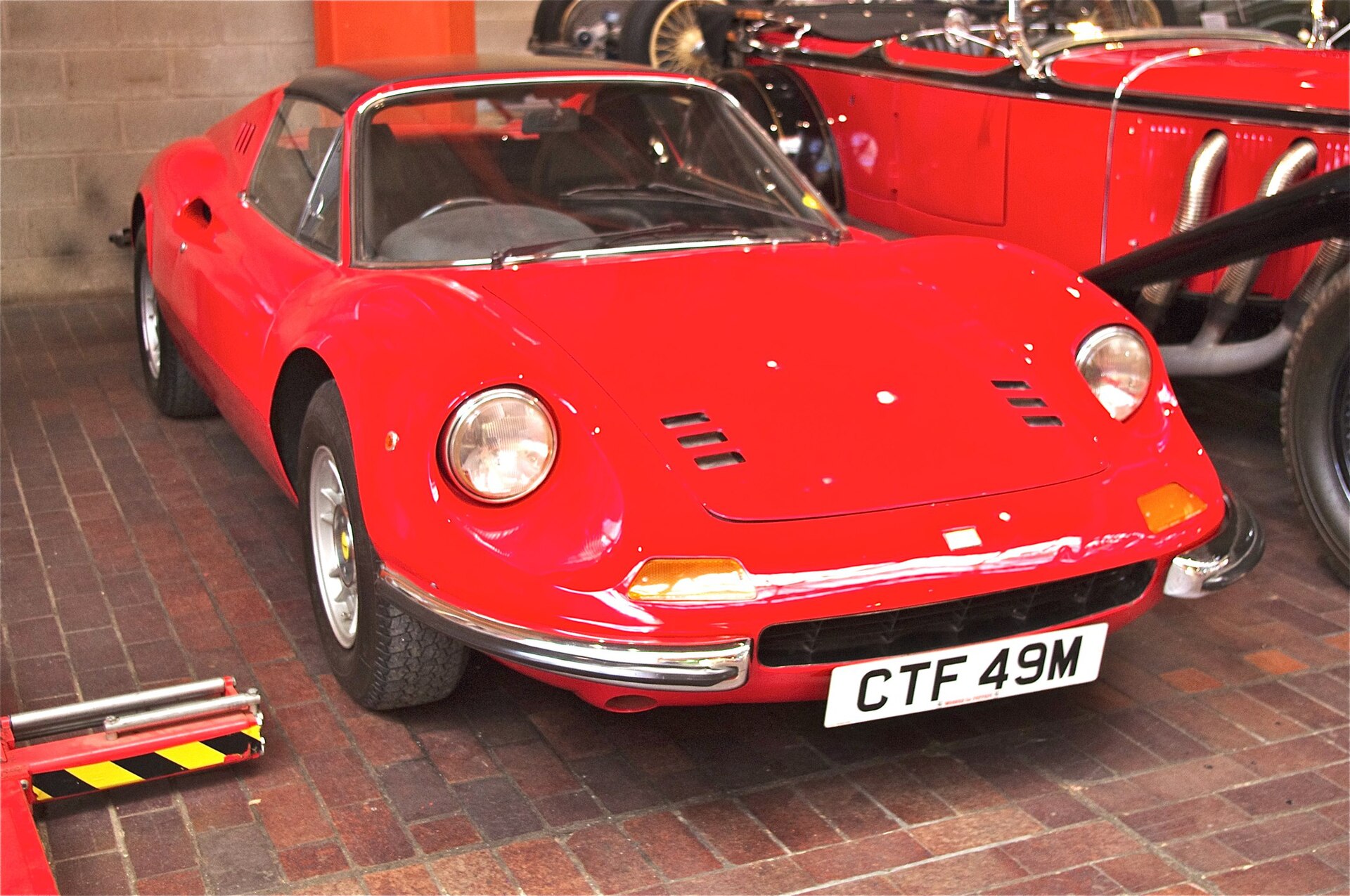
- Built
- 1967–1974
- Generations
- 2
- Top power
- 143 kW (194 PS)
Timeline
Dino 206 GT and 246 GT generations
Click a generation for its own page
- 206 GT 1967–1969 · Coupe · 132 kW (179 PS)
- 246 GT / GTS 1969–1974 · Coupe · 130–143 kW (177–194 PS)
Newest first · 2 generations since 1967
-
1969
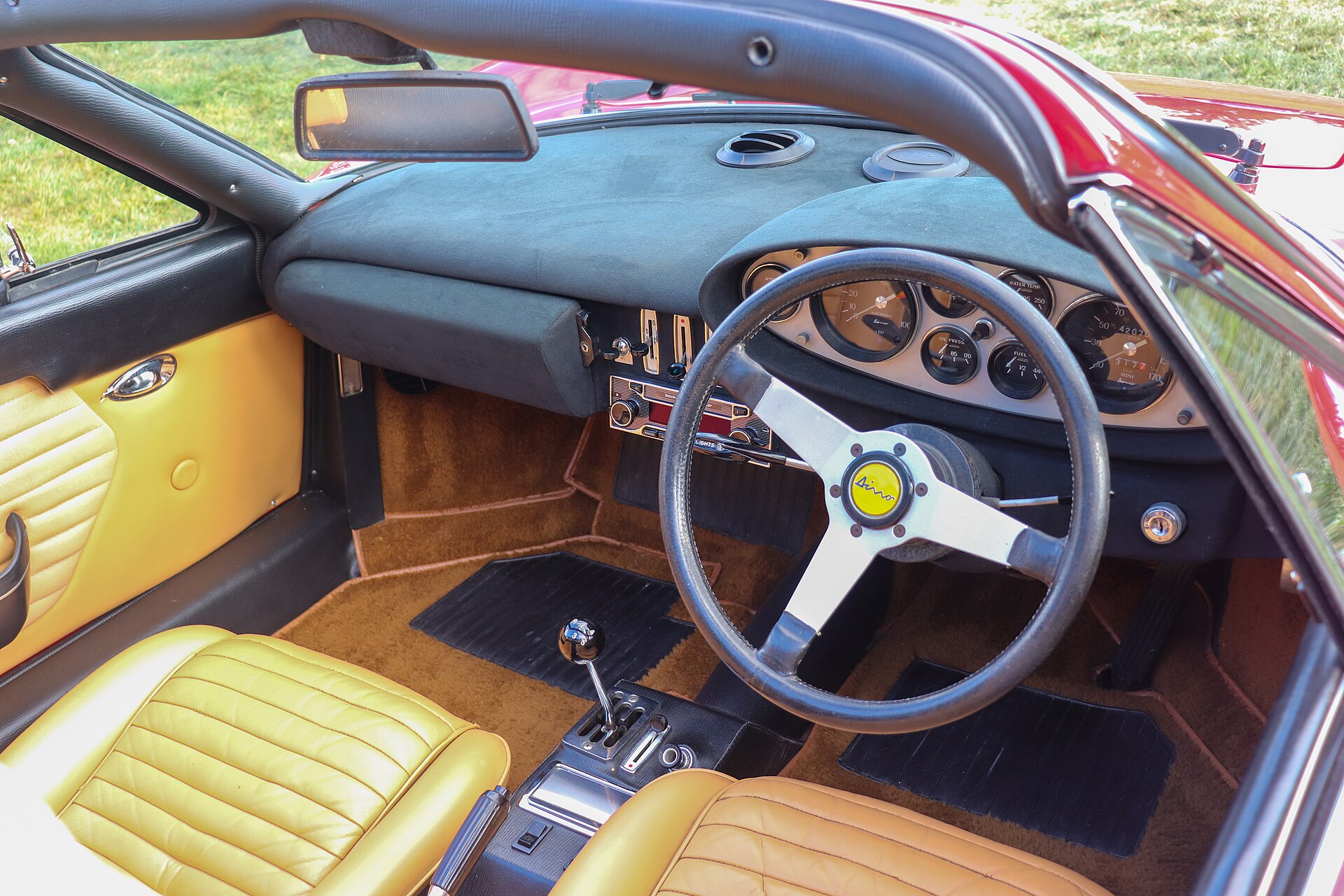
-
1967
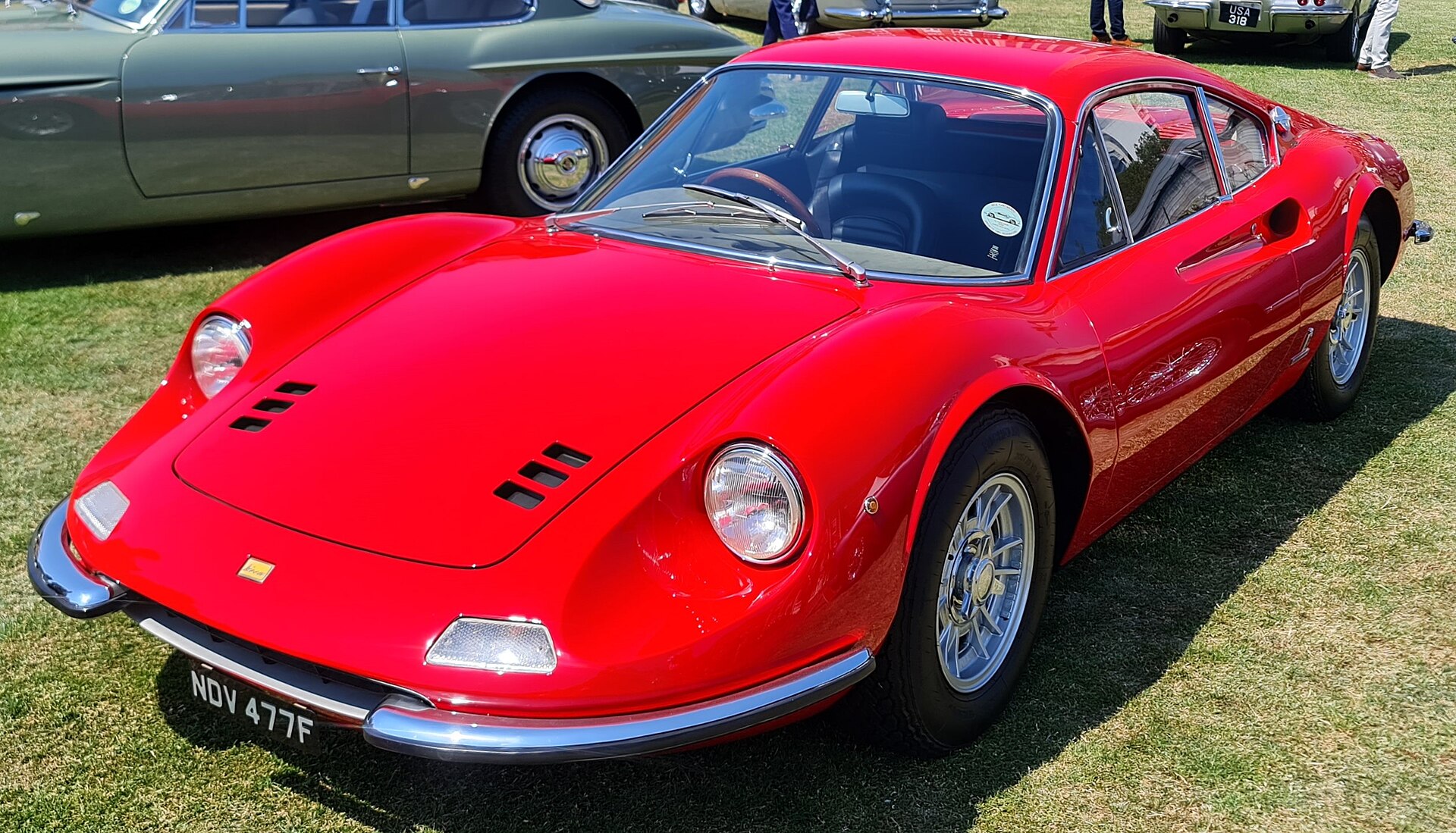


All generations by year: 246 GT / GTS (1969–1974) · 206 GT (1967–1969)
Which one is mine?
Pick the year of first registration to see which generation it is.
- 246 GT / GTS 1969–1974
- 206 GT 1967–1969
The Dino 206 GT and 246 GT are small mid-engined V6 sports cars that Ferrari built from 1967 to 1974. They were sold under a separate brand, Dino, named after Enzo Ferrari's son. Styled at Pininfarina and bodied by Scaglietti, they were Ferrari's first attempt at a smaller, more affordable road car built in larger numbers. The aluminium-bodied 2.0-litre 206 GT was made in only about 150 examples. The 2.4-litre 246 GT and the open 246 GTS that followed reached 3,569 cars.
In short
- Built from 1967 to 1974 under the Dino brand; designed by Aldo Brovarone and Leonardo Fioravanti at Pininfarina, bodies by Scaglietti.
- Transverse mid-mounted 65° V6 developed with Fiat: 1,987 cc with 132 kW (180 PS) in the 206 GT, 2,419 cc with 143 kW (195 PS) in the 246 GT.
- 206 GT: aluminium body, about 150 cars (Wikipedia: 152), all left-hand drive.
- 246 GT and GTS: steel body, longer wheelbase, 2,295 coupés and 1,274 GTS targas; claimed top speed 235 km/h.
Dino 206 GT and 246 GT at a glance
| Specification | Dino 206 GT | Dino 246 GT / GTS |
|---|---|---|
| Production | 1967–1969 | 1969–1974 (GTS from 1972) |
| Cars built | about 150 (152 per Wikipedia) | 3,569 (2,295 GT, 1,274 GTS) |
| Body | aluminium berlinetta | steel berlinetta or targa (GTS) |
| Engine | 1,987 cc 65° V6, DOHC | 2,419 cc 65° V6, DOHC, iron block |
| Power | 132 kW (180 PS) at 8,000 rpm | 143 kW (195 PS) at 7,600 rpm |
| Torque | 187 Nm at 6,500 rpm | 226 Nm at 5,500 rpm |
| Gearbox | five-speed manual | five-speed manual |
| Wheelbase | 2,280–2,290 mm | 2,340 mm |
| Weight | - | 1,080 kg (GT), 1,100 kg (GTS) |
| Successor | 246 GT | Dino 308 GT4 and Ferrari 308 GTB/GTS |
All Ferrari and Dino models are listed in the Ferrari catalogue.
Origins: the Dino name and the prototypes
The name honours Alfredo "Dino" Ferrari, Enzo Ferrari's son, who died in 1956 while working on a V-engine project. From the late 1950s it was used for Ferrari's V-engined Formula One and sports racing cars. The 1965 166 P was the first model to carry a Dino badge on its nose instead of the prancing horse: a yellow rectangle with a blue script signature.
There were also commercial reasons for the road car. Ferrari needed more sales and lower production costs, and a smaller car that could be built on an assembly line would be the company's first. Racing rules helped to shape the plan: from 1967, Formula 2 engines had to be based on a production engine built in at least 500 units a year. Ferrari could not build that many on its own, so it turned to Fiat. Fiat produced the V6 both for its own front-engined Fiat Dino coupé and spider and for Ferrari's mid-engined car.
Pininfarina showed the first design study, the Dino 206 GT Speciale, at the 1965 Paris motor show, with a mid-mounted engine and headlights under a full-width clear cover. A second prototype at the 1966 Turin show had an elliptical grille, headlights in the wings and a higher roof. On a third prototype in 1967 the V6 was turned 90 degrees to sit across the car, with the gearbox below and behind it. The car shown at the Turin show in November 1967 was almost identical to the production model.

Dino 206 GT (1967–1969)
Production of the 206 GT ran from 1968 into 1969. Ferrari says about 150 were built over nine months; Wikipedia gives 152. All were left-hand drive. Compared with the show cars, production cars lost the clear headlight covers and gained quarter lights in the door windows. The 206 GT can be recognised by its exposed chrome fuel filler cap on the left rear pillar. The chassis numbers used a new, even-numbered sequence for the Dino brand, and the factory type reference was 607.
The body was made entirely of aluminium, unusual for Ferrari at the time. It had a Kamm tail with two round tail lights on each side and an oval instrument panel with black-faced dials, features also seen on the 365 GTB/4 Daytona.
The engine, type 135B, is a 65° V6 with chain-driven twin overhead camshafts per bank, an aluminium-alloy block with cast-iron liners and a displacement of 1,987 cc (bore 86 mm, stroke 57 mm). Three twin-choke Weber carburettors sit in the vee. It produced 132 kW (180 PS) at 8,000 rpm and 187 Nm at 6,500 rpm. The Dinoplex electronic ignition developed by Magneti Marelli was Ferrari's first electronic ignition, and the 206 GT was also the first Ferrari with rack-and-pinion steering.
Wikipedia notes that the engine was the same as in the Fiat Dino, for which Fiat quoted a lower output. 150 engines from the first 1968 batch went into 206 GTs. The road-going version of the racing V6 had been adapted by Aurelio Lampredi at Fiat.

Dino 246 GT and GTS (1969–1974)
In 1969 the 2.0-litre engine was replaced by a 2.4-litre unit, and the car became the 246 GT. To reduce cost, the body was now made mostly of steel, and the larger engine had a cast-iron block with alloy heads. The wheelbase grew to 2,340 mm - Ferrari says by 60 mm, Wikipedia by 53 mm - with a longer engine cover and a repositioned fuel filler under a flap. The interior was revised, and the engine lid had 14 vents instead of 12.
The 2,419 cc V6 has a 9.0:1 compression ratio, two valves per cylinder and three Weber 40 DCNF carburettors. It produces 143 kW (195 PS) at 7,600 rpm and 226 Nm at 5,500 rpm. US cars, with an air pump and different timing, were rated at 130 kW (175 hp). The coupé weighs 1,080 kg.
The targa-topped 246 GTS appeared in 1972 and weighs 1,100 kg. US-market cars had side marker lights, and buyers could order flared wheel arches, Daytona-style seats and wide Campagnolo alloy wheels.
| Figure | Dino 246 GT |
|---|---|
| Top speed | 235 km/h claimed; 238 km/h measured by Motor (July 1971) |
| Kerb weight | 1,080 kg (GT), 1,100 kg (GTS) |
| Wheelbase | 2,340 mm |
| Height | 1,120 mm |


Three series of the 246
| Series | Built | Main features |
|---|---|---|
| Series I ("L") | 357 cars, until summer 1970 | centre-lock wheels and opposed "clapping hands" wipers, as on the 206 |
| Series II ("M") | 507 cars, until July 1971 | five-bolt Cromodora alloy wheels, parallel wipers |
| Series III ("E") | 1,431 GT and 1,274 GTS, 1972–1974 | minor changes to gearing and fuel supply; US sales began with this series |
In total Ferrari built 3,569 Dino 246s: 2,295 GT coupés and 1,274 GTS targas. Ferrari notes that demand was still high when production ended in 1973–74.
Chassis and engineering
The chassis is built from longitudinal main tubes with cross bracing and subframes. Suspension is independent all round with wishbones, coil springs, hydraulic dampers and anti-roll bars at the front and rear, and the car has servo-assisted ventilated disc brakes on all four wheels. The five-speed all-synchromesh gearbox was designed and built by Ferrari and sits in unit with the engine, below and behind it.
The 2.4-litre V6 had a long career outside the Dino. It was used in the Fiat Dino 2400 and in the Lancia Stratos rally car.
Legacy and collectors
The Dino was Ferrari's first car built in larger numbers, and it changed how the company approached smaller sports cars. Its successors were the Bertone-styled 2+2 Dino 308 GT4 and the two-seat Ferrari 308 GTB/GTS, which moved from a V6 to a V8. In 2004 Sports Car International placed the Dino sixth among the top sports cars of the 1970s, and Motor Trend Classic ranked it seventh in its list of the ten greatest Ferraris.
The 1975 Cannonball Baker Sea-to-Shining-Sea Memorial Trophy Dash across the United States was won by a Dino 246 GTS. Ferrari's sales brochure called the car "Tiny, brilliant, safe… almost a Ferrari", and Ferrari itself notes that purists first doubted it was a "real" Ferrari until they saw and drove it. Talk of reviving the name has continued since; see our article on plans to revive the Dino name. The wider story is in our history of Ferrari.
For collectors the main groups are clear. The aluminium 206 GT is the rarest. The early Series I and II 246 cars have their own wheels and wipers, and the more common Series III includes all GTS targas.
Photo gallery


Ferrari Dino 206 GT and 246 GT: first vs latest generation
| Spec | 206 GT | 246 GT / GTS | Change |
|---|---|---|---|
| Years | 1967–1969 | 1969–1974 | 2 years apart |
| Most powerful version | 132 kW (179 PS) | 143 kW (194 PS) | +11 kW (+8%) |
Oldest and newest generation in the 1cars catalog. Power is the strongest version of each; other rows are shown only when both generations have the figure.
Ferrari Dino 206 GT and 246 GT in our rankings
- No. 487 of 912 · Longest-running car nameplates (7 years · top 60%)
- No. 65 of 94 · Most powerful cars of the 1960s (132 kW · top 70%)
- No. 595 of 859 · Most powerful cars (143 kW · top 70%)
- No. 108 of 127 · Most powerful Italian cars (143 kW · top 86%)
- No. 278 of 313 · Most powerful coupes (143 kW · top 89%)
- No. 245 of 345 · Cars with the most generations (2 generations)
In production longer than 40% of ranked nameplates in the 1CARS catalog (No. 487 of 912).
FAQ
Is the Dino a Ferrari?
Yes. It was designed, developed and built by Ferrari, but sold under the separate Dino brand, named after Enzo Ferrari's son Alfredo "Dino" Ferrari, without the prancing horse badge.
What is the difference between the Dino 206 GT and 246 GT?
The 206 GT has a 2.0-litre V6 with 132 kW (180 PS), an aluminium body and a shorter wheelbase. The 246 GT has a 2.4-litre V6 with 143 kW (195 PS), a mostly steel body and a longer wheelbase.
How many Dino 246s were built?
3,569: 2,295 GT coupés and 1,274 GTS targas, built in three series between 1969 and 1974.
Who built the Dino engine?
The V6 was produced by Fiat, which also used it in the Fiat Dino, and adapted by Ferrari for transverse mounting behind the cabin.
Data sources
Data checked by an editor against the sources below.