 Ferrari Daytona
Specs, engines and history
Published Sources (1) Report an error
By Felix Hartmann, Automotive Technology & EV Contributor
- Built
- 1968–1973
- Top power
- 259 kW (352 PS)
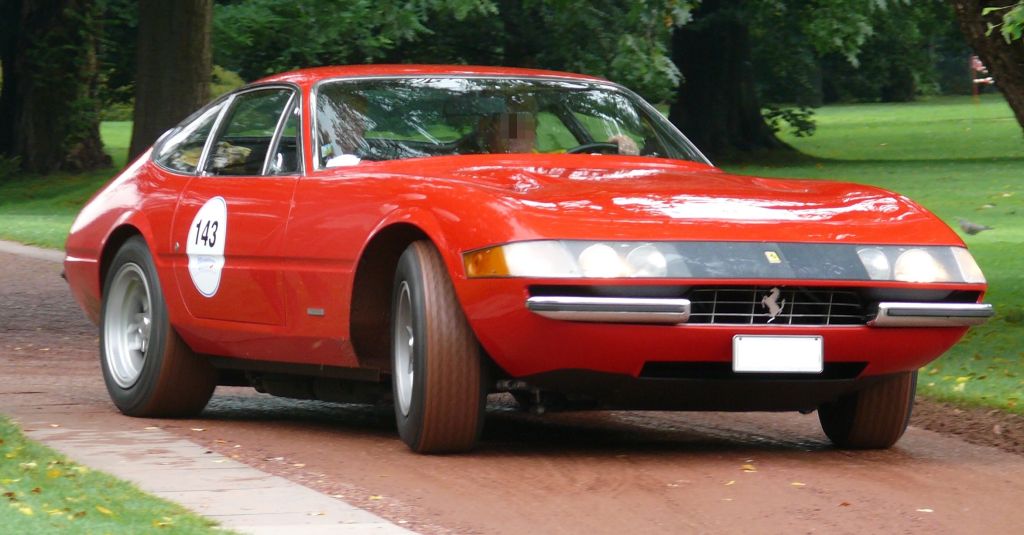
The Ferrari 365 GTB/4 is the front-engined V12 berlinetta that Ferrari built from 1968 to 1973, known everywhere by its unofficial name, "Daytona". It replaced the 275 GTB/4 at the top of the Ferrari road-car range, introduced a sharp new shape by Leonardo Fioravanti of Pininfarina and was the last front-engined twelve-cylinder Ferrari flagship before the mid-engined Berlinetta Boxer took over. About 1,406 were built, including the open 365 GTS/4.
In short
- Unveiled at the Paris motor show in 1968; berlinetta built 1968–1973, Spider (365 GTS/4) 1971–1973, bodies by Scaglietti and assembly in Maranello.
- Tipo 251 Colombo V12, 4,390 cc, six Weber carburettors: 259 kW (352 PS) at 7,500 rpm and 431 Nm at 5,500 rpm.
- Five-speed manual transaxle at the rear, independent suspension all round, dry weight 1,200 kg, top speed 280 km/h.
- Raced by private teams: fifth overall at Le Mans in 1971 and GT class wins at Le Mans in 1972, 1973 and 1974.
Daytona at a glance
| Specification | Ferrari 365 GTB/4 "Daytona" |
|---|---|
| Production | 1968–1973 (GTS/4 Spider 1971–1973), Maranello (Italy) |
| Cars built | about 1,406 in total: 1,284 berlinettas and 122 Spiders |
| Body | two-seat berlinetta or spider, body by Scaglietti |
| Engine | Tipo 251 Colombo V12, 60°, four overhead camshafts, 4,390 cc |
| Power | 259 kW (352 PS) at 7,500 rpm |
| Torque | 431 Nm at 5,500 rpm |
| Gearbox | five-speed manual, rear transaxle |
| Dry weight | 1,200 kg (berlinetta) |
| Dimensions | 4,425 mm long, 1,760 mm wide, 1,245 mm high, 2,400 mm wheelbase |
| Predecessor / successor | 275 GTB/4 / 365 GT4 Berlinetta Boxer |
The Daytona is part of the classic range in the Ferrari catalogue. Its modern descendants - front-engined V12 grand tourers such as the Ferrari 812 - follow the same basic formula of a large V12 in the nose and two seats.
History and the Daytona name
For its new flagship of the late 1960s Ferrari stayed with a front-mounted V12 and a rear gearbox, and developed the new car directly from the 275 GTB/4. The engine capacity grew by more than a litre, while the four-camshaft layout, the dry-sump lubrication and the transaxle were kept.
The new car was unveiled at the Paris motor show in 1968 as the 365 GTB/4. Following Ferrari's naming system of the time, "365" is the capacity of one cylinder in cubic centimetres, "GTB" stands for Gran Turismo Berlinetta and "4" refers to the four overhead camshafts.
The name "Daytona" was never official. It was applied by the press in memory of Ferrari's one-two-three finish at the 24 Hours of Daytona in February 1967, when a 330 P3/4, a 330 P4 and a 412 P crossed the line together. Ferrari itself has rarely used the name, but it stuck so firmly that the car is better known by it than by its type number.
Design by Fioravanti and Scaglietti
The body was designed at Pininfarina by Leonardo Fioravanti, who had earlier worked on the styling of the Dino. The Daytona marked a clear break from the rounded, curvy Ferraris of the early 1960s: it has a long, flat bonnet, a short tail cut off sharply at the rear, and a strong line running along the flanks. RM Sotheby's describes it as a remarkable departure from the soft, undulating lines of earlier Ferraris.
Apart from the first prototype built by Pininfarina, every body was built by the coachbuilder Scaglietti.
The front end changed during production. Early cars had fixed headlights behind a transparent acrylic cover that ran across the full width of the nose. A new rule in the United States banned covered headlights, so from 1971 the Daytona received pop-up headlights, which became the standard for all markets.

The Colombo V12 and performance
The engine is the Tipo 251, a member of the V12 family designed by Gioacchino Colombo. It is a 60° V12 with two overhead camshafts per bank, two valves per cylinder and dry-sump lubrication. Bore and stroke are 81 × 71 mm, giving 4,390 cc. Six twin-choke Weber 40 DCN/20 carburettors feed the engine, and the compression ratio is 9.3:1 (8.8:1 on the US version, which also had a different exhaust).
| Version | Power | Torque | Notes |
|---|---|---|---|
| 365 GTB/4 and GTS/4 (road) | 259 kW (352 PS) at 7,500 rpm | 431 Nm at 5,500 rpm | US engine with 8.8:1 compression |
| Competition, first batch (1970–71) | as road car | as road car | lightened body |
| Competition, 1972 batch | about 298 kW (406 PS) | not published | five cars |
| Competition, 1973 batch | about 336 kW (456 PS) | not published | five cars |
The gearbox is a five-speed manual mounted at the rear in unit with the differential. This transaxle layout, inherited from the 275, moves weight backwards and improves the balance of a car with a heavy V12 in front. Suspension is independent at all four wheels, with wishbones and coil springs.
The Daytona's top speed is given as 280 km/h, a very high figure for a road car at the end of the 1960s. Its endurance was shown in 1971, when racing driver Dan Gurney and journalist Brock Yates drove a Daytona in the unofficial Cannonball Baker run from New York to Los Angeles: 4,628 km in 35 hours 54 minutes, an average of 129 km/h.


The 365 GTS/4 Spider
In 1971 Ferrari added an open version, the 365 GTS/4, which replaced the 365 GTS. It has the same engine, gearbox and chassis as the berlinetta. Only 122 were built, seven of them with right-hand drive, which makes the original Spider much rarer than the coupé.
For right-hand-drive coupés the figures differ slightly by source: Wikipedia counts 156 cars for the United Kingdom, while RM Sotheby's describes one of "only 158" right-hand-drive Daytonas.

Daytona in racing
The Daytona was not designed as a racing car, but private teams soon took it to the track. The first competition car was an aluminium-bodied example entered at Le Mans in 1969, which crashed in practice. From 1970 Ferrari built 15 official competition cars in three batches of five (1970–71, 1972 and 1973), with aluminium and glass-fibre panels and plexiglass windows. The first batch kept the road engine; the 1972 cars had about 298 kW (406 PS) and the 1973 cars about 336 kW (456 PS). They were run by private entrants, not by the factory team.
The results were strong for a front-engined grand tourer. A Daytona finished fifth overall at Le Mans in 1971, and the model won the GT class there in 1972, 1973 and 1974. In 1972, 365 GTB/4s took the first five places in the GT class. At the 24 Hours of Daytona in 1979 - more than five years after production ended - a 1973 car won its class and finished second overall.
Legacy
The Daytona was replaced in 1973 by the 365 GT4 Berlinetta Boxer, a mid-engined car. It was more than two decades before Ferrari returned to a front-engined V12 flagship, with the 550 Maranello of 1996.
The car's standing has only grown since then. In 2004 Sports Car International named it the top sports car of the 1970s, and Motor Trend Classic placed it second in a list of the greatest Ferraris of all time. It appeared in films such as A Star Is Born and The Gumball Rally (both 1976). A Daytona was on the cover of the Carpenters' 1973 album Now & Then. The television series Miami Vice used replicas built on Chevrolet Corvette C3 underpinnings; Ferrari sued the maker of the replica kits, and in the third season the fake Daytona was replaced by a Testarossa.
There were also one-off bodies. The best known is a shooting brake built by Panther Westwinds in Surrey, England, to the order of Chinetti-Garthwaite on chassis 15275, the 805th GTB/4. It was offered at auction at Pebble Beach in 2016 but did not sell. In 2024 Ferrari presented the 12Cilindri, whose black band across the nose was designed as a tribute to the 365 GTB/4. For more on the company's history, read our history of Ferrari.
Photo gallery

Ferrari Daytona in our rankings
- No. 346 of 859 · Most powerful cars (259 kW · top 41%)
- No. 66 of 127 · Most powerful Italian cars (259 kW · top 52%)
- No. 188 of 313 · Most powerful coupes (259 kW · top 61%)
- No. 637 of 912 · Longest-running car nameplates (5 years · top 77%)
More powerful than 59% of ranked cars in the 1CARS catalog (No. 346 of 859).
FAQ
Why is the Ferrari 365 GTB/4 called Daytona?
The name is unofficial. The press gave it to the car in memory of Ferrari's one-two-three finish at the 24 Hours of Daytona in February 1967.
How many Ferrari Daytonas were built?
About 1,406 in total: 1,284 berlinettas and 122 factory Spiders (365 GTS/4), plus 15 official competition cars that are counted in the total.
What engine does the Daytona have?
A 4,390 cc Colombo V12 with four overhead camshafts and six Weber carburettors, producing 259 kW (352 PS) at 7,500 rpm and 431 Nm at 5,500 rpm.
How fast is the Ferrari Daytona?
Its top speed is given as 280 km/h.
Did the Daytona race?
Yes, with private teams. It finished fifth overall at Le Mans in 1971 and won the GT class there in 1972, 1973 and 1974.
Data sources
Data checked by an editor against the sources below.