 Ferrari 360
Specs, engines and history
Published Sources (1) Report an error
By Felix Hartmann, Automotive Technology & EV Contributor
- Built
- 1999–2005
- Top power
- 313 kW (426 PS)
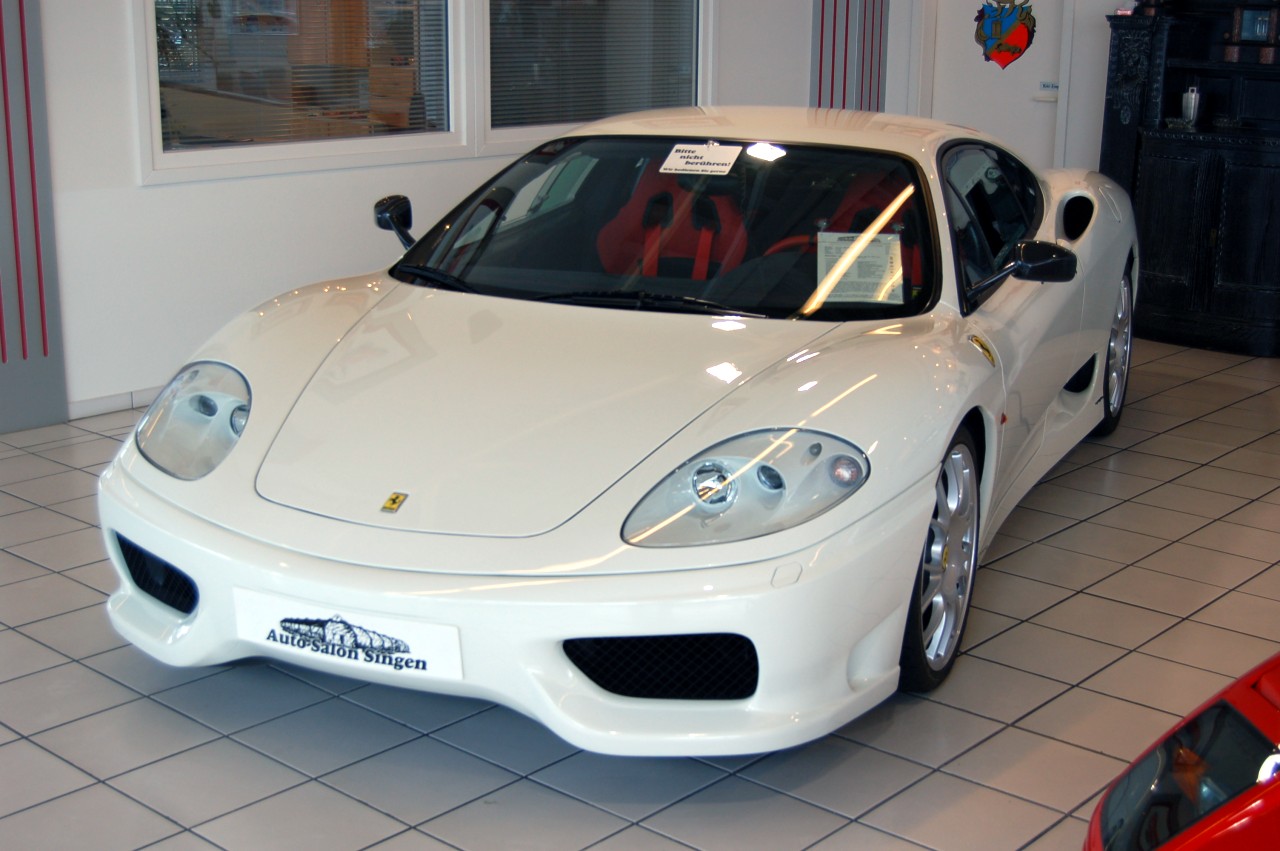
The Ferrari 360 is the mid-engined V8 berlinetta that Ferrari built from 1999 to 2005, first as the 360 Modena coupé and then as the 360 Spider and the lightweight Challenge Stradale. It replaced the F355 and was the first Ferrari road car built around an all-aluminium spaceframe. More than 17,000 road cars were made, and it was also the base of a busy one-make racing series.
In short
- Built 1999–2005 in Maranello; Wikipedia gives 8,800 Modena coupés, 7,565 Spiders and 1,288 Challenge Stradale.
- 3,586 cc naturally aspirated V8 (F131) with five valves per cylinder: 294 kW (400 PS) at 8,500 rpm; Challenge Stradale 313 kW (425 PS).
- Aluminium spaceframe developed with Alcoa: 40 per cent stiffer and 28 per cent lighter than the steel frame of the F355.
- Ferrari quoted 0–100 km/h in 4.5 s and a top speed of 295 km/h for the Modena.
Ferrari 360 at a glance
| Specification | Ferrari 360 Modena |
|---|---|
| Production | 1999–2005, Maranello (Italy) |
| Cars built | 8,800 Modena, 7,565 Spider, 1,288 Challenge Stradale |
| Body | two-seat berlinetta; Spider from 2000 |
| Chassis | aluminium spaceframe with aluminium body |
| Engine | F131 3,586 cc 90° V8, five valves per cylinder, mid-mounted |
| Power | 294 kW (400 PS) at 8,500 rpm |
| Torque | 373 Nm at 4,750 rpm |
| Gearbox | six-speed manual or six-speed F1 automated manual |
| Weight | 1,493–1,553 kg (sources differ) |
| Predecessor / successor | F355 / F430 |
The 360 sits in the line of Ferrari's V8 mid-engined cars between the F355 and the Ferrari F430, which in turn led to the Ferrari 458 Italia. All models are listed in the Ferrari catalogue.
Development and the aluminium chassis
By the late 1990s the F355 was a success, but its steel-based chassis limited how much weight Ferrari could save in a larger, better-equipped successor. For the new car Ferrari worked with the aluminium producer Alcoa on an all-aluminium spaceframe. According to Wikipedia, the new frame was 40 per cent stiffer and 28 per cent lighter than the frame of the earlier car, even though the overall dimensions grew by about 10 per cent. Ferrari said the complete car was 60 kg lighter.
The extra size went into space for the occupants. The wheelbase was 2,600 mm and the body 4,477 mm long and 1,922 mm wide, making the 360 roomier and easier to live with than its predecessor. The weight distribution was 42 per cent front, 58 per cent rear.
The 360 Modena was launched in 1999, named after the city of Modena. It was produced alongside the Spider until the F430 replaced both.
Design by Pininfarina
The body was designed by Pininfarina under design director Lorenzo Ramaciotti. Clay models were made in 1996 and 1997, the exterior was approved in late 1997 and the design was frozen for production the following year. Wikipedia describes it as the first Ferrari fully developed with computer-aided surfacing.
The 360 broke with Ferrari tradition at the front. Instead of a single egg-crate grille it has two separate intakes at the corners, feeding low-mounted radiators. Under the car, a flat floor with twin rear diffusers generates downforce, so no rear spoiler was needed. The headlamps had clear covers - a first for a Ferrari V8 berlinetta - and the engine sits under a curved glass cover, so the V8 is on display. Large elliptical scoops behind the doors feed air to the engine.
Inside, Pininfarina and Ferrari's Centro Stile designed a cabin focused on the driver, with exposed aluminium and leather trim.

Engine and gearbox
The F131 V8 has a displacement of 3,586 cc (bore 85 mm, stroke 79 mm), a 90-degree angle between the banks and a flat-plane crankshaft. Each cylinder has five valves. Titanium connecting rods, a compression ratio of 11.2:1 and Bosch Motronic 7.3 injection help the engine rev to 8,650 rpm.
| Version | Power | Torque | 0–100 km/h | Top speed |
|---|---|---|---|---|
| 360 Modena | 294 kW (400 PS) at 8,500 rpm | 373 Nm | 4.5 s (Ferrari) | 295 km/h (Ferrari) |
| 360 Spider | 294 kW (400 PS) | 373 Nm | slightly slower than the Modena | 290 km/h (295 km/h in the specification table) |
| Challenge Stradale | 313 kW (425 PS) at 8,500 rpm | 373 Nm at 4,750 rpm | 4.1 s (Ferrari) | - |
Car magazine measured 0–100 km/h in 4.98 seconds in November 1999, slower than Ferrari's claim. Other tests recorded a top speed of 282 km/h, limited by the rev limiter.
Two gearboxes were available: a six-speed manual with the traditional open gate and the six-speed "F1" electro-hydraulic automated manual made by Graziano, operated with paddles behind the steering wheel. The F1 gearbox took most of the sales: only 469 Modena coupés and 670 Spiders were built with the manual.

The Ferrari 360 Spider
The open version was unveiled at the Geneva Motor Show in 2000. It was Ferrari's 20th road-going convertible. To keep the body stiff without a roof, Ferrari reinforced the sills, the floor and the windscreen frame, added a cross brace in front of the engine and stiffened the rear bulkhead to reduce noise in the cabin. The Spider weighs about 60 kg more than the coupé. Its fabric roof is electrically operated and was offered in black, blue, grey or beige.
The Spider kept the full 294 kW (400 PS) engine and was nearly as fast as the coupé. It sold well: 7,565 were built, almost as many as the Modena.

Challenge Stradale
The Challenge Stradale was Ferrari's road version of its one-make racing car. Ferrari said it was designed for about 20 per cent track use and 80 per cent road use. The engine was raised to 313 kW (425 PS). Carbon-ceramic Brembo brakes, taken from the Enzo, were standard and saved 16 kg. Lightweight BBS wheels, Lexan windows and other parts reduced the weight by up to 110 kg compared with the Modena; the kerb weight was 1,430 kg and the dry weight 1,180 kg.
Ferrari quoted 0–100 km/h in 4.1 seconds and a lap of its Fiorano test track 3.5 seconds faster than the Modena. 1,288 were built. It is now one of the most sought-after Ferrari V8s of its period.

Racing versions
| Version | Years | Power | Notes |
|---|---|---|---|
| 360 Challenge | - | 306 kW (416 PS) at 8,500 rpm | one-make Ferrari Challenge car, F1 gearbox only, fewer than 200 built |
| 360 N-GT | - | over 402 kW (547 PS) derestricted | prepared by Michelotto for the FIA N-GT class |
| 360 GT | 2002–2004 | 321 kW (436 PS) | 20 sold to customers |
| 360 GTC | from 2004 | up to 352 kW (479 PS) with restrictors | six-speed sequential gearbox, 1,100 kg |
The 360 Challenge had a stripped interior with a carbon racing seat, roll cage and fire suppression system. Ferrari quoted 0–100 km/h in 3.9 seconds and a limited top speed of 298 km/h.
One unusual car deserves a mention: the 360 Barchetta, a one-off based on the Spider. Gianni Agnelli commissioned it in 2000 as a wedding present for Ferrari's president Luca Cordero di Montezemolo. It has no roof or roll bars and a small visor instead of a windscreen.
Legacy
The 360 moved Ferrari's V8 cars to aluminium construction, and Ferrari's later mid-engined V8 cars kept aluminium as the main material. It was larger and more comfortable than the F355 without being heavier, and its F1 gearbox made paddle shifting the normal choice for Ferrari buyers. The F430 that replaced it in 2004–2005 kept the basic concept and added a new 4.3-litre engine. The wider story of the company is told in our history of Ferrari.
Photo gallery

Ferrari 360 in our rankings
- No. 275 of 859 · Most powerful cars (313 kW · top 33%)
- No. 57 of 127 · Most powerful Italian cars (313 kW · top 45%)
- No. 152 of 313 · Most powerful coupes (313 kW · top 49%)
- No. 563 of 912 · Longest-running car nameplates (6 years · top 69%)
More powerful than 67% of ranked cars in the 1CARS catalog (No. 275 of 859).
FAQ
How much power does the Ferrari 360 Modena have?
294 kW (400 PS) at 8,500 rpm from a 3.6-litre V8; the Challenge Stradale has 313 kW (425 PS).
How many Ferrari 360s were built?
According to Wikipedia: 8,800 Modena coupés, 7,565 Spiders and 1,288 Challenge Stradale, plus racing cars.
How fast is the Ferrari 360?
Ferrari quoted 0–100 km/h in 4.5 seconds and a top speed of 295 km/h for the Modena.
What replaced the Ferrari 360?
The F430, introduced in 2004, with a 4.3-litre V8.
Data sources
Data checked by an editor against the sources below.