 Aston Martin Valkyrie
Specs, engines and history
Published Sources (1) Report an error
By Felix Hartmann, Automotive Technology & EV Contributor
- Built
- 2021–2024
- Top power
- 865 kW (1,176 PS)
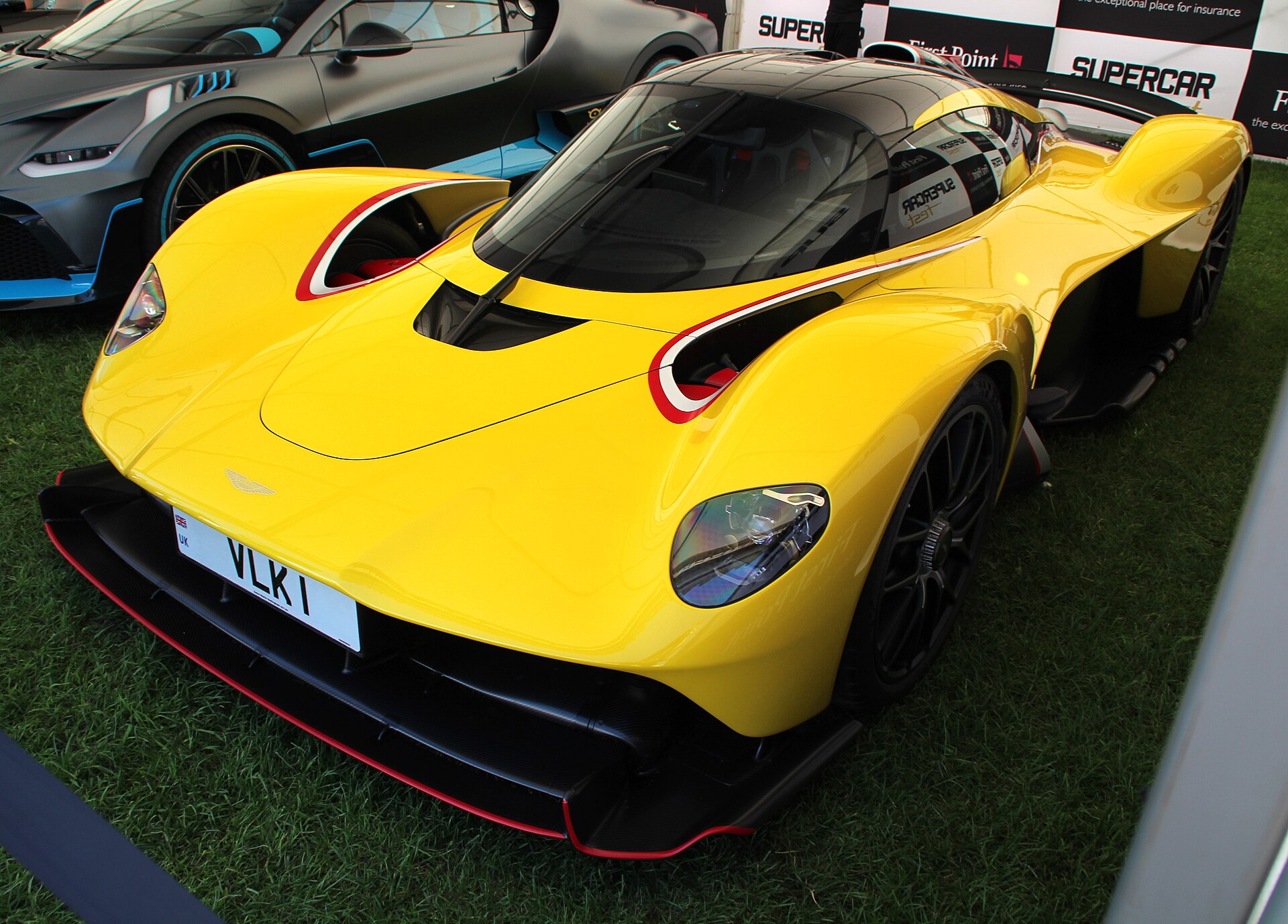
The Aston Martin Valkyrie is a mid-engined hypercar developed by Aston Martin together with Red Bull Advanced Technologies and designed around the ideas of Formula One engineer Adrian Newey. Built in Gaydon from November 2021 to December 2024, it combines a 6.5-litre naturally aspirated Cosworth V12 with a hybrid system for a combined 865 kW (1,176 PS). Only 275 were made: 150 coupés, 85 Spiders and 40 track-only AMR Pro cars, and a racing version has competed in the World Endurance Championship since 2025.
In short
- Concept AM-RB 001 shown in July 2016, name Valkyrie announced in March 2017; production in Gaydon from November 2021 to December 2024.
- 6.5-litre Cosworth V12 with about 746 kW (1,014 PS) at 10,500 rpm and a redline of 11,100 rpm, plus a 120 kW (160 PS) electric motor; 865 kW (1,176 PS) and 900 Nm combined.
- Carbon fibre monocoque and body, ground-effect aerodynamics with up to 18 kN of downforce; 0–100 km/h in 2.6 seconds.
- 275 cars in total: 150 coupés, 85 Spiders, 40 AMR Pro.
Aston Martin Valkyrie at a glance
| Specification | Aston Martin Valkyrie |
|---|---|
| Production | November 2021 – December 2024, Gaydon (England) |
| Cars built | 275 (150 coupés, 85 Spiders, 40 AMR Pro) |
| Body | two-door coupé with gull-wing doors; Spider with removable roof |
| Layout | mid-engine, rear-wheel drive |
| Engine | Aston Martin-Cosworth RA 6.5-litre V12, naturally aspirated, plus hybrid system |
| Power | 865 kW (1,176 PS) combined at 10,500 rpm |
| Torque | 900 Nm at 6,000 rpm |
| Gearbox | seven-speed Ricardo single-clutch automated manual |
| Weight | 1,030 kg announced; 1,340–1,355 kg kerb weight in other data |
| Designers | Adrian Newey, Miles Nurnberger |
The Valkyrie is the most extreme road car Aston Martin has built. All models of the brand are listed in the Aston Martin catalogue, and the company's background is told in our history of Aston Martin.
Development: from AM-RB 001 to Valkyrie
The project began as a partnership between Aston Martin and the Red Bull Formula One team's engineering arm, Red Bull Advanced Technologies. It was first known internally as "Nebula" — from Newey, Red Bull and Aston Martin Lagonda — and then as AM-RB 001. The idea was credited to Adrian Newey, then Red Bull Racing's chief technical officer, Aston Martin chief executive Andy Palmer, team principal Christian Horner and Simon Sproule of Aston Martin.
A full-size, non-running model of the AM-RB 001 was shown at Gaydon in July 2016. In November 2016 the car was displayed at the Etihad Towers in Abu Dhabi, the day before the Abu Dhabi Grand Prix. Most of the specification was published in February 2017, and in March 2017 the name Valkyrie was announced. The car was shown in near-production form at the Geneva Motor Show that month. Palmer later said that owners who resold their cars quickly for profit would lose the right to buy future special editions.
Red Bull Advanced Technologies was responsible for the aerodynamics, while Aston Martin's design team under Miles Nurnberger shaped much of the exterior. A long list of specialist suppliers was involved: Cosworth for the engine, Ricardo for the gearbox, Rimac for the battery, Integral Powertrain for the electric motor, Multimatic for the carbon tub, Bosch for the engine management and stability systems, Alcon and Surface Transforms for the brakes, Wipac for the lights and Michelin for the tyres.
Production started in November 2021, later than planned. Only ten cars were delivered in the last quarter of 2021, which caused Aston Martin to miss its profit target; the company said all cars were sold and the delay affected only timing. In March 2022 an AMR Pro ran demonstration laps at the opening Formula One round in Bahrain. Production ended in December 2024.
Design, chassis and aerodynamics
The shape of the Valkyrie is dictated by airflow. Instead of large wings on top of the body, most of the downforce is created under the car: the underfloor is shaped according to the Bernoulli and Venturi principles to create ground effect, in the manner of a racing prototype. Gaps above the front axle and in the roof, together with a large front splitter, feed air into these channels. At high speed the car produces up to 18 kN (about 1,800 kgf) of downforce.
The structure is a carbon fibre monocoque made by Multimatic, with all-carbon bodywork. The coupé has gull-wing doors. The driver sits almost in the centre of the car, secured by a six-point harness, in carbon fibre seats moulded to a 3D scan of each owner. The steering wheel is removable to make getting in and out easier.
The car rides on magnesium alloy wheels — 20-inch at the front and 21-inch at the rear — with centre-lock nuts from racing. Tyres are Michelin Sport Cup 2: 265/35 ZR20 at the front and 325/30 ZR21 at the rear.
| Dimension | Valkyrie coupé |
|---|---|
| Length | 4,500 mm |
| Width | 1,965 mm |
| Height | 1,070 mm |
| Wheelbase | 2,770 mm |

Engine and hybrid system
At the heart of the Valkyrie is the Aston Martin-Cosworth RA, a 6.5-litre naturally aspirated V12 developed and tuned by Cosworth. On its own it produces about 746 kW (1,014 PS) at 10,500 rpm and revs to 11,100 rpm. Aston Martin described it as the most powerful naturally aspirated engine ever fitted to a road car.
The engine is supported by a hybrid system that works like the energy recovery of a racing car. Integral Powertrain supplied the electric motor and Rimac the 1.3 kWh battery. The system adds 120 kW (160 PS) and 280 Nm. The certified combined figures are 865 kW (1,176 PS) at 10,500 rpm and 900 Nm at 6,000 rpm.
Power goes to the rear wheels through a seven-speed single-clutch automated manual gearbox from Ricardo. The exhausts exit high on the body, a layout also seen on Formula One cars and on the Porsche 918 Spyder.
| Figure | Valkyrie (road car) |
|---|---|
| V12 engine | about 746 kW (1,014 PS) at 10,500 rpm |
| Hybrid system | 120 kW (160 PS), 280 Nm |
| Combined | 865 kW (1,176 PS), 900 Nm |
| 0–100 km/h | 2.6 s |
| Weight | 1,030 kg announced; 1,340–1,355 kg in kerb-weight data |
Wikipedia gives a power-to-weight ratio of 840 kW per tonne, based on the 1,030 kg weight announced at launch. Kerb-weight data published later are higher, which would mean a lower ratio.

Valkyrie Spider
The open version was announced in August 2021 and revealed during Monterey Car Week in California. It was limited to 85 cars and was over-subscribed twice. Because the roof formed part of the body's stiffness, the carbon structure had to be reworked and the active chassis and aerodynamic elements recalibrated. The roof consists of two removable carbon panels that hinge on a central section; the gull-wing doors were replaced by front-hinged doors.
The Spider uses the same hybrid V12. Aston Martin quoted a top speed of over 350 km/h with the roof in place and over 330 km/h without it. Production began in the second half of 2022.
Valkyrie AMR Pro and Valkyrie LM
The Valkyrie AMR Pro was introduced at the 2018 Geneva Motor Show as a track-only version, and a production-intent car was shown in 2021. It drops the hybrid system, air conditioning and infotainment. Its engine is rated at up to 820 kW (1,115 PS), and it has a fin on the engine cover in the style of Le Mans prototypes, a two-element rear wing, a larger diffuser, carbon-carbon brakes and 18-inch wheels for Michelin racing tyres derived from LMP1. Aston Martin targeted 402 km/h, 3.3 g in corners and 3.5 g under braking. Production was first planned at 25 cars, all sold, and then raised to 40.
In June 2025 Aston Martin unveiled the Valkyrie LM, an unrestricted track-only version of the race car, planned in ten examples.

Racing: the Valkyrie Hypercar
A Valkyrie for the new Le Mans Hypercar class was announced in 2019, but the project was stopped in February 2020, after the class rules changed and Aston Martin decided to enter Formula One. It was revived in 2023. The racing car, called the Valkyrie AMR-LMH, is based on the AMR Pro and modified for the FIA World Endurance Championship and the American IMSA series. It uses a race-tuned version of the RA V12 without the hybrid system.
The car made its racing debut at the Qatar 1812 km, the opening round of the 2025 World Endurance Championship. It was first planned to start at the 2025 24 Hours of Daytona, but the team skipped that race.

Legacy
The Valkyrie was the result of a rare collaboration: a Formula One design team working directly on a road car. It brought racing ideas to the street more directly than most hypercars — ground-effect aerodynamics, a high-revving naturally aspirated V12, energy recovery and a cockpit built around a racing seating position. With a total of 275 cars, it is also one of the rarest modern Aston Martins. For a very different interpretation of an Aston Martin flagship, compare it with the front-engined V12 Aston Martin Vanquish.
Photo gallery


Aston Martin Valkyrie in our rankings
- No. 3 of 109 · Most powerful British cars (865 kW)
- No. 21 of 859 · Most powerful cars (865 kW · top 3%)
- No. 18 of 313 · Most powerful coupes (865 kW · top 6%)
- No. 16 of 239 · Most powerful cars of the 2020s (865 kW · top 7%)
- No. 794 of 912 · Longest-running car nameplates (3 years · top 89%)
More powerful than 97% of ranked British cars in the 1CARS catalog (No. 3 of 109).
FAQ
Who designed the Aston Martin Valkyrie?
The car was designed by Adrian Newey and Miles Nurnberger. Red Bull Advanced Technologies was responsible for the aerodynamics, and Aston Martin's design team for much of the exterior.
How much power does the Valkyrie have?
The 6.5-litre Cosworth V12 produces about 746 kW (1,014 PS); with the hybrid system the combined output is 865 kW (1,176 PS) and 900 Nm.
How many Aston Martin Valkyries were built?
275 in total: 150 coupés, 85 Spiders and 40 track-only AMR Pro cars, built between November 2021 and December 2024.
Does the Valkyrie race?
Yes. The Valkyrie AMR-LMH, based on the AMR Pro, entered the FIA World Endurance Championship Hypercar class in 2025, with its debut at the Qatar 1812 km.
Data sources
Data checked by an editor against the sources below.