 Opel Meriva
All generations, specs and history
Published Sources (1) Report an error
By Felix Hartmann, Automotive Technology & EV Contributor
- Built
- 2003–2017
- Generations
- 2
Timeline
Meriva generations
Click a generation for its own page

Newest first · 2 generations since 2003
All generations by year: Meriva B (2010–2017) · Meriva A (2003–2010)
Which one is mine?
Pick the year of first registration to see which generation it is.
- Meriva B 2010–2017
- Meriva A 2003–2010
Verdict
Our verdict · Felix Hartmann
The Meriva B is an excellent family car. Parents will appreciate the way the rear doors open, and the pleasant looks, good equipment and high safety level make it a sensible choice. Be ready for a firm ride, which pays off in good stability on the road. Opel also priced it attractively, which helped its popularity. Production has ended, but anyone looking for an affordable, comfortable, economical and roomy compact MPV should consider a used Meriva.
The Opel Meriva is a front-wheel-drive compact multi-purpose vehicle with five seats - what Europeans call a compact MPV. Two generations were built between 2003 and 2017. The second, Meriva B, became famous for its rear-hinged FlexDoors, which make getting in and out of the back unusually easy, especially with children.
In short
- Meriva A (2003–2010) was a mini-MPV based on the Opel Corsa C; Meriva B (2010–2017) grew into the compact MPV class.
- Meriva B debuted at the Geneva motor show in March 2010 and was facelifted in 2013.
- Petrol 1.4 engines with 74–103 kW (100–140 PS) and 1.3, 1.6 and 1.7 CDTI diesels with 55–100 kW (75–136 PS).
- FlexSpace rear seats and FlexDoors that open to 84 degrees; 400 to 1,500 litres of luggage space.
Opel Meriva at a glance
The Meriva sat below the Zafira in Opel's MPV range and was replaced by the Opel Crossland X crossover. More Opel models are listed in our Opel catalogue.
| Generation | Years | Base | Notes |
|---|---|---|---|
| Meriva A | 2003–2010 | Opel Corsa C | Mini-MPV, FlexSpace seating; also built in South America |
| Meriva B | 2010–2017 | Floorpan related to the Zafira Tourer | Compact MPV with FlexDoors; facelift 2013 |
History
The first Meriva was unveiled in 2002 and went on sale in May 2003 as a mini-MPV. With the change of generations in 2010 it grew into the compact-MPV segment: Meriva B was shown to the public at the Geneva motor show in March 2010 and went into production that July. It is 4,288 mm long, compared with 4,052 mm for its predecessor. Three years later Opel showed a facelifted Meriva B at the Frankfurt motor show in September 2013. The changes were modest, but the car combined attractive, bright design, a roomy and comfortable cabin and wide flexibility. Production ended in June 2017.
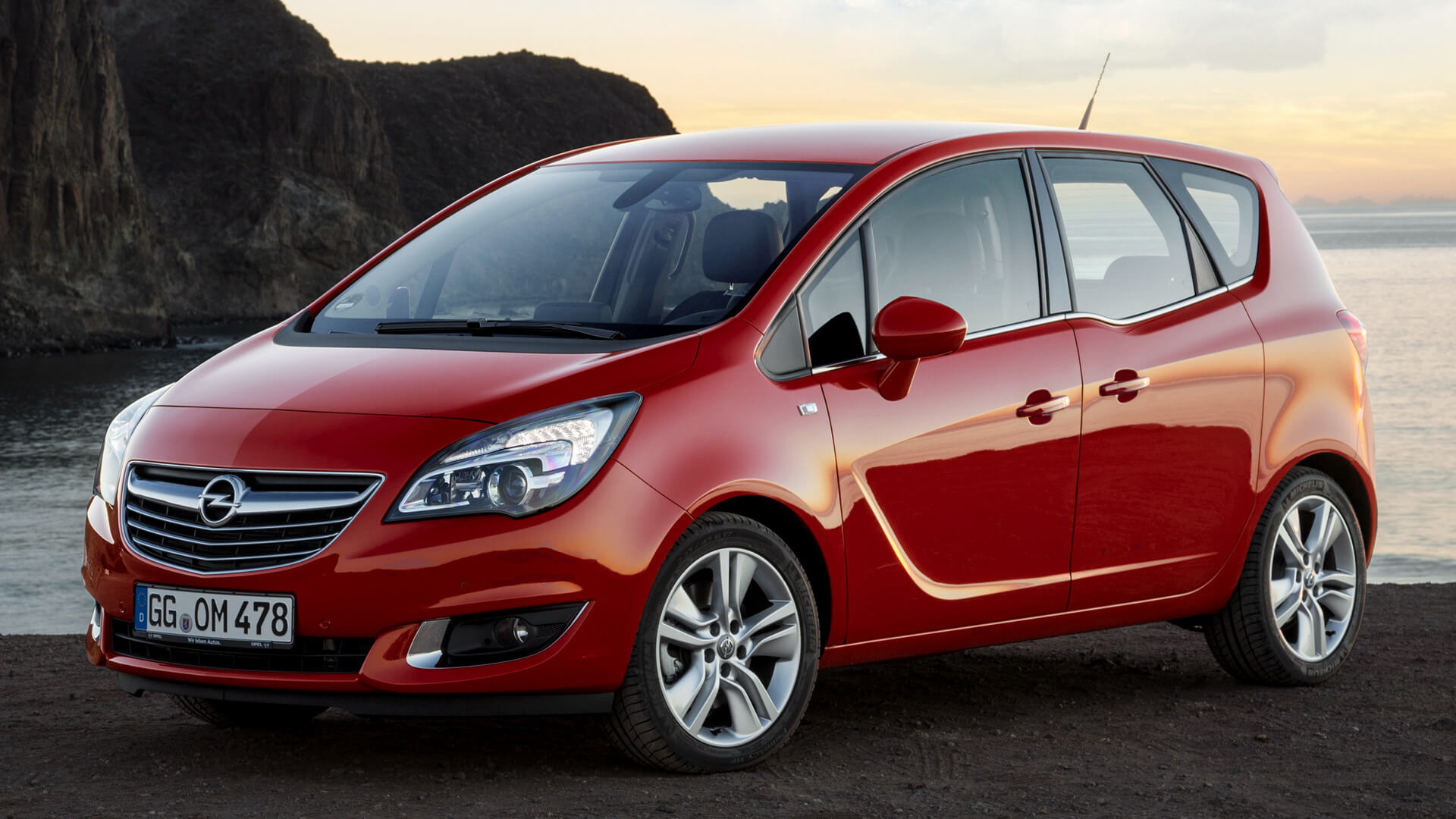
Exterior of the facelifted Meriva B
The designers did not move away from the existing concept, and some people may not even notice the difference from the earlier car. The changes are detailed, but the MPV looks fresher and more modern, with the sculpted precision and clean lines typical of Opel at the time.
The front is more refined thanks to a larger grille with a thin chrome surround. The headlights keep their shape but can now be ordered with LED technology (optional only). The lower bumper has a differently shaped intake, and the compact fog lamps gained a light chrome surround. The front end recalls the flagship Opel Insignia, which is a small compliment for a small car.
The profile is more interesting, with a distinctive wave-shaped kink in the window line at the rear doors and crisp creases running the length of the body to the rear lights. Compared with the earlier car, the window line is now highlighted by a chrome strip. The mirrors sit on sturdy stalks, and the neat wheel arches take 17- or 18-inch wheels - the car looks more stylish on the larger ones. The rear-hinged rear doors are the Meriva's signature feature. Ground clearance is an average 150 mm.
The rear is almost vertical, with stylish light clusters and a very convenient tailgate. Some see a resemblance to Volkswagen models, for example in the tail lights, but their internal structure is unique. A small spoiler with an additional brake light sits at the top, and the large rear bumper has only a plastic protective strip, with a single exhaust below. The Meriva is not sporty, but it stands out in traffic in a way many rivals do not.
Interior
The cabin is roomy and flexible. The rear seats can be folded individually or all at once to enlarge the luggage area and adjusted to the size of their occupants. The seats are set fairly high, which gives a good view of the road and makes getting in easier. The facelifted Meriva B offers ergonomic seats certified by AGR, the German campaign for healthier backs.
The driver's workplace is well thought out, with typically good German ergonomics. There is a three-spoke multifunction steering wheel adjustable for height and reach and an informative, stylish instrument panel with soft lighting. The front seats have noticeable side support, suit people of almost any build and offer six-way adjustment.
The angled centre console carries a 7-inch IntelliLink infotainment display. It is not a touchscreen, but it has many functions and an improved interface. At first the many buttons seem confusing, but it takes little time to get used to them. The system supports USB, CD, Bluetooth phone connection and voice control. The equipment list is long, there are plenty of pockets, and the front seatbacks have fold-down tables. A dual audio system lets rear passengers listen to CD or radio through headphones independently of the front.
Opel also worked hard on noise insulation, with an aerodynamic shape, extra door seals, better-insulated dashboard, vibration-damping engine mounts and front-suspension mounting points on a subframe.
The second row uses the FlexSpace seating system, and FlexDoors open to 84 degrees, which makes boarding easy and helps when fitting ISOFIX child seats. Opel describes the Meriva B as the first production car in its class with rear-hinged rear doors. The boot holds 400 litres as standard; folding the rear seats in a 40/20/40 split or completely raises this to 1,500 litres.
Engines and transmissions
| Engine | Fuel | Power (kW / PS) | Torque | Gearbox |
|---|---|---|---|---|
| 1.4 | Petrol | 74 kW / 100 PS | 130 Nm | 5-speed manual |
| 1.4 Turbo | Petrol | 88 kW / 120 PS | 175 Nm | 6-speed manual or 6-speed automatic |
| 1.4 Turbo | Petrol | 103 kW / 140 PS | 200 Nm | 6-speed manual |
| 1.3 CDTI | Diesel | 55 kW / 75 PS | 180 Nm | Manual |
| 1.3 CDTI ecoFLEX | Diesel | 70 kW / 95 PS | 180 Nm | Manual |
| 1.6 CDTI (from 2014) | Diesel | 70–100 kW / 95–136 PS | 280–320 Nm | Manual |
| 1.7 CDTI | Diesel | 74–96 kW / 100–130 PS | 260–300 Nm | Manual or automatic |
The naturally aspirated 1.4 reaches 100 km/h in 13.9 seconds, has a top speed of 177 km/h and uses about 6 l/100 km on the combined cycle. The 88 kW (120 PS) 1.4 Turbo with the automatic gearbox takes 12.5 seconds, reaches 185 km/h and uses about 7.2 l/100 km. The top 103 kW (140 PS) 1.4 Turbo gets to 100 km/h in 10.3 seconds, reaches 196 km/h and uses only about 6.3 l/100 km - modest consumption for its performance. All versions are front-wheel drive.
Chassis
The suspension carries over the proven layout: MacPherson struts at the front and a torsion beam at the rear. It is on the firm side: small bumps are barely noticeable, but larger potholes are felt clearly. The upside is minimal body roll in fast corners. All four wheels have disc brakes (ventilated at the front), and ABS and ESP are standard.
Safety
As a family car, the Meriva B had to meet high safety standards, and it received five stars in the Euro NCAP test in 2010. Equipment includes six airbags (front, side and curtain airbags), automatic hazard lights under hard braking, ISOFIX mounts, ABS, EBD, ESP, traction control, hill-start assist, tyre-pressure monitoring, Park Pilot parking sensors and navigation, depending on the version.
Well-equipped entry-level versions have ABS, ESP, air conditioning, electric power steering, heated electric mirrors, heated seats, an audio system, hill-start assist, front airbags and electric windows. Higher trims add climate control, cruise control, a rear camera, rain and light sensors, optional leather upholstery and a heated steering wheel.
What owners say
Owners praise the roomy, easily reconfigurable cabin, good sound insulation, excellent visibility, absorbent suspension, solid build quality and high seating position. For a small car, the equipment and safety are good, and the cabin is very comfortable. On the other hand, some owners find the engines underpowered, turbocharger problems occur, and the ground clearance is low. Known teething troubles include leaking cooling lines for the automatic gearbox and rear door locks that stick in frosty weather. Considering the price, these shortcomings are easier to accept.
Rivals
The Meriva competed with the Skoda Roomster, Volkswagen Golf Sportsvan, Citroën C4 Picasso, Renault Scenic, Mazda5 and Volkswagen Touran.
Image credits · Photos from Wikimedia Commons under free licences
- Opel Meriva B · Photo: M 93 / Wikimedia Commons, CC BY-SA 3.0 de
Opel Meriva in our rankings
- No. 259 of 912 · Longest-running car nameplates (14 years · top 30%)
- No. 270 of 345 · Cars with the most generations (2 generations)
In production longer than 70% of ranked nameplates in the 1CARS catalog (No. 259 of 912).
FAQ
When was the Opel Meriva built?
The Meriva A from 2003 to 2010 and the Meriva B from 2010 until June 2017.
What are FlexDoors on the Opel Meriva?
Rear-hinged rear doors on the Meriva B that open to 84 degrees, making it easier to get in and out and to fit child seats.
How big is the Opel Meriva B boot?
400 litres as standard and up to 1,500 litres with the rear seats folded.
What replaced the Opel Meriva?
The Opel Crossland X crossover.
Data sources
Data checked by an editor against the sources below.