 Peugeot 508
All generations, specs and history
Published Sources (1) Report an error
By Felix Hartmann, Automotive Technology & EV Contributor
- Built
- 2010–2025
- Generations
- 2
Timeline
508 generations
Click a generation for its own page


Newest first · 2 generations since 2010
All generations by year: 508 II (2018–2025) · 508 I (2010–2018)
Which one is mine?
Pick the year of first registration to see which generation it is.
- 508 II 2018–2025
- 508 I 2010–2018
The Peugeot 508 is a large family car in the D segment, offered as a saloon and an estate (SW). The first generation was unveiled at the Paris motor show in autumn 2010, previewed by the "5 by Peugeot" concept shown in Geneva earlier that year, and was intended to replace both the Peugeot 407 and the larger 607. The second generation was announced online on 22 February 2018 and shown in full at the Geneva motor show in March 2018, with the SW following at the Paris show that autumn. Both generations were built in Rennes, France, and in Wuhan, China, with Dongfeng. Production ended in 2025 without a successor, closing Peugeot's chapter in the D-segment saloon class.
In short
- First generation (2010–2018): saloon, SW and the RXH hybrid crossover estate; five Euro NCAP stars in 2011.
- Second generation (2018–2025): a fastback with a hatch-style tailgate and an SW, on a stretched EMP2 platform.
- Engines from 96 kW (130 PS) to 165 kW (225 PS) for the petrols, 96–132 kW (130–180 PS) for the diesels, plus plug-in hybrids and the 265 kW (360 PS) 508 PSE.
- Eight-speed EAT8 automatic on most versions; facelift in February 2023.
Peugeot 508 at a glance
The 508 is a front-wheel-drive car with a transverse engine; the 508 PSE adds a rear electric motor for all-wheel drive. More Peugeot models are listed in our Peugeot catalogue.
Peugeot 508 generations
| Generation | Years | Bodies | Notes |
|---|---|---|---|
| First | 2010–2018 | Saloon (4.79 m), SW (4.81 m), RXH | Shared platform with the Citroën C5; RXH diesel hybrid from 2012; facelift 2015 |
| Second | 2018–2025 | Fastback saloon, SW; long-wheelbase 508L in China | Stretched EMP2 platform; plug-in hybrids from 2019; PSE from 2020; facelift 2023 |
The first 508 sold well: more than 400,000 had been sold worldwide by 2016, according to published figures. Its 2015 facelift brought a new vertical grille with the lion emblem, full-LED headlights and new engines. Its range included 1.6 THP petrol and 1.6, 2.0 and 2.2 HDi diesels, the most powerful producing 150 kW (204 PS) and 458 Nm in the 508 GT.
Second generation (2018–2025)
Exterior
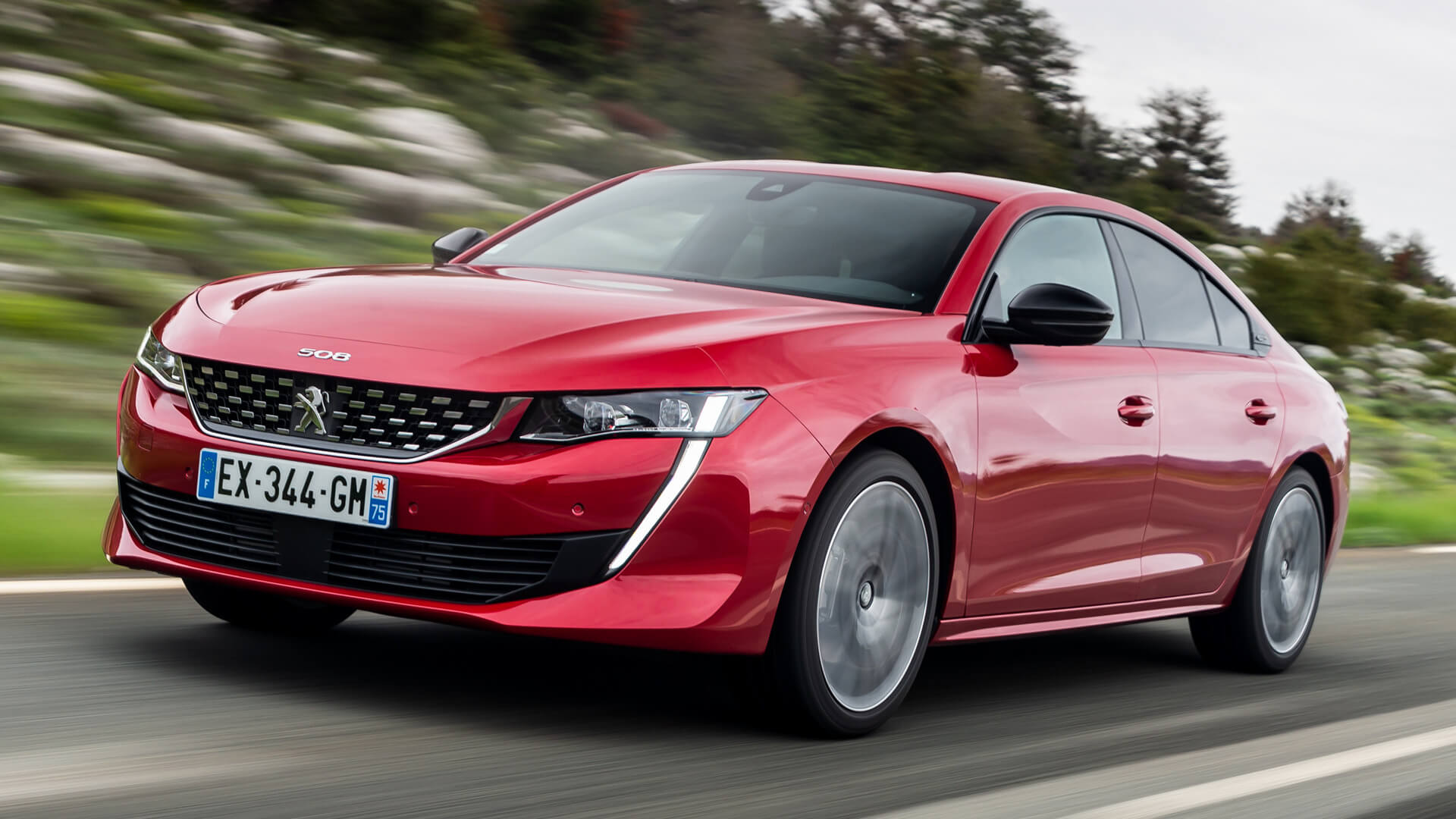
The second-generation 508 looks large in photographs, and the designers worked to give rear passengers as much comfort as those in the front. Bold lighting, large intakes and plenty of sculpting make it look more expensive than it is — and this applies to the SW too. The low front has a pronounced slope, with creases at the outer edges of the bonnet that lead the eye to the trapezoidal grille, filled with a fine chrome pattern and a large brand emblem. LED headlights are joined by vertical LED "fangs" that run down from each headlight — a striking signature. A wide strip separates the lower front, which has a small intake slit and two aerodynamic elements.
The side starts with a domed roof above large windows with gloss-black frames, flowing into sculpted surfaces with smooth transitions and crisp edges that end in slightly enlarged wheel arches. Wheels range from 16 inches as standard to 19 inches as an option, and ground clearance is about 180 mm according to published figures. Published figures also give a drag coefficient of 0.26 and an average weight reduction of about 70 kg compared with the previous model.
The rear has a steeply raked window flowing into a short tailgate with an aerodynamic lip, beneath which full-width tail lights with a 3D effect stretch across the car. The lower bumper has slots for two large exhaust outlets at the outer edges. The SW is 28 mm longer and 17 mm higher, according to published figures, with an identical design. A sporty GT version and an optional GT Line package bring a different grille, unique wheels and round exhaust outlets.
Interior
The interior continues Peugeot's experiments with unusual styling — the kind of futuristic design that people tend to love or hate. In quality, Peugeot aimed for a premium feel, with Nappa leather and plenty of wood, and combinations of leather and Alcantara are available. The 508 uses Peugeot's i-Cockpit layout: a small two-spoke leather steering wheel with aluminium inserts and six buttons, and a raised 12.3-inch digital instrument display with several display styles, including one with drum-type speedometer and rev counter. A head-up display with six modes is available. Depending on version, the front seats are sports seats with strong lateral support, power adjustment, ventilation and massage.
The centre console is angled towards the driver, which makes it slightly less convenient for the passenger. Base versions have an 8-inch touchscreen, and higher versions a 10-inch touchscreen with navigation, beneath slim air vents and above silver-finished shortcut keys and the climate controls. The sloping tunnel carries the gear selector, cupholders and storage space. Wireless charging, a panoramic roof and Focal audio are available, and the Amplify function switches between Boost and Relax settings for ambient lighting, music and massage.
The rear bench offers adequate space, although some rivals are roomier, and rear passengers can have heated seats. The saloon is really a liftback, with an optional power tailgate. Luggage space is 487 litres, rising to 1,537 litres with the rear seats folded; the SW offers 530 and 1,780 litres, according to published figures. A spare wheel and tools sit under the floor.
Engines and transmissions (second generation)
| Fuel | Engine | Power (kW / PS) | Torque | 0–100 km/h | Top speed |
|---|---|---|---|---|---|
| Petrol | 1.2 PureTech | 96 kW / 130 PS | 230 Nm | 10.0 s | 204 km/h |
| Petrol | 1.6 PureTech | 132 kW / 180 PS | 250 Nm | 7.9 s | 229 km/h |
| Petrol | 1.6 PureTech | 165 kW / 225 PS | 300 Nm | 7.3 s | 250 km/h |
| Diesel | 1.5 BlueHDi | 96 kW / 130 PS | 300 Nm | 9.7–10 s | 208 km/h |
| Diesel | 2.0 BlueHDi | 118 kW / 160 PS | 400 Nm | 8.4 s | 230 km/h |
| Diesel | 2.0 BlueHDi | 132 kW / 180 PS | 400 Nm | 8.3 s | 235 km/h |
| Plug-in hybrid | 508 PSE, 1.6 + two electric motors | 265 kW / 360 PS | 520 Nm | 5.2 s | 255 km/h |
The petrol engines are turbocharged with direct injection and variable valve timing, and the diesels are common-rail BlueHDi units. According to published figures, the diesels use 3.7–4.7 l/100 km and the 1.6 petrol 5.4–5.6 l/100 km. The 1.5 BlueHDi was available with a six-speed manual until 2020; all other versions use the eight-speed Aisin EAT8 automatic. Plug-in hybrid versions were revealed in September 2019, and the 508 PSE (Peugeot Sport Engineered) followed in February 2020. Drive modes include Eco, Comfort, Normal and Sport.
Chassis
The 508 uses the EMP2 modular platform with a body structure of high-strength steels, aluminium front wings and bonnet and a thermoplastic tailgate, according to published figures. Suspension is fully independent, with MacPherson struts at the front and a multi-link rear. The 96 kW (130 PS) versions have passive dampers, with electronically controlled adaptive dampers optional, while the petrol versions have adaptive dampers as standard. Rack-and-pinion steering has variable electric assistance, and all four brakes are discs, ventilated at the front.
Safety and equipment
The second generation earned five stars from Euro NCAP in 2018, with 96% for adult occupant protection. Equipment includes ABS, EBD and ESP, automatic hazard lights in emergency braking, tyre-pressure monitoring, multiple airbags, ISOFIX, adaptive cruise control, a surround-view camera, lane keeping assist, hill-start assist, LED lights, traffic-sign recognition, driver fatigue and blind-spot monitoring, park assist and a night-vision camera that detects people and animals up to 250 metres ahead. Base versions have halogen headlights with LED daytime running lights, 16-inch alloys, a leather multifunction steering wheel, cloth seats, a six-speaker audio system, the 12.3-inch digital instruments and dual-zone climate control; higher trims add full-LED lights, a 180-degree camera, power seats, smartphone integration, adaptive cruise control, leather, 17- or 18-inch wheels and a ten-speaker audio system.
Strengths and weaknesses
Owners of the 508 praise its attractive styling, good headlights, decent sound insulation, pleasant materials, strong and economical diesels, reliable automatic gearbox and a level of comfort that feels more expensive than the car is. Complaints include water drainage problems around the boot lid and slightly firm suspension; first-generation owners also mention awkward cupholders and a vague gear selector. Rivals included the Volkswagen Passat and Arteon, Skoda Superb, Ford Mondeo, Opel Insignia, Toyota Camry, Renault Talisman and Volvo S60 and V60.
Image credits · Photos from Wikimedia Commons under free licences
- Peugeot 508 I · Photo: Dinkun Chen / Wikimedia Commons, CC BY-SA 4.0
- Peugeot 508 II · Photo: Vauxford / Wikimedia Commons, CC BY-SA 4.0
Peugeot 508 in our rankings
- No. 251 of 912 · Longest-running car nameplates (15 years · top 28%)
- No. 298 of 345 · Cars with the most generations (2 generations)
In production longer than 72% of ranked nameplates in the 1CARS catalog (No. 251 of 912).
FAQ
Which models did the Peugeot 508 replace?
The first 508 replaced both the Peugeot 407 and the larger 607.
Is the Peugeot 508 a saloon or a hatchback?
The second generation looks like a saloon but has a liftback tailgate; an SW estate is also offered.
What is the most powerful Peugeot 508?
The 508 PSE plug-in hybrid with 265 kW (360 PS) and all-wheel drive.
Where is the Peugeot 508 built?
It was built at Rennes in France and in Wuhan, China, until production ended in 2025.
Data sources
Data checked by an editor against the sources below.