
 Nissan Juke
All generations, specs and history
Published Sources (3) Report an error
By Felix Hartmann, Automotive Technology & EV Contributor
- Built
- 2010–present
- Generations
- 2 · F15 to F16
- Top power
- 105 kW (143 PS)
- New price
- from about €18,999 (2019)
Timeline
Juke generations
Click a generation for its own page


Newest first · 2 generations since 2010
All generations by year: Juke F16 (2019–now) · Juke F15 (2010–2019)
Which one is mine?
Pick the year of first registration to see which generation it is.
Check by VINThe Nissan Juke is a subcompact crossover with front- or all-wheel drive, aimed from the start at younger buyers who value a lively drive and want a car that expresses their personality. It combines unusual styling with decent driving manners. Two generations have been built so far; the second made its debut on 3 September 2019 and gained a full-hybrid version in 2022.
In short
- First generation 2010–2019 (facelift 2014), second generation from September 2019 on the CMF-B platform.
- First-generation 1.6 four-cylinder with 86 kW (117 PS) and a CVT; second-generation 1.0 DIG-T turbo three-cylinder with 86 kW (117 PS) and 200 Nm.
- Boot space grew from 354 to 422 litres.
- The second generation adds ProPilot driver assistance on higher versions.
Size at a glance
| Dimensions | Nissan Juke F16 |
|---|---|
| Length | 4,210 mm165.7 in |
| Width | 1,800 mm70.9 in |
| Height | 1,595 mm62.8 in |
| Wheelbase | 2,636 mm103.8 in |
| Boot | 422 L14.9 cu ft |
Running cost
Fuel · Juke F16 1.0 DIG-T
about 1,300 EUR fuel a year at 15,000 km
4.9 l/100 km · petrol at 1.75 EUR/l · change mileage, fuel price or version
Known problems
-
High Juke F15 (2010–2019)
CVT automatic wear and failure (F15 Xtronic CVT) all years
Whining or grinding noises, rev fluctuations and hesitant drive, especially under load.
Fix: Fluid change if caught early; a failed CVT is replaced or overhauled. Typical cost: €5,000–7,000
Verified Source: Gebrauchtwagenberater: Nissan Juke I F15 2010-2019 problems and weak points -
High Juke F15 (2010–2019)
Timing chain stretch and oil consumption (1.2 DIG-T 115 PS) 2014–2019
Rattle for a few seconds after a cold start, oil level dropping between services, in the worst case serious engine damage.
Fix: The garage replaces the timing chain, guides and tensioner and checks oil consumption.
Verified Source: Gebrauchtwagenberater: Nissan Juke I F15 2010-2019 problems and weak points -
Critical Juke F15 (2010–2019)
High-pressure pump pulley wears the timing belt (1.5 dCi recall) 2010
No warning; a skewed belt can wear early and break, stopping the engine.
Fix: Recall work realigns the pump and checks the belt free of charge.
Verified Source: ADAC Gebrauchtwagen-Info: Nissan Juke (2010-2019) -
Medium Juke F15 (2010–2019)
Rusting exhaust and centre silencer, oil leaks at the TÜV test all years
Louder exhaust, blowing at joints, oil marks under the engine and gearbox.
Fix: Silencer or exhaust sections are replaced and leaking seals renewed.
Verified Source: ADAC Gebrauchtwagen-Info: Nissan Juke 2010-2019 (report PDF) -
Medium Juke F15 (2010–2019)
Axle mounts, steering joints and parking brake (TÜV findings) all years
Knocks over bumps, play in the steering and a parking brake that does not hold.
Fix: Worn mounts and joints are replaced and the parking brake adjusted or repaired.
Verified Source: ADAC Gebrauchtwagen-Info: Nissan Juke 2010-2019 (report PDF) -
Low Juke F15 (2010–2019)
Air-con pipe to the compressor can shear (F15) all years
Air conditioning stops cooling, sometimes with a hiss of escaping refrigerant.
Fix: The pipe is replaced and the system refilled.
Verified Source: Auto Express: Used Nissan Juke Mk1 (2010-2019) problems and recalls -
High Juke F16 (2019–present)
Rear seat back may not latch (F16 recall) 2019–2020
Folded rear seat back does not lock securely when raised, so it can move in a crash.
Fix: Recall work fits new latches.
Verified Source: Auto Express: Used Nissan Juke Mk2 (2019-date) review -
Medium Juke F16 (2019–present)
Water ingress through the roof (F16) all years
Damp rear seat or boot floor after rain.
Fix: The garage traces the leak and reseals the roof area.
Verified Source: AUTO BILD: Nissan Juke F16 Gebrauchtwagen-Test (7 Dec 2024) -
Low Juke F16 (2019–present)
Infotainment crashes and front camera faults (F16) all years
Screen freezes or reboots; a faulty front camera switches off assistance systems with warnings.
Fix: Software updates; defective camera units are replaced.
Verified Source: AUTO BILD: Nissan Juke F16 Gebrauchtwagen-Test (7 Dec 2024) -
Medium Juke F16 (2019–present)
Hybrid control software fault (1.6 Hybrid recall) 2022
Faults in the hybrid system control on cars built from June to December 2022.
Fix: Dealer updates the hybrid control software.
Verified Source: Auto Express: Used Nissan Juke Mk2 (2019-date) review
Specs by version
Engines
| Version | Engine | Power | Torque | Gearbox | Drive | Production years |
|---|---|---|---|---|---|---|
| Hybrid · 1 version | ||||||
| F16 · Hybrid | Hybrid | 105 kW 143 PS141 hp | - | Automatic | Front-wheel drive | 2022 |
| Petrol · 1 version | ||||||
| F16 · 1.0 DIG-T | Petrol | 86 kW 117 PS115 hp | 180 Nm133 lb-ft | - | Front-wheel drive | 2019 |
Performance
Show all 2 versions
| Version | 0–100 km/h | Top speed | Fuel consumption | CO₂ |
|---|---|---|---|---|
| Hybrid · 1 version | ||||
| F16 · Hybrid | 10.1 s 0–62 mph | 166 km/h103 mph | 4.9 l/100 km48.0 mpg US · 57.6 mpg UK | 111 g/km |
| Petrol · 1 version | ||||
| F16 · 1.0 DIG-T | 10.4 s 0–62 mph | 180 km/h112 mph | 4.9 l/100 km48.0 mpg US · 57.6 mpg UK | 112 g/km |
Dimensions and weight
Show all 2 versions
| Version | Length | Width | Height | Wheelbase | Kerb weight | Boot | Fuel tank |
|---|---|---|---|---|---|---|---|
| Hybrid · 1 version | |||||||
| F16 · Hybrid | - | - | - | - | 1,400 kg3,086 lb | 354 l12.5 cu ft | 46 l12.2 gal US |
| Petrol · 1 version | |||||||
| F16 · 1.0 DIG-T | 4,210 mm165.7 in | 1,800 mm70.9 in | 1,595 mm62.8 in | 2,636 mm103.8 in | 1,182 kg2,606 lb | 422 l14.9 cu ft | 46 l12.2 gal US |
Verified Manufacturer and type-approval data from our catalog · Sources and methodology
Nissan Juke at a glance
The Juke is widely seen as the car that started the class of compact B-segment urban crossovers. It is a monocoque crossover with a transverse engine, MacPherson struts at the front and a torsion-beam rear axle in both generations. More Nissan models are listed in our Nissan catalogue, and an extreme one-off take on the model is covered in our Nissan Juke-R 2.0 article.
History
The Juke was previewed by the Qazana concept at the Geneva motor show in 2009, and the production first generation was presented there in March 2010. An update in 2014 refreshed the exterior, carefully improved the interior and revised the technology. The second generation was officially revealed on 3 September 2019, simultaneously in five European cities.
Nissan Juke generations
First generation (2010–2019)
The first Juke's styling divided opinion, which is exactly what attracted some buyers and put others off. Narrow lights sit high up, above the bonnet line, with halogen units as standard and LED lighting optional. The unusual grille carries the Nissan badge in its centre, while round main headlights are set into wells in the bumper, alongside air intakes and compact fog lamps. Muscular wheel arches, mirror-mounted indicators and rear door handles hidden near the rear arch give the side its character, and a sloping roof meets a rising window line. Wheels are 17 or 18 inches and ground clearance is 180 mm. At the back, L-shaped tail lights, a small spoiler with a third brake light and plastic inserts in the bumper complete the look.
The cabin is as distinctive as the exterior. A three-spoke wheel carries media controls, and the sporty instrument panel has deeply recessed dials. Higher versions have a 5.8-inch infotainment screen. The centre tunnel is painted in a bright colour chosen by the owner from a palette and holds two cupholders, the gear selector and the handbrake. Front seats are sporty and heated; design and ergonomics are good, but hard plastics and glossy inserts that mark easily lower the perceived quality, while expensive versions have leather. Three adults can sit in the rear, but space is not generous. The boot holds 354 litres, rising to 1,189 litres with the rear seats folded, with a space-saver spare and tools under the floor.
The best-known engine is a naturally aspirated 1.6-litre four-cylinder with multi-point injection, a timing chain, 16 valves (DOHC) and variable valve timing, producing 86 kW (117 PS) and 158 Nm. It is paired with an Xtronic CVT and front-wheel drive: 0–100 km/h takes 11.5 seconds, top speed is 170 km/h and combined consumption is about 6.3 l/100 km. The Juke uses the front-wheel-drive Nissan B platform with a high proportion of high-strength steel, MacPherson struts at the front and a semi-independent torsion-beam rear, with coil springs and anti-roll bars at both ends. Steering is rack-and-pinion with variable electric assistance, and the dual-circuit brakes use discs all round with ABS and EBD.
Equipment on the first generation could include six airbags, climate control, 17-inch alloys, ABS, EBD and ESP, heated front seats, electric windows and mirrors, cruise control and a leather steering wheel. Higher versions added navigation, a surround-view camera system, leather upholstery, xenon headlights, lane and blind-spot monitoring, rain and light sensors, 18-inch wheels and keyless entry.
Second generation (2019 onwards)
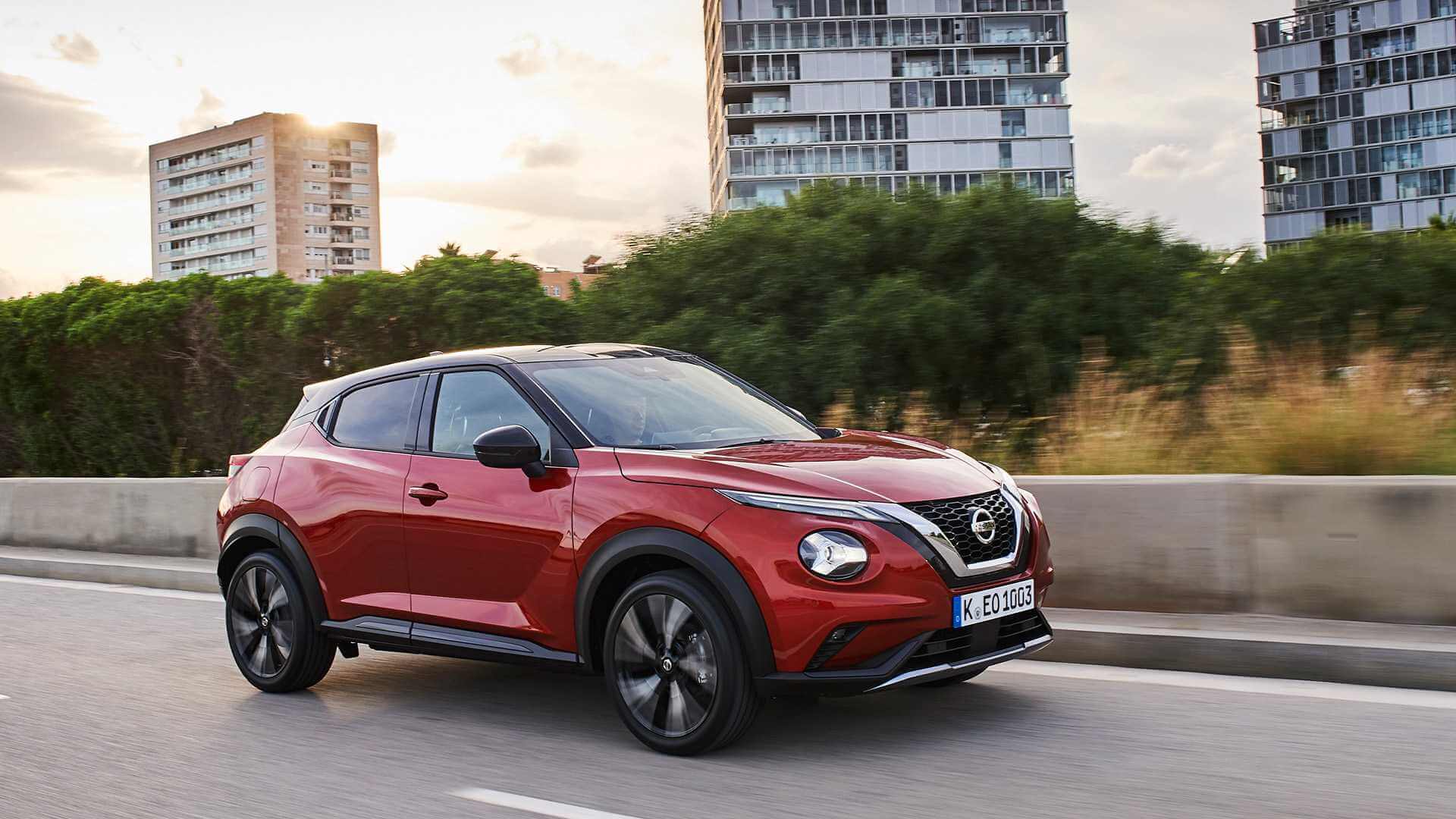
The move to the CMF-B platform made the second Juke 75 mm longer, 35 mm wider and 25 mm taller, yet 23 kg lighter. The designers kept the original's unusual shape and proportions but refined them: round headlights with a Y-shaped light signature, a larger V-motion grille merging with slim daytime running lights, a reshaped bumper and bonnet, and muscular haunches over the rear wheels. The rear door handles remain hidden in the window frame. Wheels range from 16 inches as standard to 19 inches optionally, and ground clearance is 180 mm. New faceted LED tail lights, a revised tailgate and a redesigned bumper complete the rear. Eleven paint colours are offered, including Fuji Sunset, and a contrasting roof is available.
Inside, the old dashboard and fuel-tank-shaped centre tunnel are gone. Clear dials, a free-standing infotainment display, round air vents and a neat climate panel define the new layout, with well-bolstered seats that have integrated headrests. Materials include soft plastics, leather, Alcantara and suede. Equipment includes LED lights, a multifunction wheel, an electric parking brake, push-button start, an 8-inch NissanConnect touchscreen, an eight-speaker Bose Personal Plus system with two speakers in the front headrests, Apple CarPlay and Android Auto, Google Assistant, TomTom navigation, a Wi-Fi hotspot and over-the-air updates. The NissanConnect Services app can lock and unlock the car remotely and check oil level and tyre pressures. Rear head- and legroom have increased, and the boot now holds 422 litres; folding the 60/40 rear seats gives a flat floor almost 1.5 m long and 1,088 litres.
Engines and transmissions
| Generation | Engine | Power (kW / PS) | Torque | Gearbox | Drive |
|---|---|---|---|---|---|
| 1st (2010–2019) | 1.6 four-cylinder, naturally aspirated | 86 kW / 117 PS | 158 Nm | Xtronic CVT | Front |
| 2nd (2019–) | 1.0 DIG-T three-cylinder turbo, direct injection | 86 kW / 117 PS | 200 Nm | 6-speed manual or 7-speed dual-clutch | Front |
The 1.0 DIG-T has 12 valves and variable timing on both intake and exhaust camshafts. It uses about 4.8–4.9 l/100 km; 0–100 km/h takes 10.4–11.1 seconds (the manual is quicker) and top speed is 180 km/h. Eco, Standard and Sport driving modes are available. No all-wheel-drive version was offered this time; instead, in 2022 Nissan added the Juke Hybrid, which combines a 1.6-litre petrol engine with electric motors for a system output of 105 kW (143 PS).
The second generation keeps MacPherson struts at the front and a torsion beam at the rear, with coil springs and anti-roll bars, rack-and-pinion steering with electric assistance, and disc brakes all round - 280 mm ventilated at the front and 260 mm solid at the rear.
Safety and driver assistance
The second-generation Juke recognises road signs, pedestrians and cyclists, and offers lane keeping, automatic emergency braking and blind-spot monitoring. Higher versions have ProPilot, which keeps the car in its lane, accelerates and brakes to hold a safe distance, warns the driver of danger when changing lanes or overtaking and steers back into the lane, and also manages the cruise control and adaptive headlights. Even the base version has front and side airbags, ABS, EBD and ESP, full LED lights, an electric parking brake, electric windows and mirrors, air conditioning, a four-speaker audio system, 16-inch alloys, cruise control and automatic braking.
Key specifications
| Parameter | 1st generation | 2nd generation |
|---|---|---|
| Years | 2010–2019 | 2019 onwards |
| Platform | Nissan B | CMF-B |
| Power (kW / PS) | 86 kW / 117 PS | 86 kW / 117 PS |
| 0–100 km/h | 11.5 s | 10.4–11.1 s |
| Top speed | 170 km/h | 180 km/h |
| Ground clearance | 180 mm | 180 mm |
| Boot | 354 / 1,189 l | 422 / 1,088 l |
Strengths and weaknesses
Owners of the first generation highlight its ground clearance, economy, reliability, compact size, safety, decent performance and suspension; even without all-wheel drive it copes with light off-roading. On the downside they mention handling, ergonomics, sound insulation, a cabin slow to warm up and a small boot. The second generation is more modern and stylish, roomier and better equipped, with a larger boot and a turbocharged engine, but at launch all-wheel drive was missing. Rivals include the Renault Captur, Opel Mokka, Peugeot 2008, Ford Puma, Volkswagen T-Roc and Suzuki Vitara.
Owning a Nissan Juke
Common problems, best and worst years, maintenance and running costs - only data checked by our editors, with sources.
Best years
- 2016–2019 Juke F15 (2010–2019) - Late facelifted F15s have the larger 354-litre boot and far fewer breakdowns: ADAC records 17.3 per 1,000 cars for 2016 and 9.6 for 2017 registrations, against 27.1 for 2011. Verified Source: ADAC Gebrauchtwagen-Info: Nissan Juke (2010-2019)
- 2021–2026 Juke F16 (2019–present) - Cars built after August 2020 are outside the rear seat latch recall, and the 1.0 DIG-T 114 replaced the 117 PS version by December 2020. Verified Source: Auto Express: Used Nissan Juke Mk2 (2019-date) review
Years to avoid
- 2010–2013 Juke F15 (2010–2019) - Early F15s have the highest ADAC breakdown figures (27.1, 24.8 and 20.4 per 1,000 for 2011-2013 registrations), with the starter battery a frequent cause. Verified Source: ADAC Gebrauchtwagen-Info: Nissan Juke (2010-2019)
Questions and answers
What are the most common Nissan Juke problems?
CVT automatic wear and failure (F15 Xtronic CVT) (all years): Whining or grinding noises, rev fluctuations and hesitant drive, especially under load.; Timing chain stretch and oil consumption (1.2 DIG-T 115 PS) (2014–2019): Rattle for a few seconds after a cold start, oil level dropping between services, in the worst case serious engine damage.; High-pressure pump pulley wears the timing belt (1.5 dCi recall) (2010): No warning; a skewed belt can wear early and break, stopping the engine.; Rusting exhaust and centre silencer, oil leaks at the TÜV test (all years): Louder exhaust, blowing at joints, oil marks under the engine and gearbox.; Axle mounts, steering joints and parking brake (TÜV findings) (all years): Knocks over bumps, play in the steering and a parking brake that does not hold..
What are the best years for the Nissan Juke?
2016–2019: Late facelifted F15s have the larger 354-litre boot and far fewer breakdowns: ADAC records 17.3 per 1,000 cars for 2016 and 9.6 for 2017 registrations, against…; 2021–2026: Cars built after August 2020 are outside the rear seat latch recall, and the 1.0 DIG-T 114 replaced the 117 PS version by December 2020..
Which Nissan Juke years should you avoid?
2010–2013: Early F15s have the highest ADAC breakdown figures (27.1, 24.8 and 20.4 per 1,000 for 2011-2013 registrations), with the starter battery a frequent cause..
Data checked November 12, 2026 Used Nissan Juke buying guide
Image credits · Photos from Wikimedia Commons under free licences
- Nissan Juke F15 · Photo: LukaCali / Wikimedia Commons, CC0
- Nissan Juke F16 · Photo: Alexander Migl / Wikimedia Commons, CC BY-SA 4.0
Popular comparisons
Nissan Juke in our rankings
- No. 11 of 166 · Lightest SUVs and crossovers (1,182 kg · top 7%)
- No. 29 of 222 · Smallest SUVs and crossovers (4,210 mm · top 14%)
- No. 60 of 333 · Most economical cars (4.9 l/100 km · top 20%)
- No. 22 of 114 · Most economical SUVs and crossovers (4.9 l/100 km · top 21%)
- No. 96 of 466 · Lightest cars (1,182 kg · top 21%)
- No. 134 of 608 · Smallest cars (4,210 mm · top 23%)
Lighter than 93% of ranked SUVs and crossovers in the 1CARS catalog (No. 11 of 166).
FAQ
How many generations of the Nissan Juke are there?
Two: the first from 2010 to 2019 and the second from September 2019.
What engine does the second-generation Nissan Juke have?
A 1.0-litre DIG-T turbocharged three-cylinder with 86 kW (117 PS) and 200 Nm, with a six-speed manual or a seven-speed dual-clutch gearbox.
How big is the Nissan Juke boot?
354 litres in the first generation and 422 litres in the second, rising to 1,088 litres with the rear seats folded.
What was the Nissan Juke concept called?
The Qazana, shown at the Geneva motor show in 2009.
Data sources
Data checked by an editor against the sources below.
- Wikipedia - Nissan Juke
- Autonotizen - Nissan Juke Ausstattung Preise Premiere Edition 2019
- EEA CO₂ monitoring (European Environment Agency, CC BY 4.0)


